Wednesday, June 8, 2016

6/8/16 Report - Treasure Coast Treasure History: Cobb Coin VS Unidentified Wreck. 2000 Year Old Cache of Hasmonian Coins.


Written by the TreasureGuide for the exclusive use of treasurebeachesreport.blogspot.com.
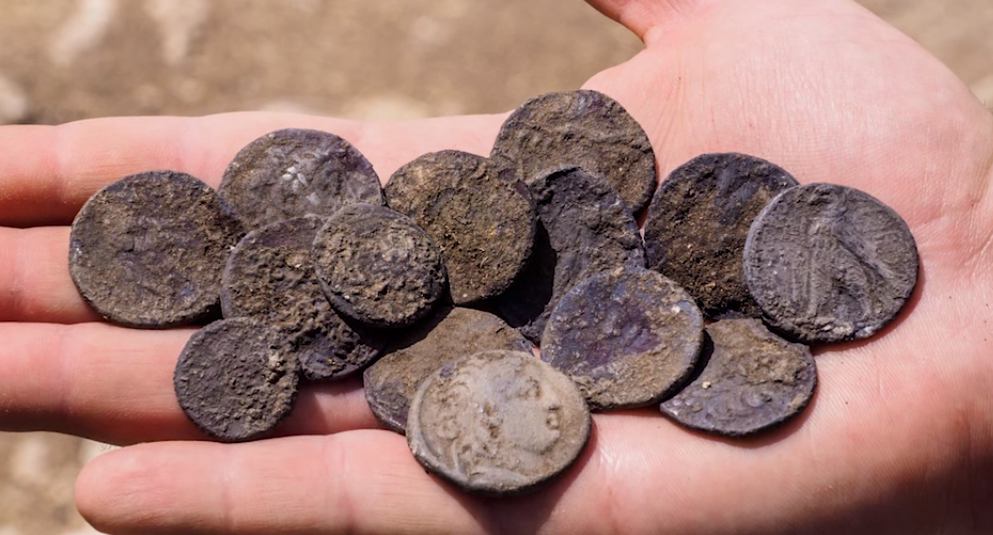
Cache of 2000-year-old Coins Uncovered.
Source: Times of Israel.


Cache Being Uncovered.
Source: Times of Israel.


A treasure trove of 2,150-year-old silver coins excavated in the central Israeli city of Modiin apparently belonged to a Jew who had to leave the nearby house but never managed to retrieve his hidden cache.

The 16 coins from the Hasmonean period (2nd-1st century BCE) were concealed in a rock crevice up against a wall of a large agricultural estate, the Israel Antiquities Authority announced on Tuesday.


Below is the link.

http://www.timesofisrael.com/cache-of-hasmonean-era-silver-coins-uncovered-in-modiin/


---

Here is an interesting piece of treasure history.

COBB COIN COMPANY, INC., a Florida corporation, et al., Plaintiff, v. The UNIDENTIFIED, WRECKED AND ABANDONED SAILING VESSEL, etc., Defendant. No. 79-8266-Civ-JLK. August 31, 1982. United States District Court.

I pasted four excerpts below.  You might want to read the entire document though.

In the summer of 1963, Mr. Mel Fisher, owner of a scuba diving shop, came to Florida from California and became associated with Mr. Wagner and Real Eight. Mr. Fisher formed salvaging groups named Universal Salvage Co., Cobb Coin Co., and Treasure Salvors, Inc. Between October 1963 and August, 1972, Mr. Fisher's companies and Real Eight worked some of the sites of 1715 wrecks pursuant to various agreements, under authority of Real Eight's State leases. Under these agreements, they divided their recoveries 50-50 after deducting 25 percent for the Division of Archives and Records Management. The combined effort yielded large quantities of gold, silver, and other valuable artifacts.[2] See Plaintiff's Exhibits No. 8 and 9 and State's Exhibit No. 68. Although the State's archivists admit to having received these artifacts, none could testify with certainty what the State now has, nor are there any records of precisely which of the artifacts it received came from the Corrigan site or other wrecks of the 1715 Fleet...

 Real Eight terminated its contract with Fisher's company in 1972. At that time, Mr. Fisher was apparently devoting more of his attention to the search for the treasures of the Atocha and Santa Margarita, which sank in 1622 40 miles west of Key West. Mr. Fisher testified that he gave up on the east coast wrecks because the State officials were slow in sending field agents to accompany salvage vessels and in returning the salvors their share of the recovery... 

Mr. Kenworthy stated that his company recovered sixteen (16) silver coins from Corrigan's *547 in its two years of salvage under the exclusive State lease. Tr. at 92. The State's representative testified that Quest found nine (9) coins. The coins were turned over to the State for safekeeping; they have since disappeared.

 In 1980, the plaintiff recovered 734 individual silver coins, two gold discs, 10 clumps of inseparable silver coins, and 300 pieces of "encrusted objects." In 1981, it recovered 25 or 30 "encrusted objects," 300 silver coins, and 12 Royal Eight Escudo gold coins. The Royal Eight Escudos are in "fairly good shape." Tr. at 806. Many of the silver coins are pieces of eight, minted in 1713; the value of one is now estimated at $500.00 to $600.00. The value of a Royal Eight Escudo is estimated to range between $5,000.00 and $12,000.00, depending on the quality of the coin...

Here is the link if you want to read the entire document.  Some of you might be interested in the legal aspects of the case.

https://coast.noaa.gov/data/Documents/OceanLawSearch/Cobb%20Coin%20Co.%20v.%20Unidentified,%20Wrecked%20&%20Abandoned%20Sailing%20Vessel,%20549%20F.%20Supp.%20540%20(S.D.%20Fla.%201982).pdf?redirect=301ocm

Did you notice mention of the 12 Royal Eight escudos?

I wonder how the coins disappeared from the State's safekeeping.

---

On the Treasure Coast we'll have a couple more days of flat surf.  The wind will be out of the west.  We'll also have some negative low tides.

Happy hunting,
TreasureGuide@comcast.net

Tuesday, June 7, 2016

6/7/16 Report - Tropical Storm Colin Already Gone. Study Resources For Treasure Coins. 1970 Quarter Error.


Written by the TreasureGuide for the exclusive use of treasurebeachesreport.blogspot.com.

Tropical Storm Colin.
Source: nhc.noaa.gov
Tropical Storm Colin is leaving us already.  We have some cooler air this morning, coming with the west wind.

Yesterday the surf was a little more choppy than I expected.  We'll have something like a one-foot surf for a few days.  Today we'll have some good negative tides again around 4:30 PM.

Beach Yesterday Around Low Tide.
If you look closely you might be able to see some small cuts in the distance up by the bend.

The beach front was firm but there was a lot of sand.

Beach Near Low Tide Yesterday Showing Small Cuts.

---

In 1985 Alan Craig, a geographer and geologist specializing in Latin American studies, first proposed doing a complete study of the gold coins in the Florida Collection.  In 1988 his book on the gold coins in the Florida Collection was published.  That book was revised in 2000.  He published a book on the silver coins in the Florida Collection in 2000.  I have not seen any updates, revisions or similar studies published since that time.  That means unless I've missed it, we haven't seen a major study of the coins and artifacts added to the Florida Collection over the past 15 or so years.

The state does maintain a database of artifacts.  However it is not available to the public online.  In fact the database is for "internal use" only.

If you want to study treasure coins, it seems that the best and most easily available resource is the auction records.  There are tons of good pictures and descriptions in the various auction catalogs.  If we didn't have those, the public would have very little opportunity to study treasure coins.  I guess it is a good thing that so many coins are in private hands and come up for public auction.  Ideally, our tax-funded collections would be more accessible to the public.

I was lucky to find a 1977 Bowers and Ruddy treasure auction catalog, complete with realized prices, in a thrift store a number of years ago.  That was before we had all of the online resources we have today.

---

There is a story about a 1970 error quarter that is appearing almost everywhere on the internet.  According to Country Living, The pieces of change were printed over 1941 Canadian quarters and therefore feature a teeny "1941" marking just above the word "DOLLAR" on the pack of the coin. It's almost impossible to see without a little help, but you can see the error explained in this eBay listing. You'll also see that 26 people are interested in paying $35,000 for this one coin—woah!

Here is the link.

http://www.countryliving.com/shopping/antiques/news/a38734/quarters-from-1970s/

I" prefer to see this error described on a numismatic web site.  You can't believe everything you see on eBay.

---

Happy hunting,
TreasureGuide@comcast.net

Monday, June 6, 2016

6/6/16 Report - Tropical Storm Colin. A Cob Grading System. Cooper Case Closed. Silver Suffragette Pin.


Written by the TreasureGuide for the exclusive use of treasurebeachesreport.blogspot.com.

Projected Path of Tropical Storm Colin.
Source: nhc.noaa.gov
Tropical Storm Colin will pass over North Florida today and tomorrow.

On the Treasure Coast we'll get some wind and waves, but the surf will be small because the wind will be from the south and west.

We'll have some nice big tides, including some good low tides.

---

Recently I published some posts that looked at cobs sold in public auctions and discussed some of the factors that help determine prices.

Some cobs have been graded by companies such as NGC but most have not.  There are different grading systems.  I thought the grading system used by the Bowers and Ruddy auction gallery was useful.  Here it is.

Grade A:  Highest quality mint product with outstanding characteristics.  Especially well struck and well centered, with complete shield and including date or other exceptional details; on a pleasing planchet without defects.

Grade B: Sharply struck and distinctly detailed showing nearly complete shield and partial legends, mintmarks and dates.  Planchet mildly misshapen, and design suffers minor effects of filing.

Grade C: Average strike, legible but not distinct, usually combined with major loss of design due to excessive filing or off-center or uneven strike.  Planchet commonly shows edge cracks or breaks or serious irregularities.

Grade D: Identifiable but mostly indistinct due to weakness of  strike, extensive filing or multiple striking.


----

If you aren't old enough to remember when a fellow parachuted out of an airliner with $200,000 in cash, you probably remember reading about it.  After 45 years, the FBI is ready to close the case.  

Thanks to Dean for providing the following link.

http://www.dailymail.co.uk/news/article-2070038/DB-Cooper-case-solved-FBI-tells-niece-skyjacking-suspect-matching-fingerprint.html

---

From Kovels Komments:

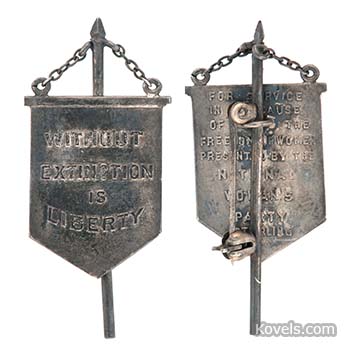
This sterling silver pin awarded by the National Women’s Party “For Service In The Cause Of The Freedom Of Women” recently sold for $6,425, more than three times the high estimate. About 150 to 200 pins were given to the women who were the “Silent Sentinels” picketing the White House in 1917. Only five of the pins are known to exist today...
 
---

Happy hunting,
TreasureGuide@comcast.net

Sunday, June 5, 2016

6/5/16 Report - Storm Headed For Florida. Escudos: Then and Now. Find Face App.


Written by the TreasureGuide for the exclusive use of treasurebeachesreport.blogspot.com.

Tropical Depression Three
Source: nhc.noaa.gov
Tropical Depression Three is expected to become a storm that passes over North Florida next week.  Don't expect any big surf on the Treasure Coast though.

---

We all know about the fantastic 2015 treasure finds made by the savage crews along the Treasure Coast last year.  While those finds are unprecedented, there were definitely big days in the 1900s too.  

First, in the early 1960s the the famed "carpet of gold" was found.  Over 1000 gold cobs were uncovered.

And in 1974, after an otherwise unproductive day of diving, over a thousand escudos were found.

---


The chart above shows the realized prices of 18 Mexico-minted 1714 8-escudos that were sold in a 1977 Bowers and Ruddy auction.  The label on the horizontal axis incorrectly says 17 instead of 18.

That is a fairly good sample size for one auction, especially of one specific date.

I'll be analyzing various samples of treasure coins from time to time.

As you can see from the chart, the highest priced 1714 Mexican 8-escudo in the 1977 auction sold for $1500.  The lowest priced of the same mint and year was $550.  There were two that sold at $1350 and two that sold at $550.

That seems like a low prices for 1714 eight-escudos.  One thing that has to be taken into consideration is inflation.  It would take just over $40 in 2016 to buy what $10 would buy in 1977.  So if you wanted to compare 1977 prices with 2016 prices, you might multiply the 1977 prices by four.  That would make make the high price for those sold in 1977 equivalent to $6000 in 2016 dollars, and the low price would then be about $2200 in 2016 dollars.

Why such a range?  One of the neat things about cobs is that they are all different.  Some varieties are more common and others more rare, some are better struck and are in better condition, etc.  The highest priced 1714 Mexico 8-escudo in the 1977 auction, while being nice overall, had one outstanding feature that undoubtedly added significantly to the price.  It was the only one of the 18 that had a partial date showing on the reverse (cross side).

Things were different 40 years ago.  Many more cobs have been found in the last forty years, and I suspect that people looked at collecting cobs a bit differently in the early days.

There was only one Mexico-minted 1714 8-escudo in the most recent Sedwick Coins auction, and the winning bid on that escudo was $10,000.  Without adjusting for inflation, that is a price that is over six times greater than the highest priced Mexico 8-escudo sold in the 1977 auction.  With an adjustment for inflation the 2016 price is still nearly twice the price of the highest priced Mexico 8-escudo  in the 1977 auction, and more than four times the price of the lowest priced Mexico 8-escudo in the 1977 auction.

To be more precise I'd have to take into account a variety of factors, but I'll just look at the comparisons in very general terms for now.   Without getting more specific, I will say that the Mexico 1714 8-escudo in the 2016 Sedwick auction was the second lot in the auction and a fine example.  It undoubtedly compares fairly well to one of the higher priced Bowers and Ruddy Mexico 8-escudos.

I'll do a more complete analysis in the future.

---

I thought this Market Watch article was interesting.  Here is an excerpt.

A new app called FindFace, recently released in Russia, gives us a glimpse into what this future might look like. Made by two 20-something entrepreneurs, FindFace allows anybody to snap a photo of a passerby and discover their real name — already with 70% reliability. The app allows people to upload photos and compare faces to user profiles from the popular social network Vkontakte, returning a result in a matter of seconds. According to an  interview in the Guardian, the founders claim to already have 500,000 users and have processed over 3 million searches in the two months since they’ve launched.

What’s particularly unsettling are the use cases they advocate: identifying strangers to send them dating requests, helping government security agencies to determine the identities of dissenters, and allowing retailers to bombard you with advertisements based on what you look at in stores.

Here is the link.

Saturday, June 4, 2016

6/4/16 Report - New Cyclone Likely To Form In Gulf. Jetons: Reckoning Counters or Game Pieces.


Written by the TreasureGuide for the exclusive use of treasurebeachesreport.blogspot.com.

Tropical Storm Bonnie and One Newer Disturbance.
Source: nhc.noaa.gov.
Tropical storm Bonnie is now headed east into the Atlantic, but there is a new disturbance down by Yucatan that has a 70% chance of becoming a cyclone in the next 48 hours.  It could hit the Florida West Coast in a few days.

---


Jetons were token or coin-like medals produced across Europe from the 13th through the 17th centuries. They were produced as counters for use in calculation on a lined board similar to an abacus.  They also found use as a money substitute in games, similar to modern casino chips or poker chips.  Thousands of different jetons exist, mostly of religious and educational designs, as well as portraits, these most resembling coinage.  (Excerpt from https://en.wikipedia.org/wiki/Jeton)


Jetons have been found on Spanish colonial sites including St. Augustine.  Most were made in cities we now associate with Germany.  Nuremberg being one.

Here is a site showing how jetons were used as reckoning counters.

http://www.chicagocoinclub.org/projects/PiN/juh.html

The jeton shown above is from a Ph.D. dissertation by Kroum Nickolaev Batchvarov.


Here is the description of that jeton.

Token KT101 has an irregular shape and was struck slightly off center of the brass blank (fig. 80). On the reverse of the token is depicted a ship, viewed from the port quarter. The depiction is highly stylized and appears to illustrate a two-decked warship. It is surrounded by the motto Plus Ultra (Further Beyond) of the Holy Roman Emperor Charles V. Subsequently, this also became the motto of Habsburg Spain. According to mythology, the Pillars of Hercules (Straits of Gibraltar) bore the warning Nec Plus Ultra or “nothing further beyond” to prevent sailors from falling off the earth. The adoption of the modified motto by Charles V was meant to state a commitment to going further than 252 any before him. The association with the Pillars of Hercules is probably the connection between the motto and the ship depicted on the token. The obverse contains a sun face, moon and stars. Around the periphery is inscribed “E. L. S. Lauer RECHEN PF.” The first stands for Ernst Ludwig Siegmund Lauer, the manufacturer of the jeton. Lauer evidently was born in 1762, started work in or about 1783 and retired in 1833. It appears that he died as late as 1845. The second part of the inscription is to be read as rechen Pfennig, or “accounting token” in German. It appears that Lauer struck large quantities of this type as they frequently appear on internet auction sites. A Lauer jeton was also found at Corinth in Greece, but as the article did not include an illustration of it, I cannot be certain that it is identical to KT 101.255 Fig. 80. KT101 An accounting token struck by Ernst Lauer. 


Below is the source link.  The title of the dissertation is The Kitten Shipwreck: Aarchaeology And Reconstruction Of A Black Sea Merchantman.

It is a lengthy dissertation.  A number of nice artifacts are shown near the end of the dissertation. Take a look.

Here is the link.

http://nautarch.tamu.edu/Theses/pdf-files/Batchvarov-PhD2009.pdf

It takes a while to load.

---

Warren D. Who Returned Lost Necklace to Tourist.
See yesterday's post.

---

The surfing web sites are predicting a very flat surf on the Treasure Coast for the next week or two.

Happy hunting,
TreasureGuide@comcast.net

Thursday, June 2, 2016

6/3/16 Report - Lost, Found and Returned Necklace by Warren D. Sacred Heart of Jesus. Problems Related To Antique Shipwreck Ceramics.


Written by the TreasureGuide for the exclusive use of treasurebeachesreport.blogspot.com.

Necklace With Gold Coin Pendant
Find and photo by Warren D.
I received the following email from Warren D. yesterday.

Yesterday I was detecting the wet sand behind the a major hotel in Indialantic with my White's TDI pulse detector when a woman approached me and asked if I could help her and her husband. I said sure and she pointed up the beach to a neighboring hotel where a man in a orange shirt was scraping dry sand. I told her my name and asked what did they lose. She said a necklace with a gold charm on it. As we were walking there she said she took the necklace off and laid it on a beach chair and they forgot about it. When they left they just folded up the chairs and walked to the parking lot and put the chairs in the trunk of the car. I said I hear that happens a lot and it made me think this could be a little more complicated than I thought. I met with her husband and said I'll do a big box search and drag my foot and trace their steps to the staircase. I kept asking them if I was staying in the general area OK. After about an hour the woman followed me and I gave her a running commentary about targets and some were too deep to be a recent drops and the distance was about 60 yards from the chair spot to the steps.

I found a tungsten ring, a quarter and bottle caps and was moving kind of fast to cover the area and I sensed they were leaving soon and Susan said they were flying out that day. I said give me your contact info and if you want put it on Craig's list lost and found and someone may find it. Well she and her husband decided to go in to the hotel and prepare to check out and I continued hunting about another 15 to 20 minutes and I got a hit. It was about midway between the chair location and the stairs and I assume the charm/coin must have fell down on edge and didn't lay flat. Coming from a different direction my coil got a hit. I brought the White's TDI with the Sierra T-foot coil 18" by 5" because my plan was to do wet sand and go deep. But this was hunting for a shallow target but the size of my coil gave me good coverage.

I got it in one scoop, it was shallow maybe under a half inch of sand. All balled up the chain was very fine. Luckily it was hidden or it would have been a eyeball find for somebody. 

I pulled out my phone and their contact info and I said Susan, I got it come back to the beach. They came back out to the beach and they were holding hands. Her Husband Rocky tried to hand me a bunch of bills and I said no thanks, I like the challenge. I said have a good vacation now and I bet you lost a lot of sleep last night. 

They're back home now and they just sent me these pics. The charm or coin is a Gold coin, $10 or $20 piece.

Warren D.

As you and I know, that kind of thing happens all of the time.  Tourists or locals lose things and get them back because of a friendly detectorist.

Thanks for sharing Warren.  I'd like to tell more of these types of stories.

You might remember how Warren returned a fine ring back a while.

Notice that he found another ring while searching for the necklace.  That happens a lot.  You look for one thing and find something else.  Things are lost where things are lost.  One is a good sign that there could be another.

If a coin is on edge, it will often give a much less of a signal when you sweep over it in one direction than if you sweep over it another direction.  Try it out for yourself with your own detector.

Stick a coin in the ground and sweep over it one direction and then at a 90 degree angle and notice the difference in the signal.  The difference when using some pulse detectors might not be as great, but you should experiment so you learn exactly how your detector responds to a coin like that.

---

In some old posts I posted information about the Sacred Heart of Jesus, including information relating to heart-shaped reales.   Laura Strolia did a great article on the heart-shaped reales that I posted in my Nov. 8, 2015 post.  You can find other posts mentioning the subject in this blog too.

June is the month of the year that the Catholic Church dedicates to Sacred Heart of Jesus. But just what does a devotion to the Sacred Heart mean? Here is one article on the subject.

http://epicpew.com/8-facts-sacred-heart/

---

Here is a good article on some problems relating to antique ceramics found on shipwrecks.  It provides a few helpful reminders for dating shipwrecks as well.

Here is one excerpt.

Let us take for example, the small models of boys portrayed wearing blue aprons and seated with arms and legs outstretched. A number of these were recovered from the Nanking Cargo (1752). This fitted the dating theory well, as the group had always been attributed to the mid 18th century. The same figures appear also to have been found on an unpublished wreck from about 1730 – 1740. By comparing them closely, it can be seen that the 1730 – 1740 figures do indeed relate to those on the 1752 Nanking Cargo.

When similar models were discovered on the Tek Sing (1822) it was assumed by some that they were mid-18th century “antiques” on board a 19th century ship. However , after closer study, slight differences were found in the large group of 1822 Tek Sing figures. They are not “antiques” at all, but simply later examples of an enduringly popular model.


Here is the link.

http://orientalceramics.com/index.php/shipwreck-ceramics/

The pictures do not seem to show up on the site.  Make sure to scroll all the way to the bottom of the article.

---

Expect a good flat surf through the weekend.

Happy hunting,
TreasureGuide@comcast.net

Wednesday, June 1, 2016

6/1/16 Report - Walking Around and Saving Cast-offs of Local History.


Written by the TreasureGuide for the exclusive use of treasurebeachesreport.blogspot.com.

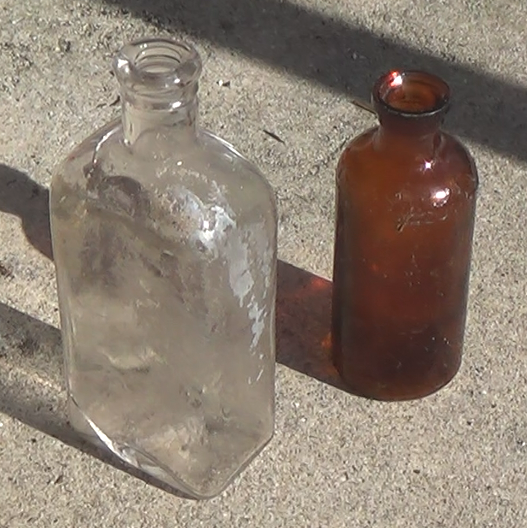
Old Brown Carter's Cone Ink Bottle

First, a little information on the bottle.  Embossed on the bottom is "CARTER'S/1897/MADE/IN U.S.A."  This type of cone ink bottle was produced from 1897 into the 1910s.  Earlier bottles are most often aqua and the later ones are clear glass.  There was a paper label that no longer remains.

Brown is a less common color and appears to me to be an earlier bottle.  One of the first old ink bottle that I ever found was an aqua ink bottle.  I sold the aqua bottle years ago.

I just picked p this bottle from an area where nice old bottles have been showing up occasionally for several months now.  They are surface finds.

I've been checking this area about once in a while for several months and continue to come up with bottles ranging from the late 1800s to the mid or late 1900s.  Previous to this year the same area never produced any old bottles, but several months ago, the area eroded and started to produce.

The past couple of months the area has filled in a bit.  The erosion is not as deep as it was, still older bottles continue to show up.  I did a little probing to see if there were bottles deeper, and there did not appear to be.  It seems that the bottles are now moving in with the sand.

On the same day I found another ink bottle at the same location, but it was not as old.  It was a screw top.  

The same area has produced soda bottles, mostly mid 1900s to 1970 or thereabouts, milk bottles, and assorted cork top bottles.

For the previous ten years or so this spot produced virtually nothing in the way of old bottles. I think this shows again how much is out there.  In my opinion, only a very small part of what is out there has been found, whether you are talking about treasure from shipwrecks or old bottles.  

The people that wrote to me seem to agree that James Miller was wrong.  One person pointed out the technological advances and new techniques that contribute to new finds, including the big treasure finds made by the Capitana crew last year.  Another person pointed out that most detectorists are hunting the same sites and only scanning the first few inches on land sites.

Below are a few more bottles from the same site.  Immediately below is an embossed Boutwell Dairy milk bottle.


Boutwell Milk Bottle Surface Find.
In the 1940s William Boutwell was in the dairy business in Lake Worth and invented the process that produced the product, "half and half."  He purchased the Jupiter Dairy in 1954.  His son, George H. Boutwell, was also involved in the dairy business.

And here is another dairy bottle found at the same location, I think, but at a different time.  It is an older round bottle.

Round Breakstone's Painted-Label  Dairy Bottle.
And below are just a couple more examples of bottles coming from the same old spot.

Random Bottles From The Same Spot.

None of these bottles are worth a lot, but the brown ink bottle could bring $20 or more.  For me, it is more about the local history and the fact that there is still a lot out there to be found.  Remember, these are surface bottles.  You can find old things just walking around.  It doesn't even take a metal detector. Knowing where to look helps.  If you think about it, the top bottle is about 100 years old and the 1715 Fleet is just over 300 years old.

---