Showing posts with label Pelican of Piety. Show all posts

Friday, July 3, 2020

7/3/20 Report - EXCITING Gold Find Made on Douglas Beach Wreck. Biker Ring Find. Lessons From Liquefaction and Water Lenses.


Written by the TreasureGuide for the exclusive use of treasurebeachesreport.blogspot.com.

Gold Pelican of Piety Artifact
Found by Captain Bonnie Schubert

If you've been reading this blog very long you might remember reading Laura Strolia's research concerning the Pelican of Piety artifact that was found by Captain Bonnie Schubert on the Douglas Beach wreck site in 2010.  As you can see from the photo above, it was missing a wing.  Well, ten years later, in 2020, Captain Henry Jones and 1st mate Tracy Newman along with Brian Fisher working on the M/V Perfect Day, found the missing wing, along with an attached segment of chain and connecting ring.

Missing Wing Found by Captain Jones and Crew of M/V Perfect Day.
Queens Jewels LLC Photo submitted by Captain Jonah Martinez.


Thanks to Captain Jonah for sending me this news.

For Laura Strolia's research and interpretation of the Pelican of Piety artifact, see the following web site.


If you want to read more about the Pelican of Piety artifact, use the search box and do a search of this blog.


===

Alberto S. found this stainless steel biker ring about 10 inches deep.


Stainless Steel Biker Ring
Find and Photo by Alberto S.


Alberto also said, I also found that the heat was unbearable, good thing I carried some water with me, 2 bottles which was not good enough for a 2 hour hunt. 

If you are working out on the beach these days, be sure to take water along with you.


Thanks for sharing Alberto.

---


People talk about the sun coming up or going down.  That is how they see it.  There is nothing wrong with describing it that way - unless you really want understand or describe what is really going on.  In that case, you might want to talk about how the earth moves relative to the sun.

For a long time I've been trying to move the discussion away from objects sinking in the sand.  They do sink, at times, but it is not like an item at rest will be drawn by the force of gravity alone to lower levels, which is how I would picture objects described as sinking.  It has a lot to do with the movement of the sand, which might to the eye seem relatively stationary.

The sand can move in a very obvious or very subtle way.  Sometimes it is easy to see it moving and sometimes not so much.

As you can see from the above illustration, which really gives a good description of one way that items are sorted and resorted in wet sand, resulting in stratification of layers with successive waves of pore pressure changes.

I'll leave it at that for today.  I've been trying to put together a good description of how items become stratified (you might say sink) in wet sand, but it is fairly complex and I'm going to have to invent my own descriptions and illustrations.  None of the experiments that I've seen take into account forces such as crashing waves, which is critical in many cases. That is just one of several important factors.  A crashing wave, like the passing waves shown in the above illustration, changes the pore pressure between grains.  Think about how a pressure hose can be use to set a dock pier.  The hose creates turbulence and separates grains to create a hole into which the pier can be set.

Anyhow, I'll try to elaborate on that more in future posts.

---

The surf is really flat on the Treasure Coast and there are no signs of storms forming.

Happy hunting,
TreasureGuide@comcast.net


Saturday, September 30, 2017

10/1/17 Report - Pelican of Piety. Two Finds. Effect of Changing Shoreline and Shifting Sand. High Surf This Week.


Written by the TreasureGuide for the exclusive use of treasurebeachesreport.blogspot.com.

Source: usedchurchitems.com

Some of the greatest and most meaningful 1715 Fleet finds have been religious items. I found the web site of a company that they are "devoted to preserving Catholic 'Traditional Latin Mass' church items, and invite you to experience the passion and quality of liturgical antiquities from our past."
Here is that link.

http://www.usedchurchitems.com/

One of the items I saw pictured on their web site was the lectern shown at the top of this post.  Look familiar?  It looks very much like the gold pelican of piety found by Bonnie Schubert on the Nieves site.

If you aren't familiar with the pelican of piety you should take a look at my  11/4/12 post in which researcher and author Laura Strolia described the significance of the item.

http://www.surf-forecast.com/breaks/Wabasso/forecasts/latest/six_day

See also the following article describing the original find.

http://archive.tcpalm.com/news/vero-beach-mother-daughter-team-find-solid-gold-bird-statue-from-1715-treasure-fleet-off-fort-pierc--345668992.html

And here is a link that will give you more about the meaning of the pelican in heraldry.

http://www.sacred-texts.com/lcr/fsca/fsca41.htm

---

Civil War Bullet and 18K Ring
Find and photo by Duane C.
Duane C. sent the above picture of two finds that he found on the same recent hunt.  That is quite an unusual combination of finds.

Congratulations Duane!

---

Brian B. send this link to a good site that gives good surfing and weather information.  Take a look.

http://www.surf-forecast.com/breaks/Wabasso/forecasts/latest/six_day

---

I've been talking a lot about the changing shoreline in recent posts.  The movement of sand and other items is something that I've talked about a lot in the past.  It is one of  the most important things for a beach hunter to understand.

As the shoreline changes items will be brought into metal detector range or covered and put out of detector range.  There are some places where you have a more-or-less progressive loss of sand or a progressive accumulation of sand.  Where there is a long-term progressive erosion, you'll have a good shot at finding older items.  These days they do so much beach renourishment that it is not easy to find areas that are continually eroding and uncovering newer materials.

When you get erosion of the back dunes, old items can easily wash out and down onto the beach.  That mostly happens on the narrow beaches with cliffs on the face of the back dunes.

Sometimes coins and things wash up and onto the beach.  I've described how that happens in the past.  However before items can wash up onto the beach, they have to be uncovered.  That might sound obvious enough, but it is important.  As long as items are covered by sand, they aren't going to wash up.  Therefore, when the shoreline is moving east (on the East Coast), more items are being more deeply covered.  That covering of sand will have to be moved before those items can wash up.

One of the things I see on many of the Treasure Coast beaches now is a lot of sand in front of the beach in the shallow water.  Not only does that sand cut the force of the waves before they hit the beach, but it also covers and protects buried items.  If sand is eroded from a beach, it can end up directly in front of the beach and more deeply cover old items there.  You can therefore see a beach that is eroded but find no old coins on the beach because they are deeply buried in the shallow water and also not being washed out of the dunes.  Those are the two main sources of old coins on a beach: those washed up from in front of the beach, and those washed out from the dunes.  A third source includes old coins that were originally deposited when the beach was eroded or previously washed up onto the beach and then subsequently got uncovered before either being dragged out into the water again or getting covered again.

---

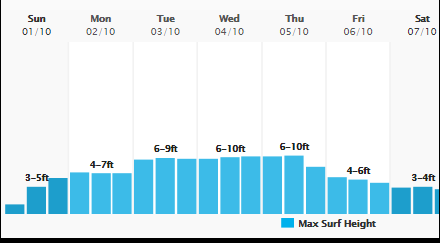
Source: MagicSeaWeed.com

This should be an interesting week.  If the predictions are correct, the surf starts to build Sunday then stays high for a few days.  Even if we don't get favorable winds or swells, the surf might be high enough to do some good.

Please add your response to the blog poll.

Happy hunting,
TreasureGuide@comcast.net

Sunday, August 16, 2015

8/16/15 Report - Why An Artifact Is More Than An Artifact.


Written by the TreasureGuide for the exclusive use of treasurebeachesreport.blogspot.com.

Did you ever wonder what it is about treasure hunting that makes it so fascinating?  Even people that have never done it find it interesting.  It is the subject of books and movies, and young children play games and seek pirate treasures.

 I find myself wondering why I like to watch Diggers and those goof-ball guys digging up mostly rusty junk.  It isn't really any great drama, yet I enjoy watching it.

First off there is the element of discovery and surprise.  Those are basic.  The youngest child gets excited playing peek-a-boo and shows joy when things appear.  Some of my earliest memories involve going out to see if the chickens laid any eggs to gather.  The same thing for wild strawberries and other fruit.

There is very little that could have more survival value.  Maybe it is a part of our DNA.

I found an interesting article on the CRUX web site.  I feel like just pasting the entire article, but that wouldn't be right, and also I want to add my own comments.

The article starts off saying, The exhibit "Indiana Jones and the Adventure of Archaeology" at the National Geographic Museum until Jan. 3, features 100 carefully crafted film props alongside real archaeological finds.

There’s the golden Ark of the Covenant from "Raiders of the Lost Ark" — the model for the container that housed the Ten Commandments, complete with two winged cherubs as described in the Old Testament.

There’s the cup representing the Holy Grail from "Indiana Jones and The Last Crusade."

I didn't know where the National Geographic Museum is, so I looked it up.  It is at 1145 17th Street, NW (17th and M) Washington, DC 20036. 202–857-7700.  It is amazing how hard it can be to find such basic information on otherwise really good web sites.

Sounds like a great place to visit if you are ever in the area.

The article goes on to mention that archaeology students love the Indiana Jones movies.  The curator of the Indiana Jones exhibit said he thought that was because they make people think about the past, about God and the afterlife.

I never liked the Indiana Jones movies myself and don't really know why I don't like them other than perhaps they are too unrealistic.   Maybe I prefer my treasure hunting to be real.  

The Diggers aren't very dramatic, but they are more realistic.  The only thing that puts me off is the antics of the two fellows.  I'd like the program better without all of that..

But is the appeal of the Indiana Jones movies actually that they make you think about the past, God and the afterlife? 

The CRUX article says, “It’s not simply archaeology but the archaeology of the sacred, the idea that once upon a time humans had this immediate capacity to connect with something sacred,” said Manseau, who writes about Jones’ connection to sacred objects in an upcoming issue of the magazine CrossCurrents.  

According to Webster sacred means worthy of religious worship : very holy. : relating to religion. : highly valued and important : deserving great respect.

Before I go any further, I want to say I think Manseau is partly correct.  I want to strongly disagree with one thing though - humans still have the capacity to connect with the sacred - at least some of them.  It is not a "once upon a time" thing for many people.  It is a daily thing.

The article goes on to say, Sacred artifacts also excite people because they lend legitimacy to religious stories, Manseau noted. As much as religion is a matter of faith, he said, these archaeological adventures are at some level quests for proof because sacred artifacts make religion “physical in a way that’s hard to ignore.”

I'll agree with part of that.  Artifacts help people touch the past.  The treasure hunting community acknowledges that.

Besides the elements of adventure, discovery and surprise, it puts us in touch with something beyond ourselves - something bigger than ourselves.

There is also the success and failure thing.  We are rewarded by our efforts, and we enjoy the exercise and we enjoy nature in the process.

If you think about it, many of the things we seek and have an obvious connection with the sacred.  Sometimes it is symbolic.

Almost every cob has a cross on it.  Did you ever think about that?  And U. S. coins proclaim "In God We Trust."  That is so common and obvious that we tend to ignore it.

The "Ark of the Covenant," and the "Holy Grail" are the ultimate artifacts.  They were sought by the Crusaders and Knights Templar.  They are a part of our cultural roots that extend back thousands of years.  They are part of religion, history, and I think they are part of our psyche in a deeper way than we consciously acknowledge.

If you like old, they are old.  They are more than artifacts, they are archetypes.

It is not accidental or insignificant that almost every cob displays a cross.  Nor is it an accident that our coins say "In God We Trust," no matter if you like it or not.

Then there are the crucifixes, medallions and even wedding bands with a sacred or religious connection.

Even the precious metals and gem stones have been used in symbolically.  Gold has long been a symbol for deity because of its timeless untarnishing lustre.  It is no accident that it is used to create sacred artifacts.

Artifacts can touch as deeply.  They defy time.  They can span generations.

As we dig up a find and wipe away the dirt to see what was underneath, the artifacts sing the words of the old hymn Amazing Grace, I once was lost but now am found,

It is often said that Royals were made as presentation pieces for the King.  Frank Sedwick wrote a detailed paper about Royals, and says they were not likely for that purpose.  In fact they may have actually had a church connection like the uniquely shaped heart and animal votive cobs.

I've posted Laura Strolias research on some of the amazing artifacts found on the Treasure Coast including the Pelican of Piety and a gold reliquary pendant.  

In my 11/4/12 post Laura's article said,  Using the visual art of a pelican in piety, whether it was a painting or a sculpture, greatly aided the devout when contemplating the image of Christ on the Cross and his presence in the Eucharist.

In my 8/31/14 post Laura said this about the reliquary pendant.  The Reliquary Pendant found at Douglass Beach is also called a triptych, a term meaning that a work of art is made up of three hinged panels that can be opened for display, or folded shut when desired.  The circular opening on the 1715 reliquary would have held a holy remain behind a piece of rock crystal.  A fabric-covered paste board would have been stitched to the back of it.


It is intriguing to wonder about the final destination of this 1715 reliquary if the hurricane never happened.  Perhaps it was meant to hang in a private chapel of a wealthy household, or near the bedside of a clergy member?  We will never know the answer. But in this modern day of age, we are so fortunate to be able to view an artifact, such as this one, that holds such beauty and significance. 
What I am saying today is that treasure hunting is more than it seems.  It is deeper, more basic and instinctual than we may realize.  And finds are more than objects.  They provide a bridge - not only to a time and place and person in history, but to something deeper in each and every one of us.
---

Here is the link to the article in CRUX.

http://www.cruxnow.com/life/2015/08/13/indiana-jones-quest-for-the-sacred/

----

I think I should end there today.

Happy hunting,
TreasureGuide@comcast.net