Showing posts with label fid. Show all posts

Saturday, December 2, 2017

12/2/17 Report - Art Hartman's Anchor? Tools From the Age of Sail. Fid or Marlinspike. Difficulty of Identifying Some Finds. Big tides.


Written by the TreaureGuide for the exclusive use of treasurebeachesreport.blogspot.com.

Recovered Rusted Remains of Anchor
Find and photo by Darrel S.
Darrel S. dug this anchor years ago.  One of the all-time top treasure salvage guys of the Treasure Coast got excited when he saw this anchor because he remembered the time when Art Hartman lost an anchor in the same area.

If you know much about Treasure Coast treasure salvage, you probably know something about Art Hartman (deceased Dec. 24, 2015, sorry to say).

---

The dating game can be very difficult. I'm not talking about trying to meet a member of the opposite sex.  I don't know how you know what is the opposite sex any more.  According to what I've been hearing, there are a dozen or more other sexes.  You've probably heard about the LGBTXYZ... whatever.   Anyhow.  In the past things weren't thrown away like the are today.  Broken objects were repaired or the parts or materials were reused.  A tea kettle, or example, would be repaired time and time again, and then when it was beyond repair the copper would be used to make other things.  I saw pictures of finds from one old fort site that yielded at least twenty different types of items made from the copper from old kettles.  Items were repaired so many times and were used for such a long time that it could be especially difficult to put a date or age on the item.

I often remind people that old items are being lost everyday.  That is another thing that can be confounding.  I've found coins just after they were lost that were hundreds of years old.  People still wear or carry old stuff at times.

Deciding what a thing is can be difficult too.  Some things could be used for a variety of different purposes.  Just think about a rock.  It could be a building material, a weapon, a weight, a hammer.  How it was actually used, can be a difficult thing to determine.  And some items were used in more ways than one.

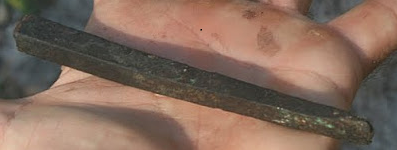
How about the item found on the Treasure Coast by Gayle C that I showed yesterday?  John L. thought it might be a fid.  That was one of my first thoughts.  It could certainly be a fid or something very similar.

Brian M. sent this photo of a similar item he once found at a land site.  His is a bit longer and thinner.  Note the eye at the one end of Brian's item.

Find by Brian M.

The fid was the traditional tool of the sailor from the dawn of sailing all the way into the beginning of the last century.  It was used to loosen and tighten knots.  It was used to separate the strands of rope for splicing.  The fid was used as a club and a temporary pull handle.  It was used to shape hand sewn grommets in sails and clothing.  After the knife, it was the sailors most important tool.  The fid was often a handmade affair and was sized according to the size rope that was being worked.  Wood, bone and antler being the predominant choices.  Its an easy tool to make for yourself and can be made from just about anything you have available.   This simple tool had a good long run and is still of use to those who work with traditional ropes and cordage.  As ships began to transition to mechanical power and rigging was replaced with wire cables, the fid fell out of favor.

That text is from the pirateking web site.  Here is the link.

http://www.thepirateking.com/historical/marlin_spikes.htm

It seems that some people use the terms "fid" and "marlinespike" interchangeably, but I think "fid" more often refers to an object made of wood and used to work with ropes, while "marlinespike" more often refers to a metal object which is used to work with wire cables.

Here is a description of a Marlinspike.


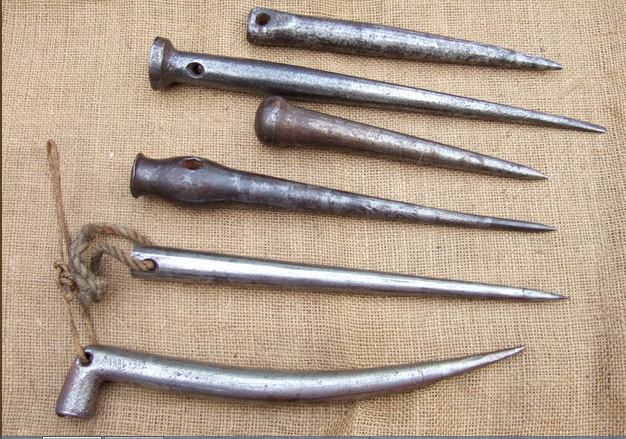
Below is a picture of a variety of pointed sail-making tools.

Variety of Sail Making Tools.

I lost the sources for the last two pictures.  If you know where they came from, let me know.  I'll post the sources as soon as I find them.

I once posted a similar find that I made (See following link.).  I thought it could be a fid or an awl.  Hard to tell.  There were a lot of good uses for pointed objects on sailing ships.

http://treasurebeachesreport.blogspot.com/2016/08/81216-report-south-hutchinson-island.html

And here is the link to a very good web site that shows a wide variety of old sailing ship tools.

http://www.ageofsail.net/aosbt.asp

I think we have yesterday's mystery find narrowed down as well as we can.  Gaylen now has the job of cleaning and preserving his find.

---

I can tolerate cold weather and snow when putting up Christmas decorations, but I find mosquitoes and fire ant bites especially annoying and something one shouldn't have to put up with at this time of year, but that is what I got.


We're getting close to a full moon and the tides are now big.  The surf will only be 2 - 3 feet though.

Happy hunting,
TreasureGuide@comcast.net
Saturday, August 13, 2016

8/13/16 Report - Wedges and Chisels and Other Old Nautical Tools. Iron Artifacts of Port Royal. Conservation of Iron Artifacts.


Written by the TreasureGuide for the exclusive use of treasurebeachesreport.blogspot.com.

Artifacts Found On Treasure Coast Beaches.
There are more than coins and gold and silver to be found on the 1715 Fleet wrecks.  Besides the cargo there were all the necessities of daily life, and the nautical tools that were needed to keep a sailing ship in good working order.  While those things might not be as glamorous or valuable as the queen's jewels they can be just as interesting and meaningful.

After finding information on the awl or fid that I showed yesterday, I decided to research a couple more iron beach finds a little more.  They fall into the category of tools.  They are shown above.

The larger one is not a chisel.  That is what I called it for a while, but then one helpful reader informed me that it is not a chisel.  It is a wedge.

A chisel removes material.  A wedge separates things, like boards on a ship when they are going to be caulked.

I'm not sure if the smaller one is a wedge or chisel.  I suspect it is a wedge too.  If it is a chisel, it would be for wood - maybe stone.

Years ago I found the bronze one shown immediately below.


While doing research on nautical tools, I found a great resource.  It is a master's thesis by Katie Custer, entitled Wrought Iron Hand Tools From The Underwater Archaeological Excavations of Colonial Port Royal, Jamaica, C. 1692.

The thesis is a very informative paper that you will probably want to browse.  As the title suggests, it describes iron tool artifacts having to do with various trades active in Port Royal in the late 17th Century.

Not only does the thesis look at the artifacts, it also considers historical records and inventories.  And of course there is a very useful reference list at the end.

Here is the link.

http://anthropology.tamu.edu/papers/Custer-MA2004.pdf

---

If you learn to interpret and appreciate iron artifacts, you will also want to be able to properly clean and conserve them.

One good reference is a PDF file entitled, The Care and Preservation of Historical Iron.  This article was authored by Clara Deck, Senior Conservator of The Henry Ford Museum.

This one has a lot of good useful information too.

https://www.thehenryford.org/docs/default-source/default-document-library/the-henry-ford-iron-conservation.pdf?sfvrsn=2

---

Horsing Iron.


Here is another web site you might want to look at.  It shows a lot of antique nautical tools, including this horsing iron, which would be used for caulking.

http://www.ageofsail.net/aosbt.asp


---

I wanted to comment on the mystery item that I posted on 8/11.  I received an number of excellent thoughts from helpful readers of this blog.

My opinion is that the item is likely more modern.  A couple of knowledgeable and well-known shipwreck experts told Bob C. that the mystery item could be from a shipwreck.  The item was found near other items that I believe are probably 1715 Fleet. I don't presume to be more knowledgeable than the well-known experts, who also had the advantage of seeing the item in person, but my opinion after viewing the picture, is that it is most likely more modern.  My confidence level is 70 or 80 percent that it is modern.  Of course I could be wrong.

The item might be easier to identify after it is cleaned.

Thanks to all who offered opinions.

---

There is no tropical activity of interest right now and the surf will remain calm for at least a few days.

Happy hunting,
TreasureGuide@comcast.net

Friday, August 12, 2016

8/12/16 Report - South Hutchinson Island Beaches and Salvage Vessel Begins Day. Awl or Fid Artifact. More Storms Predicted.


Written by the TreasureGuide for the exclusive use of treasurebeachesreport.blogspot.com.

Walton Rocks This Morning.
I looked at some beaches along South Hutchinson Island this morning.  Beach conditions remain poor.  There was a lot of mushy sand.  You'll see that in some of the pictures.

I also stopped at Blind Creek, but didn't take pictures.  There were a lot of nudists there already. They used to stay well south of the access, but now are up by the Blind Creek access.  It gives a new meaning to the name Blind Creek.

Beach South of Frederick Douglas Beach.
John Brooks Beach Looking North.
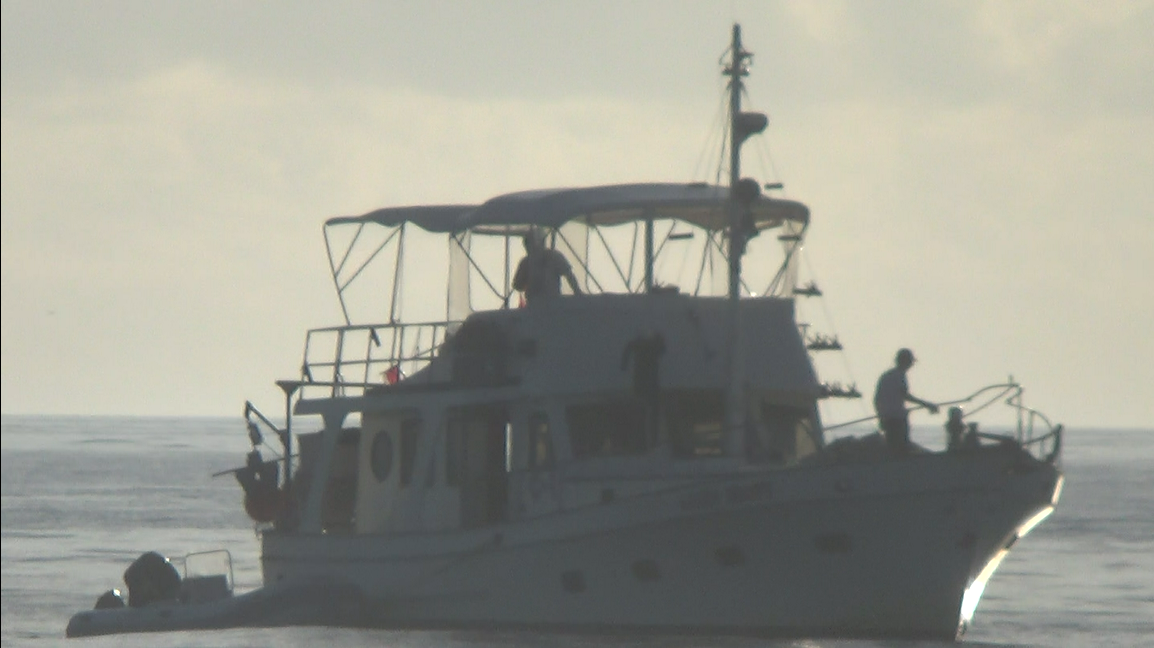
Treasure Slavage Vessel
Arriving At North End of Nieves Site.
Same Boat Getting Ready To Begin Day.
---

Treasure Coast Shipwreck Beach Find.
What do you think this object is?  I wondered about it, but now feel more confident about the answer.  I feel about 80% confident now.

The reason I'm now fairly confident is that I saw a picture of another one having exactly the same shape, and it was described by an archaeologist as an awl.  Unfortunately I can't find that picture again right now.  That one was about an inch and a half longer than the one shown above, but they come in different sizes, and this one probably lost some material to corrosion.

I don't know how they determined that it was an awl, but I assume they had good reason. It looks like it could be a fid.  Maybe it had a dual function.  That could certainly be the case.  Awls and fibs would be used by the same type of person, and you would expect both to be present on a sailing ship.

A fid is conical pin or spike used in splicing rope.  Below are some fids.  They also come if various sizes.


The one awl shown below has a wood handle.  The one shown at the top of the post, if that is what it is, does not, and I do not believe it ever had a handle.  I don't think it would be pointed at the big end if it had a handle.

What I am very confident of now, is that it is either an awl, as the archaeologist said, or perhaps a fid.

---

They revised projections for this hurricane season.  They think there will be more storms than originally predicted.


So far there have been five named storms and two hurricanes. The most active months of the season are just beginning.


Here is a link to that story.


http://www.baltimoresun.com/news/weather/weather-blog/bs-md-weatherpage-0812-20160811-story.html

Happy hunting,
TreasureGuide@comcast.net