Written by the TreasureGuide for the exclusive use of treasurebeachesreport.blogspot.com.
For example, in my blog I reported on musket parts and a barrel mold that was found by Will R. You can find information on that find in my 12/4/12 post and my 6/25/19 post. Will was able to create a cast of the barrel.
I also remember one being found in the Sewall's point area, although I did not find right off where I reported on that one in my blog.
There are others for sure. I found what I believe is most likely a piece of a silver side plate.
Here is the link to the post where I previously posted that.
I once found a photo showing a side plate almost exactly matching the shape and design on the one that I found. I don't know where that is now but there is a somewhat similar one shown in my old Dixie Gun Works catalog.
I clearly remember the first musket find that I made and have told that story before. I found the rusted hammer and jaws of a musket on a steep hillside. I can remember digging it up like it was yesterday, even though at the time I didn't know for sure what it was. It was my first hunt in a historic area like that, and I didn't pay too much attention to the rusted twisted piece of metal that I just uncovered, and left it where it was. In just a few short minutes, I found the flint. I also didn't keep that. I totally regret that to this day, but I just didn't have the knowledge and didn't know what I was doing. Sometimes you are just not ready for a find. You can make good finds and not even know it if you don't have the necessary knowledge. It would have been better if I found those items today rather than many years ago. If I appreciated the items for what they were when I dug them up, I would have hunted the area better and I would have followed up by doing the research to better identify them. You can also ruin a find by not knowing how to conserve and store it. Years later, I can now say that the musket lock and flint I found on that hillside was most likely English.
Yesterday I ended up talking about the wheellock and the fact that none have been found around Florida. At the time they were used, they were thought to be unreliable and were not used much in the New World by the Spanish.
Next came the flintlock, the miquelet being an early version of the flintlock.
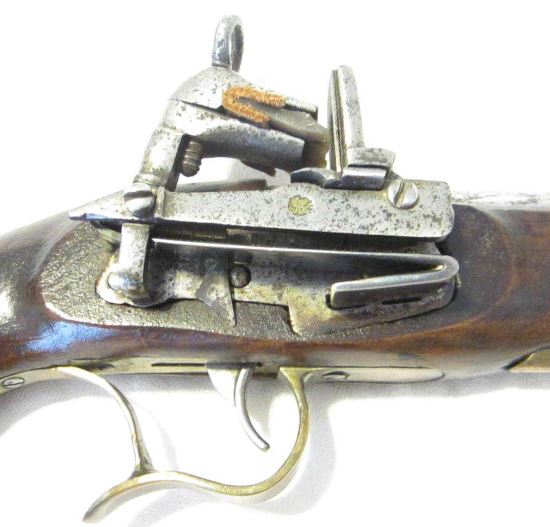 |
| Lock of Miquelet Pistol. |
You can easily see the flint being held in the lock by what in this case looks like maybe a piece of leather where you would often see a piece of lead.
You can often tell a Spanish flintlock from those made in other countries. Spanish made miquelets were more boxy, while those made by some of the other countries were more curved and graceful in appearance.
Don't forget that Spanish galleons were provisioned by equipment from many countries, so if something isn't Spanish that doesn't mean that it didn't come from a Spanish treasure ship.
If you want to know more about the parts of a miquelet lock, click here to see a good video.
So what has been found in and around Florida waters? First here is what Noel Wells' book Small Arms of the Spanish Treasure Fleets says about that.
As I said yesterday, matchlocks have been found on the 1622, 1715, and even the 1733 wreck sites, and never, according to Wells, has a wheellock been found in or around Florida waters.
* 24 French cavalry pistols (flintlocks) were found on one 1715 shipwreck site. Some were totally encrusted.
*A miquelet musket stock (broken in the area where the lock would have been) was found on a 1715 fleet site.
* A 1660s era miquelet pistol from a 1715 site which is in the McLarty museum collection.
* In 1990 a trubuco musket was recovered from a 1715 site.
* In 1993 treasure divers found 2 encrusted muskets on a 1715 Fleet site.
* Around the year 2000 a beachcomber at a 1715 Fleet beach found a complete encrusted English flintlock lock that had never been fitted to a weapon.
Those are the ones I found listed in the wells book. I might have missed one or two. Of course there must be others.
For example, in my blog I reported on musket parts and a barrel mold that was found by Will R. You can find information on that find in my 12/4/12 post and my 6/25/19 post. Will was able to create a cast of the barrel.
I also remember one being found in the Sewall's point area, although I did not find right off where I reported on that one in my blog.
There are others for sure. I found what I believe is most likely a piece of a silver side plate.
 |
| Piece of Silver Side Plate? |
Here is the link to the post where I previously posted that.
I once found a photo showing a side plate almost exactly matching the shape and design on the one that I found. I don't know where that is now but there is a somewhat similar one shown in my old Dixie Gun Works catalog.
I clearly remember the first musket find that I made and have told that story before. I found the rusted hammer and jaws of a musket on a steep hillside. I can remember digging it up like it was yesterday, even though at the time I didn't know for sure what it was. It was my first hunt in a historic area like that, and I didn't pay too much attention to the rusted twisted piece of metal that I just uncovered, and left it where it was. In just a few short minutes, I found the flint. I also didn't keep that. I totally regret that to this day, but I just didn't have the knowledge and didn't know what I was doing. Sometimes you are just not ready for a find. You can make good finds and not even know it if you don't have the necessary knowledge. It would have been better if I found those items today rather than many years ago. If I appreciated the items for what they were when I dug them up, I would have hunted the area better and I would have followed up by doing the research to better identify them. You can also ruin a find by not knowing how to conserve and store it. Years later, I can now say that the musket lock and flint I found on that hillside was most likely English.
I've become painfully aware of how slowly I gain knowledge from experience and how that knowledge only makes my long history of ignorance that much more regretful. Being a person that tends to learn independently rather than being quick to take advantage of the knowledge of others, much of my learning comes from making mistakes over the years. One thing I've learned the hard way is that I could have saved myself a lot of wasted time and grief by being more organized and detailed in my documentation and record keeping. I've said that before, but it is something I find myself very often regretting that I did not do. I have objects that I can't easily find when I want to, and I've read things that I can not longer find when I want to. I guess you can't avoid that, but being highly organized can help.
---
The tides are pretty flat now, as is the surf.
Happy hunting,
TreasureGuide@comcast.net
---
The tides are pretty flat now, as is the surf.
Happy hunting,
TreasureGuide@comcast.net


