Showing posts with label military button. Show all posts

Monday, February 12, 2018

2/12/18 Report - Two Types of Metal Detecting Mistakes and Which Is Worse. Marx FIT Lecture. 54th Foot Button.


Written by the TreasureGuide for the exclusive use of treasurebeachesreport.blogspot.con.

Pewter British 54th Regiment of Foot Button
The above button years ago in the West Indies.  It was found near a battle site where the French and British fought in December of 1788.  I'll talk about that more below.

The 54th Regiment of Foot was an infantry regiment of the British Army. Originally formed in 1755 as the 56th Regiment of Foot, it was renumbered as the 54th when the 50th Regiment and 51st Regiment were disbanded. It was renamed as 54th (the West Norfolk) Regiment of Foot on 31 August 1782.


I've made a lot of mistakes and expect to keep making mistakes as long as I walk this earth.  I expect to make mistakes but I try to avoid repeating the same mistakes.

There are two types of mistake that I want to talk about today.  They are opposites.  One is thinking a find is not a good when it actually is, and the other is thinking an item is good when it is actually not.

The first example of the first type of error that comes to my mind is a musket flint that I found.  I detected a very twisted rusted piece of metal that I uncovered, but paid no attention to.  I then saw the flint.  This was my first time that I detected a site like that.  I was accustomed to digging gold rings in those days and didn't know much about hunting artifacts.  I can remember that experience precisely today: where I was, uncovering the rusty metal item, etc.  And I regret to this day that I didn't recognize the twisted piece of rusty metal and flint.  I'd appreciate them much more today than I did then.

Not only do I wish I had kept what I later realized was a musket hammer and the flint, but the failure to appreciate the find in the field resulted in not hunting the immediate area more effectively. Who knows what else might have been found where those items were.  I did find several other nice finds during that hunt including grape shot, soldier art and military buttons ( including the one at the top of this post ) but I still wish I had picked up the flint and hammer.

That is an error caused by not recognizing the possible significance of a find when it was found.  If I had taken the item home but still didn't realize its significance, I could have still lost it or damaged it through improper cleaning.  If you do not treat an item as potentially significant until you prove otherwise, a good find can easily be lost again or damaged beyond repair.

The area had already been studied by archaeologists but the park ranger was interested to see what I could find near the ocean where the archaeologists couldn't excavate.  They had a small museum there, and they kept a grapeshot that I found.

Another example would be a medallion from a  1715 Fleet beach that I did not recognize because when I dug it up it was encrusted and didn't look like anything other than a common coin.  I kept it for quite a while without really studying it and eventually put it in a tumbler with a bunch of modern coins.  When I took it out of the tumbler, it was clean enough that I could recognize it as a religious medallion and it still had some silver gilt on it.  After that it was studied, but the damage was already done.

I could give you more examples of times when I made the same type of mistake, some of them involving even nicer items, but the point is that treating a find as being nothing significant before you know for sure can have disastrous results.

If, on the other hand, you make the other kind of mistake - that of treating an item as valuable or significant when it is nothing - the results aren't nearly as bad.  The biggest thing with that type of error is that you end up getting disappointed when you learn that the item is not as good as you hoped it would be.  That is why I recommend trying to avoid the first type of error even if it means making the second kind of error.

Here are two recommendations that I often repeat.  First, never throw away an item until you KNOW that it is nothing good.  Don't be hasty.  And second, if an item has any chance of being good, treat it as if it is.  As I've shown in the past, it can take a long time to be absolutely sure.  You might never solve the puzzle.  It is better to think a find might be good even if it is not, than to make the mistake of concluding that it is no good and then finding out too late that it is better than you thought. I learned the hard way.  Some of my biggest regrets are the result of not appreciating an item enough to care for it properly.   My advice is that when there is any doubt, keep it and study it until you are absolutely sure.

To give just one example of when I thought a find was good when it wasn't, I once found what appeared to be a gold escudo.  That was back in my early days of detecting.  It would have been my first gold escudo, and it came from a treasure wreck beach, so it seemed possible.  It was encrusted and so I tried to clean it.  I took great pains to carefully clean it.  I got it fairly well cleaned and was confused by the fact that I couldn't identify it.  This was before I was experienced with testing metals, and I didn't have the reference books that I have today.  Eventually I figured out that it was a fake.  Yes I was disappointed, and I wasted time in trying to carefully clean it, but I learned a lot.

---

There will be a free Robert Marx lecture at FIT on February 20.

---

Civilized people should be able to disagree without being disagreeable.

Happy hunting,
TreasureGuide@comcast.net

Wednesday, June 3, 2015

6/3/15 Report - Join The Enironmental Metal Detecting Movement. Various Finds By Readers Of This Blog.


Written by the TreasureGuide for the exclusive use of treasurebeachesreport.blogspot.com.


Great Military Button Find.
Find and photo by William M.

I'm going to start it right here right now - I was going to call it the Green Metal Detecting Movement, but that might be taken as a broader political statement, so for now I'll use the term Environmental Metal Detecting Movement instead.

Detectorists remove metallic items that otherwise might be in or on the ground for centuries.  If you think about it, who else will remove all of the lead sinkers and fish hooks from the beach?  Who else is going to pick up the pull tabs in the parks?   Nobody!  And those beer cans are not biodegradable.  The same old cans and pull tabs will be littering the ground for thousands of years if they are not removed by somebody, and that somebody is us.

I like to leave a location in some way better than I found it.  That might mean removing iron, aluminum, lead, glass or whatever.  You don't have to do it all at once.  You can do it gradually..

I don't pick up every piece of junk on any one visit.  That would be impossible.  But I do remove some junk on every visit.  You'd be surprised how that helps.  If nobody ever picks it up, in time the entire area will be covered with a solid blanket of junk.

Some Treasure Coast beaches that were once heavily littered with beer bottle caps, pull tabs and what have you, are now much much cleaner.  I know that for certain.  You can now detect some beaches with absolutely no discrimination and find almost no junk.  That is a big change and a real accomplishment.  It was accomplished little by little over time.  I'd like to think that I had some small amount of influence in getting that done.

Who wants our fields and beaches to be covered with junk?  If you see junk, how hard is it to pick it up and stick it in a bag?  Some of it can be recycled for cash.  Recycling junk is another benefit o the movement.

If you see trash and don't remove it, how are you whole lot different from the person that littered in the first place?

I like the beach.  I like nature.  I like the woods.  I like that old path I showed the other day.  And I hate to see it junked up with all kinds of trash - buried or not.  Some of it might be buried now, but that doesn't mean it always will be.

If you remove the trash, not only are you preparing the site for better detecting, but you are also cleaning up the natural environment.  I think that is a good thing.

We don't do a good job of letting people know how everybody benefits from the detecting hobby.  I think this is something we should promote, do and publicize.  In time people might come to appreciate it.

If we all become a part of the movement, it will make a difference.

---
Same Button
Find and photo by William M.

The picture at the top of this page shows a military button found by William M.  I previously said that it was from the Seminole War period.  That was wrong.  My mistake.  This button actually would date something like 1875 to 1902.

Very nice condition with a lot of gold still on the front.

The back mark is Horstmann Philadelphia 


Below is a picture of some miscellaneous finds by William, including the button and a ring along with a close-up of the ring.

Congratulations William!  Thanks for sharing.


Miscellaneous Finds by William M.
Photo by William M.

Closer View Of Ring.
Find and photo by William M.


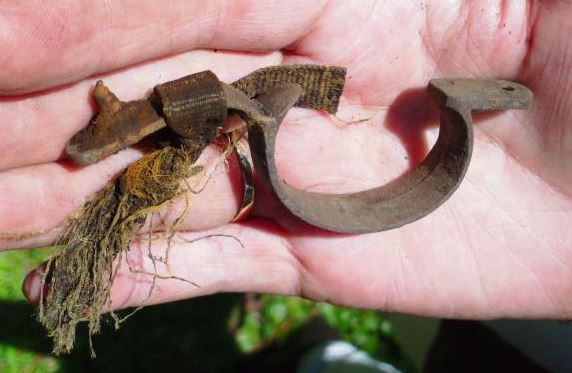
James F., his wife and several friends have been hunting an old Seminole era fort site in Central Florida on private land where they received permission to hunt. 

Musket Ball From Central Florida
Photo by James F.
Trigger Guard with Material Attached.
Found by Mrs. James F.


James said they were using a good bit of discrimination because of the foil, aluminum, pull tabs, and crushed beer cans.

As you know, I showed a lead shot from West Virginia a couple of days ago.  James said he was surprised to read that I was talking about lead shot when that is the kind of thing they were finding.

 Congratulations to Mr. and Mrs. James F.!

Very nice finds.  Thanks for sharing.

And from the Treasure Coast, Dan B. submitted this picture of some partially cleaned old props.

Find photos submitted by Dan B.


Those old boat props could bring in a pretty penny.


And here is a toe ring find by Dan B.

Looks like silver.

Thanks for sharing and congratulations Dan!


People are finding things.  Not too much from the Treasure Coast beaches though.  You know how that goes.  Conditions just haven't been very good for beach hunting.  A lot of people are more interesting in the older item.  There are different types of hunting, and as I advised the other day, it is good to switch it up once in a while.

It is sometimes surprising what is most valuable.  It pays to be aware of the prices of different types of items even if you don't plan to sell things.

---

On the Treasure Coast it looks like we'll have a one to two foot surf for a few days.  At least we have a decent negative tide.

Sometime we'll get an actual change in beach detecting conditions.  Hopefully sooner rather than later.


Happy hunting,
TreasureGuide@comcast.net