Showing posts with label celt. Show all posts

Sunday, July 7, 2019

7/7/19 Report = Unidentified Button Find. Possible Shell Tool Find. Resource on Shell Tools. Florida Laws Web Site.


Written by the treasureguide for the exclusive use of treasurebeachesreport.blogspot.com.


Old Unidentified Button.

Here is one old button find that I can't identify.  I can't make out the design on the front.  The back says "EXTRA FEIN."


Let me know if you can identify this one or anything about it.

---

Israel officially opened a stairway, known as "Pilgrim's Road," that Jesus is believed to have walked on in ancient Jerusalem as another place with the significance of "biblical proportions" to billions, especially for Judeo-Christian visitors to the Holy Land.
The City of David Foundation unveiled the 2,000-year-old main thoroughfare from Roman-era Jerusalem that it says served pilgrims ascending to the ancient Jewish Temple from the Pool of Siloam built by King Hezekiah. Until recently, it was hidden under a potato field and discovered by accident in 2004 after a pipe burst...

Here is the link.
https://www.foxnews.com/science/israel-road-jesus-temple-ancient-jerusalem

---


Scott B. sent me the following photos and email. 


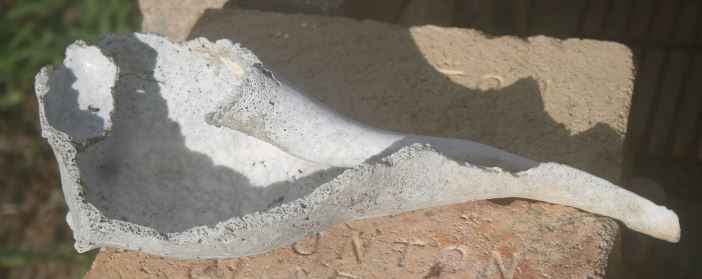
Shell Item Found by Scott B.
Photos by Scott B.

After seeing the picture you posted recently, I remembered this piece of shell I found a while back. At the time, it just seemed like an interesting smooth piece of shell. I’m pretty sure I found it at a Treasure Coast beach, but not 100% positive.

After looking closer at it, the item really fits well in my hand including a thumb stop and two notches on the other side where my middle and ring fingertips fit. It’s quite smooth, the years in the elements haven’t left any visible signs that it was worked with tools.

I think this may have been some type of hand blade for skinning or slicing. The thinner side is a bit worn, but could have been sharpened, I imagine.

Perhaps this is all coincidence, but thanks to your picture of the celt, I gave this a closer look and realize it could be a neat piece of history.

As always, thanks for all you do.

Scott 


Thanks Scott.  I'm glad my post inspired you to take another look at the item.   There are a variety of online resources you might want to consult, but when I'm not sure about an item nothing helps like talking to a knowledgeable person at a university, museum or trade show or just getting the opinions of others who are more informed.  People who know what to look for can identify the signs of the item being worked or used.

Maybe some of my readers will add their thoughts about your item.

---

If you are interested in learning more about Florida shell artifacts, here is a lengthy thesis of over 200 pages.  It presents many examples of various types.

Here is the first paragraph, which will give you some idea of the contents.

With this thesis, I aim to fill a gap in our knowledge of shell
artifacts from the northwest part of the state of Florida. It represents
a first look at the range of shell artifacts in the collections of the
University of South Florida (USF) obtained during the ongoing program
of archaeological investigations in the Apalachicola Valley and
surrounding region. There are 46 sites in the study area that have
been identified as yielding shell artifacts, of which samples from 27
sites are curated in the USF Archaeology Laboratory. The proposed
typology is based on an analysis of over 2300 specimens collected
from archaeological sites in northwest Florida, including the Gulf Coast,
barrier islands, St. Joseph Bay, and the Apalachicola River drainage.


Here is the link.

---


Most detectorists don't know much about stone or shell artifacts.  I certainly don't.  But we should know enough to realize that they are out there and how to identify and respect them.  We also need to know something about the applicable laws.

I added the following to yesterday's post late yesterday, so in case you didn't see it, I'm posting it again.


As you probably know, there are laws regarding archaeological resources.  They are many and complex and can be very confusing.  I can't summarize or interpret them all, so don't ask me to.  Do, however, realize that there are penalties for removing artifacts from state and federal lands.  If you have WRITTEN permission, you CAN collect artifacts on private land.  That is my understanding.

On the Treasure Coast it is not extremely unusual to find artifacts on the beach or on your own property.  I've been asked several times while on the beach, about items just found by tourists.  I've found artifacts on my property and have posted some examples.  

Beachcombers, shell collectors and tourists often pick up unusual or interesting items on the beach without knowing what they are.  If you look through any large collection put together by a shell collector, there is a very good chance you will find a possible artifact or two.  

Metal detectorists do not generally go out looking for artifacts and might not recognize them.  I think I've shown that they can be difficult to identify unless you have studied a little.  I am not good at identifying stone and shell tools in particular and have to ask those who know more about them.

We all want to respect artifacts and follow the laws.  Laws can be broken unwittingly, and I hope this post will help you begin to become more familiar with artifacts so that you will be better able to identify, respect and protect artifacts and follow the applicable laws.

As a beginning, you might want to look at this summary of the Florida laws.  Here is a link.


I know that this quick summary might give rise to more questions than it answers, but that is the best I can do.

Here is one good principle: when in doubt, just take photos of the item and report your find.  Most of us carry smart phones with good cameras these days, so that is easy enough to do.

---

Keep learning,
TreasureGuide@comcast.net

Saturday, July 6, 2019

7/6/19 Report - Bone and Shell Artifacts From the Treasure Coast and South Florida and Reader Thoughts.

'
Written by the TreasureGuide for the exclusive use of treasurebeachesreport.blogspot.com.

Yesterday I talked about points.  Below are some other items I've shown before.  They all came from the same Treasure Coast beach, but were found at different times in shell piles.  Mostly found by a shell collector, included are what appears to be a celt, made from a heavy conch shell, an arrowhead, a discoidal, and a rounded shell, maybe either a discoidal or a preform of some sort.


You can see more examples of many similar items online.  I'd recommend checking out the PeachStateArchaeologicalicalSociety web site, where you'll find many examples.

http://peachstatearchaeologicalsociety.org/index.php/26-shell-decorative/446-shell-tools-2


Here are some other Florida items.

Two Bone and Two Shell Artifacts.
The two on the left appear to be shaped bones for punching.   To the right of that is what appears to be a shell punch.  And last is  a piece of shell that I'm told was for shaping a shaft or something.  The wood, if that was the case, would be drawn through the curved depression at the top.

Not only are stone points occasionally found on beaches, but there are also other types of items.

I don't know much about these types of  things, but if you are on the beaches much, you might see pieces of shell that appear to have been worked into a usable form such as a spoon, scrapper or cup.

The Horse Conch shell shown below is a bugle.  I thought it might be Native American, but the people at the Florida State Museum said it is probably modern.

Horse Conch Shell Bugle.
The first thing I noticed was the slot.  Then I noticed the top was removed and that it works as a horn if you blow it.

Here is what I learned after doing a little research on the bugle.

In classic Mayan art, the Horse Conch is shown being utilized in many ways including as paint and ink holders for elite scribes, and also as a bugle or trumpet.

In southern Florida, Native Americans, including the Calusa and Tequesta, used the horse conch to make several types of artifact. The whole shell, or more commonly only the columella, was attached to a wooden handle and used as a hammer or woodworking tool. The body whorl was used as a drinking cup. The columella was also used to make plummets or sinkers.

So now it is known that the shell is a Horse Conch, and that Horse Conchs were used as bugles, and additionally, that they were used by the Calusa and Tequesta Indians.

I also found that locals used conch shells as horns in the 19th century when they hunted possums with dogs. 


Of course it might be even more modern than that.

I have learned to blow it with pretty good results, but it takes some practice.

The shell below looks like it was modified to make a ladle.  It is over a foot long and has what appears like a nice handle.  You'll see things like that in the shells at the beach.  Shell collectors pick them up all the time.

Ladle.

I'm never sure when I see things like that, if it is accidental or worked.  I just don't have the knowledge and skill to know without asking.  Just by appearances, I find it very unlikely that this one was broken accidentally in that way, but it could have.

Here is example of a piece that I would think would NOT break that way naturally.

Broken or Formed (?)
And here is one that would make a nice cup or holder - with legs yet.

Two Views of Broken or Formed Shell.

You'll also see columella that look like they might have been worked.

One reader provided excellent information on the coral arrowhead I posted yesterday and said it looked reworked.  He explained why and referred to a couple great references.  One is the Overstreet Arrowhead Identification and Pricing Guide.  You can find that online.  He said he gets the new one every year to see the new point photos and stone tools.  It also has a tutorial.  Looks like an excellent reference.

Here are a couple of links.


Very useful.

---

As you probably know, there are laws regarding archaeological resources.  They are many and complex and can be very confusing.  I can't summarize or interpret them all, so don't ask me to.  Do, however, realize that there are strict penalties for removing artifacts from state and federal lands.  If you have WRITTEN permission, you CAN collect artifacts on private land.  That is my understanding.

On the Treasure Coast it is not unusual to find artifacts on your own property.  I've found artifacts on my property and have posted some examples.  It is not uncommon.

Beachcombers, shell collectors and tourists will pick up unusual or interesting items and remove them without knowing what they are.  If you look through any large collection put together by a shell collector, there is a very good chance you will find an artifact.  I've been asked several times while on the beach, about items found by tourists.

Metal detectorists do not generally go out looking for artifacts and might not recognize them.  I think I've shown that they can be difficult to identify.  I am not good at identifying stone and shell tools in particular, and have to ask those know.

We all want to respect artifacts and follow the laws.  Laws can be broken unwittingly, and I hope this post will help you begin to become more familiar with artifacts so that you will be better able to identify, respect and protect them and follow the laws.

As a beginning, you might want to look at this summary of the Florida laws.  Here is a link.

https://dos.myflorida.com/historical/archaeology/underwater/laws/

I know that quick summary might give rise to more questions than it answers, but that is the best I can do.

One good principle when in doubt is to take photos and report your find.  Most of us carry smart phones with good cameras these days, so that is easy to do.

---

I also received an email from Susan E. who appreciated reading the Declaration of Independence, which I posted a couple days ago.  Here is what she said.

Thank you for printing this document.  While I was reading the list of grievances against Britain, I knew that each one referred to specific events.  What if a Revolutionary history textbook began with the Declaration, and then used as its chapter headings each of the complaints and justifications presented in the document?

What was most important to the Congressmen?  Why were the grievances listed in that order?  Were any left out, and if so, then why?  What was/were the "last straw(s)"?  And how do all of these things compare to what the rest of the people thought and felt? 

Susan

Thanks Susan.  Great ideas!

I'm surprised that I have not yet received photos of any Treasure Coast arrowhead finds.  Maybe they are not found on the beach as commonly as I thought.

Happy hunting,
Treasureguide@comcast.net


Friday, September 28, 2018

9/28/18 Report - Native American Artifacts From Treasure Coast Beaches. Bigger Surf Coming.


Written by the TreasureGuide for the exclusive use of treasurebeachesreport.blogspot.com.

Artifacts Found On Treasure Coast Beaches.
A few days ago I wrote about what I called a "complete beach hunter."  I explained what I meant by that three-word term and how it means going beyond being just a detectorist.  It includes being aware of and finding all kinds of beach treasures - not just metallic.

Above is an example of one nonmetallic type of beach treasure that can be found on the Treasure Coast beaches.  On the left is a shell celt.  In the middle is an arrowhead made of agatized coral.  And on the right is a rounded shell object, and below that is a gaming piece.  All of those have been examined by experts.

Here is what the myflorida.com site says about agatized coral.

Coral is the outside skeleton of tiny ocean animals called polyps, which live in colonies attached to hard underwater surfaces. When alive, polyps combine their own carbon dioxide with the lime in warm seawater to form a limestone-like hard surface, or coral.

Agatized coral occurs when silica in the ocean water hardens, replacing the limy corals with a form of quartz known as chalcedony. This long process (20-30 million years) results in the formation of a "pseudomorph," meaning that one mineral has replaced another without having lost its original form. In 1979 agatized coral was designated the official state stone.

Agatized coral is found in three main Florida locations: Tampa Bay, the Econfina River, and the Withlacoochee/Suwannee river beds.
(See https://dos.myflorida.com/florida-facts/florida-state-symbols/state-stone/)

So the agatized coral arrowhead or the stone that was used to make it came from somewhere other than the Treasure Coast even though the arrowhead was found on a Treasure Coast beach.

Small Discoidal Artifact.

You'll find a lot of written about discoidals (disc-shaped gaming pieces).  The one shown above is deeply concave on both sides.  It is my uninformed opinion that the one shown above is too small to have been used in the game that is described below.

Many surviving discoidals are both beautiful and durable. Quartz and granite were often used in the making of these popular game stones. Both materials are extremely hard, and they had to be. Discoidals were continuously used in sporting contests over generations, so they had to be durable. A very few discoidals are made from colorful flint. Discoidals are very popular today with collectors because they come in many styles and colorful materials. Many are so finely made that today they are seen as works of sculptural art...

Here is the link for more about discoidals.

http://www.arrowheads.com/index.php/discoidals/632-mississippi-discoidals-ancient-sports-collectibles

I've seen other people find arrowheads on the beach.  One day after some good erosion a lady staying at the Disney Resort in Wabasso approached me and showed me one she found.

The first one I found was on a South Hutchinson Island beach.

These types of artifacts aren't found often but you can find them.  Like other types of treasure they appear once in a while - mostly after a rough surf that has piled up larger shells.

You can develop eye-balling skill just like you can develop metal detecting skills.

---

The big news for today is the big surf predictions.

Source: MagicSeaWeed.com.
This chart shows a five to nine foot surf on Sunday, then several days of big surf.  That could bet interesting.  At some time during all of that, the angles should be right.  There is not telling how long the angles will be right though.  It could be too quick for anything good to come of it.  We'll have to wait and see how things develop.

Kirk has been hard to call.  He was stronger then weaker and then stronger again, and he turned north, then south, then north again.  It appears he has turned towards the north again.

Source: nhc.noaa.gov
Happy hunting,
Treasureguide@comcast.net


Tuesday, November 10, 2015

11/10/15 Report - Artifacts Found On Treasure Coast Beaches In The Past. Baby Dinosaur. Tropical Storm Kate.


Written by the TreasureGuide for the exclusive use of treasurebeachesreport.blogspot.com.

Items Found On Treasure Coast Beach With Sea Shells.
Here are some artifacts found on Treasure Coast beaches.  They were found when shell piles appeared on the beach.  Things like this will appear all along the Treasure Coast.

There have been a few times when I was detecting and a someone came up to me and asked me about an arrow head they just found.  You don't have to be looking for them, but they are occasionally out there to be found.

If you keep your eyes open while you detect you might see something like these.

I forgot to put a coin or something for size comparison in the photo, but it isn't really needed because the round shell piece on the bottom right is the same size as a U. S. quarter.

The item on the left is a large piece of a shell.  It is quite thick.  I'll show the other side below.

The arrow head is made of agatized coral.

Agatized coral is the state stone of Florida.

http://dos.myflorida.com/florida-facts/florida-state-symbols/state-stone/

I'm not sure of the material of the quarter-size round shell.  It might not be a finished object.  Or it might be a discoidal.  I don't know.

The round object at the upper right of the photo is a discoidal and is very concave on both sides.  I'm not sure what it is made of.

Discoidals vary in size and shape.  I find it hard to believe they were all used the same way.  The common interpretation is that they were used in games.

Authentic Head Knocker In Very Exceptional Condition.
This head knocker is owned by an avid enthusiast and expert from up north.  It is from the Mid-West. It is in very excellent condition.  You'll never find one of those on the beach.

That is just a reminder today.

---

The fossil of a baby pentaceratop was discovered in the New Mexico desert and it is currently the only one on the planet. After years of excavations, the researchers were finally able to move the fossil to Albuquerque with the help of the National Guard, which employed a Blackhawk helicopter to airlift the precious finding...

Here is the link for that story and the video.

http://www.aol.com/article/2015/10/31/incredibly-rare-70-million-year-old-baby-dinosaur-fossil-gets-ai/21256953/?icid=maing-grid7%7Cmain5%7Cdl2%7Csec3_lnk3%26pLid%3D861867879

---

Tripical Storm Kate is out by the Bahamas.  It is predicted to go out into the Atlantic.

Expect about a 2 -4 foot surf today.

Happy hunting,
TreasureGuide@comcast.net