
Showing posts with label denomination. Show all posts
Showing posts with label denomination. Show all posts
Tuesday, April 22, 2014
4/22/14 Report - Denominations Of Silver Treasure Cobs Found On Treasure Coast Beaches And Why
Written by the TreasureGuide for the exclusive use of treasurebeachesreport.blogspot.com.
Going back to the eighties it has been my observation that more low denomination cobs are found on the Treasure Coast wreck beaches than high denomination cobs. There are eight and four reales found on the beach, but not as many as the lower denomination cobs.
Of the cobs found on the Atocha and Margarita, which can't be compared to 1715 Fleet wrecks for more than one reason, 8 reales are most numerous (63%), followed by 4 reales (22%). 2 reales were rare (15%), while 1 reales were scarce (.001 %). 1/2 reales recovered from those two wrecks are almost non-existent. It appears that cobs of the larger denominations were chosen for bulk transport of the Crown's silver. That makes sense.
That information came from the Odyssey Marine Paper (30), 2013.
By the way, there were no gold coins listed on the Margarita or Atocha manifests, although at least 77 were found on the Margarita site and 128 on the Atocha site. Those were undoubtedly the personal property of individuals.
Alan Craig in Spanish Colonial Silver Coins in the Florida Collection states, Since the Florida Collection is based on samples of bulk specie being shipped back to Spain, it is deficient in these small denominations that were usually retained in the New World to support daily commerce. Those that were placed on board treasure galleons often did not survive well in the corrosive marine environments... HE goes on to say, Eights dominated colonial mint production...
OK. So large denomination reales were a good choice for the bulk transfer of silver, and small denomination cobs were needed in the New World for daily commerce. That all seems to support the idea that more large denomination coins would be found on the treasure ships.
I don't, however, buy the idea that smaller denominations disappeared in great numbers due to corrosion. They do indeed corrode, but the numbers that have been found on the beaches do not seem to me to agree with that idea. They might be corroded but you can usually tell pretty much what they are.
Commenting on the small number of small denomination cobs in the Florida Collection, Craig says, The contrast between large denominations recovered from salvaged shipwrecks of the 1715 Plate Fleet is easily seen beginning with the year 1710.
Taking 1714 as a prime year for 1715 Fleet cobs, the Florida Collection, as of the time Craig's 2000 book was written, contained 288 eight-reales, 81 four-reales, 2 two-reales. 2 one-reales, and 3 half-reales.
That is very different from what I have observed of those that were found on the Treasure Coast beaches. I've seen a lot more half reales, followed by a good number of one and two-reales, with very few four and eight reales that were found on the beaches. That is almost the opposite of the sample in the Florida Collection.
I did a poll in this blog once and found that the results supported the idea that more small denomination cobs were found on Treasure Coast beaches.
Some beaches, such as Bonsteel, to name one, is known for the small cobs that have been found there. Not only are they small denomination cobs, but they are also heavily worn.
Bonsteel, not being associated with a nearby wreck, might be an exception. From what I've seen though, some other beaches have produced a big disproportion of small denomination cobs. That could be more true in the last ten years than it was in earlier years when I believe more detectorists were missing the smaller denomination cobs on the beaches.
I know that there are places and times when eight reales and four reale cobs have been found on Treasure Coast wreck beaches. I'm just talking about overall relative numbers.
In 1713 the Mexico mint produced about four times the number of eight reales as half-reales. I don't have the numbers for 1714. In the years leading up to the 1715 Fleet, there were times when nearly ten times more eight reales were produced than half-reales.
All things considered, I believe that higher numbers of small denomination cobs have been found on the Treasure Coast beaches than were salvaged from the water. I know I haven't provided an iron-clad closed case. Maybe some day I'll take the time to get this all put together better.
Here are some possible reasons why smaller denomination cobs have been found so disproportionately on the beaches even though it would seem from what I've read that there should be many more large denomination cobs on the treasure ships.
1. Smaller cobs are washed up onto the beach more easily and frequently than larger cobs which tend to remain out in deeper water.
2. Smaller denomination cobs might for some reason be salvaged first by the Spanish salvors. For example, maybe they were personal property and so the owners traveling with them made sure to get them out.
3. Maybe they weren't carried in the depths of the cargo areas.
4. Maybe they were used for commerce during salvage operations.
5. Once salvaged, maybe they were more easily lost or left behind in the surf and sand of the beach.
6. Maybe they were not cared for quite as carefully.
I'd like to hear what you think. Let me know if you have any additional reasons or think any of these ideas are not likely true.
On the Treasure Coast today we have the wind coming out of the North/Northwest. Doesn't seem like much wind at all. The surf is supposed to be up to about five feet today and declining for a week or so.
On the basis of what I saw yesterday, I'm not expecting much good to happen.
Happy hunting,
TreasureGuide@comcast.net


Wednesday, December 11, 2013
12/11/13 Report - Poll Results and Treasure In Your Own Back Yard
Written by the TreasureGuide for the exclusive use of treasurebeachesreport.blogspot.com.
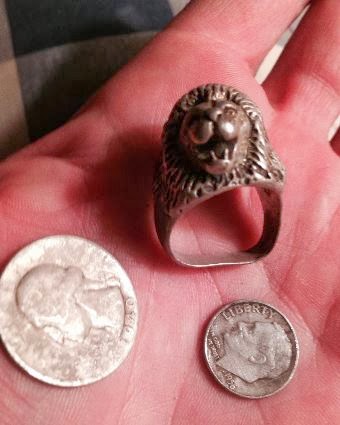 |
| Ring and Silver Coins Found in Yard Finds and Photos by Dan B. |
As I've said before, you don't have to drive long distances to metal detect. Your own back yard can be an excellent place to do a little detecting and add to your skill level.
Dan B., while continuing to learn to use his detector, found these silver coins and ring in his own yard. He says that the finds surprise him since his property has so little history.
You never know to you look.
If you've gone over your yard many times, don't let that stop you. I'll bet you can still get something out of it as you learn new things.
In my previous post I mentioned that about one in five people who detected during November found a cob or treasure coin. During that time period I had a level three rating for a several days.
I've been trying to quantify my rating scale. Those numbers work out well. It appears that what I've been calling level three detecting conditions will give you about a one in five chance of finding a cob or treasure coin on the Treasure Coast.
Roughly approximating, I'll say that with level two conditions the probability would be about `10%, level three detecting conditions would give you about a 30% chance, and level five, a 40% and up chance. Level one conditions would give less than a one percent chance of finding cobs or treasure coins on the beach.
I'll test those hypothetical numbers out in the future and continue to refine my beach detecting conditions scale. It may be a good while before we get level four or five conditions. They don't happen often, which makes it more difficult to quantify. Nonetheless, I've been happy with how well my predictions have worked out so far and how the data has supported my guesses.
One thing I found out in the poll that was summarized in my 11/29 post is that if you found one cob, the probability is very high (about 4 - 1) that you found more than one. That data referred to a time period when the conditions rating as level three for multiple days. I doubt that the probability of multiple finds is as high if the good conditions do not last as long.
I'll address what the poll says about silver cob or treasure coin finds today.
First, the most recently concluded poll confirms my belief that more cobs found on the beach are cobs of smaller denominations.
Of the reales reported found in this poll, it appears that something like two thirds were either half-reales or one-reales. The same number of people reported finding half-reales as one-reales (5).
In previous posts I've shown photos of both half-reales and one-reales found during November.
Two people reported finding two-reales and two reported finding 4-reales.
Only one person reported finding an eight-reale.
It has been my theory that more lower denomination cobs are found on the beach, and that is supported by the data.
I also believe different beaches produce different size cobs. Bon Steel, for example has long been know for it's small cobs. The fact that there is no known shipwreck pile adjacent to the beach might be significant, but many questions remain.
The source of the cobs might also be significant. My theory is that the larger cobs tend to come from the back dunes more than being washed up onto the beach, but that is just a theory with almost no data to either support or refute it. Can it be that it takes more to wash the larger cobs up onto the beach? Sounds like a possibility to me, but I can't say.
Very small cobs, especially small half-reales seem to be washed up not too much differently than shells at times.
I've also commented in previous posts about how under-weight many of the beach cobs are and gave weights for some. It is not surprising that silver cobs corrode and deteriorate in the rough salt water surf. They will not last forever. Some appear to have lost nearly two-thirds of their original minted weight. Of course some are exposed to more hostile conditions, while others remain hidden and somewhat more protected from the rough surf and salt water.
When the back dunes erode, I think more eight-reales will be found. That will more than likely be during level four or five beach conditions.
There is more good poll information that I'll explore in the future.
Here is an interesting article about the lost colony of Roanoke Island.
http://news.nationalgeographic.com/news/2013/12/131208-roanoke-lost-colony-discovery-history-raleigh/
Happy hunting,
TreasureGuide@comcast.net
Tuesday, September 17, 2013
9/17/13 Report - Another Beach Cob Find, Cob Weights and Denominations & Beach Conditions
Written by the TreasureGuide for the exclusive use of the treasurebeachesreport.blogspot.com.
 |
| Another Recent Treasure Coast Beach Reale Find and Photo by William M. |
Yesterday I showed a cob found by William M. He was going through his finds and was excited to see that he had dug another cob.
The one I showed yesterday I'm guessing from the photos might be a Lima half reale. William is going to get it weighed so then we'll have a better idea if it is a half reale for sure.
This one is small and probably a half reale too. It looks like a rather typical beach find. It appears to be a Mexico half. You can tell from the ends of the cross that it was minted in Mexico.
The one he showed yesterday had a bar across the ends of the cross instead of the ball, like this one.
We'll see what if any more we can learn about these cobs. Maybe we'll get some more photos.
 | ||
| One Treasure Coast Beach Yesterday Near Low Tide.
The above is pretty much the kind of thing that you'll typically find around the Treasure Coast right now.
There are several things to notice. One is the sea weed and the sea weed line, which shows that light materials including sand had been coming in. The sea weed line can also tell you where the last high tide was.
On this beach a sand bar that was in shallow water is now pretty much attached to the front beach. In this photo, that would be between the white water and top seaweed line.

The black narrow rectangle shows the approximate area where I was getting miscellaneous targets. The targets were deep, below several inches of sand and near the top of a covered layer of shells.
When you don't know the denomination of a cob, you can often figure it out from its weight. Here are the proper weights for the denominations of silver cobs according to Royal Proclamations up to the year 1728.
8 reales - 27.468 grams 4 reales - 13.734 grams 2 reales - 6.867 grams 1 reale - 3.4335 grams 1/2 reale - 1.7167 grams 1/4 reale - 0.8584 grams As you probably know, cobs were not always made to the proper weight. Many were off when they were minted. But I think you can expect most cobs found on the beach to be slightly under weight due in part to corrosion. That has certainly been my experience. Most of the cobs that I've found in the past were just a touch underweight to considerably underweight. Sometimes you can tell when a cob has lost a lot of material to corrosion by looking at it. Cobs that were minted overweight cheated both the owner and the Royal Hacienda. If they were too much overweight, it would be detected and the entire batch would be remelted, costing the mint and assayer a lot of money. In 1728 the prescribed weights for reales were reduced slightly and stayed the same until 1825. William's cob shown above looks like it has that common black crust on it. Maybe we'll get a photo of the other side soon. Ingrid is in Mexico and Humberto is headed north into the North Atlantic. No other storms appear on the National Hurricane Service maps right now.
 A higher surf of 3 - 5 feet is now predicted for Wednesday and Thursday. Maybe I'll be able to increase my beach detecting conditions rating. Low tide today will be around 1 PM. The high tide will be a little higher than normal. Happy hunting, TreasureGuide@comcast.net |

Tuesday, July 17, 2012
7/17/12 Report - How To Tell The Denomination of a Worn Cob
Written by the treasureguide for the exclusive use of treasurebeaches report.blogspot.com.

Here are four silver cobs, all minted in Mexico, and all from the same 1715 shipwreck beach.
The denomination is visible on only one of the four.
So how do you know the denomination when it is not marked on the cob?
One way that people sometimes use, is the weight of the cob.
An eight reale should weigh about 27.3 grams, a four real about 13.65 grams, a two real about 6.825 grams, a one real about 3.4 grams, a half real about 1.7 grams and a quarter real about .85 grams.
You can't always go by weight though. Besides the fact that it appears that some cobs were not manufactured at exactly the correct weight, some cobs lost significant amounts of silver while rolling around in the salt water and sand.
Can you tell the denomination of these cobs?
From top to bottom is a 2 real, 1 real, half real and another half real.
The top one is the same two real that I showed a few days ago when I talked about the shields.
The last half real has been severely corroded and has lost nearly half of its original weight. In addition to loss of weight, I can tell that it corroded by the loss of detail in the design.
When you can't tell by weight, you can often tell the denomination by the design of the cob, when you can see enough of it.
On the undersized cob, you can make out the cross, which is the type used by the Mexico mint.
There are rare quarter reals that show a cross, but this is not likely one of those. Most quarter reals show a castle on one side and a lion on the other.
On the other side, this one shows a bit of a Carlos monogram. That would indicate that it is an undersized Mexican half real rather than a quarter real.
To sum up the main point, when you don't see a denomination mark on a cob, and can't tell by weight, you can usually tell by any remaining design features. That might take a lot of research in some cases.
My apologies to those of you who read this blog early in the morning. I often have a lot of typos and errors that don't get fixed until later in the day.
There are no storms brewing. The wind is south/southwest. Seas are running about two feet, decreasing later today. No change in conditions predicted.
Here is another surf web site that you might check out.
http://www.swellinfo.com/surf-forecast/fort-pierce-florida.html
Happy hunting,
Treasureguide@comcast.net
Subscribe to:
Posts (Atom)


