Showing posts with label lightening. Show all posts

Friday, September 26, 2014

9/2614 Report - Many Nice Old Metal Detector Finds From Treasure Coast Off-Beach Sites. Lightning Noise In Detectors Lately. GoPro Cameras.


Written by the TreasureGuide for the exclusive use of treasurebeachesreport.BlogSpot.com.


Finds by William M.
Photo submitted by William


If you've been having trouble finding much due to poor detecting conditions lately, there are alternatives to hitting the same over hunted beaches. 

I've noticed more than a few opportunities lately.  On the Treasure Coast it seems there has been a lot of construction and quite a few newly demolished buildings.

Bill M. has been finding a lot of really cool stuff.  He has been getting permission to work on private property.

Here is a photo of some of his finds.  There are a lot of really nice finds there.

Congratulations William!


Notice all of the silver coins in the photo.  Below is an example of one very nice Mercury dime in exceptional dug condition.

If you want to find something old, there is a lot of it out there.  I'd say that only a very tiny portion of the old stuff like this has been found.  Most of it is still out there in the ground deteriorating and waiting to be saved.

Many places have not been worked at all, and many that have been worked still hold many very good targets. 


Very Nice Mercury Dime Found by William
Photo submitted by William


Here is a very nice 1917 dime found by William.  It has about $1.50 worth of silver in it, but it is in very nice condition and therefore worth more than that.

1917 D dimes bring good money.

Very good photo William.

Notice all of the silver coins in the photo above.

You might find the relics even more interesting.

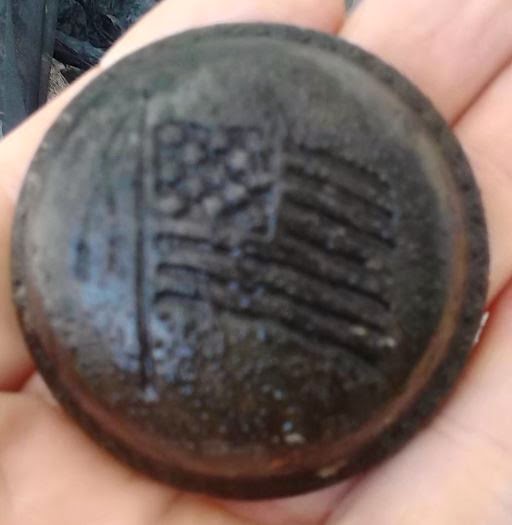
Below is one photo showing some buttons and buckles.


Buckles and Other Items Found by William.
Photo by William.
Charm Found by William
Photo by William.


To the right is a nice charm.  It probably had a personal significance to someone -  maybe a runner.  It would be nice to know more about that.

On the left is also what looks like a hair beret and a thimble.


I've found thimbles on the beach where I'd never expect to find them.  I have a hard time telling how old they might be.  I certainly don't know anyone who uses a thimble. today.   They can be centuries old.


And here are a couple more neat finds by William.


Like I always say, There is always some place to hunt and something to be found.  William did his homework and made a lot of great finds.   Thanks for sharing William.  Way to go!


As I write, it is pouring rain again.  I went outside to play around with a detector last evening and the lightning was causing the detector to beep occasionally, sometimes giving a good "bell" tone, which on that particular detector indicates a good target. 

Lightning can cause noise in a metal detector.  I previously mentioned that one of my detectors had been  noisy lately, and I thought it might be developing problems, but I have now decided that the problem was caused by distant thunderstorms, which have almost always been somewhere around the Treasure Coast lately.   Thunderstorms can cause detector noise even when they are miles away.


Gopro makes a really good waterproof camera.  I use one sometimes, but since it is made primarily for action photography, it isn't what I need most of the time.   It is very good technology though, and I've commented on that.

Gopro went public a few months ago and the stock has gone from 24 to over 80.  That is a nice return.

You'll see Gopro cameras used on some of the detecting, treasure hunting and diving TV programs. 

They claim that they will be making a video channel.  That should be good.


Other than one disturbance out in middle of the Atlantic, there isn't much to watch. 

On the Treasure Coast we are having two to three foot seas for a few days.


I have still have more finds to show and know of one other big project that I can't wait to tell you about.

Thanks for your responses to the blog poll.

Happy hunting,
TreasureGuide@Comcast.net


Saturday, July 26, 2014

7/26/2014 Report - How To Learn What You Might Be Missing With Your Metal Detector: Test Results. VLF Lightening. Water Proofing A Low Cost Detector.


Written by the TreasureGuide for the exclusive use of treasurebeachesreport.BlogSpot.com.

Yesterday I looked at how a relatively inexpensive detector with a target ID display responded to gold items in Coin and Jewelry hunting modes.  Today I'll report on how the same detector (Ace 250) responded to the same gold items in the Relic and All Metals modes.

This picture shows the five sample gold objects that were used in the following tests.


Test Items.  Same As Yesterday.
In the Relic mode the two small rings (1 & 2) showed on the ID display as nickels.   The slightly larger ring (no.3) jumped back and forth between nickel and pull tab.  The largest ring (no. 4) showed up as a pull tab.  The gold bracelet (item 5) showed as a nickel.

So in Relic mode these items showed up very much like they did in the Jewelry Mode.  One difference with this mode as compared to the Jewelry mode is that the jewelry mode would discriminate out lower conductivity targets such as lead and brass that you would actually like to detect in Relic mode.

I'm not going to get into the Custom mode, but will move on to the All Metals mode.

In All Metals mode, the two small rings (numbers 1 and 2) both showed as nickels.  The larger rings (items 3 and 4) both showed as pull tabs.  And the bracelet showed up as a nickel.  

Both of the small gold rings showed up in all four modes as nickels.  The smallest gold ring (item 1) jumped between nickel and foil in Jewelry mode only.  I suspect that if there were even smaller gold rings in the sample, they might have showed up more towards the foil ID.

Coin mode, as useful as it is for finding coins, did not detect the two larger rings at all.  That is a danger with using the Coin mode.  You can miss average size rings.

I thought Coin mode was very seductive.   You could pretty much guarantee you had a coin if it was solid on the coin ID and could avoid digging anything else.  That might be what you want in certain situations.  But the danger is that you could easily get lulled into just picking up coins.   I'm personally not that interested in digging lots of clad coins.  One gold ring can be worth a lot more than hundreds of coins, so I'd rather dig gold.

Coin mode actually did its particular job very well if it wasn't for missing so much gold.  It identified coins very well and eliminated or identified trash.  It was not unusual for trash such as pieces of aluminum cans to cause the ID to jump back and forth between pull tab and dime or whatever. 

The Coin mode would be useful if you are targeting  coins.  It could also be very useful as one step in a Step Search.  I described how to do a Step Search a few days ago.

Using a Step Search, if you don't know what a site holds, you can use coin mode during your first search to get an estimate of the amount of activity at the site and the date of the site from the coins that you find.  At the same time you will also get some sense of the amount and type of junk present even if you don't dig it.   After doing a search in Coin mode, you might then switch to another mode such as Jewelry mode if you suspect the possibility of jewelry, or Relic mode if you suspect the presence of interesting relics or if you decide to clean up the site by removing large iron that might mask other coins or jewelry.  That gives you a few examples about how to use different modes during a Step Search.  It is a very good technique for a site holding a good number of targets.

The three modes other than the Coin mode, identified the larger rings as pull tabs, with the exception of the Relic mode, which showed item 3 as nickel/pull tab.

The gold bracelet was identified by all four modes as being a nickel.

The larger rings were missed completely in the Coin mode and identified as pull tabs by the other three modes.

If you assumed the ID display to be 100% accurate and dug items identified as nickels but not trash such as pull tabs, you would miss about 40% of the gold items in this sample. 

I know this is a small sample of items, but I think the test provides very good information.  Of course there are factors and complexities that I did not take into account here, such as depth and overlapping trash.  That can be for another day.  Of course different detectors will work differently.

You should do these types of tests with your own detector and the types of targets you are most interested in.   I highly recommend testing your detector on a variety of targets.  That is the best way I know of to get to better know your machine.

In the future, I'll post results of similar tests of target ID using other targets, such as treasure cobs.


I've never tried the Ace 250 with the coil in the water but Robb M. has.   It works.  Robb made a YouTube video showing that.  He also made a video showing how to waterproof the 250 control box and ear phones.  Check out Robb's Homemade Life channel on YouTube.  The video he made about an alternative to Disneyworld talks about treasure beach detecting and this blog.

Here is the direct link to the video on water proofing the control box.

https://www.youtube.com/watch?v=r9O3k2lLnO4


We've had a lot of thunder storms lately, and you may have heard the crackle of distant lightening in your ear phones.  And maybe your detector seemed to go a little crazy for a brief time.  Here is an article about the sounds of lightening.

The Earth sings every day, with an electric chorus. With the right tuning, radios can eavesdrop on this sizzling symphony of crackles, pops and whistles — the melody of millions of lightning bolts. ...

With a VLF receiver, anyone can listen to the constant chatter of Earth's lightning, estimated at 8 million strikes every day. (Not every lightning bolt becomes a whistler.)

A worldwide listening network is tuned to one particular lightning sound, called whistlers.

Here is the link for the rest of that article.

http://www.livescience.com/46995-volcano-lighting-whistlers-earth-chorus.html


Absolutely no significant change in beach detecting conditions on the Treasure Coast again.

This is the season to watch for storms and I will be doing that.

Happy hunting,
TreasureGuide@Comcast.net