Showing posts with label pistareens. Show all posts

Tuesday, December 27, 2016

12/27/16 Report - Pistareens On The Treasure Coast Beaches In 1775. T. C. Beaches Today. Scams of Old.


Written by the TreasureGuide for the exclusive use of treasurebeachesreport.blogspot.com.

Douglass Beach Looking North Near Low Tide Tuesday.


Heavily Eroded Fort Pierce South Jetty This Near Low Tide

South Hutchinson Island Around Noon.

Another South Hutchinson Island Beach Near Low Tide Tuesday

There were a good number of beach goers out taking advantage of the warm weather after Christmas.  There were no big crowds or anything, but a more people than normal for the Treasure Coast.

The beaches did not look very good for metal detecting.  There was one beach that had a firm front.  I will take another look at it in a day or two.

---

You are probably familiar with the name Bernard Romans, who published a book in 1775 concerning the natural history of Florida and in the process mentioned shipwrecks observed along the Treasure Coast and including a map.  For those of you who are not intimately familiar the Romans book, I decided to post a couple of excerpts from pages 273 and 274.  Here they are.


Not only did Romans see the remains of the wrecks, but he also made note of the fact that "pistareens" were repeatedly found by those walking the beach after "eastern gales."  He goes on to speculate that more would be found on the wrecks.  Remember, he wrote this in 1775, sixty years after the sinking of the 1715 Fleet.  

Here is the link to a facsimile edition of the book which you can read online.


Romans saw wreckage.  I read somewhere that wreckage besides ballast stones was visible still in the 1940s and 50s.  Today there is little left to see.  A lot of the ballast stones have been removed - some very systematically.

---

Here is another item from the "nothing new under the sun" category.  The email scams you see today were going on long ago - just without email.  The following excerpt is from a 1920 issue of the Washington D.C. Evening Star.
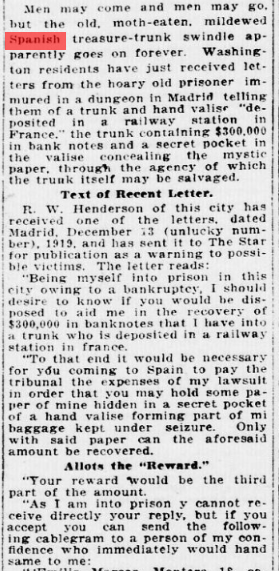


The letter goes on to tell the reader how to receive a reward amounting to one/third the amount stored in the trunk.

Who would guess todays email scams are just updated recycled scams.

----

Happy hunting,
Treasureguide@comcast.net

Monday, September 7, 2015

9/7/15 Report - Great Numismatic Study of Dug Pistareens. Tropical Storm Grace Headed This Way. Ring Beach Find.


Witten by the Treasure Guide for the exclusive use of TreasureBeachesReport.blogspot.com.

Found This Morning On A Treasure Coast Beach.

I went to the beach this morning.  Conditions had not changed at all.  I saw a couple of detectorists on the same beach.  One had done a good bit of the beach before I arrived.  The other arrived later.

People were arriving early for the Labor Day holiday.  There were a few distant showers and a little lightning and thunder.

When the holiday crowds are at the beach, they spread out a little farther than normal from the main gathering spots.

I had just switched from motion mode to non-motion mode, just to check it out, and hit the ring.  It sounded much larger.

I think it is a very good idea to be very familiar and practiced with all the modes that your detector offers.  There are times to use each one.

---

Yesterday I posted Bernard Romans' statement about pistareens being found along the Treasure Coast beaches after Easterly gales.

The coins Romans referred to were not really pistareens.  Pistareens, as the term is more strictly defined, are Spanish coins minted in the old world. In the 1700s pistareens were commonly used in the American colonies along with a variety of other foreign coinage.  Of course, there was no U. S. currency yet.  It would be natural for Romans to refer to the Spanish cobs found on the beach as being pistareens, since they were commonly used in the colonies and had similar markings.

Pistareen 

Mint Marks.

1. Seville
2. Madrid
3..Segovia
4.Cuenca
I found a super study of dug pistareens recovered in the tobacco raising colonies of
America.  Pistareens found by both relic hunters and archaeolgists are included in the study.  Many of of those included in the study were found in Virginia.

This is definitely THE best study of a large sample of dug coins that I have ever seen.  The study was published in the April 2001 The Colonial Newsletter.  The title of the study is When Cross Pistareens Cut Their Way Through the Tobacco Colonies.  The author is Thomas A. Kays.  I posted the link below.

Here are some of the conclusions describing the typical dug pistareen.


It crossed the Atlantic westward as a 1721 dated pistareen minted by King Philip V at Seville.

The coin was used to make everyday purchases in Colonial America before the Revolution • 

It grades very fine having circulated actively for fifteen years and was saved for twenty five. • 

It was cut into quarters for frontier change at a tavern losing 25% by weight to the melting pot. • 

It would have gone to melt completely before the 19th Century had it not been casually lost. • 

It lay undisturbed (save for the pass of the plough) for over two centuries until it was dug up. 

The study includes many illustrations and a map showing where the pistareens were found and a lot of other really good information.  I think you'll want to read this.

Here is the link.

http://numismatics.org/wikiuploads/CNL/Pistareens.pdf

The mint marks shown to the left are from the same linked study.


I'll add this link to my list of reference links on the first page of the blog.


---

t
Tropical Storm Grace.
Grace seems to be following about the same path as Erika.  She is still days away and supposed to decrease to a depression around the West Indies.  We'll just have to watch that one for a while.

The surf this morning was one to two feet.  It looked a little rougher than I expected, but won't change much the next few days.

Happy Labor Day,
TreasureGuide@comcast.net

Sunday, September 6, 2015

9/6/15 Report - Bernard Romans And The 1715 Fleet. Tropical Storm Grace.


Written by the Treasureguide for the exclusive use of treasurebeachesreport.blogspot.com.


You might know the name Bernard Romans.  In 1775 he wrote the book, A Concise Natural History of East and West Florida.  As luck would have it, he turned out to be a well known name in treasure history.  It wasn't his intent.  He wasn't a treasure hunter.  He just happened to mention the shipwrecks of the 1715 Fleet that littered the area around Sebastian River back in the 1770s.

In 1962, the University of Florida Press reprinted his book, and it became a resource that was read by those seeking more information about the shipwrecks and the pistareens mentioned by Romans that were found in the sand after "strong eastern gales."

As is the case so often, history is produced by the alignment of circumstances.  Some moments become highlighted in the story of man - disproportionately so - sticking out in memory like stars in a night sky.   Many more moments, just as important and just as necessary, fade from memory and are never told.  The fact that they fade into oblivion makes them no less important and no less necessary to the flow of events.

Isn't it the little things we do, the countless moments, tasks and dreams that fill the vast space between the few over-remembered times and events that really makes us who we are?

Everyone knows the name Shakespeare, but who actually knows the man?  Who really cares? Is he anymore than a name?  He is not your grandma, brother, wife or son.  He doesn't touch your life like any one of them.   And he doesn't touch other's lives like you do today.

We need statues and monuments,  They may be hollow, but they are shared.  As much myth as fact, they provide the tapestry of human consciousness that unites us with a sense of common story.

Hidden in life are countless precious moments much like gold coins buried under sand. Many remain undiscovered.  They just don't grab our attention at the time.  They are just there.

Maybe moments like that are not important to anyone but you, but that makes them all the more unique and rare.  They belong to you and are to be shared with those you care about the most.  Take the time to seek out those moments, dig them up, hold them, admire them, jump up and down, share, and celebrate, like they were the most precious treasure you ever imaged.

---

I certainly didn't know where that was going when I started.  I'll leave it there for now even though it may seem a rambling meaningless mess to many of you.  It is more me than most of what I write.

Back to Bernard Romans.  He was a historical figure in many ways, though most of us know him for his mention of the 1715 Fleet.  He was a real person - a complex and many talented person at that.  He was a botanist, engineer and participant in the Revolutionary War.

The original printing of his book is rare and valuable.  Those who later used it for research undoubtedly read the 1962 reprint.  The original is that rare.

I highly recommend reading the Introduction to the reprint edition written by Partick Rembert.   It tells a lot about Romans and his work.

You might find much of the book of interest.  Romans mentions other shipwrecks and hurricanes as well as many interesting observations on the nature of Florida at the time.

Here is a link to the complete online book.

http://ufdc.ufl.edu/UF00095971/00001

Here is a sample page.  At the bottom of this page you will see his mention of the pistareens.

A concise natural history of East and West Florida - Page B-273
As you can see, they use "f" for "s."

It is an interesting book.

Thanks to the University of Florida Press for reprinting the book and making it available online.

---

On the Treasure Coast we'll have a one foot surf for the next couple of days.

Fred is sputtering out in the mid-Atlantic.

We now have Tropical Storm Grace that could head this way.  Here is the projected path of Grace.


Happy hunting,
TreasureGuide@comcast.net