Monday, February 7, 2011

2/7/2011 Report - Mystery Artifact, La Galga Shipwreck, & Artifact Conservation


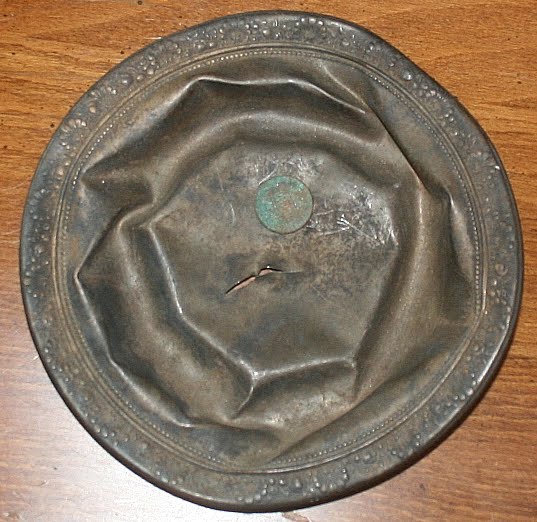
Bronze Artifact Found with Metal Detector on a Treasure Coast Beach.

This item appears to be bronze. If was not broken, it would have a diameter of about four inches and maybe a very slight funnel shape. It has a good heavy fluted rim that varies from about 1/8 to 3/16 inches across. It is a little less than four inches long or deep. The metal on the end opposite the rim seems thinner.

When I first saw it I thought it might be a scupper. I've seen 1715 Fleet scuppers, but the ones I've seen are lead. I've read of scupper liners, but I don't know what they look like.

If you have any ideas what this might be, I'd like to hear your thoughts.


Congratulations to the Packers. I thought the Steelers did a great job this year even though most of the world is probably tired of them. They were supposed to come in third in their own division, but despite all of the suspensions, fines, injuries and everything, they managed to go to the Big One, and even though everyone was picking the Packers, they still made it close at the end.

The difference between winning and losing in athletics and treasure hunting is often a matter of inches. You can miss a TD pass by a matter of inches and you can miss a find of a lifetime by a matter of inches.

Skill is doing things in a way that improves the probability of success. Skill proves itself over the long term even though luck blows one way and then another from time to time. In the long term luck evens out.


I found a good digital book on conservation of artifacts. It is a very complete work that probably tells more than you will ever want to know. It is very technical too.

If you find something that you don't know how to treat, you will be able to find the answers in this book.

Here is the link to that book.

http://www.scribd.com/doc/37695972/The-Archaeologist-s-Manual-for-Conservation-a-Guide-to-Toxic-Minimal-Intervention-Artifact-Stabilization

Knowing how to treat finds can be important. Often you can't see the information on coins or artifacts until they are at least partly cleaned. And if you find something, you want it to last. It is no fun to watch nice artifacts deteriorate.

The book above will tell you how to clean, treat and store all kinds of materials.


A North Carolina man thinks the Spanish wreck La Galga is buried in a marsh on Assateague Island. Despite his evidence, he is having trouble obtaining a permit to explore.

http://hamptonroads.com/2009/04/nc-mans-search-history-lies-finding-la-galga

The Spanish say they have never abandoned any of their shipwrecks. That is easy to say, and it is also laugable.


Forecast and Conditions.

The wind is from the south and the seas are calm so conditions remain the same. There hasn't been a change for quite a while.

The surf web site is predicting calm seas for the next few days, so there is not much immeidate hope for any significant improvement in conditions.


Happy hunting,
TreasureGuide@comcast.net

Sunday, February 6, 2011

2/6/11 Report - Rill Cove Shipwreck & Moving Sand


4 Real From Rill Cove Wreck for Sale on EBay.

Artificial light can give a strange color to photographed items.


I ran across an interesting site concerning the "Rill Cove Wreck," sometimes referred to as the "Lizard Silver Wreck." It isn't a Treasure Coast wreck, but reading about it is instructive and provides information that anyone hunting the Treasure Coast beaches should know.

The wreck remains a bit of a mystery. What is known is that it was a 17th Century merchantman that wrecked in 1618.

The coins from this wreck are Philip II and III Mexico, Lima and Potosi cobs. The cob shown above was originally purchased from Sedwick Coins.

The web site says that the site of this wreck (the Rill Cove wreck) is one af the hardest in the area to work with enormous movements of sand so much so that the site is now totally unaccessible under no less than 20 feet of gravel and sand, surveys identified the extent of the site but soon the sand started to return and within a few months, it was necessary to dig a hole 50 feet in diameter and 15 feet deep to survey one square metre.

Here is the link if you want to read more of the article.

http://www.users.globalnet.co.uk/~travis1/rillcove.htm


I talk about sand and it's movement a lot in this blog. One of the big differences between beach (and water) hunting when compared to hunting on stable dry land is the dynamic nature of the environment. Sand moves in the water almost constantly, and just slightly less on the beach.

Of course the front of the beach moves around the most. The sand on the very front of the beach moves almost as much as that in the water. Sometimes it moves more than the sand in the water, depending upon exactly where and how deep the sand is.

On the beach, the further back on the beach the coins are, the less they will be moved and exposed. It takes very high seas for the water to hit the back dunes in most places. Coins can remain buried in the dunes for decades or centuries before being washed out.

Where the waves hit the front beach with a lot of energy, there is a lot of churning and sifting. You can see that at different times, different types of items will be washed up onto the beach. Sometimes it will be small shells, sometimes rocks, sometimes sand and seaweed, and sometimes coins. You can tell a lot by watching what is being washed up and deposited.

Cobs don't just show up on the beach and then lay there for days, weeks, months or years. Items that wash up can disappear just as quickly as they appeared. Sometimes the open window is a matter of a few hours and sometimes weeks.

I've mentioned before one very good hole that I worked for two days and while I was working it, I saw a front move overhead. The wind changed and the next day when I went back to continue working that hole, where there was a target on every square foot of ground, it had all disappeared. It was that quick - going from more than I could dig to nothing.

That is one thing that caught my attention in the article about the Rill Cove Wreck. Discovery depends heavily upon the movement of sand and being in the right place at the right time. The Jupiter Wreck was discovered one morning when the life guard was out for his morning swim, looked down there was a cannon. He'd been in the same spot before, but this time the cannon had been uncovered.

Before that wreck site was being worked by salvage crews, the beach was giving cobs to a few detectorists that worked that frequently worked that beach. (Let me give a shout out to Dave who worked that beach back in the eighties and who I haven't seen for a number of years. While I'm giving shout-outs, I'll also send one out to Arkansas Bill, who used to travel around in his van and sometimes worked the Ft. Lauderdale beaches in the winter.)

I'm sure there are still wrecks that have not been discovered, simply because no one was at the right place at the right time. And I'm sure there are still good beach spots that are little known or unknown. And I'm sure that some of the dunes are protecting hoards that have not yet been discovered simply because they've been covered by tons of sand for at least the last few decades, if not centuries.

What I often say, and have said in this blog a few times before, is "follow the sand." The sand moves. When it moves, see what if anything it uncovered.


Forecast and Conditions.

Summer beach conditions persist. Unbelievable! I really didn't expect to see such a long period of calm seas this time of year.

The wind is still out of the west and the seas are still calm and will continue to remain calm for some time. It seems we are having a steady stream of fronts and west winds passing through. The low tides are still good and low.

Did anyone get down to work the cut at Juno?

Well, not much of anything to say other than we really need to see a strong northeaster.


Happy Super Bowl Day.
TreasureGuide@comcast.net

Friday, February 4, 2011

2/4/11 Report - Mexican Reales & Crystallized Shells and Fossils


A Guatemala 8 Reales That Sold for Over $35,000.

Photo from web site linked below.

A lot of Mexican coins did very well in the Stacks-Bowers numismatic auction held in January of 2011. The 4200 lots brought in a total of 7.86 million.

A Mexican 1823 MoJM "Hookneck Eagle" 8 Escudos in NGC AU-55 — the first gold coin of the Mexican Republic sold for $35,400.

A Guatemala 1854 A.E. 8 Reales certified AU-55 by NGC,said to be the only 8 Reales produced by Guatemala, sold for $70,800.

Other Mexican coins that did very well included a Proof 65 Pattern 50 Centavos that sold for $28,320, an extremely fine 1784 8 Escudos that sold for $35,400, and a
1860 Au-55 4 Escudos that sold for $30,680.

Here is the link for more of that story.

http://www.coinnews.net/2011/01/24/7-86-million-realized-at-stacks-bowers-numismatics-auction-in-2011-nyinc/

The bad thing about most shipwreck coins, especially silver, is that they usually aren't in very good condition.

The other day I started talking about non-metallic treasure that you can find on Treasure Coast beaches. You might not know about some of the things that are interesting and also can have some economic value.

Crystallized Shells.

Old shells can crystallize. You might know about the famous clam shells that are found at Ruck's Pit, which is up by Fort Drum. It is nationally know for the calcite fossil clam shells that are found there.

I think you can still visit the pit, pay a price and hunt for your own shells.

If you don't know about the calcite clam shells, you can search for them on eBay and learn more about them there, or you can find Ruck's Pit on the internet.

All types of old shells can cystalize and you can find nice examples on some of the Treasure Coast beaches where fossils are found.

Fossil Bone with Crystals Inside.

I've found a fair share of crystallized shells before, but here is something that I never saw before. It is a fossillized mammal bone with crystals inside.

I don't really know if it is really that unusual or if I am the only one that never seen it before. But in any case, I think it is interesting.

Same Fossil Bone.

As you can see there are a lot of things to look for on the beaches. I might show some more of this kind of thing in the future.


Forecast and Conditions.

There isn't much new to say here. Conditions haven't change for a while.

The wind is still out of the south/southeast and the seas are calm, and it looks like they will remain calm for several more days.

The low tides are really nice and low. That is one of the few positives I can mentinon.

I know from my email that some of you have been hitting the low tides and digging up some stuff.


Just added Friday evening: Tilin F. says there is a big cut down at Juno Beach


Happy hunting,
TreasureGuide@comcast.net

Thursday, February 3, 2011

2/3/11 Report - Flat Seas, Porpoises, Fossil Sand Dollar, and More


Flat Sea and Fishing Boats Off South Hutchinson Island This Morning.

Looks more like August than February.

It seemed like the fishing boats were all heading south of Fort Pierce this morning.

The beach looked like it was August too. The beach was accumulating sand. South and Southeast winds will tend to do that.

I didn't really see any beach spots worth detecting. I only took a look at four spots though. I suspect, but don't know, that you'll find the same type of thing all along the Treasure Coast.


The fishermen weren't the only ones out fishing today.

Not a Shark.

I saw three porpoises. (They say porpi some places.) They were right over the Nieves wreck site.

Like I said, the beach conditions were poor. In one place the new sand was about fifty yards east of the old cut. That is a lot of sand.

As a result, I did some eye-balling. There were some shell piles, but I didn't see any pot shards or much of anything like that.

I did find a fossil sand dollar. Sand dollars are not at all uncommon, but this is the first fossilized one that I've found.

Fossil Sand Dollar.

There were some calcite crystals in the matrix attached to the back of the sand dollar.

Since non-metallic finds were more prevalent today and may continue to be for a while, I thought I'd show this and maybe some other types of things in the near future.

Here is one web site where you can take a look at a variety of things like this for sale.

http://www.mcculloughfossils.com/

Of course there are many more sites where fossil sand dollars are for sale, I just thought this one showed a good variety of things that you might want to be familiar with.


And here is the web site of one shipwreck salvage group. The site has a lot of interesting things to look at. It talks about some of the wrecks they have worked, and they also have a photo gallery showing a lot of nice artifacts, as well as artifacts that are for sale.

You might enjoy browsing it.

http://shop.alldeepblue.com/main.sc

I've already talked about the current conditions. It looks like there won't be any change in beach conditions real soon. The seas are predicted to remain flat for several days.

The flat water does make it easy to do some shallow water hunting if you are someplace where you can do that. The low tides are also going to be good and low, which helps.

Well, there are a variety of things to hunt, and there is always something to be found.

Happy hunting,
TreasureGuide@comcast.net

Wednesday, February 2, 2011

2/2/2011 Barrel Hoop, Fisher Finds & Coin Lines and Holes


Barrel Hoop Remnant From the Santa Margarita.

I noticed this barrel hoop from the Atocha for sale on eBay. A lot of people pass up rusty looking items like this, but they can be worth something. This particular barrel hoop already was bid up over $250 and will probably go up much more.

Part of the value comes from the fact that it is known (as well as can be) to come from the Santa Margarita. Another part of its value undoubtedly comes from the certification of authenticity and Mel Fisher's autograph.

A few days ago I wrote about keeping good records on your finds. Even rusty old things can sometimes have value when you are able to establish where they came from, especially if the source happens to be an old shipwreck.

The barrel hoop also was attractively displayed in a framed case. That helps.


Someone wrote in asking what are the characteristics of the coin lines and coin holes that I have been talking about.

Both coin lines and coin holes are concentrations of coins that have either been washed up onto the wet sand or washed down to the wet sand from high dry sand. They occur when the wave action washes away sand and sifts and deposits the coins in the wet sand area. Other items besides coins are often found in coin lines and coin holes, but there are more coins.

A coin line is formed when the coins are deposited in a long line which runs roughly parallel to the waterline. I've seen coin lines up to over one hundred yards long although they are more typically closer to 10 or 20 yards long.

Coin lines can be either narrow or wide. When wide, the lighter coins like zinc pennies are most often higher on the bank. That is especially true when the erosion is near the water and the coins come from the water rather than the higher sand. Quarters and heavier items, such as gold are more often lower on the bank.

The coins in long coin lines are usually not as close together as those in shorter lines.

Coin holes, rather than being shaped like a line or band, are oval shaped distributions of coins. Lighter objects in coin holes usually are found more at the upper edge and ends with the heavier objects found closer to the middle of the hole.

Of course, coin holes also vary in density.

I've talked before about how you can scan a beach to find any possible coin lines and holes, and I've also done posts on to work each.

A nice densely packed coin hole is a good place to find gold objects.

Coin holes are also found in the water. When that is the case, the target of primary interest will be gold objects.

When there is a good sifting due to the wave action, gold will generally be found lower and deeper than coins whether it is in the water or in the wet sand.

Often there will be a deep layer of dense material such as clay or rocks that traps the gold and keeps it from sinking deeper.

A rock bottom can be very hard to work and almost impossible to use a regular scoop.

A good hole over a densely packed rock bottom can be a very productive place to work. A clay bottom is about as good.

I've talked about how to work a water site having a packed rock bottom before too.


News from the Mel Fisher Group.

This week the crew of the Magruder found a rare early 1600 2-reale and 3 eight-reales while working on the Atocha.

Three iron spikes, 4 iron nails and a variety of unidentified encrusted objects were also found on the trail of the Atocha.

People have been sending me pictures of a bunch of mystery objects. I have a few more to show too in the future.

I've been told that other people enjoy them as much as I do.


Forecast and Conditions.

The wind is from the south. The beaches aren't very good for finding shipwreck treasure.

With the calm seas and low tides it wouldn't be a bad time to be in the water. I know someone will ask where they can and can't hunt in the water along the Treasure Coast. I've posted photos of the leased shipwreck sites along the treasure coast and also posted the applicable rules and regulations, so if that is what you are wondering about, you can use the search box for this blog and you will find most of that information.

In the most general terms, anywhere there is a leased treasure ship salvage site, you can't detect in the water. That is the most detail I can give on that right now.


Happy hunting,
TreasureGuide@comcast.net

Tuesday, February 1, 2011

2/1/11 Report - Star of Lima 8 Reale & Low Energy Beaches


1659 Star of Lima Eight Reale.

Just a really neat coin that very well illustrates the coins of Lima during the early period. It seems there are a gazillion variations.


One person who metal detects in South Florida recently wrote and said that the beach he has been hunting does not show any pattern of coin distribution in the wet sand. He said that the targets were distributed randomly like in the dry sand. That was a good observation.

I know the beach he was talking about very well. That beach is bordered by very shallow water that runs for a hundred or more yards off shore. And the beach there does not often erode because the waves decrease before hitting land.

When you don't get much wave energy on a beach for whatever reason, you won't often find either coin lines or coin holes developing. In those circumstances, the coin distribution will be pretty much the same in both the dry and wet sand because you do not have the waves stirring things up and sorting things out.

As you observe beaches over a long period of time, you will learn where coin lines and holes tend to develop. The first thing you need for a coin line or hole to develop, is a target rich area. You can't get a concentration of coins unless there are coins in the area to begin with. That is obvious. It is not necessary that the targets be from recent years. They could have been deposited when the beach was more heavily used and less heavily detected some time in the past. Some of the best spots that I've found were on beaches that were used in past decades but were abandoned in more recent years.

The second thing you need is a source of accumulated targets that can be affected by the level of wave energy that is unleashed on that particular beach. Too much sand over the source, too steep of a drop off next to the beach, or too little wave energy on the beach can prevent formation of coin lines and holes.

Certain spots will repeatedly develop coin lines or coin holes while others seldom will. Once you find a spot that develops lines or holes, it can be worth repeatedly checking that area. Coin lines and coin holes will often replenish when the conditions are right.

At some spots it takes more extreme wave conditions to create a line or hole. And spots will replenish more frequently than others.

I am not suggesting that you avoid areas that do not have coin lines or coin holes, but when there are holes or lines forming somewhere, you will often find it more productive and more time-efficient to hunt those areas rather than most other areas.


Oliver Hazard Perry's ship, the USS Revenge, may have been found. That is what one diver thinks.

Here is the story.

http://www.huffingtonpost.com/2011/01/08/uss-revenge-shipwreck-fro_n_806177.html


Not too long ago I showed a strip of lead sheathing that had a checked pattern on one side. One report that I recently read said that lead sheathing was sometimes mounted over a layer of course cloth and the pattern of the cloth could be seen on the sheathing that was salvaged. I wonder if that could be the cause of the pattern on that strip of lead that I showed? Possible, I guess, but who knows.


If you have an Atocha emerald that you want to sell, someone on Craig's list is wanting to buy one.

Here is the ad that LB sent me.


WANTED: Emerald from Atocha shipwreck (melbourne)

--------------------------------------------------------------------------------
Date: 2011-01-30, 9:42AM EST
Reply to: sale-xb4hd-2187963434@craigslist.org [Errors when replying to ads?]

--------------------------------------------------------------------------------

Looking for a reasonably priced emerald salvaged from the shipwreck Atocha (mel fisher) to compliment my Aotcha coin


Forecast and Conditions.

The wind is out of the southeast and the seas are calm. It looks like they'll stay that way for at least a few days. That means no significant change in conditions real soon.

I did get a look at a few beaches this morning. Most were very sandy. The beach south of the Fort Pierce lost a foot or two of sand sometime in the last few days but was filling in again.

Oh well.

Happy hunting,
TreasureGuide@comcast.net

Monday, January 31, 2011

1/31/2011 Silver Plate Find & Value of Keeping Metal Detecting Records


Old Silver Plate Found with Metal Detector.

I found this silver plate a number of years ago. The penny in the plate is for size comparison.

Since the time the plate was found the price of silver has gone up nicely and now the plate is worth about ninety dollars in melt value.

I personally value the plate higher than that as an interesting artifact and would never melt it down, but with current metals prices these days it is worth digging things like this.


I ran across some of my old records the other day. Unfortunately I only found two pages and the year wasn't marked on those pages,but I know those records are from when I first started detecting. Even though I kept fairly detailed records, I wish I would have kept more detailed records. It was fun looking at what them anyhow.

If I was starting out again, I would keep better records. I'd recommend that you consider keeping good detailed records of your finds. It can help you determine things like the most productive hunting areas, what things you are finding when using different detectors, and if you keep really detailed records, what detector settings are working best for you under specific conditions.

When I first started I was primarily keeping track of the number of coins I found. After a few months, I see that I added information about where I hunted, including if I hunted the wet sand, dry sand, or in the water, and descriptions of any jewelry or other interesting finds.

I also recommend adding the detector used and the settings used, but I doubt that many people are that detail oriented. The information could be useful if you have the discipline to keep it though.

One Page of My Old Metal Detecting Records.

Just to see the percentage of different types of coins found, I took my total from one place in my records where I totaled 8978 coins found. Doing the math revealed that at that point, about 18% of the coins were quarters, 21% dimes, 12% nickels, and 48% pennies.

Unfortunately I don't know what detector I was using then, but since the records are from shortly after I started, I would guess that I was probably using my Fisher 1280 Aquanaut.

Later I started keeping track of jewelry items and their approximate value. That can be a very important statistic because even though some places produced many jewelry items, there were places that produced fewer but much more valuable items. One good piece of jewelry can be worth more than a dozen lower quality pieces. Since some places tend to produce more valuable items, you have to make a decision whether you want to go for quantity or quality.

I knew one place where I could almost always find a some type of jewelry, but it was never the highest quality. I usually decided to go where I could find the higher quality items even if it took longer.

Good records can help you make decisions like that. As they say, past results do not guarantee future returns, but knowledge help you make more informed decisions.

Of course many factors go into determining your level of productivity and you have to take many factors into account if you want to make the best decisions. One very big factor is current conditions. No matter what a particular beach has produced in the past, you should consider present conditions.

Besides keeping paper records (a spreadsheet would be a good idea but has some disadvantages too), I also regularly took photos of jewelry or other interesting finds. That is helpful in a variety of ways, especially if you keep them in a safe deposit box, which I highly recommend.

I can't understand all of the codes on my records now, so if you want to be able to look back and decipher your records, be sure to make them clear.


On another subject, if you have a bunch of finds to store, separately wrap them. Silver and other metals stored together can leach and discolor. Of course, you don't have to worry about that with gold, but other metals, especially if they are corroded or tarnished, should be individually wrapped.


One person sent an email asking about a rock that they found. I responded to their email only to have my response kicked back. I generally respond to emails but sometimes something happens - sometimes due to technology.


Forecast and Conditions

The wind is from the east today, but the seas are very calm. It might be a good time to get in the water. Smooth water is easier to work, although not always the most productive.

It looks like conditions won't change much for the next few days.

I haven't been out lately, but will have to get out there just to look around.


Happy hunting,
TreasureGuide@comcast.net