Showing posts with label fossils. Show all posts

Saturday, July 4, 2020

7/4/20 Report - Independence Day Greetings. Things That Can Not Be Burned.


Written by the TreasureGuide for the exclusive use of treasurebeachesreport.blogspot.com.

July 4th Postcard
Circa 1906.
---

Researchers at the University of Hong Kong have built a drone capable of seeking out gemstone deposits and fossils at night using a laser. The drone uses a scanning laser to react with fluorescents in the various objects that can later be detected in processing.


The researchers, Thomas G. Kaye and Michael Pittman, found during experiments that laser-stimulated fluorescence (LSF) would react and begin to glow under laser light. The drone detects the glowing objects in the ground by recording a video. 


To ensure it can detect even small fossils, minerals, organisms, and archaeological artifacts, the drone is flown 4 meters (13 feet) from the ground, enabling it to detect objects of interest as small as a thumbnail...

For more of that article about how to use drones to find fossils and gemstones, here is the link.


---
Troops at Bailey's Crossroads on Nov. 20, 1861
Source: See WashingtonPost.com link below.


Yesterday I couldn't help but be reminded of my friend Larry Persina, who passed away a few months ago.  His birthday was July 3, and his favorite holiday was always the fourth of July, but I also got word of the passing of another relative who was always part of our 4th of July family picnics as far back as the 1950s.  Those picknics were very much what you would expect for that time in history.  

Yesterday, receiving sad news and yet being filled with fond memories, ended for me around mid-night listening to the Battle Hymn of the Republic as it was being sung in front of Mount Rushmore.  I was filled with awe and grateful for the everlasting assurance of those who had departed.

The last verse of the Battle Hymn was originally written as follows:

In the beauty of the lilies Christ was born across the sea,
With a glory in his bosom that transfigures you and me:
As he died to make men holy, let us die to make men free,
While God is marching on.


The words are too challenging for some, and the second phrase of the third line is sometimes changed to read "let us live to make men free," or "let us fight to make men free."  But there are those who have died to make men free.

One interpretation of the hymn is that it is about the judgment of evil at the end of time. It is based on the Book of Isaiah and the Book of Revelation. The enemy is spiritual as well as physical.  The melding of Biblical imagery and the Civil War is truly amazing if you take the time to study each.

See https://literarydevices.net/the-battle-hymn-of-the-republic/

Written in Nov. of 1861 by Julia Ward Howe in the predawn hours after reviewing the troops at Bailey's crossroads the day before, the lyrics were written to the tune of John Brown's Body.

Howe's words show the keen intellect and penetrating sensibilities of an accomplished author and poet who was fluent in several languages, and who fought for causes including the abolition of slavery and women's rights.  Analysis of both the lyrics and the author's accomplished, complex and troubled life would be fruitful endeavor for any honest student.

On June 8, 1968, as the 21-car funeral train bearing the body of assassinated U.S. Sen. Robert F. Kennedy from New York to Washington crept through Baltimore, a lone mourner in the crowd began slowly singing, Mine eyes have seen the glory . . .

Others in the throng of stricken bystanders picked up the lyrics and the melody singing

Glory, glory, hallelujah..


Many old hymns have amazing inspiring stories behind them.

For me a day that started with sad news ended with many memories and a deep sense of contentment.

---

Here is a really good web site that provides access to a broad range of resources for historical research.  For example, for the Civil War you will find the contemporary Harper's Weekly issues describing the progress of the war, but other periods of history are included.

http://www.sonofthesouth.net/

---

Tropical storm number 5 is heading out to sea and away from us.


Wishing you a deep and happy fourth of July.
TreasureGuide@comcast.net


Tuesday, June 30, 2020

6/30/20 Report - Calm Surf and Sandy Beaches. Treasure Coast Fossils. Fishing Artifacts.


Written by the Treasureguide for the exclusive use of treasurebeachesreport.blogspot.com.


Typical Sandy Treasure Coast Beach.


The Treasure Coast beaches have been accumulating sand for weeks now.  In the photo you can see where the waves are crashing on a sand bar and then washing sand in, during high tide, up on the beach.

Waves Breaking on Bar

If there is a dip inside the bar, the waves will break on the bar and then disappear if the dip is deep enough.  Where there is less of a dip, the waves will continue in.  You can easily look out and see where the dips are.  


Waves Breaking on Sand Bar.

The dip shown in the above photo had a lot of loose sand and shells in it.  The water was clear and you could see what look like waves of sand on the bottom.  It was far from washed down to bedrock.


John Brooks Beach Yesterday Morning.

---

Recently I posted a photo of a fossil snake vertebra that I found on a Treasure Coast beach.

Here is an article discussing the evidence that men ate snakes long ago.  Notice the reptile vertebra  pictured in the article (below).


Source: LiveScience.com link below.
Here is the link.

https://www.livescience.com/ancient-humans-ate-snakes.html

---

Here is another small fossil vertebra found on a Treasure Coast beach.  It is in great shape and is very different than the snake vert.  I don't have any idea what type of animal it might have come from.


Two Views of Small Fossil Vertebra 
on US quarter for size comparison.

If anyone can tell me the animal, I'd love to know.  It doesn't look like the fish verts that I'm familiar with.

---

Here are a couple stone-age fish hooks found at an inland site that was once a lagoon.  Between 1932 and 2020 the land was drained.  You can see that the fishhook that was excavated before the land was drained is in much better condition than the one excavated from the drier earth.


Source: See ScienceNorway link below.


Here is the link for the article about the excavation of fish bones and fishing artifacts from a stone-age site.

https://sciencenorway.no/archaeology-history-stone-age/archaeologists-have-found-astonishingly-well-preserved-gear-from-a-fisherman-who-lived-5000-years-ago/1705054

---

As they mentioned on the Dino Hunters TV show, bones have to have the right conditions to fossilize.  After an organism's soft tissues decay in sediment, the bones are left behind. Water seeps into the remains, and minerals dissolved in the water seep into the spaces within the remains, where they form crystals.

---

Source: nhc.noaa.gov

An area of low pressure off North Carolina has a small chance of developing into a cyclone in the next 48 hours, but it is expected to head northeast.

The surf remains small on the Treasure Coast.

Happy hunting,
TreasureGuide@comcast.net


Thursday, June 25, 2020

6/25/20 Report - Treasure Coast Historic Places - Fort Pierce Casino and Sea Mist. Some Recent Fossil Finds.


Written by the TreasureGuide for the exclusive use of treasurebeachesreport.blogspot.com.


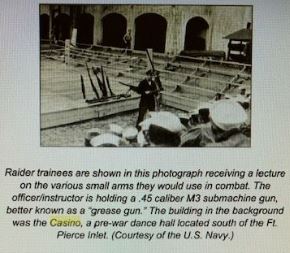
Fort Pierce Casino
Submitted by GM.

I received the above postcard image of the Fort Pierce casino from GM, who also sent the following picture of the casino being used during WW II. That caption refers to the casino as "a pre-war dance hall located south of the Ft. Pierce Inlet."


Thanks GM.


Nick, who sent the following pictures of the casino said, The casino was right where you make the left curve into ty he now jetty parking lot. 


Fort Pierce Casino (Bottom Right)
Submitted by Nick.


Fort Pierce Casino
Submitted by Nick.

Thanks Nick.
---


Guapo (GM) also sent me the following photos and captions showing the Sea Mist.  Sorry if it is a difficult to read, but you can see the original source - the Vero Beach Press Journal.


Thanks again GM.

---


Recent Beach Fossil Finds by Timothy M.
Photo submitted by Timothy M.

Timothy M. recently found the above fossils and sent the following message.


Hello again. My wife and I were out around low tide Monday afternoon just walking some beaches cleaning up trash and doing some eyeballing. She has an eye for sea glass and picked up a few nice greens. I had been talking about fossils when just north of middle cove I found a small bone with a joint, leg, wing? Little later on at the north end of Walton rocks, she found this nice dark black bone fragment with visible marrow! She trumps me again.

Your blog always encourages people to think above lost human treasures. We had a great time wondering about the origin of these obviously truly ancient objects.

Once again thanks for sharing your knowledge and joy of discovery.

Thanks for sharing Timothy.  Glad you enjoy the various types of treasure that can be found on the Treasure Coast beaches.

---

On the Treasure Coast the surf is still small, but we have some negative tides.

We are getting some dust from the Sahara dust storm.

Happy hunting,
TreasureGuide@comcast.net


Wednesday, June 17, 2020

6/17/20 Report - Florida's Most Collected Gems. Fishing For Treasure.


Written by the TreasureGuide for the exclusive use of treasurebeachesreport.blogspot.com.

Florida Calcite Fossilized Clam Crystals.
Calcite crystals in fossilized clam shells are said to be the most collected Florida gems. I've talked about that and Ruck's Pit in previous posts but decided to make a few photos after finding one of my photos being used by Google or Bing or whoever it was describing fossilized shells.  They didn't give credit either, so they used copyrighted material without any mention whatsoever of the source.  But the photo was good, and evidently useful, so I thought I'd make a few more.


An internet search showed the photo below, which was originally posted in the above post.  It was made using ultraviolet light to show the fluorescence.  It wasn't an easy photograph to capture.  I guess I'll have to learn to label my photos better.

Fossilized Shell With Crystals Photographed in Ultraviolet Light.

Geologyin.com says, The calcite geodes [at Ruck's Pit] were also of special interest, as they had formed as large aggregations of dogtooth spar growing inside fossilized clams (bivalve mollusks) and whelks (gastropod mollusks). As far as is known, this type of dogtooth spar geode is unique to the Fort Drum Mine.  However, I've found them on Treasure Coast beaches. In fact, the one shown immediately above was found on South Hutchinson Island, and it is far from the only one that has been found there.


I even once showed crystals that formed in the hollow of a fossil bone.

Here is one more photo of a crystalized shell that I just took in natural light.

Fossilized Clam Shell Crystals.
---

Here is a link to a good article about the damage done by fish trawlers to shipwreck sites and the items that come up in the nets.

https://www.academia.edu/3597737/Sean_Kingsley_Out_of_Sight_Out_of_Mind_Fishing_and_Shipwrecked_Heritage?email_work_card=view-paper

Here are just a couple examples from that article.


Not only do the trawlers bring up the kinds of things you might expect. like olive jars and pottery, but also heavy and large things like cannons.

---

There is a fairly large statue of a mermaid in the Indian River that is not very recognizable because it is covered with oyster shells.

---


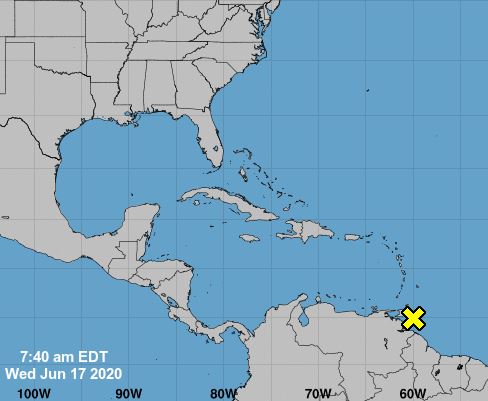
Source: nhc.noaa.gov

As you can see, there is a new system down by South America that could develop.  It is that time of year.

On the Treasure Coast today the surf is very small - only one or two feet.  The tides are not big, and the primary swell is ENE.

Happy hunting,
Treasureguide@comcast.net

Sunday, June 14, 2020

6/14/20 Report - More Fossils: Mammoth and Bison. Ancient Off Shore Channels.


Written by the TreasureGuide for the exclusive use of treasurebeachesreport.blogspot.com.

Newspaper Clipping Telling About Mammoth Find by Randall S.
Submitted by Randall S.

I got some emails in response to my post on fossil finds.  Randal S. sent me this newspaper clipping showing his Mammoth tooth find.  And below is a tusk to go with it.

Randall S. With Mammoth Tusk.
Submitted by Randall s.
Great finds Randall.

I understand that Randall, since moving to Florida no longer sports the "mountain man" look.  Looks good to me, but probably not for the hot weather.

There have been mammoth tusks found by treasure salvage crews and I have seen them sold in a Sedwick auction.

---

Bison Joint with Hole.
Find and photo by Kurt R.
Kurt R. sent this photo of a bison joint with a hole in it.  It was found at Rio Mar about thirty years ago.  The indigenous peoples often split bones to get the marrow.  If you look closely, sometimes you can see how a hole was drilled.

Thanks Kurt.

I've seen a number of fossils from the Rio Mar area.

---

DJ, who went to the Peace River suggested that a beach scoop might work better than a shovel for digging fossil material.  That sounds good to me.

One of the advantageous of doing different kinds of hunting, is the creativity that comes from transferring knowledge and methods from one kind of hunting to another.  That is one reason I recommend investigating different types of hunting.

---

While on this subject of fossils, Dino Hunters is a new TV series that will premier on the Discovery channel, June 19 at 9PM.   It could be good.  I hope they keep it real.

You can find old fossils on the Treasure Coast, but no dinosaurs.

---

Here is a link that will take you to a collection of papers.  Marine Aggregates and Prehistory is only one of them.  Several of the others discuss wrecks.

https://www.academia.edu/2068779/Marine_Aggregates_and_Prehistory?email_work_card=view-paper

In the Marine Aggregates and Prehistory article I found this illustration showing a paleo-channel.


The seismic analysis shows a filled channel.  In fact there is a smaller and even older channel very nearby.

As you probably know, our coastline has changed a lot since the ice age.  Florida was once much larger and coastal ancient coastal settlements are now submerged.  There are submerged archaeological sites like the one off Venice Florida, and there are channels made by streams that are now covered by the ocean.

If you watch Bearing Sea Gold, you probably noticed how some of the teams were working old channels miles off shore.

Don't forget that our coastline was much farther out than than it is now, and the entire landscape extended out quite a ways.  Some channels created in the distant past are now filled with sand or other materials but they can be identified.

---

There is not tropical activity of any significance.

The surf will remain around two feet, and the tides are small.

Happy hunting,
TreasureGuide@comcast.net

Tuesday, June 9, 2020

6/9/20 Report - Fossilized Sea Shells. Fenn Treasure Found. One Mistake I've Repeated.


Written by the TreasureGuide for the exclusive use of treasurebeachesreport.blogspot.com.

Fossil Shells.
Photo and Find by Melissa B.

I received these photos and the following email from Melissa B.

I found your article on fossil shells with unique crystals yesterday. I was searching the internet after some interesting finds I stumbled across with my kids in an estuary in Florida. These shells were exposed after the heavy rain we’ve had and I believe they were brought in with the parking lot fill. They were all in the parking lot area of the estuary especially in the eroded areas from heavy rain. Here are pics of what we found. Can you help me to identify? There were some interesting crystals on a few of the shells also.

Fossil Shell
Photo by Melissa B.

I've done a few posts on fossilized shells.  Here are a couple.

https://treasurebeachesreport.blogspot.com/2015/05/52815-report-unique-beach-treasures.html


Fossilized shells can be fascinating treasures.  Some are fluorescent and some have nice gem crystals.

---

As I reported yesterday, the Forrest Fenn treasure has been found.

Millionaire art collector Forrest Fenn was told he would die of cancer in 1998. And wanting to leave his mark on the world and help others get into the outdoors, he devised a plan: Fenn decided he would take his 10-by-10-by-6-inch bronze Romanesque chest and load it with his best treasures — ancient jewels, gold, jade, diamonds (now estimated to be worth 2 million dollars)—take it into the mountains, and die beside it.

But, before dying, he would “architect” a poem that, if solved, would lead an explorer exactly to the treasure.

A twist of good fortune kept Forrest alive, and he now resides in Santa Fe where he writes books, gives hints, and frequently engages with those on the chase.

That comes from this Fenn Treasure web site (link below).


Forrest Fenn received the treasure of life for more years than maybe he was expecting.  Despite the prognosis, Fenn is still alive, and has mixed feelings about the treasure being found.

It took years for the puzzle to be solved and the treasure found.  It undoubtedly took a lot of persistence to solve that problem.

The person that found the Fenn treasure has chosen to remain anonymous.


A treasure chest full of gold, jewels and other valuables worth more than $1m (£790,000) is said to have been found in the Rocky Mountains.

Antiquities collector Forrest Fenn says he hid the bronze chest more than a decade ago, creating a treasure hunt for people to find it.

Thousands of people searched for it, many quitting their jobs and using up their savings. Four people died.

Now, Mr Fenn says, a man from "back East" has finally tracked it down.

"It was under a canopy of stars in the lush, forested vegetation of the Rocky Mountains and had not moved from the spot where I hid it more than 10 years ago," Mr Fenn, an 89-year-old millionaire from New Mexico, said in a statement...


Here is the link for more about that.

https://www.bbc.com/news/world-us-canada-52966449

It took ten years and a lot of persistence.

The Rockies offer many treasures, natural and otherwise.

----

I'll describe one more of my mistakes today.  I often learn from my mistakes, but some take more repetitions than others.

This mistake doesn't apply to small finds like coins, but this is a mistake I've made more times than I care to remember.

When walking a long distance and expecting to return the same route (along the shore, for example), I'll often leave larger finds to pick up later when I am on  my way back.  Several things can happen.  One is that I get focused on my metal detecting and pass up the item on the way back.  That is easy enough to do.  Someone else can also find the item, but sometimes I just forget about it on the way back.

One thing I often do is take the item up to the dunes and put it where it is not likely to be noticed. Since there is a good chance I'll have my nose to the ground on the return trip, some kind of marker can be helpful - maybe a big line in the sand a pile of stones or something that.   A rising tide or big wave can remove a line or move or obscure other markers, so that doesn't always work out.

If the item is very good, don't take any chances.  When you really don't want to take a chance on losing an item, it is better to not leave it behind.  Too many things can happen.


You can find some pretty big things.  I once carried this six-foot iron anchor on my shoulder a couple hundred yards and up over a high dune.  I wouldn't even attempt it today.

---

Wednesday the surf will still be small, but later in the day it will start to increase.


Defund the criminals.

TreasureGuide@comcast.net

Sunday, June 7, 2020

6/7/20 Report - Meaning and Folding of Burial Flags. Being Prepared for Larger and Different Kinds of Finds. Cristobal.


Written by the TreasureGuide for the exclusive use of treasurebeachesreport.blogspot.com.

Source: http://wvutoday-archive.wvu.edu/resources/1/1251677894.jpg

With the current controversy regarding showing respect for the flag, I thought it would be helpful to actually look at some of the symbolism and significance of burial flags and memorial flags for veterans.


Here is an excerpt from one site.


Here is how to understand the flag that laid upon it and is surrendered to so many widows and widowers: Do you know that at military funerals, the 21-gun salute stands for the sum of the numbers in the year 1776?

Have you ever noticed that the honor guard pays meticulous attention to correctly folding the United States of America Flag 13 times? You probably thought it was to symbolize the original 13 colonies, but we learn something new every day.


To understand what the flag draped coffin really means.
  • The 1st fold of the flag is a symbol of life.
  • The 2nd fold is a symbol of the belief in eternal life...


Etc.

Here is that link for more.


---


A few days ago I started a series of posts on mistakes I've made after finding an object.  The first one that I discussed was having a hole in your pocket or goodie bag resulting in finds being lost before getting them home, and the second mistake that I already discussed was damaging an object during recovery, for example hitting it with your scoop or digger.   I'll discuss the third mistake today, which as to do with bottle finds.

Before starting with that new mistake though, I just remembered another example that fits in with the hole in pocket or bag mistake.  One day there were a lot of fossils on the beach - some of them being large. A few of them were a foot long, and some were heavy.  It was an unusual occasion.  I've only seen so many and such large fossils on the beach that one time in many years.

I wasn't planning on hunting fossils that day and had never found so many.  As a result, I got caught unprepared.  It caught me by surprise and all I had with me to use was some plastic shopping bags. Not only were some of the fossils large, but some were also pointed.

As I gathered fossils like a kid picking up Easter eggs, I stuffed them into my bag, which eventually broke, and some of the fossils came out as I walked far down the beach.  I lost some good fossils before I discovered that one of my bags broke.  I learned from that experience that it is a good idea to have some large and sturdy bag or container with me.  A back pack, big sturdy bucket or something like that can come in very handy.

Think about it.  If you ever come across that treasure chest or cache of silver bar that you always dreamed of finding, how are you going to carry it?   It won't fit in your pocket, and if you plan to come back for it later, you might be disappointed about how that works out.  It isn't like you are out in a remote location where there are no other people or where there are no tides or waves or anything.  The beach is not a good place to leave finds with the hope of retrieving them later.  A big heavy duty bag, bucket or container might save you.

Obviously you can't be prepared for every situation, but you might keep things in your car that might come in handy.   I have a large (about three by four feet) heavy duty bag  that I keep in the trunk of my car.  I've carried some big heavy stuff in that bag, but there are times when even that would not do the job.  You might not always need something like that, but you don't want to lose your best find just because you weren't prepared for something bigger or heavier than you expected to find.

Now I'll get back to the mistake that I planned to discuss today.  It is related - not having some materials for padding or packing fragile items.

One of the great things about treasure hunting, is that you never know what you might find.  The first time I found some good old bottles was after Hurricane Andrew.  That was my first experience collecting old bottles. I was metal detecting, when I noticed some old bottles rolling in the surf.  I took a look at some of them, and they were embossed and appeared to be old.  I didn't know much of anything about old bottles at the time, but decided to collect them.  Of course, that wasn't what I was thinking of doing when I went metal detecting that day, so I was totally unprepared to carry back a lot of old bottles.  I found some old plastic bags laying in the trash along the beach and used those.  They worked on that occasion.  I sold some of those bottles but still have a few of them.

Plastic bags aren't great for carrying old bottles or other breakable items though.  One day when I found some good bottles, I had a couple plastic bags along with me, and filled two or three bags.  I had two bags in one hand.  When I walked the bags would swing, and so eventually the two bags clashed together and my best bottle got broke.

Here is one way to find out which is your best bottle -  it is always the one that breaks.  If two bottles clash together, the best one will break.   That is my experience.  When the two swinging bags came together, the bottom corner of one bottle hit the weakest spot of the best bottle and broke the best bottle.   It was an pre-1900 Busch beer bottle.  I never again found one that old.

Plastic bags are easy to carry in your pocket and can come in handy, but they aren't good for carrying  heavy, sharp, or fragile items.  If you get caught in an unexpected situation and only have some plastic bags for carrying fragile finds, you can do what I learned to do - pad or pack the fragile items with something.  I've found, for example, that seaweed can be used to pad bottles.

---


Cristobal is hitting the north Gulf coast.  According to the NHC...


We'll have a small surf and big tides on the Treasure Coast.

Happy hunting,
TreasureGuide@comcast.net


Monday, March 16, 2020

3/16/20 Report - Reales Found While Sifting Peace River For Fossils. Meth? Handy Tools For Any Detectorist.


Written by the TreasureGuide for the exclusive use of treasurebeachesreport.blogspot.com.

1784
1784 and 1805 Coins Found by Lady Sifting For Fossils In The Peace River.
Submitted by Robert H.
Robert H. sent me this news along with the two photos.
Here’s a very cool and interesting story. I belong to a Facebook fossil group and this lady found 2 reales sifting for fossils on the Peace River. Unfortunately it looks like the fossil group or she took down the post but the lady that found them gave me permission to share with you.

Other Side of Same Two Coins.
Photo submitted by Robert H.
I know that some of the readers of this blog have been fossil hunting on the Peace River.  Its always an interesting trip.

I went there once myself.  I hired one of the guides that do it for a business.  If you hire somebody to take you the first time, you'll save a lot of time trying to find out where to go.

I always like sifting.  When targets are packed closely together, there is no need to detect each and every one separately.  Just dig and sift.  And of course sifting is good for non-metallic targets.

Thanks Robert.

---

It seems we have a diversity of opinions on the mystery items I showed yesterday.  Brian F. says the crystal like items look like crystal meth.  He provided the following link.


https://chapterscapistrano.com/how-to-tell-if-someone-is-on-crystal-meth-signs-of-crystal-meth-use/

Brian also said, Meth seems to come in blue or white and i have detected two heroin bottles on TC beaches before. This would not surprise me. 

---

A detectorist will find a variety of items beside a metal detector and sand-scoop helpful.  One of the less obvious is an ultra-violet or black light.

A black light is most useful for identifying non-metallic objects such as gems or minerals.  Certain types of glass, such as Vaseline glass or depression glass will fluoresce.

I discovered that one piece of red sea glass that I found fluoresced under ultraviolet light on just one side.  I believe it was a piece of a lantern from an old buoy that was infused with uranium. I noticed some yellow in the glass, but didn't pay much attention to it until I put it under a black light and found out it glowed.


Many interesting beach finds, including calcite crystals, certain fossil shells and even arrow points made of fossilized coral will glow.  I once found an old fishing lure that glows in the dark.  

Yesterday I posted a discussion of fluorite crystals, which will fluoresce.  In fact, the word "fluoresce" was derived from the word "fluorite" which was the first mineral discovered to fluoresce.

Other tools that might come in hand include the following.

Obviously enough, a magnifying glass, jewelers loop or microscope will undoubtedly come in handy.  Sometimes the naked eye just isn't enough.

A camera that will take good closeup photos is also very useful.

Another very useful item is a magnet.  Many of the questions that I receive can quickly be answered by using a simple magnet.  It is inexpensive and easy to use.  Some coins are magnetic, such as the steel war pennies and many foreign coins.

Another important item is a good scale for weighing small items such as coins.  The weight of a coin will often tell you a lot about the coin - perhaps what denomination it is, how badly it is corroded, or if it is made of the correct metal.

An acid test or test pen for testing metals is very handy, although you can take items to a pawn shop or jeweler to have the metal tested by XRF.

I'd also recommend a rock tumbler for cleaning common coins.  DON'T tumble items that could be historic or valuable.  Don't tumble encrusted objects until you know what they are.  I've made that mistake before.

---

Don't expect any more than a four foot surf this week.

Happy hunting,
Treasureguide@comcast.net