Showing posts with label buoy. Show all posts

Friday, August 10, 2018

8/10/18 Report - New Beach Jewelry Find. My All-Time Favorite Sea Glass Find and The Secret That Made It Really Special.


Written by the TreasureGuide for the exclusive use of treaurebeachesreport.blogspot.com.

10K Ring Find.
Even when beach conditions are poor you can still find things that have just been lost by beach goers.  This time of year it is good and hot and people are eager to get in the water for a little fun.

This recent ring find is 10K gold.  I  don't know what the stone is yet.

I haven't done much beach detecting at all this year due to a variety of factors beyond my control, but the few times I did get to the beach,  I did ok.  The last few months I spent more time on an inland site, which took a lot of time.  I couldn't just walk out and detect that site.  I could only do it at certain times, and the site was challenging in a variety of ways.  I posted several of the coins from that site recently.

Then I got into studying coin finds.  I never guessed how involved that could get, but I found out there is a lot of study that can go into coin collecting if you get heavily into errors and varieties.  There is really a lot to learn. I looked at coins and then had to go back and look at the same coins several times as I learned more what to look for.

My curiosity and interest has always been active and far-reaching.  I can always find something interesting to study.  I'm not one to stay on a narrow path or limit myself to one subject for ever.  As a result my finds are varied.

Some people are more focused.  They want to find Spanish colonial coins, or maybe valuable modern jewelry, or maybe Civil War or Native American artifacts.  It seems that I like all of that and more, which makes it easy for me to be an opportunist.  I'll hunt what ever is available and accessible at the time.  That might include sea shells, fossils, bottles, jewelry, coins or artifacts or whatever else I might be able to find.

In each category I have my favorite finds.  Two pieces of sea glass finds stick out to me, for example.  It seems that for every category and type of find, there are a few, perhaps only one or two, that seem more interesting or that I like more than the others for some reason.  It can have to do with value, but that is not often the case with me.  It often has more to do with the story - either how or when the item was found or what I learned about the item.

One post that was read by thousands of people and is the third most read post of this blog  is about one of those favorite finds - a truly exceptional piece of sea glass.  It seems that other people liked the find as much as I did even though it was not a metal detector find.


I originally posted about that sea glass on 1/9/14.  It is a remarkable piece of sea glass - something that I didn't appreciate for quite some time because I didn't know that much about sea glass and there was something remarkable about that piece that I didn't understand for quite a while. Not only was it a good sea glass find, being a rare red color and a particularly nice size and shape - it would be very suitable for a piece of jewelry - but what I learned later really set it apart.  Not only was it an exceptional piece of sea glass but it glowed in the dark.


When you are like me, you often find things you don't know much about.  And when that happens, you might not appreciate the find until after you've held it for some time.  Then you learn more about it and learn to appreciate it more.

Well over a year after I found the item, I learned that the piece of sea glass held a secret.  Not long after I found the sea glass, I noticed that on one side under normal light, there appeared to be small yellow speckles in the depressions on one side.  I eventually found out that it was not only a nice piece of sea glass, but it was uranium glass.  It was treated to glow in the dark.  Additional research revealed that uranium glass was once used with a lantern on top of a buoy.

There are several reasons this is my favorite sea glass find.  It is attractive, well-formed and by far the most valuable piece, but there is more to it than that.  It held a secret and a story.  It is a part of history, and it took me through a journey of discovery.

---

There is no tropical cyclone activity in the Atlantic.

The surf is small, and we'll have some big tides today.  There will be a good low tide.  That will give you some opportunities in the wet sand and shallow water.

Happy hunting,
TreasureGuide@comcast.net


Monday, December 18, 2017

12/19/17 Report - 500 Year Old Gold Coin Found by Detectorist. Miscellaneous Finds From North Florida. Repurposing Finds.


Written by the TreasureGuide for the exclusive use of treasurebeachesreport.blogspot.com.

500 Year Old Gold Coin Found By Detectorist.
Source: See TheTimes link below.

A gold coin more than 500 years old has been discovered by an amateur treasure hunter close to the battlefield where Henry Tudor triumphed over Richard III in the Wars of the Roses.

Michelle Vall, a teaching assistant from Blackpool, found the coin, a half angel, during a charity metal-detecting event at Monks Kirby in Warwickshire in September. The site is 11 miles south of Bosworth Field in Leicestershire.

The coin was minted during the two-year reign of Richard III — the last Yorkist king, who was killed during the battle in 1485 — and is one of only a handful in existence. The coin measures about 2cm in diameter and weighs less than 3g and is expected to fetch £15,000 at auction...


https://www.thetimes.co.uk/article/fleeing-army-may-have-dropped-richard-iii-gold-coin-h8fwxqbsc

---

Finds by Chris N.
Photo by Chris N.
Here are some finds and message from Chris N..

Here is some interesting finds I got down near Vilano Beach. Small Silver Ring old ,some Clad Coins, and a Copper Yes? Copper U.S. Army Insignia. Very Worn! So was the ring. I found them on a down slop wash out.
Thats what. Love about Metal detecting, you never know what your going to unearth... 

Everybody have a "Blessed Safe Christmas" and Prosperous New Year 2018.

Thanks Chis.

---
Buoy Made Into Bell
As I've said before, I like to find things that can be useful.  Sometimes it takes a little work, but it isn't difficult and can be rewarding.  I found a buoy on the beach and turned it into a sleigh bell.  All it took was a little silver paint.  The rope was painted red.  I used black tape instead of painting the black part.  I was thinking of the bell in the Polar Express movie when I made it, but it is something like, but much bigger - about a foot across - than a crotal bell I once dug (shown below) .

Dug Crotal Bell
Finding an item that can be repurposed is only part of the fun.  The other part is actually transforming it and then using it.

---

Happy hunting,
TreasureGuide@comcast.net


Thursday, September 17, 2015

9/17/15 Report - How One Artifact Continues To Reveal More Of Its Story. Tropical Depression Nine.


Written by the TreasureGuide for the exclusive use of treasurebeachesreport.blogspot.com.

nhc.noaa.gov


We have tropical depression nine now.  It is supposed to stay out there.  Probably won't have much effect on us.

As you can see there is another disturbance behind that one, and one down by Key West.

Today we had around a three or four foot surf on the Treasure Coast.

The tides are moderate.  The surf will be down around one or two feet again this weekend.

---


I found this red sea glass quite a while ago.  It is in my opinion an exceptional piece of sea glass and would sell for a few dollars.

It is nicely worn and shaped and is a rare color.  Yellow is more rare, but red is right up there.

But what I wanted to talk about today is the detective story and how information about an item can be revealed slowly over time.

As I said, I found it a long time ago.  As with all finds, I'm always interested in trying to determine what things are and where they come from.  I didn't know, but I guessed that this piece was part of a lens.  If so, what kind of lens?

Well, it sat around for a good while without me gaining any more information about it.  I had inspected it with a loop and saw some very small yellow specks in the glass.  They weren't really on the surface - more like in the small air bubble depressions.  I didn't have any idea what that yellow residue was about.

Yesterday I showed how a black light could be used to reveal more information about fossil seashells.  That was just one example, but a good one.  What I was really trying to show is how to inspect items in various ways, such as under magnification and different types of lighting.

Vintage Glass Finds.
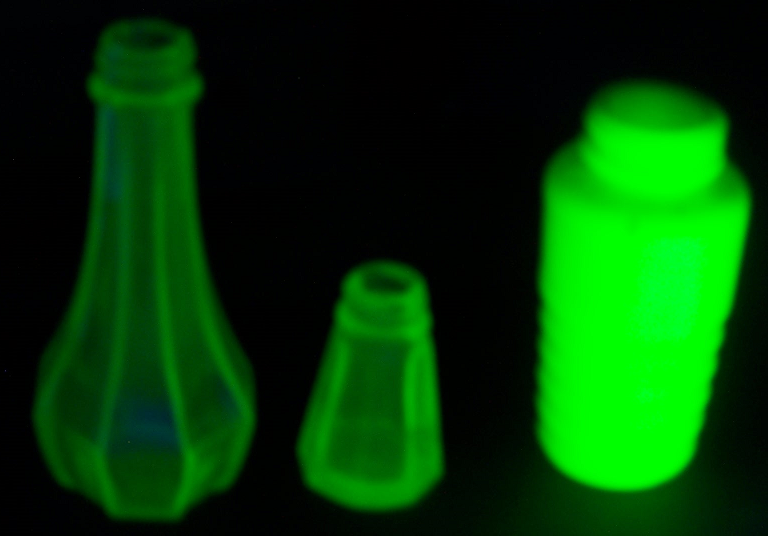
I often find old bottles and glass.  The above picture shows three such finds.  The two on the left are Depression glass and the one on the right is Vaseline glass.  I think those are the right terms.

There are a lot of collectors of both depression glass and vaseline glass.  I've sold some pieces in the past.

I'm not changing topics.  I'm going somewhere with this.

Depression Glass and Vaseline Glass Photographed Under Black Light.
I tried the black light on those items, and you see what I saw.  They glow.

Both types of glass were made with uranium.  Yes, uranium.  Vaseline glass has a more yellow color. To create the more green depression glass, iron oxide was added.

OK.  A black light can reveal some interesting things with some types of glass.  So now I tried the red sea glass under black light.

Red Sea Glass Under Black Light.
I shut out all the light and shined the black light onto the red glass.  The one side showed nothing.  I couldn't even see it in the dark room, let alone photograph it.

I turned it over, and saw a world of difference.  On this one side, it glowed!

It was the side with the yellow specks infused in the glass that glowed.  It glowed orange.

What does that say?  Uranium isn't used in glass nearly as much as it was back in the day, although people do copy depression glass and vaseline glass.  So is this glass older?  I thought it was older just judging from how it was worn into a very rounded cushion shape.  And why was it made to glow?

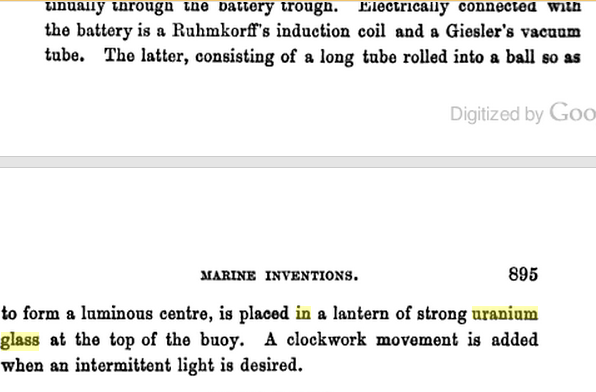
Then I ran across the following text.


This clip was found in an 1878 nautical magazine.  It is talking about how uranium glass was used on a buoy.  Is that what I have a piece of?  I don't know.  But the evidence is mounting that this red sea glass was once part of a lens, perhaps like was used on a nautical buoy.

Click here to link to the nautical magazine.

What I am talking about today is how an item can continue to reveal more about itself, and how various methods of inspection and research can help make a find come alive.

The same process can occur with almost any kind of item.  Even an item as simple and mute as a squarish little piece of glass will continue to tell you more of the story as long as you are curious and really want to know.

It is something like that with people too.


---

I was without internet most of the day, so that is it for today.  I didn't think I was going to get any kind of post done today.

Happy hunting,
TreasureGuide@comcast.net.