Written by the TreasureGuide for the exclusive use of treasurebeacheserport.blogspot.com.
 |
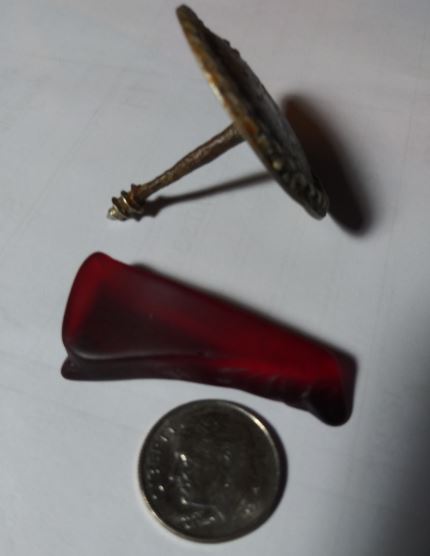
| Antique Furniture/Upholstery Screw and Red Sea Glass Finds Finds and photo by John L. |
He is now most curious about the red glass. After some research he found that it could possibly be hundreds of years old.
 |
| Same Treasure Coast Finds by John L. |
He now believes the red sea glass is "gold ruby glass," which could be hundreds of years old.
He thinks the furniture screw could be a replica. It does look in very good shape.
He found the following information relative to the red sea glass on the Corning Museum of Glass website.
"Gold ruby is arguably one of the most beautiful colors of glass. Beyond its aesthetic qualities, there is an alchemical connotation: Since ancient Greek times, descriptions of the sorcerers’ stone agree that it was believed to be a red substance and the key to the transmutation of metals, principally the making of gold (Ganzenmüller 1937;
idem 1956, pp. 85–128; Kerssenbrock-Krosigk 2001, p. 13). Whoever discovered how to color glass red must have thought himself to be on the right track to attaining the ultimate goal of alchemy. The 10th-century Persian physician and philosopher Rhazes (about 865–between 923 and 935) apparently believed that he had already fulfilled that objective. In his formula, the earliest known written account of a gold ruby glass, he stated that this glass attracted gold and silver like a magnet, and that it could convert 1,000 times its weight into gold.
1
About 800 years later, enthusiasm for gold ruby was at its peak. As far as can be determined from the legacy of princely treasures in today’s public collections, almost every central European sovereign seems to have owned one or more gold ruby glass vessels. This high point in the popularity of gold ruby glasses was confined to a relatively brief period: between about 1685 and 1705. It was preceded by a long history of developments that culminated in the production of large vessels that glow in a deep yet translucent ruby color. At its height, gold ruby glass was apparently considered to be not just another decorative folly but a genuinely new and precious material. It was ranked about as high as hard-paste porcelain, which came into production in Europe only a few decades later. During the 18th century, interest in gold ruby persisted in some regions and occasionally arose in others, but it never regained the widespread appreciation that it had engendered earlier.
The history of gold ruby has many beginnings. Red glass of some sort was produced almost from the time that glassmaking began. Knowledge was gained and then lost, and while there were rediscoveries on several occasions, this glass does not seem to have been produced again until it was revived in Brandenburg in the late 1670s and 1680s. It is here, with the arrival of the alchemist, pharmacist, and glassmaker Johann Kunckel (1637?–1703; Fig. 1) in early 1678, that the real story of gold ruby glass begins...
Interesting finds. Thanks John!
---
Russ P. has done a lot of inland hunting, and found thousands of silver coins, was out to the beach this past week. I've posted some of his research.
Here is what he had to report.
… I checked most of the known treasure beach access points from Sea Grape north, but only got my detector out at Bonsteel, with only a few trash finds. All the rest of the beaches seemed to have deteriorated from yesterday, in my opinion, with a lot of sand deposited at the base of cuts. Based on what I saw today, I don't think any of the cuts got close, at any point, to the size seen at John Brooks.
On the bright side, it was a beautiful day at the beach. I stopped at Melbourne Beach on the way home. It actually looked the most promising with a firm slope with black sand below a two foot cut. There were two other detectorists at the beach on my arrival. I have very little overall beach experience, but I found the coin line quickly. There weren't many coins, but it was stretched out over several hundred yards. There was no trash in the coin line. It was fun to put all the theoretical knowledge learned in this blog to good practical use. It really works!
Also, the Equinox 800 was superb. The coins were all six inches deep minimum, but gave strong signals. There was virtually no falsing, either in black sand or transition from dry/wet sand or vice versa. I picked up some very small pieces of fishing lures the size of earring backings. I was very impressed...
Although Russ hadn't done much beach hunting, he was able to apply what I've said about coins lines and quickly found one.
No matter if you walked away from the beach last week with a bunch of finds or not, you should walk away with some good new information. Always be learning.
Depending upon how you define the Treasure Coast, it is around a hundred miles, more or less, long. That gives you over 5 million square yards of beach to scan.
Only a relatively small amount was actually detected, even if some beaches were hit by dozens of detectorists. Many areas were just too far from the beach access for most people. There are a lot of good spots that are far from the access. Some of those will continue to hold good targets even after some of the other beaches fill in.
With the smaller surf, some areas (mostly higher on the beach) of the more productive areas will remain basically as they were a few days ago. I know that there are coins just laying there still waiting to be detected. I could get into that more some other time, but people tend to conclude it is all over just because the hottest of known spots have deteriorated.
We'll just have a two to four foot surf for a few days.
Happy hunting,
TreasureGuide@comcast.net


