Showing posts with label Calusa. Show all posts

Saturday, April 25, 2020

4/25/20 Report - 16th Century Fort San Anton de Carlos. Calusa. Koreshan Community. IRC Beach Openings.


Written by the TreasureGuide for the exclusive use of treasurebeachesreport.blogspot.com.


Site of Fort San Anton de Carlos
Source: See links below.

In 1566, Pedro Menéndez de Avilés arrived at the capital of the Calusa kingdom. During that same year Menéndez issued the order to construct Fort San Antón de Carlos, which was occupied until 1569. This fort was also the location of one of the first Jesuit missions (1567) in what is now the United States. We now can confirm what archaeologists and historians have long suspected: the location of the fort and the capital of the Calusa was Mound Key (8LL2), located in Estero Bay in southwestern Florida. In this article, we present the first archaeological evidence of structures and fortifications associated with the 16th-century Spanish fort and mission of San Antón de Carlos. We conducted this work, which includes both remote sensing and excavation, in an effort to better document the history of the Calusa capital up to and including the colonial period.

That is an abstract of an article published in Historical Archaeology.  Here is the link to the site where you can purchase the entire article.

https://link.springer.com/article/10.1007/s41636-020-00236-6


FloridaMuseum.ufl.edu provides the following information on the same topic.


Florida and Georgia archaeologists have discovered the location of Fort San Antón de Carlos, home of one of the first Jesuit missions in North America. The Spanish fort was built in 1566 in the capital of the Calusa, the most powerful Native American tribe in the region, on present-day Mound Key in the center of Estero Bay on Florida’s Gulf Coast.

Archaeologists and historians have long suspected that the fort, named for the Catholic patron saint of lost things, was located on Mound Key. Researchers have been searching for concrete evidence in the area since 2013
....

Artifacts From the Site
Photo credit: Amanda Thompson.

Researchers continue to question how the Spanish survived on Mound Key and met their daily needs despite unreliable shipments of minimal supplies from the Caribbean and strained relations with the Calusa – whose surplus supplies they needed for survival. The only Spanish fort known to be built on a shell mound, Fort San Antón de Carlos was abandoned by 1569 after the Spaniards’ brief alliance with the Calusa deteriorated, causing the Calusa to leave the island and the Spanish to follow shortly after...
Here is that link.
Additional information can be found in the newsletter by using this link.
Mound Key is a state archaeological park located in Estero Bay accessible only by watercraft. You can launch from nearby Koreshan State Park, which has its on unique history.

Here is what FloridaStateParks.org says about that.

Koreshan State Park offers a window into the lives of a unique and eccentric pioneer group that made its home under towering oaks on the banks of the Estero River.

In 1893, the Koreshans, a religious sect founded by Dr. Cyrus R. Teed, moved here and built a settlement based on a commitment to communal living and a belief that the universe existed on the inside of the Earth. Living celibate lives, the enterprising Koreshans established a farm, nursery and botanical gardens.

The park is home to 11 immaculately restored and nationally registered historic buildings erected by the Koreshans between the late 19th and early 20th centuries. A quiet and peaceful refuge amid busy Fort Myers, the park's interpretative and natural resources provide great opportunities to learn and and to enjoy nature. 
Here is a little more history on that.

Following the 1908 death of Dr. Teed, who had renamed himself “Koresh,” Hebrew for “Cyrus,” the Unity went into decline. Several groups split to form other groups. One, The Order of Theocracy, left in 1910, moved to nearby Fort Myers and lasted until 1931. The fact the Unity was celibate did not help, although celibacy was not the real problem; there was a married status within the Unity. However, celibates were the highest order and held the most important positions. With members leaving and no new members joining, the Unity slowly dwindled.


In 1961, Hedwig Michel, one of the few surviving members, and president of the Koreshans’ religious community, deeded the property to the State of Florida, which then became Koreshan State Park. In 1967, after restoration of eleven buildings on the National Registry of Historic Places, the park was renamed Koreshan State Historic Site. In 2017, shortly after Hurricane Irma, the site again became Koreshan State Park.

That reminds me of the 1993 Waco siege of the Branch Davidians by federal agents that lasted 51 days and ended in a fire that killed 80 men, women and children.  David Koresh, the leader of the cult, was born Vernon Wayne Howell.  Maybe he got the idea for his name from the Koreshans or maybe it was a Bible thing.
---

I saw a fellow from the Bureau of Land Management on TV.  He seemed to be encouraging people to visit and enjoy BLM lands. He suggested a visit to the blm.org web site.  They don't seem to have any land in Florida, unless I missed it.

---

I just received more news on the Indian River County beach openings from DJ.  Here it is.

S: Some IRC Beaches to open 4-28-20 at 7am
The public beach access points at Golden Sands, Wabasso Beach, Tracking Station Beach, Round Island Beach, the east end of Beachcomber Lane, South Beach, Humiston Beach, Sexton Plaza Beach, Conn Beach and Jaycee Beach will open to the public on 4-28 with conditions. Click on this link to read IRC Executive Order #2020-005:   https://www.ircgov.com/Public_Notices/COVID-19/Beach_Re-opening.pdf

---

If you've been wondering about your stimulus check, JamminJack Just got his.  Here is what he said.


I just checked my mail this evening, and there was the check for $1200. I went online immediately to compare to a legitimate one and looks real. I had just earlier that day checked "Get My Payment", and said should receive by 24th. Hmm, today!


If anyone needs info to check online here is what to expect;


Social Security 

Birth Date

Address used for filing

Zip Code.


Take Care, JamminJack

---

On the Treasure Coast we'll be having nothing but one and two foot surf for another week.

Getting real close to 2.5 million page views.

Happy hunting,
Treasureguide@comcast.net

Tuesday, April 7, 2020

4/7/20 Report - Beaches Closed But Some Have Access. In The Field: Points. Calusa Fish Farming. Gold and Tides Up.


Written by the TreasureGuide for the exclusive use of treasurebeachesreport.blogspot.com.

Beautiful View of Fort Pierce Beach.
As you've seen the past few days, I featured some items that are not metal detector finds, but are still great finds.  In fact they are better than most metal detector finds if you really appreciate old items.

With the beaches closed, some people are hunting elsewhere, even if it is their own yard.  Below is the plowed field where points and other items I recently posted were found.

Newly Plowed Field With Plenty of Space for Social Distancing.
Photo by JamminJack.

And here is another find by JamminJack's buddy.


Another Nice Arrowhead Find.
Photo sumbitted by JamminJack

---

Source: See FloridaMuseum link below.

The mighty Calusa ruled South Florida for centuries, wielding military power, trading and collecting tribute along routes that sprawled hundreds of miles, creating shell islands, erecting enormous buildings and dredging canals wider than some highways. Unlike the Aztecs, Maya and Inca, who built their empires with the help of agriculture, the Calusa kingdom was founded on fishing.
But like other expansive cultures, the Calusa would have needed a surplus of food to underwrite their large-scale construction projects. This presented an archaeological puzzle: How could this coastal kingdom keep fish from spoiling in the subtropics?


A new study points to massive structures known as watercourts as the answer. Built on a foundation of oyster shells, these roughly rectangular enclosures walled off portions of estuary and likely served as short-term holding pens for fish before they were eaten, smoked or dried. The largest of these structures is about 36,000 square feet – more than seven times bigger than an NBA basketball court – with a berm of shell and sediment about 3 feet high. Engineering the courts required an intimate understanding of daily and seasonal tides, hydrology and the biology of various species of fish, researchers said...

For more about that see https://www.floridamuseum.ufl.edu/science/watercourts-stored-live-fish-fueling-floridas-calusa/


---

If you remember the post I did not too long ago about what was closed and not closed, some people will still have access to the beaches even if they are closed to the general public.  Here is one sentence from that previous post.


People with private access, such as hotel guests, HOA and condominium residents and community association members can visit the beaches.

I do not know why a person who owns property next to the beach should  have access to a public beach when the general public does not.   I don't think they should.  But there will always be those that have access to the beaches when the general public does not, and it isn't limited to those mentioned above.  Park rangers detect where others are not allowed to.  Parks employees, police and wildlife officers, security guards,  utility workers and construction workers, and others will have access even when the beaches are "closed."


Local authorities will close park accesses, even if they do not have any real jurisdiction over the beaches.  The state owns the beaches from the high tide line down.  The problem is that unless you swim or arrive by boat, you have to cross land to get to the beach.  And as we know private homeowners will not permit that and local agencies will not always permit it.

By the way, the state also claims to the other waterways and the beaches or banks up to the mean high tide line.

The public pays for the beaches, most especially those beaches that are constantly renourished using public funds, yet hotels and beach clubs etc. often act as if they own them.

Right now the beaches are closed to fight the coronavirus.  Regardless of the legalities, or even the common sense of it all, people are complying because it seems like the right thing to do.

Still, as always, there will be some that will visit the beaches and get in a little detecting.  As I've said before, there is always a way.  It might not be easy, convenient, or even something you want to do, but there is a way if you really want to.

---


Gold is now over $1700 per oz., well above levels of only a month ago.  Gold prices have been very volatile, as has the stock market.

---

Funny how they are all claiming with certainty that the mitigation efforts are working, while at the same time claiming they can't say anything about the effectiveness of a drug being used widely for treatment even though it has been studied rather well in other countries and is currently being studied in robust scientific studies in this country.   How can you say the mitigation efforts worked without the same kind of scientific evidence they require for other things, including drugs.  Yes we all want to believe that our extreme efforts payed off, but maybe the pandemic naturally peaked out or slackened off for any of a variety of reasons.

---

The high tides are now very high.  We are near a full moon.  As you probably know, Easter occurs on the first Sunday after the first full moon after the spring equinox.

The surf is decreasing, today being around 4 - 6 feet.

Happy searching,
Treasureguide@comcast.net

Friday, June 23, 2017

6/23/17 Report - Calusa Artifacts for Reference - Silver, Gold and Copper


Written by the TreasureGuide for the exclusive use of treasurebeachesreport.blogspot.com.

Photo of Calusa Artifacts Displayed in the Florida Museum of Natural History.
Photo by Darrel S.

In order to help you identify finds, yesterday I showed a variety of Seminole artifacts - mostly silver. Today I'm showing Calusa artifacts.  A lot are silver, but there are also copper, gold and even a couple lead items.  All of the Calusa artifact photos were taken by Darrel Strickland at the Gainesville museum.

Just to let you know, Darrel has made some great finds.  He knows more about these things than what he saw at the museum.

What he considers his greatest beach find was "a complete Native American necklace with wrapped shipwreck coins, beads, shells, etc."  The twine was made of horse hair and plant strands.  It has been viewed by experts.  He has also made other great finds.  One, a bison bone, is in the Fountain of Youth collection.

Below is a closer look at some of the artifacts Darrel photographed in the Gainesville museum, including both gold and silver items.

Photo by Darrel S.
Next are some made of copper.

Photo by Darrel S.

And below are some cone shape silver items.

Photo by Darrel S.

Beads on the Left, Tablets Center, and Other Items on the Right.
Photo by Darrel S.

Here is a closer view of some of the above, especially tablets.

Photo by Darrel S.

Below are close-up views of some beads and tinklers.

Photo by Darrel S.

Below are a few more unique Calusa items. 

Photo by Darrel S.

This post should provide a good reference for identifying old Calusa artifacts.

---

On the Treasure Coast we are had some big low tides today.  Combined with the small surf that should give you good access to some beach areas that might be hard to get to at other times.

That is all for today.

Happy hunting,
TreasureGuide@comcast.net

Monday, March 27, 2017

3/27/17 Report - Calusa Site Yields Remarkably Preserved Artifacts, Beer Bottle Facts and Dating Old Beer Bottles


Written by the TreasureGuide for the exclusive use of treasurebeachesreport.blogspot.com

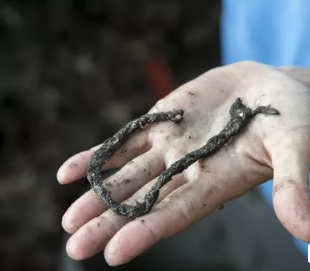
Remarkably preserved cord made of twine found at a Calusa site.
Source: See lNews Press link below.
The above cord is just one of many rare artifacts that were preserved by the wetland conditions at a Pineland Calusa site.

No one has seen remnants of ancient daily life like this since the 1800s, when a Smithsonian expedition led by pioneering anthropologist Frank Hamilton Cushing unearthed more than 1,000 remarkably well-preserved artifacts, including the celebrated Key Marco cat near Marco Island.

Some of the more extraordinary things to emerge from the Pine Island pit are pieces of netting, complete with tied-on weights. Archaeologist Bill Marquardt, curator in South Florida archaeology and ethnography at the Florida Museum of Natural History and director of Pineland's Randel Research Center points to a bagged white clam with a hole knocked in it, threaded with knotted twine.

"These ark shells they used to weight down their gill nets and their seine nets, with the knots still tied — that’s the kind of preservation we’re getting. In addition to that, we’re getting pieces of wood you can still see the working marks on, and seeds such as squash seeds that will help us figure out what kinds of plants they were using."...

Here is the link for the rest of the article.


http://www.news-press.com/story/news/2017/03/23/pineland-wet-site-dig-yields-rare-calusa-artifacts/99210580/


---


I was looking for some information on a recently found bottle and found a web site that gave some interesting facts.  Besides being interesting they might help you narrow down the date range of any old beer bottles.

The web site is the www.beerbottlecollector.com.

Here are the facts that I mentioned.


Did you now that Glass did not become widely used until after the Civil War (1865)..??

....................................................................................................................................

Did you now that up to 1860 all beer bottles had pontiled bases...??

......................................................................................................

Did you now that beer bottles from 1860-1870 are very rare??

from 1870-1880 they are scarce. From 1880-1890 they are Semi- Common.??

......................................................................................................................

Did you now that Bottles marked Ale or Porter were first Manufactured from 1850-1860..??

............................................................................................................................................

Did you now that until the 1870's beer bottles were sealed with cork..??

.............................................................................................................

Did you now that the lightening stopper was not invented until the late 19th century..??

....................................................................................................................................

Did you now that before the 1930's beer came in green bottles then after the Prohibition,

brown glass was used because it was thought to preserve freshness by filtering out sunlight ..??

...............................................................................................................................................

Did you now that in 1873, a British inventor Hiram Codd invented a bottle with a glass marble

confined inside its neck, When the bottle was filled with an effervescent liquid, gas pressure forced

the marble to the top of the neck, sealing the bottle.??

........................................................................................................................................................

Did you now that from 1879 to early 1900's the Hutchinson stopper was commonly used. A heavy wire

loop controlled a rubbler gasket that stayed inside the cork..??

---

On the left is a bottle that I found a fews days ago, and on the right one that I found a long time ago.


The one on the left reads "FEHRS." The one on the right reads "FRANK FEHR BREWING CO."

I think they are both Fehr beer bottles. The one on the left looks newer than the one on the right.

Above we read, Did you now that before the 1930's beer came in green bottles then after the Prohibition,... brown glass was used because it was thought to preserve freshness by filtering out sunlight ..??

And that would suggest that the one on the left is later than 1930, which I would have guessed anyway, and that the one on the right, which looks more green in person, is older than 1930.

Just an example of how the facts listed might help you narrow down a date range for beer bottles.


While I'm at it, here is another found beer bottle.


This one is a Pabst bottle.  Also brown.  Looks very much like the brown bottle above, but judging from the additional embossing, I would guess maybe a touch older than the brown Fehr bottle.

It shouldn't be hard to get a better date estimate on any of these bottles with a little more research.

---

If Congress has shown me anything in the past week, it is the glaring need for term limits.  Those guys that make a lifetime job out of it need to go.

---

Not much change in beach conditions to report.  Expect another day or two of three to five foot surf.

Happy hunting,
TreasureGuide@comcast.net

Wednesday, May 4, 2016

5/4/16 Report - 300-Year-Old Intact Pot Uncovered. Evolving As A Treasure Hunter. Mound Key Archaeology.


Written by the TreasureGuide for the exclusive use of treasurebeachesreport.blogspot.com.


300-Year-Old Intact Bowl Uncovered In St. Augustine.
This rare 300-year-old intact bowl was recently uncovered by archaeologists in St. Augustine.

Here is the link to the video.


---

If you don't evolve as a treasure hunter, you probably won't be a treasure hunter very long.  If you don't evolve, you'll probably quit.

I see some people who believe all they have to do is get a detector and swing it around, and the detector will find treasure.  That won't get you very far.  You won't find much, and you'll probably quit before long.

Learning is necessary if you want to find much, but it is also a lot of the fun of metal detecting.  If you are not learning, you're missing out in both ways.

To be most effective, you have to learn to use your detector.  You have to learn about different areas and how to read the environment so yo will see the clues that will lead you to good finds.  You have to learn techniques and strategies.  

You'll also change what you want to find.  Your goals will change.  You'll expect to find more, and you'll target higher quality finds.  

That is why I say, "If you don't evolve, you are not a treasure hunter."  It might be slightly more accurate to say, "If you don't evolve, you won't be a treasure hunter very long."

I think it is good to ask yourself every once in a while if you've been evolving.  If so, how, and if not, why not.  

---

Here is an academic publication in which the formation of Mound Key, the capital of the Calusa kingdom at the time of European contact in the sixteenth century was studied.


Here are some of the key observations from the study.

First, it appears that the island was occupied early in its existence, abandoned, and then reoccupied. During Mound Key’s second occupation, its inhabitants substantially altered the landscape by redepositing old midden to form at least the upper portions of the two largest midden-mounds. We argue that this reoccupation and the associated large-scale labor projects are part of a deep history of human-environmental interactions tied to the production of aquatic surpluses.

Here is the link if you want to read the entire article.


---.

It seems the crew of the Dare has identified a new target that has them excited on the site of the Atocha.  It is a new EM target that the magnetometer did not show. 

---

We got some much-needed rain. I'd rather have that than the hot sun.

The surf is smooth today, but there is a bigger tide.   I've been waiting for a negative tide, but won't get a chance to get out today.

Happy hunting,
TreasureGuide@comcast.net