Showing posts with label St. Augustine. Show all posts

Wednesday, October 30, 2019

10/30/19 Report - St. Augustine Lighthouse History. History of Tools. More Thoughts on Troy's Find. Higher Surf Coming.


Written by the TreasureGuide for the exclusive use of treasurebeachesreport.blogspot.com.


St. Augustine Lighthouse Turns 145 This Year.
Source: HistoricCoastCulture.com (Full link below)


This beloved black-and-white-striped lighthouse turns 145 in 2019 but its fascinating history dates back more than 400 years. Its Florida’s very first lighthouse and, along with the structures that preceded it, the oldest permanent aid to navigation in North America.

It has been the site of battles and picnics. Confederate soldiers hid its lens during the Civil War. During WWII, it was occupied by armed guards. It has seen tragic fires and passionate restoration. It may be haunted by four different ghosts. It’s a gathering place and guiding point for St. Augustine...

First built in 1589 by Spain, the tower was under Spanish rule twice for a total of 211 years. The British took control for 20 years following the Revolutionary War. In 1821, Spain ceded Florida to the United States who has maintained ownership ever since...

Here is the link to read more about this history.


----

The discussion of Troy's find chisel(?) find continues. Susan E. suggested making a distinction between what the item was originally made for and how it might have ultimately been used. Here is what she said. The question is whether this artifact was used as a chisel.

I would examine the surface on the flat end, for signs of use.   For example, Troy C. says that it is iron coated with bronze or copper, so if it was struck by an iron hammer we would expect to see loss of the coating (which is softer than iron).   Also, perhaps that end would be a bit smoother than the rest of the artifact due to repeated contact with the hammer.   

Its often difficult to reach a conclusion from a photo.  You can't look at everything you'd like to, and you don't get the same feel for an object that you can hold in your hand.

I thought the plating or whatever looked quite odd in the photo and wondered about the metallic composition.

Bill P. said, I have a hard time believing that any chisel would be made of anything but steel. That pic looks like brass or bronze. Even when chiseling wood the bronze would never hold an edge for very long. It's something else.

Thanks guys.  Great thoughts.


I found a very interesting website on the history of woodworking tools.  Here is a photo of some 18th century tools, including chisels.

18th Century Back Saw, Chisels and Other Edged Tools.
Source: WoodWorkingHistory.com (Full link below).

They were made in Birmingham, long a center for iron and steel metalworking.

Among other interesting facts, you will find this list of reasons why it is often difficult to identify the source or identity of old tools.

first, the tool is an object of daily use, subjected while in service to hard wear and, in some cases, ultimate destruction;

second, a tool's usefulness is apt to continue through many years and through the hands of several generations of craftsmen, with the result that its origins become lost;

third, the achievement of an implement of demonstrated proficiency dictated against radical, and therefore easily datable, changes in shape or style; and

fourth, dated survivals needed to establish a range of firm control specimens for the better identification of unknowns, particularly the wooden elements of tools—handles, moldings, and plane bodies—are frustratingly few in non-arid archeological sites.


That is just a small sample of what you will find at the site.  Some of it is in "olde" English.

Here is the link.


---

If you don't like my philosophizing, you might want to bail-out now.  Fair notice.

A couple times recently I said, "The more I learn, the more I don't know."   On the face, that sounds contradictory and like it could not possibly be true.  When the thought first came to me, I liked it because it had the definite ring of truth, but there was also a feeling of mystery to it.

If you believe in a world in which there are only a finite number of things to be known, when you get to know one of those things, there is one less that is unknown.  That would make the statement false,
but the truth of the statement that originally wasn't clear to me, is that the world does not consist of a finite number of things to be known, and when you take a step down the path of truth what opens up before you is a even larger world in an ever expanding universe of marvelous new possibilities.   It is something like coming to the top of a hill on a clear night and seeing the countless stars like never before.  It is beyond words, logic or reason.  You encounter the incomprehensible infinite and become a part of it.

---

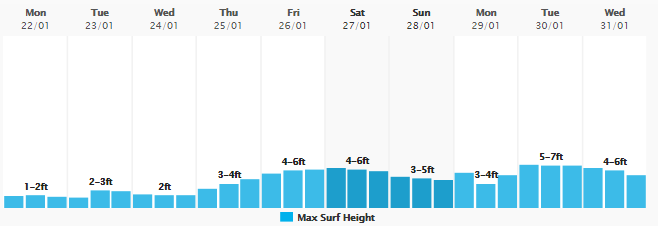
The tides are pretty big now and it looks like we'll have some bigger surf at the end of the week.


Source: MagicSeaWeed.com.

Happy hunting,
TreasureGuide@comcast.net

Thursday, October 17, 2019

10/17/19 Report - Two Hoards. Columbus Landing. 17th Century St. Augustine Shrine.


Written by the TreasureGuide for the exclusive use of treasurebeachesreport.blogspot.com.


Ancient Coin Cache Found.
Photo by Denis Glicksman


A HOARD OF EXCEPTIONAL COINS FROM THE END OF THE XVTH CENTURY DISCOVERED IN DIJON

During an archaeological diagnostic in the center of Dijon, near the old abbey of Saint-Bénigne, an Inrap team has brought to light a coin hoard of about thirty gold and silver pieces from the second half of the XVth century, coming from Italy and the Holy Roman Empire states. This hoard, of great numismatic interest, bears the likeness of a catalog of portraits of all the great princes from the end of the Middle Ages.

Here is that link.


---


Depiction of Christopher Columbus Landing.
Source: SpiritDailyBlog.  See link below.

Columbus day, which has traditionally been celebrated in the United States and other countries on-Oct. 12, in today's super-divisive hyper-political world, instead of a day of pride has become an opportunity to hold up and celebrate the uniquely egregious sins of Caucasian Christians.

For Christopher Columbus was not only a devout Catholic, but — like other explorers who would follow in his wake — a missionary. He considered the evangelization of the New World his primary goal...

Here is a link to an article about the religious feelings and motives of Christopher Columbus.
https://spiritdailyblog.com/commentary/hidden-history-columbus-amazing-catholicism

---


.- Bishop Felipe Estévez of St. Augustine announced Friday that the Shrine of Our Lady of La Leche has been elevated as a National Shrine by the US bishops' conference.

The Shrine is located at the Nombre de Dios mission in St. Augustine, founded in 1587. According to the Diocese of St. Augustine, it is America's oldest Marian shrine... 
Here is that link.


https://www.catholicnewsagency.com/news/historic-marian-shrine-in-florida-elevated-to-national-shrine-54052

---

Found Contents of a Bronze Age "Tool Kit."

Bronze Age Europe was a violent place. But only recently have scientists uncovered the scope of the violence, at a 3000-year-old site in northern Germany where thousands of well-armed young men fought with sophisticated weapons in in what appears to be an epic battle. Now, a bagful of bronze artifacts and tools found at the bottom of the river in the middle of the battlefield suggests some of these warriors traveled from hundreds of kilometers away to fight. That suggests northern European societies were organized on such a large scale that leaders could call warriors to distant battlefields, long before modern communication systems and roads.

Here is the link for more about that.

https://www.sciencemag.org/news/2019/10/3000-year-old-toolkit-suggests-skilled-warriors-crossed-europe-fight-epic-battle

Thanks to Douglas for that link.

---


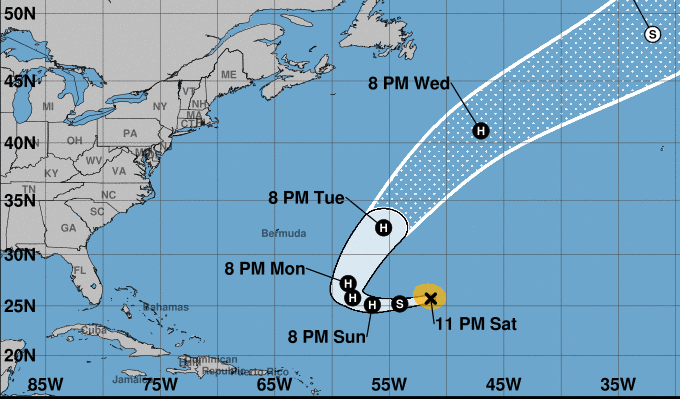
Source: National Hurricane Center.
As you can see from the map, there is a system in the Gulf that is expected to become a cyclone in the next forty-eight hours.

If that one affects us at all, it won't be before several days.

Happy hunting,
TreasureGuide@comcast.net

Sunday, October 28, 2018

10/28/18 Report - Valuable Paper Money in Circulation. Watch For Cleaned Coins. Erosion in North Florida. Old Ship Found.


Written by the TreasureGuide for the exclusive use of treasurebeachesreport.blogspot.com.

Dug Corroded Partly Cleaned Penny.
I just cleaned a load of old corroded coins.  I tried a new experimental procedure that didn't work out real well.  I wouldn't recommend the process, but I sort of like the look of the coins.

You can often tell when you get somebody's dug coins in change.  I'm going to put a number of these in circulation, and am showing you with the hope that you'll tell me if you get one.  I know I'll recognize them if I get them back.  They all are banged up and corroded, having spent time in the surf.  They have a dark background scuffed bright high design features.


---
Erosion in St. Augustine Area
Photo by Bruce B.
Bruce B. said the beaches in the St. Augustine area are losing a lot of sand and provided the photo above.

There is always some place to detect.  Some spots are better than others.  If you look around enough you can usually find a decent spot.

There is a tropical storm in the Atlantic: Oscar.  Below is Oscar's predicted track.

Tropical Storm Oscar.
Source: MagicSeaWeed.com
Oscar will, however affect us to some extent.


Wednesday Wind Predictions.
Source: Ventusky.com
You can see the north wind that we'll get Wednesday, when the Treasure Coast surf will increase.


---

I've been enjoying checking the serial numbers of the paper money that I receive in change.  It is possible to receive a bill worth hundreds of dollars.  Many are worth less than that but more than the face value.

It is an entertaining activity with the possibility of profit something like playing the lottery but without the cost.  All you have to do is check.

Here are a couple web sites that describe serial numbers that might be worth something.

https://www.dailymail.co.uk/news/article-2423315/Dollar-Serial-numbers-make-banknotes-worth-thousands-online-trend.html

This one will give you some idea of the value of bills with various serial numbers.

http://coolserialnumbers.com/ForSale.aspx

---

A centuries-old ship was found by archaeologists.
The finds include parts of a merchant vessel, a cog, dating back to the 13th century, as well as some imported German and Danish ceramics, possibly brought to Sweden on the same ship.
Here is the link for the articles and photos.

https://www.thelocal.se/20181024/archaeologists-find-medieval-ship-and-german-ceramics-in-enkping

---

The weather is beautiful.  Just judging from the northeast wind that I see outside, I think you might be able to find some small cuts.

Happy hunting,
TreasureGuide@comcast.net


Saturday, March 31, 2018

3/31/18 Report - Ship Remains on Florida Beach. Locomotive Bottle and Mystery Object Finds. Happy Easter!


Written by the TreasureGuide for the exclusive use of treasurebeachesreport.blogspot.com

Shipwreck Timbers Left On Beach At Least Temporarily.
Source: See staugustine.com link below.

Officials had to resort to their second plan of securing the hull section in place Thursday evening after the equipment that was planned to move it got stuck in the sand and couldn’t make it to the site.
Tonya Creamer, spokeswoman for the St. Augustine Lighthouse and Maritime Museum, said Friday morning that the artifact is still on the beach and researchers plan to continue collecting as much information from it as they can...

Here is the link for more.
http://www.staugustine.com/news/20180330/update-ships-hull-secured-on-beach-after-attempt-to-move-it-fails

Heaven forbid!  The public actually gets a chance to see it.  As I said the other day, you might want to take a little day trip to see this.

---

Small Figural Bottle Found.

I didn't go metal detecting yesterday but I did go for a little walk to see what I could find.  No more rubber worms - thank goodness - but I did find this nice little figural bottle.

I walked down the beach a short ways and didn't find anything, so turned around and started back.  I don't go real slow the first trip, so it is something of a scouting mission.  So on the return trip and not having found anything, I looked for smaller objects on the return trip.

This one wasn't easy.  It is very irregular and small and partly covered with sand.  At first glance I thought it looked like broken glass, but it was a little odd, so I decided to take a closer look.  You can see what I found.


Back View Showing Small Opening.
Barely readable on the bottom of the bottle is J S Co.  Above that is what appears to be 3 D P.

At this point I suspect it is either a candy container bottle or a bottle for perfume or some liquid.  The closest thing I have found so far are candy container bottles, but the opening on this one is so small that the candy would have to be very small.

Any help on ID would be appreciated.  Thanks in advance.


Front of Train Bottle.

I also found the following item on the return trip.  I don't know what it is.


Mystery Find.
All I saw of this one is the top of the blue bubble on the top.  When I saw it I thought it was a mostly buried marble, but marbles usually aren't usually buried that deeply.  It was odd looking.

Another View From What Appears To Be The Bottom.
From the bottom you can see a smaller but similar shaped white object inside the bigger object.  The entire object appears to be a clear plastic. the bottom is flat. Another cylinder or disc is inside but does not reach the bottom.  There is no apparent functionality to it other than what you see.  What do you think it is?

You can improve your eye-balling skill through practice.  Bits and pieces that are not part of nature begin to stand out and attract your attention, even when they are small and perhaps barely visible.  I walked past both of these items once, until I set my focus on small objects for the return trip.  Very much like metal detecting, except you are using your own perception system.  I nearly said eyes, but a lot of it is information processing, as is always involved in perception.

---

Here is the surf prediction for the next few days.   Towards the end of the week, it looks like we'll have an increased surf.


---

As I always say, "There is always some place to hunt and something to find."  Sometimes you might have to make some adjustments and try some other places or techniques, but it is out there.

Let me know if you have any ideas about either of the newly found objects.

Happy Easter,
TreasureGuide@comcast.net

Monday, January 22, 2018

1/22/18 Report - New Iron Shipwreck Finds. The Secret Treasure. Precautions. Bigger Surf Coming.


Written by the TreasureGuide for the exclusive use of treasurebeachesreport.blogspot.com.

Finds From Unidentified Shipwreck North of Treasure Coast.
Yesterday I posted pictures of some 1715 Fleet treasures found not too long ago.  Today I'm posting the above picture of items from an unidentified shipwreck found under the beach north of the Treasure Coast.

Here is the email I received with that photo.

...Thought I would share with you and for your blog as Sunday after a 1 mile walk to my hidden wreck site,it produced a few more pieces of iron. As you recall,this find started after  Hurricane Matthew in 2016 as I retrieved 29 total pieces.I went back searching after Hurricane Irma in 2017 and fetched more bringing my total to 49. After our latest N'easter on Jan 3 2018 I was able finally to make the long mile hike again hoping to add to the mystery.As soon as I hit my area,first iron hit,then another,another.Due to the erosion these were only down around 10 inches or so and still have wood and roots intact as they are now in dirt rather than beach sand...I broke the 50 piece mark as I feel these are all from the same ship.Maybe one day I'll have something more interesting to show like in Today's [ yesterday's] blog....until then it's a waiting game for the next shift of sand.Thanks for all your hard work.

---

Things have changed over the decades.  You can learn a lot from TV and the internet today that would take you forever to discover on your own.

I'm now bored by Gold Rush and Curse of Oak Island, but I've seen some very interesting episodes of Expedition Unknown.  I think it was Friday that I saw episode 4 of season 4, which was about The Secret a book by Byron Preiss that presents a treasure puzzle leading to several actual treasures buried around the country.

Here is how The Secret is described.

...The Secret, a puzzle book published in 1982 by Byron Preiss.  To set up the puzzle, Preiss traveled to 12 locations in North America to secretly bury a dozen ceramic vases, or, as he called them, "casques." Each casque contained a small key that could be redeemed for one of 12 jewels Preiss kept in a safe deposit box in New York. The key to finding the casques was to match one of 12 paintings to one of 12 poetic verses, solve the resulting riddle, and start digging. Since 1982, only two of the 12 casques have been recovered. The first was located in Grant Park, Chicago, in 1983 by a group of students. The second was unearthed in 2004 in Cleveland by two members of the Quest4Treasure forum. Preiss was killed in an auto accident in the summer of 2005, but the hunt for his casques continues. 

The last part of the TV episode on The Secret ended with a search in St Augustine, where they failed to find the treasure.  It could still be there.

---

Things change.  People change too.  I was thinking over my metal detecting years and remembered how I changed.  In the very beginning I was not secretive at all about my finds.  I guess there wasn't much to be secretive about.  I was just picking up mostly modern coins on tourist beaches. 

When I got into finding gold jewelry, that changed.  I was hunting harder and finding a lot.  On top of that, I found out that people would try to claim finds that didn't belong to them.  This was in South Florida where there are a lot of criminals and theft.  That was another reason to be more discreet.  

This is something that I don't like to post about, but it might help somebody.  There is also crime on the Treasure Coast.  Every once in a while a car is broken into at one of the beach parking lots.  I know that happened several times at both John Brooks and Walton Rocks, and I'm sure at other places as well.  I remember reporting a couple years ago about a theft at gun point at Pepper Park.  Be alert, take precautions and don't leave valuables in the car.

---

If you missed yesterday's post showing the 1715 Fleet finds, you'll want to go back and take a look at that.


Surf Prediction for Fort Pierce Area.
Source: MagicSeaWeed.com
The prediction doesn't show the surf being quite as big next weekend now, but the it is showing that the surf will remain high for a longer period of time.

Happy hunting,
TreasureGuide@comcast.net

Sunday, December 24, 2017

12/24/17 Report - Firsts and Oldest.


Source: CatholicCompany web site.  See link below.

St. Francis of Assissi had a special devotion to the Child Jesus, and he is credited with creating the first nativity scene on Christmas Eve of the year 1223...

Here is the link about the first nativity scene.

https://www.catholiccompany.com/getfed/story-francis-assisi-first-navity-scene/

---


... Christmas was kept much the same in mid-18th-century Virginia as it was in late 16th-century England.

Englishmen who came to the American colonies brought along their cultural traditions. In dress, manners, and social behavior, Virginia settlers tried to recreate the ambiance they had known back home. Their Christmas, like the English manors', evolved as an interval of leisure to enjoy feasting, visiting, dancing, and games. Even in Virginia's critical early days, the settlers did not forget Christmas. Captain John Smith wrote in 1609 that he kept “Christmas amongst the Salvages: where wee were never more merrie, nor fedde on more plentie of good oysters, fish, flesh, wild fowle, and good bread, nor better fires in England then in the drie warme smokie houses of Kecoughtan.” Kecoughtan is now part of Hampton...

During the holiday season, Colonial Williamsburg doors and windows are wreathed in arrangements fashioned of natural materials. This boxwood construction is accented with holly, pine, apples, and feathers. Among other popular accents are oranges, pineapples, and seashells...

Seashells make good ornaments and decorations. I showed some examples yesterday.

Here is the link for more about Christmas in colonial Virginia.
http://www.history.org/almanack/life/christmas/hist_inva.cfm

---

The First American Christmas

The first Christmas celebration in what was later to become the continental United States took place in St. Augustine,Florida, in 1565 (for a list of entries treating American history and customs, see United States of America, Christmas in). Old documents inform us that Father Francisco Lopez de Mendoza Grajales presided over a Christmas service held at the Nombre de Dios Mission in that year. The Shrine of Nuestra Señora de la Leche now marks this location.The town of St. Augustine boasts of being the oldest settlement founded by Europeans in what is now the United States. Still, residents of Tallahassee, Florida, suspect that an even earlier Christmas celebration may have been held near the site of their town. In 1539 a party of Spanish colonists, led by explorer Hernando de Soto (c. 15001542),camped near the place where Tallahassee now stands. Since the Spaniards stayed from October 1539 to March of the following year, some Floridians speculate that they must have celebrated Christmas there.

But who knows? There might have been others.

Here is that link.

https://encyclopedia2.thefreedictionary.com/America%2C+Christmas+in+Colonial

Of course Florida did not become a part of the United States until 1819.

---


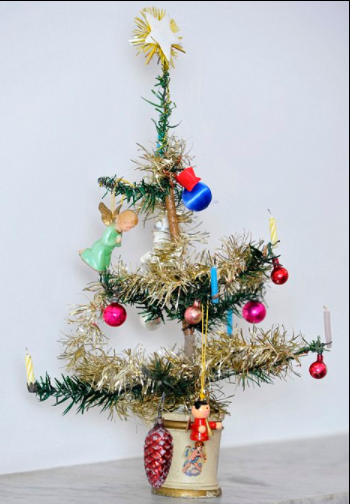
This is said to be the first artificial Christmas Tree.   124 years old and still being used.

Here is the link for more about that.

http://www.dailymail.co.uk/news/article-1336110/Worlds-oldest-Christmas-tree-makes-welcome-return--124th-year.html

---

I had another post almost done but decided I wanted to do Christmas today.

Merry Christmas,
TreasureGuide@comcast.net

Monday, April 10, 2017

4/10/17 Report - Religious Metal Detector Finds and Easter Traditions. A Letter From 1564 Fort Caroline


Written by the TreasureGuide for the exclusive use of treasurebeachesreport.blogspot.com.

Gold Metal Detector Find From The Beach Near The Nieves Wreck Site.

The figure shown above is about two inches high and was undoubtedly at one time attached to a cross.  It is truly old.  Both the method of manufacture and type of gold show that.  So does the style, wear and encrustation.  It is definitely centuries old.

It isn't a new find, and I posted it before but thought it was particularly appropriate for today's post.  

If you've been detecting the Treasure Coast very long or just reading this blog, you are aware of how many religious artifacts have been found on the shipwreck sites and beaches and how common religious symbols are on many finds.  You will find a cross prominently displayed on many treasure coins, and religious medallions are also common metal detector finds.  

The most important Christian season has begun.  You might think it would be Christmas by the way we celebrate today, but it is actually Easter. Yesterday, of course, was Palm Sunday. And Easter is next Sunday.

Easter is celebrated on the first Sunday after the first full moon after the Spring equinox.  You might have noticed the bright moon lately.

Easter isn't a new celebration at all.  Maybe it has changed some over the centuries, but it has been celebrated for many centuries, including the seventeenth and eighteenth centuries.

Even the Easter bunny and Easter eggs, which might seem to have no religious significance stem from ancient practises and meanings and still carry religious significance for some even if the same symbols carried different meanings at different times and places.  Ancient pagan beliefs and symbols related to fertility carry the meaning of redemption and rebirth for many today.

Spain is one place where Easter is celebrated with much fanfare.  I'm sure that the celebrations have changed over the centuries, but much has remained the same too.

In Spain Semana Santa (Holy Week) is the most important celebration.  

Here, the most important Catholic holiday is commemorated with a week full of color, art, religious fervor, and extravagant processions. The most spectacular events take place in Malaga and Seville, where the streets are taken over by flamboyant parades and intricate religious displays depicting biblical scenes.

Like everywhere in Spain, the festivities begin on Palm Sunday (Domingo de Ramos) and last until Easter Monday (Lunes de Pascua), with the most dramatic and passionate parades held on Maundy Thursday and Good Friday...


Although Easter celebrations in Malaga are of huge proportions, it’s the Seville Semana Santa that has crossed the boundaries becoming a world-famous event. During the Holy Week, the gorgeous Andalusian capital comes to life with thousands of pilgrims that gather here from all corners of the world to witness the city’s extravagant pasos.

See https://spainattractions.es/easter-spain/ for more.

Like many of our Christmas traditions, our Easter traditions were heavily influenced by German settlers.  That includes the Easter Bunny (Osterhase). According to the tradition, children would build brightly colored nests, often out of caps and bonnets, in secluded areas of their homes.  The “Oster Hase” would, if the children had been good, lay brightly colored eggs in the nest.  As the tradition spread, the nest has become the manufactured, modern Easter basket, and the placing of the nest in a secluded area has become the tradition of hiding baskets.

The same things we are acknowledging, remembering and celebrating this year have been celebrated for centuries and centuries.  We have a lot in common with our ancestors and the early settlers and explorers.  It is hard to imagine the same things being celebrated hundreds of years ago, but as much as things have changed, some things remain the same.  At the core and root of it all is something human and something Divine that transcends space and time.

---

Here is a letter written by a young French man from Fort Caroline in 1564.

http://ufdc.ufl.edu/UF00025123/00001/1x

---

I didn't post yesterday because I've been researching something and lost my sources.  I'll get back to it when I find them again.

It seems a lot of the snowbirds have gone home.  The beaches haven't been as busy lately.

The surf will be around three to five feet this week.

Happy hunting,
TreasureGuide@comcast.net


Thursday, February 9, 2017

2/9/17 Report - Skeletons of Colonists Being Dug Up In St. Augustine. Gold Reaches $1240 Per Oz. Full Moon and Comet This Weekend.


Written by the TreasureGuide for the exclusive use of treasurebeachesreport.blogspot.com.

I have a broad range of readers.  Some are very inexperienced.  Some haven't even bought their first detector.  And some have fifty years of experience and have made very significant archaeological discoveries.  That is one broad range indeed!  It is not easy to write something that is appropriate and interesting to both groups although it seems that generally speaking, I've managed.  I'd say it has been as much by accident as intent.  I just write what seems interesting or useful to me.  I find the basics useful because I often need to be reminded of some of the things I already knew.  It is easy to get sloppy and repeat the same old mistakes that I made when I just began detecting.

The most common questions I receive are the following.  I'm coming to Florida, so where should I go to find something good?  What detector should I get?  What are the detecting laws in Florida?  What are these things (iron flakes) that I found?  Those aren't my favorite questions but I can understand why they are asked, but I do appreciate all questions, comments and information.  Reader questions and comments help me tremendously.

I'm always trying to figure out how people respond to my posts.  I use two measures beside email comments.  Those are the number of hits and the number of Google Pluses received for each post.

The number of hits can be misleading because if a link gets posted somewhere else, that can really drive the hits up for that post.  For example, CNN posted once posted a link and that post got several thousands of hits.

There are thousands of posts in my blog.  I don't think some people realize that you can go back and read the posts made years ago, and they don't realize that you can do a keyword search.  There is a search box on the first page of the blog where you can enter your search words.

The read post of January was the 1/5/17 post, Cannon Found In River. Gems and Jewels. Wave Data Site.  Inca Emeralds.  7 Foot Surf Coming?

The most Google Plused Post of January was the 1/4/17 report, Miscellaneous Eye-balled Finds From Today.  FUN Conference. Escudo Gift. Bigger Surf Coming?

---

Skeletons of early colonissts are being dug up in downtown St. Augustine.  The site could be the site of the first parish church in the United States.

Fiesta Mall on King and Chalotte Streets is the site of this dig.

Here is the link for more about that.

---

Gold prices rose to $1240 per ounce in London on Wednesday, regaining almost half of their post-US election slump as Euro stock markets slipped and government bond prices rose amid fresh fears over the currency union's 2017 political outlook...

Here is the link for more about current bullion prices.

https://www.bullionvault.com/gold-news/gold-price-020820172

---

Friday night a partial lumar eclipse will begin.  We will have a full moon this weekend.  Also a comet will be seen some places.

Here is a link if you want to find out more about that.

http://blog.spiritdaily.com/news-links/full-moon-and-comet

---

I'm starting to wonder if we'll get any good winter storms this year.

Happy hunting,
TreasureGuide@comcast.net

Sunday, January 15, 2017

1/15/17 Report - Plenty of Copper and Iron Found Along Shell Line. St. Augustine Discovery. Surf Decreasing.


Written by the TreasureGuide for the exclusive use of treasurebeachesreport.blogspot.com.

John Brooks Beach Yesterday Afternoon.

John Brooks Beach Yesterday Afternoon.
The ideal for me is to be out on a windy rainy ripping beach all by myself.  I don't like being out on a beautiful day.  I don't like being on a beach with a bunch of sun bathers or other beach goers, even though that won't stop me if I really want to be there.  Sometimes you just have to do it.

Yesterday I was out with a bunch of other people.  I was the only one detecting though.

The first beach I visited was one of the popular 1715 Fleet beaches, John Brooks, but after looking at it, I decided to move on to another beach.  The second one wasn't eroded either.  It didn't look much good, but it was different than the first beach in one notable way: there was a shell line running for a long distance along the beach.  It was one of the longest and best shell lines I've seen in months, if I correctly recall.  Yet it wasn't the best shell line in the world.  The shells were on the small side and scattered relatively thinly.

The shell line was thin, but when I dug a hole in the shell line, I found that under a thin layer of sand the shells were another foot or two feet deep.  It resulted in a hump at the bottom of the beach.  (Unfortunately I forgot to take  photo of it.  I got busy detecting and digging.)

As I detected along the shell line, and even along the front of the beach where the shells were not on the surface, there were a lot of signals. A line of targets ran for at least a hundred yards.  Among the targets in that line were a lot of larger and deep targets.  A good number were too deep to easily recover, being one of two feet deep and below the water table.  I ended up leaving a good number of the deeper targets.

Recovered targets included a number of pieces of copper sheathing and about an equal number of rusty encrusted objects.  That is what almost all of the targets that I dug were.  I think some of those that I did not dig most likely included at a least a few spikes, and who knows what else.  If I wanted to get them I would have been better off taking a shovel.

Below is a small piece of dug copper (about one inch by one inch) that shows parallel lines near the edge.  I didn't notice that until I took a closer look this morning.  It is always a good idea to carefully check finds for marks.  In this case, it doesn't mean much.

Small Piece of Dug Copper Found in Shell Line.

Some times you need to switch detectors or digging equipment.  Yesterday I would have been better off with a shovel than the scoop I had.

---

Ancient human remains possibly dating back to the 16th century were discovered in St. Augustine during work on a water line.

Here is the link.

http://www.actionnewsjax.com/news/local/discovery-of-ancient-human-remains-prompt-excavation-prior-to-water-line-construction/483942827
---


The surf will decrease a little today and more gradually for the next few days.  We still have some nice tidal variation and negative tides.

Unfortunately they have already started to dump sand up by Sebastian.  I'm expecting almost all of our beaches to get tons of replenishment sand by the end of summer.

Happy hunting,
TreasureGuide@comcast.net

Friday, October 28, 2016

10/28/16 Report - Fairly High Surf. Metal Detecting Favorite Finds Are Usually Surprises. St. Augustine Area.


Written by the TreasureGuide for the exclusive use of treasurebeachesreport.blogspot.com.

Source: MagicSeaWeed.com

We've had a lot of wind, a fairly high surf, and even pretty high tides lately, but the angles haven't been good.  As far as I can tell it hasn't been hitting the right places yet.  The only places that I've seen erosion is by inlets or rocks or other obstacles.  I'm sticking with a 1 (poor) beach conditions rating for now.  I haven't seen a lot of the beaches and there might be a spot or two where you could find something good.  There are certainly some good spots for modern coins right now, but I haven't seen any good spots for cobs.  There might be one or two though.

---

A couple days ago I mentioned that I stopped at one beach where there were a lot of modern coins and the tide was already coming in so I tried to skip signals that sounded like clad coins and managed to pick up a gold band.  If you've been reading this blog very long, you know that I often tell people to dig everything.  This was a special case and a strategy that I've seldom used.

Digging everything is highly recommended, especially if you haven't been metal detecting for decades and you don't know the area inside out.  You will learn a lot by digging a lot of targets and it will keep you from making a big mistake.

As I think back, most of my favorite finds were surprises.  Raw gold nuggets found on a treasure wreck beach are some of my favorite finds.  I wasn't targeting gold nuggets.  I didn't expect them on a Treasure Coast beach.  I don't know if I would have passed them over or not if I was discriminating or using target ID, but since I was digging everything, there was absolutely no danger of that.  Would you correctly identify gold nuggets while beach hunting or might you miss them?

Most of my favorite finds would not be easy for any detector to identify.  Take for example the Rolexes and other high-end watches.  Do you really want to take a chance on missing targets like that because you don't feel like digging? I know it doesn't happen often, but it doesn't have to happen often to be very worthwhile.

How about a three hundred year old pistol or rapier blade?  Would you correctly identify them or discriminate them out and pass them over and then complain about finding nothing but clad.

The vast majority of my all-time favorite finds were surprises.  You don't find those kinds of things everyday.  In fact it is to some extent their rarity that makes them so valuable.  You never know what you might find, and how you detect not only determines what you find but it also determines what you don't find.

I've told stories about how I learned those lessons.  It was a long time before I ever found a shipwreck spike.  I should have found one much sooner and surely would have found one much sooner except that in those days I was targeting modern gold and was skipping a lot of things that did not sound like coins or gold jewelry.  That was until I learned that I was missing things that I would really like to find.

The more narrowly you define acceptable targets, the more things you eliminate and skip.  It is a trade-off. There are interesting and valuable targets of all shapes and sizes and made of all types of materials. Be aware of that and realize that your detecting style will determine not only what you get but also what you miss.  Your strategy should take into account your goals and what might or might not be in the area you are working.  You can't be too sure of what might or might not be there.  There is always the possibility of some big surprise.  And isn't that what detecting is all about?  Don't you want to see something appear out of the soil or sand that you never expected?  Maybe you hoped for it, but didn't dare expect it.  Do you really want to eliminate the possibility of such a surprise?

---

The damage to the Fort Pierce area was so light that you would never think that Hurricane Matthew passed by so recently.  For all practical purposes Matthew has been forgotten and life moves on.  That is the way life is.  About the only remaining sign of Matthew around Fort Pierce are the piles of limbs along Indian River Drive and perhaps a few other places where Waste Management has not yet finished picking it all up.  Things are not so normal elsewhere along our coast.

Here is what Darrel S. had to say about St. Augustine.

Went over this morning to check on our condo and I really did not see much to remind me a hurricane hit. Downtown St. Augustine was back to normal. So I thought, when I went Vilano, ton of debris out in front of every structure. From Vilano Beach up to Ponte Vedre Beach was not pleasant. I went back through St. Augustine and over the Bridge of Lions. In Davis Shore was same as Vilano. Also, sewage was backed up, and many still without water or power. Drove down to St. Augustine Beach and numerous streets had trash out front. Further down our condo was okay, but Crescent Beach had the largest devestation. Piles of trash and construction debris everywhere. Matanzas Inlet Restaurant no longer. Been eating there for over 45 years! Summerhaven was closed to thru traffic as well as the old A1A gone!! Went down to Marineland, and a new surf spot was created. The beach was now on A1A. Decided to turn around and as I went over 206 bridge could see numerous homes and docks damaged. Yet, as I was headed back to Gainesville there were people heading over for Fla vs Georgia game in Jacksonville this Saturday. GLAD to be back in Gainesville...

---

Happy hunting,
TreasureGuide@comcast.net

Wednesday, May 4, 2016

5/4/16 Report - 300-Year-Old Intact Pot Uncovered. Evolving As A Treasure Hunter. Mound Key Archaeology.


Written by the TreasureGuide for the exclusive use of treasurebeachesreport.blogspot.com.


300-Year-Old Intact Bowl Uncovered In St. Augustine.
This rare 300-year-old intact bowl was recently uncovered by archaeologists in St. Augustine.

Here is the link to the video.


---

If you don't evolve as a treasure hunter, you probably won't be a treasure hunter very long.  If you don't evolve, you'll probably quit.

I see some people who believe all they have to do is get a detector and swing it around, and the detector will find treasure.  That won't get you very far.  You won't find much, and you'll probably quit before long.

Learning is necessary if you want to find much, but it is also a lot of the fun of metal detecting.  If you are not learning, you're missing out in both ways.

To be most effective, you have to learn to use your detector.  You have to learn about different areas and how to read the environment so yo will see the clues that will lead you to good finds.  You have to learn techniques and strategies.  

You'll also change what you want to find.  Your goals will change.  You'll expect to find more, and you'll target higher quality finds.  

That is why I say, "If you don't evolve, you are not a treasure hunter."  It might be slightly more accurate to say, "If you don't evolve, you won't be a treasure hunter very long."

I think it is good to ask yourself every once in a while if you've been evolving.  If so, how, and if not, why not.  

---

Here is an academic publication in which the formation of Mound Key, the capital of the Calusa kingdom at the time of European contact in the sixteenth century was studied.


Here are some of the key observations from the study.

First, it appears that the island was occupied early in its existence, abandoned, and then reoccupied. During Mound Key’s second occupation, its inhabitants substantially altered the landscape by redepositing old midden to form at least the upper portions of the two largest midden-mounds. We argue that this reoccupation and the associated large-scale labor projects are part of a deep history of human-environmental interactions tied to the production of aquatic surpluses.

Here is the link if you want to read the entire article.


---.

It seems the crew of the Dare has identified a new target that has them excited on the site of the Atocha.  It is a new EM target that the magnetometer did not show. 

---

We got some much-needed rain. I'd rather have that than the hot sun.

The surf is smooth today, but there is a bigger tide.   I've been waiting for a negative tide, but won't get a chance to get out today.

Happy hunting,
TreasureGuide@comcast.net