Showing posts with label Celestron. Show all posts

Thursday, January 10, 2019

1/10/19 Report - Methods of Viewing and Photographing Coins. The Elephant in the Room. Sedwick Events


Written by the TreasureGuide for the exclusive use of treasurebeachesreport.blogspot.com.



Notice the Orlando FUN convention beginning today.

---


You saw her on Curse of Oak Island and the Jon Stewart show.  One of Oak Island's most revered "experts," now she'll visit your home - for a price of course.

If you want to arrange for a home visit from Dr. Lori, here is her web site.

https://www.drloriv.com/Find-Values/In-Home-Visit

---

Yesterday I mentioned using magnification for inspecting coins.  There are a lot of good choices,  You might be able to use something you already have.

Of course there are the obvious choices such as a magnifying glass or jewelers loop, which are always handy to have around the house.  That is what I used years ago.  Now I usually use something else.

Here is a good suggestion from SuperRick.

When it comes to looking at coins there is no reason to spend a lot of money if you have a smartphone. Go to Google Play and get the App Magnifying Glass Flashlight Pro! I have been using it for a while now to look at coins and meteorites, Try it out you will love it!

If you want to go through lots of coins quickly, I've found that a stand can be a big help.  You can slide them under the viewer, quickly inspect them and then slide the next one under.  A stand also provides stability. 

Some of the guys that cherry-pick rolls, will buy rolls and go through hundreds of coins at a sitting.  You might also have a pile of old coin finds to go through.


This kind of thing might be useful.

See http://forlights.com/Lighting/magnifier-lights/Electrix-7450.html

Even before I got into error coins, I always had an inexpensive Celestron digital microscope.  It attaches to a computer or monitor through a USB port.  I can go through a lot of coins quickly with that.  I use an old laptop computer that isn't good for much of anything else to view coins and save coin photos.  Since I don't use it for anything else, it makes a nice dedicated coin station.

The Celestron microscope has some short-comings.  Lighting is very important for good coin photos.  The eight LEDs on the microscope are not ideal for all situations, but they can be dimmed or turned off. Sometimes you'll want to change the angle of the lighting.  You can use another light source for that.

Some people use a good camera with a good close-up lens for coin photos.   Again lighting is critical.

Also, some scanners will make excellent coin pictures, but scanners tend to be pretty slow.  You might try out your scanner and see how well it does with coins at high resolution.

---

A cool front moved in and we're going to have a little increase in surf.
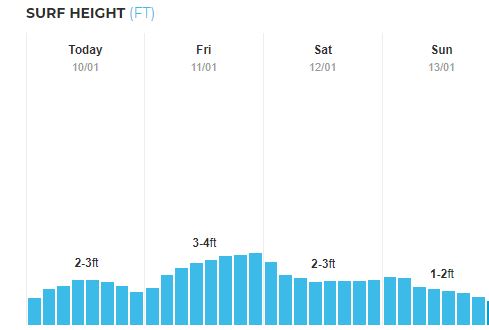
Source: MagicSeaWeed.com.

Happy hunting,
TreasureGuide@comcast.net

Wednesday, July 23, 2014

7/23/14 Report - Depression Two Moving West. Emeralds Found. Great Tool To Inspect & Photograph Coins For Errors and Grading.


Written by the TreasureGuide for the exclusive use of treasurebeachesreport.BlogSpot.com.

Projected Track of Tropical Depression Two
Source:  www.nhc.noaa.gov

What I am most interested in these days is Tropical Depression Two, which is moving towards the west.  It is not expected to become a hurricane in the next few days.  The current track seems to be towards the Gulf of Mexico.

One thing to remember is that it doesn't take a hurricane to really improve beach detecting conditions.   Sometimes a storm that sits off the coast and churns a while can actually do more to create erosion. 


The Mel Fisher organization says,  Our members spent six days sifting through material in search of Atocha Emeralds while enjoying the biggest Mel Fisher Days celebration to date. A total of 18 emeralds were recovered! The emeralds were of varying sizes and shades of green including this beautiful recovery.

I always encourage methods in addition to metal detecting.  Sifting is sometimes a good one. 


In the past I've shown photos of coins and things made with a Celestron Hand Held Microscope.  I really enjoy using the microscope.  Not only does it make good close-up photos, but it is also an easy way to inspect coins and things.

The microscope hooks into your computer using a USB port and the image appears on the computer screen.  You can then capture photos or even videos, if you want to move the object or take videos of a moving object. 

Although it is called a hand-held microscope, it comes with an adjustable stand which can be used to focus the microscope so that you can quickly pass coins and other items under the focused microscope for close inspection.  It makes it easy to see any small markings on rings or other items. And is good enough to make it very quick and easy to detect errors or other small details on coins.

Above is a nice high-relief 1946 Canadian penny at low power.  And here is a photo of the designer's initials found below the leaf on the right using higher power.

The actual computer image is even better than the photos shown here.

The microscope will show very fine details and could definitely help you find errors or grade coins.

I've started a test of the coin cleaning method that I mentioned yesterday and took photos of a coin and medallion before I froze them in water.  I'll take photos of the same objects after they have been thawed and we'll get a good idea of how well freezing worked to clean the coins.

Celestron Hand-Held Microscope Mounted On Stand

Besides inspecting coins you can also inspect other things, of course.  Have you ever had a hard time seeing the marks inside a ring?

You can put a ring under the microscope too.  Move it around so you can see all areas of the inside of the band until you find any marks.

Below is an example showing the marks found inside a silver ring.

I find it much easier to look at items under the focused microscope than trying to look through a loop or magnifying glass.  The microscope has its own variable lighting too. 

If you've tried to use a loop, you know how difficult it can be to stay out of the way of the light while getting a good view.

Marks Found In Silver Ring

One thing I should have added about the Step Search strategy that I described yesterday is that it is very much about identifying and working various layers.  You will often be working through layers.   For example, if there is a layer of surface aluminum, and you are working in a "coin mode" you'll probably being removing items from the second or third layer before the first.  Nonetheless, you should be identifying each layer and the predominate types of items found there and what is likely remaining at each layer.


On the Treasure Coast the wind will be coming from the South for days and we'll be stuck with a one foot surf.  You might like that if you water hunt for recent drops.

The tides are pretty flat now too.

Tropical Depression 2 is still way out there.

Happy hunting,
TreasureGuide@Comcast.net