Showing posts with label emeralds. Show all posts

Saturday, February 9, 2019

2/9/19 Report - Great Treasure Coast Eye-Ball Find This Week. Beach Conditions. Bigger Surf Coming.


Written by the TreasureGuide for the exclusive use of treasurebeachesreport.blogspot.com.

Emerald Found This Week On Treasure Coast
Find and photo by Joe R.

Here is what Joe said.


Eyeballed this in the surf line Mon. 2/4


2.10 carets.


My jeweler confirmed it is an emerald.

Thanks Joe.  Great find!

In the past I've posted several emeralds eye-balled on Treasure Coast beaches.

Here is an excerpt from a 2106 article about some fantastic shipwreck emerald finds.


… An exciting feature of the collection is a clutch of cut gems found on the wreck of the Nuestra SeƱora de Atocha, a galleon bound for Spain in 1622 which sank off the Florida Keys while heavily laden with copper, silver, gold, tobacco, gems, jewels and indigo.

The ships had sailed from Spanish ports at Cartagena and Porto Bello in New Granada (current Colombia and Panama, respectively) and Havana, Cuba.

In 2014, the Atocha was added to the Guinness Book of World Records for being the most valuable shipwreck to be recovered, as it was carrying roughly 40 tonnes of gold and silver, and 70 pounds (32 kg) of emeralds which are treasured for their deep, clear green...

And here is the link if you want to read the entire article.

https://www.telegraph.co.uk/news/2017/03/16/rare-emeralds-found-400-year-old-shipwreck-expected-fetch-millions/

---

I took a look at some South Hutchinson Island beaches this afternoon.  The beaches were as ugly as the weather was beautiful.

John Brooks Saturday Afternoon.
John Brooks Beach Saturday Afternoon.
As you can see there was some beach-front filling and some seaweed washed up.  You can still see the old cliff face though.  There were also Portuguese Man-O-War washing up.

Near low tide was a few scattered shells in a flat area and then a small dip in front of the beach.

Fort Pierce South Jetty Park Saturday Afternoon.
The beaches that I looked at besides John Brooks all looked pretty similar.

Fort Pierce South Jetty Beach Saturday Afternoon.
MagicSeaWeed is still predicting a five to seven foot surf tomorrow (Sun.).

Source: MagicSeaWeed.com.
Happy hunting,
TreasureGuide@comcast.net

Monday, July 23, 2018

7/23/18 Report - Cache Hunting: Tips and Misconceptions. Fisher Organization Salvage Activities.


Written by the TreasureGuide for the exclusive use of treasurebeachesreport.blogspot.com.

I've written about a couple of Florida cache finds this year.  Caches are found, but not real often.

Hunting for a cache is different than hunting for individual coins or pieces of jewelry, and a lot of what you read about how to find a cache is wrong.

The first thing about cache hunting, is you have to have reason to be looking for one.  If you just go out and cover a lot of ground, you might eventually find one, but the odds are very long against it.

Caches are rare, so it helps if you have reason to believe there might be one.  Of course if you are hunting the right kind of place, for example a historic home site, you should be aware that there is always the possibility of a cache being present.  If you don't want to miss any possible caches, you want to alert to a variety of types of targets that you otherwise might discriminate out.

If you read most articles about cache hunting, you'll probably read about things like two-box detectors for detecting really deep targets.  For many caches, a regular detector will work just fine if you aren't using too much discrimination.  The idea that every cache is going to be buried ten feet deep just isn't true.  People don't have to dig down ten feet to hide a cache.  There are other things that will hide a cache as well or better than a few feet of earth.

Someone who buries a cache, will usually hide it where they think they can find it again.  That means that the cache will be near landmarks or features - perhaps a tree, wall, fence or walk.  That can cause a problem for the detectorist.  They will not be able to detect the area well either because of physical obstacles, like walls, or noise from rebar or buried cables.  You can't detect with a two-box detector in small areas or around other big metal items.

The caches that I'm most familiar with were buried in canning jars, not treasure chests.  One cache was distributed around a home site with individual jars placed in different areas.  And each jar contained different kinds of coins.  You don't know what the container might be so you don't want to discriminate iron or a lot of other metals

If you've been hunting very long, you can probably easily tell the difference between a small surface target and a deeper large target from the sound of the signal.  You can't pay too much attention to your meter.  Many caches will give mixed signals because there can be signals from the container as well as the coins or whatever else is in the container.  They can be quite a mixed bag.

---

A very dark two carat emerald was discovered on 7/11/18 while the Magruder was working Emerald City.

The Magruder will be going back to the site of the Margarita to dig the virgin area on the northern trail near where the gold chalice was found years ago.  They will be using an airlift to excavate holes in the bedrock.

The Margruder was finding Ming Dynasty blue and white porcelain and olive jar shards on the Atocha site.

The Fisher organization will also be returning to the deep target site with Dolores.

---

I think it is amazing how little coins have changed over the past thousand years.  I guess they were well-designed for the job and worked well.  Mostly flat and round with designs on two sides.  It is fairly obvious what works well about that.

Anyway, I think coins will be going away before long.  Canada quit producing the-one cent coin in 2012.

Keys had a long run too, and are disappearing.

---

We had a nice west wind this morning, but there are no storms around, and the surf is only one to two feet.

Happy hunting,
TreasureGuide@comcast.net

Wednesday, April 25, 2018

4/25/18 Report - Understanding Factors Involved With How Coins Move in Sand. Archaeological Detecting. Emeralds and Silver Bars.


Written by the TreasureGuide for the exclusive use of treasurebeachesreport.blogspot.com.

A couple days ago I talked about how coins move on the beach.  Evidently a lot of people were interested in the topic and followed up by visiting previous posts on the subject.  As a result I decided to show something that clearly illustrates some of the main factors involved.  It isn't simple because it depends upon a variety of factors - the force and direction of the water being a couple of the most important.  The complication is that the water force can change from near zero to very high.

First, here is a question for you?  Will a coin always move in the same direction as the current.

Here is an illustration.


The illustration shows a coin lying on a sand slope.  The current is moving towards shore and up over the slope very much like it would with a surge.

What do you think will happen?   It depends upon the how strongly the current is moving, but if the current is very slight it can move sand in and pile it up on the slope and eventually cover the object.
However, if there is enough current, but not too much, the current will move the sand from around the coin, especially the that part of the coin that faces the current.  That would be red area shown in the next illustration.

When a sufficient amount of sand is moved from that area, the coin will slip down the slope a notch and remain there until enough sand is moved for the same thing to happen again.  Of course the current would have to remain about the same and the coin would be in the same orientation on the sandy slope.

I've seen this actually demonstrated in a tank filled with water and sand and a controlled current.  This is a case in which the object moves opposite the direction of the current,  If the current is either too weak or too strong, it won't happen the same way.  If the current is strong enough, it can push the coin along in the same direction as the sand.

The important factors are the characteristics of the objects to be moved, including both the density and shape, as well as the force of the current.

When an object like this coin is on a slope and the supporting sand is removed, gravity moves it down the slope.

One of the important characteristics of a coin is the shape.  Coins tend to lie flat against the surface and present a small and rounded edge towards any modest current.  The current then speeds a little as it is forced around the stationary object.

A variety of things can destroy this entire scenario.  Just think of a wave crashing right on top of the slope and coin.  In that case, sand will be thrown around and the coin moved rather abruptly.

 ---

The Society of American Archaeology web site lists a variety of projects involving detectorists.

Here is the link.

http://www.saa.org/ForthePublic/Resources/MetalDetectingInArchaeology/MetalDetectoristsParticipatinginArchaeologyRe/tabid/1030/Default.aspx

---

There are several 1715 Fleet emeralds up for auction in the current Sedwick auction.  They have starting bids of around $100.  I've posted about people who have found emeralds on the Treasure Coast beaches.  Some of those emeralds are not the greatest, but one exceptional one was a 68 karat emerald found by a lady that was collecting shells at Golden Sands beach.  Watch for green in the shell piles.

https://auction.sedwickcoins.com/Crude-natural-emerald-from-the-1715-Fleet-8-5-carats_i29836856

The big silver bars seem to be bringing in really good prices.  I think one is up to about $29,000 already.

---

The surf is pretty small now and won't start increasing again until Monday.

Happy hunting,
TreasureGuide@comcast.net

Monday, August 28, 2017

8/28/17 Report - Famous 1715 Fleet Find From the Past. More on Silver and Gold Rings. Silver Corrosion and Wear. Storm Situation.


Written by the TreasureGuide for the exclusive use of treasurebeachesreport.blogspot.com.

Famous Find From the 1715 Fleet
Photo submittted by Darrel S.

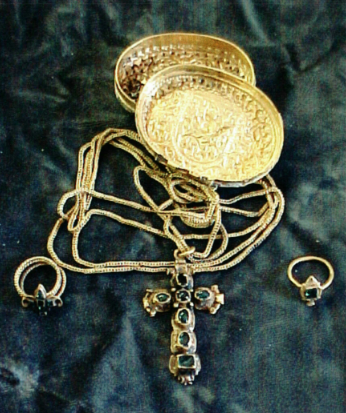
Darrel S.sent the above and following photos, about which he said, I remember when Capt. Jon Wilson found the gold box with these items inside near the Cabin Wreck. Steve Hancock received one of the rings, Jon got the necklace, state got the box, AND TAFFI GOT THE CROSS (displayed in their Sebastian Museum.)

It isn't a recent find. Darrel also said, The gold box with cross, necklace, cross, and rings was found 6/1/03.  [I originally posted 01, but the correct year is actually 03.]

 The photos are Darrel's personal photos, which he said were originally taken in the Fisher lab in Sebastian.

In the past couple of posts, I've been talking about intertwined or interlinked rings.  That discussion started with a couple of silver rings found by John C. along with a couple of cobs.  

The rings shown in the above and following picture have a very common design that I might describe as a twisted rope design.  Three gold twisted rope bands make one ring that has a gold setting with emeralds.  

Here is a closer picture of that.

Gold Ring Found by Captain Jon Wilson.
Photo submitted by Darrel S.
The twisted rope design is a very common design still used today.  You'll see that type of ring in silver and gold and other metals.

Thanks much to Darrel S. for the great pictures.


John C., after sending me the photos of the intertwined rings that were found with a couple of cobs, also sent me the following picture of a very thin silver ring and said, Some may be thinking, a silver wire ?  No it's what's left of a very badly worn silver ring .I guess it depends on the original size, but how many years does it take for a ring to become so badly worn ?

Thin Silver Ring.
Find and photo by John C.
Of course gold is not subject to the same type of corrosion as silver.  Some silver cobs found on the beaches are worn very flat and thin - by my estimation, sometimes to less than half the original weight.  The above ring is certainly worn down a lot, but I suspect was originally fairly thin to begin with. You can often find a joint on rings like that where they were cut and soldered together.

I think this kind of silver wear and corrosion can take place surprisingly quickly.  I think that kind of corrosion can take place in a matter of a few decades.  If I remember, and I run across the examples I'm thinking of, I might post them in the next few days.

Not long ago (8/3/17 post) I showed a paper thin silver Roosevelt dime that was found on a beach.  It is shown below.  I have others that are literally paper thin, and when I say literally, I mean it.

Paper Thin Silver Dime.
My first possible reale find was what I would call a razor.

Obviously, some silver coins and rings are not as worn.  Some show very little silver loss.  The amount of corrosion and material loss depends to a large extent on exactly where it has been, how much the item as been tumbled in the sand and rough surf and how much air and salt water it has been exposed to.

I still don't know why divers almost never find silver rings on the 1715 Fleet.  I have shown one example attributed to a 1715 Fleet source by our state archaeologist, who also has documented silver rings to Spanish colonial archaeological sites.  I suspect that more than one factor is involved.

Some jewelry found on the Nieves site suggests the presence of a jeweler on board.  Incomplete pieces, as well as materials and jeweler's tools, have been found on that site.

---

I hope I didn't make too many mistakes in this post.  I kept finding them, but I hope I got most of the typos corrected.

---

Maybe in the near future I'll post more examples of the kind of thing I was talking about today.

---

Source: nhc.noaa.gov
The low pressure area that has been hanging over Florida looks like it will become a tropical storm and skirt South and North Carolina.  We'll have a small surf for most of the week.

Havey looks to be headed towards Arkansas rather than going back out into the Gulf.  He won't affect us much.

There is still time to respond to the blog poll.

Happy hunting,
TreasureGuide@comcast.net

Wednesday, April 5, 2017

4/5/17 Report - Hutchinson Island Beach Conditions. Atocha Emeralds and Gomar Collection.


Written by the TreasureGuide for the exclusive use of treasurebeachesreport.blogspot.com.

Typical Beach This Morning.
I looked at a few beaches this morning.  Every one had newly accumuated sand.

John Brooks, Another Mushy Beach.

Shell Pieces Near High Tide Line
You can see from the above picture that the water had been fairly high and washed up pieces of shells. 


Fort Pierce Jetty Park
The renourishment sand is almost all gone now.  Heavy equipment is ready to begin the next renourishment project though. That will begin soon.


One More Beach With Nothing But Sand This Morning.

As you can see beach conditions generally are not good right now.  We've had a few days or southeast winds.

---

The Marcial de Gomar Collection of rare emeralds, including the largest collection of cut emeralds from the Atocha, will be auctioned on April 25 beginning at 7 PM by Guernsey's auction house. The auction will also include coins from the 1715 Fleet.


Click here to view the ecatalogue.

---

Snake hunters received a $600 reward for capturing a 15 foot python in the Everglades.

http://www.foxnews.com/us/2017/04/04/python-hunters-describe-dangers-wrangling-15-foot-snake-in-florida-everglades.html

---

The past few days I've been talking a bit about erosion.  Erosion can be one good sign of improving beach conditions, but old shipwreck coins can be found at times when there is little or no erosion. That mostly occurs when the high seas and tides push up high on the beach, such as after a hurricane when the unusually high water comes directly from the east.  Shells will often be pushed up onto the beach then too.

Those times are not as good as when you have some good erosion though.  Cobs on uncut beaches will usually be few and scattered.  The exception is when the high water hits the dunes and washes cobs out from the dunes.  Then you can get good numbers.

---

A cold front will be coming through.  A higher surf is not predicted though, until next week.

The pink diamond I mentioned the other day sold for over 70 million dollars.

Happy hunting,
TreasureGuide@comcast.net

Saturday, March 18, 2017

3/18/17 Report - Some Real Gems. Teenager Finds 7.44 Karat Diamond. Atocha Emeralds Auctioned.


Written by the TreasureGuide for the exclusive use of treasurebeachesreport.blogspot.com.

877 Karat Emerald Known As La Gloria To Be Auctioned April 25.
Source: CNN link below.

This seems to be the week for gems. Huge gems are in the news, including some from the Atocha.


On April 25, the public will have the opportunity to own some of the most magnificent and valuable emeralds in the world, when they go up for sale at Guernsey's auction house in New York...

One of the highlights of the sale is a collection of cut emeralds from the great Spanish shipwreck Nuestra SeƱora de Atocha, a galleon that sank off the Florida coast in 1622...

Here is the link for more about that.

http://www.cnn.com/2017/03/16/luxury/guernseys-shipwreck-emeralds-auction/index.html

---

Diamonds are in the news too.

An Arkansas teenager hit the jackpot Saturday when he found a 7.44-carat diamond at the Crater of Diamonds State Park in Arkansas.

Many people spend hours searching for diamonds at the park only to walk away empty-handed, but Kalel Langford, 14, had only been at the park with his parents for 30 minutes when he spotted a shiny, dark brown gem, according to a statement.  Kalel took the stone to the park’s Diamond Discovery Center later in the day and learned that the shiny rock was actually one of the largest diamonds ever discovered in the park...

Here is the link for more on that story.


I've written about Crater of Diamonds State Park in Arkansas where anyone can pay a fee and hunt diamonds.  The story about how it was discovered is interesting.  A hog farmer discovered a diamond in the mud.  I've told that story before.

Thanks to Dean for leads on both of the above stories.

---

An African church minister who supplements his meagre stipend by scrabbling for minerals in the artisanal mines of Sierra Leone has discovered one of the largest diamonds ever found.

The stone is to be auctioned, the Sierra Leonean government announced yesterday, although its value cannot be determined until its quality is assessed. An 813-carat diamond was sold at closed auction in London last month for £51m...

And here is that link.


I once got an email from a woman saying that her husband was talking about buying a metal detector and quitting his job.  She wanted to know if he could really make a living doing that.  I gave her my answer and she replied saying her husband wasn't going to be happy.

Well, first of all, most people don't metal detect for a living.  Very few do.  And there is a good reason. Most would dismally fail.   It is not something you can do that easily.

I remember years ago seeing people yelling "get a job" at a detectorist that was metal detecting in the water near Miami Beach.  I don't know if they actually thought he had no job and was detecting as a living, but it seemed like they did. Some people (very few) are professionals detectorists.  Some some people are obviously hobbyists, but I guess it might not be so obvious is if you don't know much about it.  The number that are professonals must be something like one percent of one percent of all detectorists.  That is my guess.

In the old days the professionals tried to remain invisible.  (I'm talking about detectorists here, not treasure salvors.)  The pros intentionally flew below the radar.  They didn't want to be seen or known. Today it isn't like that.  At least not entirely.  Some today do whatever they can to publicize and promote themselves.

But back to the point I wanted to make.  You can't just buy a detector and go out and expect to make a living at it.  If you are one of the few that can make a living out of it, you first have to put in a lot of time before you get to that skill level.  And it isn't easy.  You can't just go out and wave a detector around and expect to make any kind of profit.  For one thing, you have to be where there is a lot of things to find, such as South Florida.  You can't squeeze gold out of a beach that has none.  If you don't live near excellent detecting, you have travel time and travel expenses to deal with.

Most hobbyists don't keep track of expenses.  Metal detectors are expensive.  Many cost a thousand dollars or more.  And if you are hitting it hard you have more than one and you've gone through several.

Scoops are expensive too.  Then there are pinpointers, batteries, parking fees, detector repairs, wetsuits, etc. etc.  That is a lot of expense  before you can think about making any kind of profit.  I'm sure that most detectorists don't cover expenses.  Most don't really try to.

Some people that I know have paid thousands for a metal detector just because they enjoy playing with it.  They don't really care if they are making a profit.  They enjoy the activity and what they find is just icing on the cake.

Serious metal detecting can also be very strenuous.  I could not today do what I used to do.  There were times when I would walk miles and worked in very rough conditions.  There were times that it was very dangerous.  I wouldn't do some of that today.

I liked to test myself and see what I could do.  It wasn't a profit motive that drove me.  I had some good jobs and a good bit of spare time. I didn't have to find anything to pay the bills.  I did a lot of business travel so I took my metal detector and got to detect a lot of different locations.

I took a few months off between jobs once when I proved to myself that I could make a living out of detecting beaches and shallow water.  I wanted to find out if I could.  That was decades ago.

To repeat my main point - you can't just buy a detector and go out and leisurely make a living out of it.  Don't bet the bank on it without first giving it a try and really finding out what it will take to be successful.  For me now, it is a very enjoyable educational activity that provides a multitude of benefits.  It is a good way to connect with the past and learn a little more about yourself.

---

We have a small surf and small tides on the Treasure Coast now.  If you are a shallow water hunter, it is probably a good time.

The surf is supposed to increase next week.

Happy hunting,
TreasureGuide@comcast.net


Wednesday, April 20, 2016

4/20/16 Report - Gold Brooch From Corrigans. Poll Results On Treasure Hunter Spirituality. More On Andy's Crucifix Find.


Written by the TreasureGuide for the exclusive use of treasurebeachesreport.blogspot.com.


High Carat Gold Brooch With 12 Emeralds
Listed In Current Sedwick Treasure Auction.

This broach was found on the beach at Corrigans.  It is listed in the current Sedwick Treasure Auction.  The item number is 1682.  I posted it because it is an interesting beach find.

--

The most current blog poll has concluded and the results are in.  77% of the respondents said they were religious or spiritual.

It should be noted that some good number of churches preach against what might be called "religiousity" so a good number of those who described themselves as spiritual might also be affiliated with a church.  In retrospect, I probably should have defined the first two categories a little differently.

Nonetheless, the poll does show that most detectorists do have some spiritual or religious feeling. That is what I suspected from the emails I receive and what I hear people say.

Religious or spiritual feelings are evidenced in how treasure hunting is experienced and how events are interpreted.  For example, I often hear karma mentioned.  That could indicate a type of spirituality however it also could be little more than a common expression that implies little about any deeper analysis or feelings.  It might be one of those things, like the very common phrase "in our thoughts an prayers," which I believe is often used these days as a politically correct thing to say in certain situations even though the person does not have any intention of seriously praying.

9% of the blog poll respondents described themselves as agnostic, and the same number described themselves as atheistic.  A PEW poll conducted in 2014 found 4% to  be agnostic and 4.2% to be atheist.  A higher number of those that responded to the blog poll and therefore presumed to be detectorist are atheist or agnostic.  The poll therefore did not support my feeling that detectorists and treasure hunters tend to be more spiritually or religiously inclined than the general population. The blog poll did support the notion that a large majority of detectorists or treasure hunters are religious or spiritual.

A spiritual world view will affect how people behave and interpret events.  As I mentioned above, I often hear terms like karma used in the metal detecting community.  That suggests a certain type of behavior based upon what I would think would have to be a spiritual world view or at least some universal intelligence or governing agency.  I guess it could, however, be a concept held by those believing in an entirely material world that somehow behaves in a karmic manner, although I have a hard time imagining how that would work.

---

Concerning the crucifix that I talked about the last couple of days, Laura Strolia added the following.

I imagine the cross is from the 20th century. Keyholes [hangers*] began in the early 1900s. The Victorian era was known for nails, wire, and ribbon.

I never asked what the cross is made of. Why isn't it corroded? My guess it was someone's inherited crucifix from a family member and the person decided to bury it. I put my broken rosaries and other objects in the ground as one shouldn't "throw out" blessed religious artifacts. Ironic, here I am digging and placing treasure back into God's holy earth, opposite of what I do when metal detecting!

Laura

Thanks Laura!

* Added by TG.

Andy thinks it might be bronze.
---

The Treasure Coast surf has decreased and is now down to around three to five feet.  By Monday we'll be back to a one-foot surf.

Happy hunting,
TreasureGuide@comcast.net

Monday, March 28, 2016

3/28/16 Report - History and Geology of Columbian Emeralds.


Written by the TreasureGuide for the exclusive use of treassurebeachesreport.blogspot.com.


Huge 1759 Carat Columbian Emerald.
Source: Article found immediately below.
Yesterday I showed a cross found by John C. on the Treasure Coast.  It held small pieces of emerald. In the past I've shown other artifacts found on the Treasure Coast bearing emeralds and even some raw emeralds found on the Treasure Coast near shipwreck beaches.  Today I am presenting more information on South American emeralds, and the history and geology of Columbian emeralds.

Here goes.

...When the first Spaniards arrived in the New World in the early 16th century, emeralds were being worshiped, were used in jewelry, and played an important role as sacrificial offerings in ceremonies such as the famous El Dorado ceremony on Lake Guatavita, located just northeast of Bogota [Bray, 1978). Emeralds were being traded as far south as Peru and Chile and as far north as Mexico. According to Morello (1957], when Spanish conqueror Cortes met the Aztec emperor Montezuma in Mexico in 1519, the latter was bedecked with fine emeralds. Reportedly, Spanish conqueror Pizarro sent four chests of emeralds from Peru to the King of Spain in 1533. These were all undoubtedly of Colombian origin (Ball, 193 1). 

Chivor was the first operating emerald mine discovered by the Spaniards in their conquest of the New World. Gonzalo Jimenez de Quesada saw the first sign of emeralds in Colombia at Turqmequ6, Boyaca, in 1537 (Colombian American Business, 1979). Quesada sent Captain Pedro F. de Valenzuela to find the source. That same year, he located the well-developed Chibcha Indian mine of Somondoco, later to be named Chivor after a nearby valley. Soon thereafter, the Spaniards were vigorously working the Chivor mine using local Indians as slave labor. Five years after the founding of Santi'sima Trinidad de 10s Muzos in 1559 (Wokittel, 19601, the Muzo and Caijma Indians' mine was located some 7 km to the west on the Itoco Hill. Actual mining of the Muzo area by the Spaniards began in 1567, and initial production is said to have overshadowed production at Chivor (Feininger, 1970). By the end of the 16th century, both Chivor and Muzo were being vigorously worked using Indian slave labor. In 1592, the first recorded grant of Chivor was given to Francisco Maldonado de Mendoza by Antonio Gonzalez, president of the New Kingdom of Granada. By this time, however, the treatment of the Indian slaves was so inhumane that on September 22, 1593, President Gonzalez issued a 39-article decree protecting the Indians (Johnson, 1961). This decree was soon followed in 1602 by several royal orders from Phillip 111 of Spain to enforce the law. By this time, however, the Indian population had already been decimated. As a consequence of this loss of cheap labor and the litigation that followed the royal orders, production of Colombian emeralds declined drastically. In 1650, the Muzo mines were declared royal property, and production further declined. By 1675, the Chivor mine had been abandoned; its location eventually became a mystery that endured for over 200 years. Muzo continued to be worked sporadically throughout the 17th, 18th) and 19th centuries (Barriga and Barriga, 1973) until the government declared it the National Emerald Domain in 1871 (Colombian American Business, 1979). When the mines at Muzo came under government control, production all but ceased and lawless disorder came to characterize the area...

The title of the paper is Emeralds of Columbia by Peter C. Keller.

I can't get the link to work for some reason, but if you want to read the entire article, which I would recommend, I'm sure you will be able to find it by entering Emeralds of Columbia - GIA by Peter Keller.

GIA, of course, is the Gemological Institute of America.

You will learn about the geology of Columbian emerals and also the history, which goes up to the present day.

---

And here is more history from an article about carved emeralds.


...It seems that Mexico or South America are the hot spots for the origins of carved emeralds. South Americans were carving emeralds no less than 1,000 years before the Spaniards stole them all away and carried them to Europe. The oldest known carved emerald, dated from 500 BCE to 200 BCE, is a small figurine attributed to the Olmec, an indigenous people group living in the tropical lowlands of Mexico between 1500 BCE and 400 BCE.
Scientists have tested the stone and found it consistent with emeralds found in Russia (an unlikely trade route) and Colombia. As the Olmecs were known to trade with several South American groups for gems, including blue jade from Guatemala, it is most likely that this emerald originates from Colombia. {Morgan, p. 78}
Nearby Colombia, in Peru, there are legends of the goddess Esmeralda, who was purported to live in a large emerald ostrich egg.  Rumor has it that Spanish conquistador Francisco Pizarro ransacked the beauty’s temple, taking from her priests all her “children,” which were really the innumerable emeralds her loyal followers had offered to her on festal days. Those that were not destroyed by ignorance (aka, by hammer and anvil testing) were loaded on ships. Hundreds of pounds of emeralds set sail for Spain in the 16th century {Corcoran, p. 877}.
Meanwhile on the North American continent, another conquistador, Hernan Cortes (Cortez), ransacked Mexico, taking home with him his own fair share of emeralds carved by the skilled hands of Mexican lapidaries. A handful of these precious gemstones would soon be his downfall.
The Queen of Spain desired a gift, a carved emerald in the shape of a large rose. History intimates that he knew of her desire, but instead gave the rose, as well as four other carved emeralds ((a horn, a fish with golden eyes, a bell with pearl clapper, and an elaborate cup) to his wife. Some accounts relate that they were presented in the form of a charm necklace, while others describe five distinct sculptures. Regardless, he lost the favor of the Queen upon his return to Spain, and the necklace was lost at sea eleven years later during a shipwreck off the Barbary coast...
And here is the link if you'd like to read more about carved emeralds.

http://eragem.com/news/the-history-of-carved-emeralds/

---

I got out for a few minutes of surface hunting yesterday.  That was my first hunting in about a month.
I found a few interesting pieces and will post some photos sometime soon.

Among the items was a brick, which looked like it was cut from coral.  I'll have to research that.

While the surf hasn't been high for some time, I'm sure the recent tides and wind direction changes opened up a few holes that would produce modern items.  I wasn't out there to find them, but as my care-taking duties decrease, I do expect to get out more in the near future.

The surfing web sites are predicting a big surf out about ten days.  I'd bet that it doesn't happen, but will keep watching.

Happy hunting,
TreasureGuide@comcast.net

Friday, October 9, 2015

10/9/15 Report - Survey Of Some Vero and Sebastian Area Beaches. Holed Two Reale Recently Found. Beach Emeralds.


Written by the TreasureGuide for the exclusive use of treasurebeachesreport.blogspot.com.

Find and Photo by Andy.

I was talking about holed coins recently and showed a couple yesterday that were hung on a crucifix.

Here is a 1819 2-reale from the Mexico mint recently found on an Indian River County beach.

Notice the hole and the amount of wear displayed by this silver coin.

I received the email below from Andy, who found this coin.


Hi. First I want to thank you for your blog! I have read every post since you started...
multiple times in fact. In late 2009 I eyeballed a replica treasure coin before I ever touched a metal detector and sent a photo to you. You verified that it was fake but launched my interest in the subject. Since then I have used your knowledge through the blog to learn the art of beach detecting. I can't thank you enough for what I have learned. I am a local government official involved in the veroman site and other local historic sites so I love your insight on these topics. Recently your post on holed coins grabbed my interest. A few weeks ago I found a holed coin north of vero on a non treasure wreck beach along with a small ship spike. Today your post included an image of a cross up for auction with two reales attached. The coins look very similar to the one I found. I would love for you to look at the coin I found and offer your thoughts. Thank you! -andy

Thanks for sharing Andy.  

If anyone else has found a similar period coin on a beach north of Vero, I'd like to hear about it. Maybe we can come up with some ideas or maybe some theories about possible sources.


---


Amber Sand Beach This Morning After High Tide
Some of the Treasure Coast beaches are definitely improving.  But they aren't there yet.

They are losing sand.  There are some big cuts at the back of the beach in the old renourishment sand.  There are even some small cuts in front of that.  But the slopes are mushy.

I took a look at Rio Mar, which was not good at all, Turtle Trail, which was definitely improved, and Seagrape Trail, which was not as much improved as Turtle Trail.  Wabasso had a mushy slope.   Amber Sands, was somewhat improved.

There is so much renourishment sand still out there.

I'd say there will be a few cobs found somewhere, but the chances are slim for most detectorists.  I'm not going to increase my beach conditions rating yet, despite the improvement that is occurring.

I did not get to see what the bottom of the slope was like because the tide was still fairly high when I was out there.  I wish I would have been able to go out at low tide so I could have seen if there were any dips near the low tide line.


Seagrape and Turtle Trails This Morning After High Tide.


Notice the dip and the cliff up by the steps in this last photo.

The biggest disappointment was the mushiness of the slopes.  I wish I would have been there nearer low tide so I could have seen the low tide area.


This is a good first step for the Fall/Winter season.  I hope things continue to develop.


Yesterday I showed what the South Hutchinson Island wreck beaches looked like.


---

A few days ago I showed an emerald found on a Treasure Coast beach.  Bill F. had this to say.

Several years ago, when I was more active in beach hunting, knew a guy
who had found several (around 50) emeralds, all in one location. He didn't
divulge the location, and I didn't press him.  Many doubted his claim,
but after talking with him, I had no reason to doubt him.

He was turned onto the location by a lady who had walked the beach

every day for years.  I've lost touch with him, but wish him the best.   Bill F.


Thanks Bill

---

Happy hunting,
TreasureGuide@comcast.net

Saturday, August 1, 2015

8/1/15 Report - Two Valuable Treasures. Which Is Most Valuable? Detectors In Various Price Ranges And What People Are Spending.


Written by the TreasureGuide for the exclusive use of TreasureBeachesReport.blogspot.com.

Two Pearls From Margarita
Found in 2007
Gold Cross Discovered On Cabin Wreck
Recovered in 2003


Which of these is the most valuable?  You might be surprised.

This Gold and Emerald Cross was found inside of an ornate gold box that was sealed shut due to its centuries under water. Along with this magnificent Cross was a five-foot long chain and two spectacular emerald rings. Discovered on the site known as the "cabin wreck" while exploring the 1715 Fleet, the Cross may well have been meant as a gift to Elizabeth Farnese, Duchess of Palma, from King Philip V of Spain. After his previous wife died in 1714, Philip began to woo Elizabeth. She eventually consented, but would not consummate the marriage until she received her weight in gold and jewels . Already behind schedule, the 1715 Fleet was forced to delay even further so that fine jewelry and other wedding gifts could be delivered to the ships headed back to Europe. Due to turbulent weather, unfortunately, the ships carrying many of the new Queen's jewels sunk well before they reached European soil.   Estimated Price: $100,000 - $125,000

Two Pearls  In June 2007, Blue Water Ventures in conjunction with Motivation, Inc. (the Fisher family's salvage operation) found a lead box within the Margarita's wreck site that contained thousands of pearls. Following the discovery, a gemologist from the GIA was enlisted to analyze and categorize the pearls so that their history and guidelines for future care could be established. Conclusions drawn from the numerous tests performed do confirm that the pearls are historically important, the nacre condition of these pearls is good given their age and the hundreds of years they spent on the ocean floor. It is believed that the lead box they laid in had in fact protected the pearls from significant damage and erosion. These two pearls in particular are the two largest pieces stemming from the 16,000 pearl discovery aboard the wreck of the Santa Margarita, the sister ship of the Atocha. Attributed to Indian pearl divers off the coast of the Isle of Cubagua near the Venezuelan coast, this particular area was specifically prized for its oysters and their pearls beginning in the sixteenth century. Each of the two pearls in this lot have been graded by the GIA as "AA," which means they have a very high luster, and at least 75% of their respective surfaces are free from defects. Considered to be part of the most unique collection in the world, these pearls hail from a rare species of oyster associated with the Nueva Esparta region where they originated. It is perhaps poignant to note that the word "margarita" in both Greek and Spanish translates as "pearl" in English. The Isle of Margarita which is situated close to Cubagua was given its name by Christopher Columbus to honor the Infanta Margarita of Austria, who was engaged to the heir to the Spanish throne.  Estimated Price: $300,000 - $400,000

To be approved to bid on these lots, please complete Guernsey's Bidder Agreement Form (http://guernseys.com/v2/images/Mel_Deo_Fisher/docs/Fisher_BidderAgreement_Form.pdf) and return it to Guernsey's by fax or email before 12 Noon (EDT) August 5.

The above pictures are from the online auction site.


To view the online auction here is the link. 

http://www.invaluable.com/catalog/searchLots.cfm?scp=c&catalogRef=LCOZ5LM9LU

---

The most read post of July was the  7/27/15 Report - MILLION DOLLARS Of Treasure Recently Found On A Treasure Coast Shipwreck Site.  The Difference Between Compact And Mushy Sand.

---

“If you want to build a boat, don’t drum up the men and give them orders. Instead, teach them to yearn for the vast and endless sea.” -Antoine de Saint ExupĆ©ry“

I just thought that was a great quote.  Antoine de Saint Exupery wrote The Little Prince. He was a French aristocrat, writer, poet, and pioneering aviator.  He was best remembered for his novella, The Little Prince.  He once wrecked and was stranded in the Sahara and last disappeared over the Mediterranean while on a reconnaissance flight in 1944.
.
---

The most recent poll has concluded and the results are in. There were 111 people that responded - a good sample size.

Seven people, 6% of the respondents, paid $250 or less for their last detector purchase.  That could include detectors like the Garrett Ace 250 or Fisher F2.  Those are decent detectors.   

My last detector cost me closer to $2500, but the one before that was the Ace 250, which cost about 1/10 the one I purchased next.  While both are worth the money in my opinion, the Ace 250 is a good value and would be an excellent first detector, back-up, or special purpose machine.  I'm not doing an advertisement - just my personal observation.  

Some people might call these detectors toys, but they are adequate for beginners and me.  My Ace is a handy detector that I use for specific situations such as making a first pass over an old home site or scanning a junky high and dry beach.  

A note for beginners -  start with something basic and simple.   More expensive does not mean more simple. And more expensive does not always mean better.  Some advanced detectors will totally frustrate a beginner.

33 people, 29% of the respondents, paid between $250 and $750 for their most recent detector purchase.  That would include detectors such as the Garrett Ace 350, Fisher F4, Bounty Hunter Discovery at the lower end, and more advanced detectors like the Garrett AT Pro, Fisher F5 at the higher end.

As I've said before, I won't touch a Tesoro because they advertise a lifetime warranty but won't honor it.  

The largest number of respondents paid between $750 and $1500 for their most recent detector purchase.  That is not surprising to me since many of the Treasure Coast use a detector such as the very popular Excalibur which costs about $1500.  That is up some in recent years.

When you get into waterproof detectectors, the price goes up.  Also specialized hunting in difficult ground often calls for more expensive detectors.

This price range includes detectors such as the Fisher Gold Bug II, Garett GTI 2500, Fisher F75, Teknetics T2, and up right around $1500, the Minelab Excalibur.

Prices will vary depend upon where you buy and what options and accessories are included.

The Excalibur might fall in the $1500 to $3000 category, depending upon where you got it etc.   In retrospect, the one thing I would change about the poll is the $1500 cut-off point.  The Excalibur is so common on the Treasure Coast and comes in at about that price.  It could fall on either side of $1500.  

The Minelab E-Trac is close to that lower cut-off too.  

Other detectors in that range are detectors such as the Minelab SDC and CTX 3030 and  Garrett ATX,

Above $3000 you get into specialized detectors such as the GPX and GPZ gold detectors and a whole variety of detectors.

I know I didn't include all detectors, some of which are very good.  I notice that I didn't mention any Whites detector, for example.   There is nothing wrong with that brand or others that I might not have mentioned. 


---

There is one tropical disturbance still out in the Atlantic.  It is closer to Africa than us though.  

On the Treasure Coast there is no change in beach detecting conditions.

Happy hunting,
TreasureGuide@comcast.net