Showing posts with label Claddagh ring. Show all posts

Tuesday, November 19, 2019

11/19/19 Report - Two Lost Rings - One Returned. Shipwreck Skeletons Revealed by Coastal Erosion.


Written by the TreasureGuide for the exclusive use of treasurebeachesreport.blogspot.com.

Lost, Found, and Returned Ring.
Photo from WPTV.com (See link below.)


(WESH/NBC) - A Colorado woman on vacation lost her wedding ring in the sand of Cocoa Beach, Florida, last week and never thought she'd see it again.

But after posting to social media about the problem, she got connected to Dave Mollison on the Ring Finder's website...

But he combed through the sand in a grid pattern for more than four hours and finally found it.,.,

Here is the link for the rest of the story.


https://www.wptv.com/news/state/man-returns-womans-lost-wedding-ring-he-found-on-the-beach


Thanks to Jorge Y. for that link.

---

One reader reported a lost ring as follows:  Please remind everyone that I lost an 18k gold man’s size Claddagh ring at Frederic Douglass Beach, either in the south edge of the parking lot or somewhere on the beach south of there. It’s just a little less than 1/8” thick. It’s my wedding band, so if someone finds it, I’d like it back. It is also not cast as well as the one found - it’s made kind of more like ground and etched from sheet and rounded as needed on he edges.

If you found or find this one let me know and I'll give you the contact.

---

Beginning Dec. 1st equipment arrive at Jupiter beach for the latest beach renourishment project.

---

Skeletal remains of at least six people, thought to be shipwreck victims from hundreds of years ago, have been revealed by coastal erosion...

Here is the link.

https://www.bbc.com/news/uk-wales-50445855

---

The tides are still high but the surf continues to decrease.

Happy Hunting,
Treasureguide@comcast.net

Wednesday, November 13, 2019

11/13/19 Report - Gold Ring Find. Beach Conditions and Increasing Surf.


Written by the TreasureGuide for the exclusive use of treasurebeachesreport.blogspot.com.

10K Claddagh Ring Find
Find and Photo by Warren D.

I received the above photo and following report from Warren D. yesterday (Tuesday).

I've been at Turtle Trail for the past 3 days enjoying the erosion with  the crowd of detectorists. Didn't have much luck until today. I found a Claddagh ring. It appears to have been there a while, long enough to get a little green inside the band. My first reaction was is this old but with a close look I saw the 10K in the band.
The funny thing is today the beach was somewhat sanded compared to the previous 2 days.
Also very few detectorists today compared to the crowd over the weekend and that crowd had the latest and greatest detectors.
I didn't take today seriously and brought my old Minelab Sovereign XS 2a Pro detector with a pair of new headphones my niece sent me designed to be used for music listening. It has a 550 meter that I calibrated to a US quarter and when I got a TID of 387 I had to check my chart around my neck that said small yellow ring. I said to myself "yeah right" as I dug and sure enough that's what it was.
The other little piece of metal is something I have to clean. Goes to show you never know.
Warren D.
Thanks Warren.  And Congrats!

---

Last night the wind started to blow as the front came through.  The surf was up a bit this morning, but not much was happening to the beaches yet.

John Brooks Beach Wednesday Morning Around 11 AM

John Brooks Beach Wednesday Morning Around 11 AM

John Brooks Beach Wednesday Morning Around 11 AM
As you can see, there was not much erosion.  In fact the cuts that were on these beaches Saturday are now gone.

There were some shells along the high tide line.

Shells at Frederick Douglass Beach.

Although I didn't see any beach improvement on South Hutchinson Island, the surf will continue to increase and there is the possibility of some improvement either here or in the Vero/Sebastian area.

Here is the surf forecast for the Fort Pierce area.


Source: MagicSeaWeed.com

Happy hunting,
Treasureguide@comcast.net

Monday, July 29, 2019

7/29/19 Report - More On Finger Rings Including Those From Florida and Caribbean Spanish Colonial Sites. Weather in Caribbean To Watch.


Written by the TreasureGuide for the exclusive use of treasurebeachesreport.blogspot.com.

Gold and Emerald Ring Find.

This emerald ring is an old find.  I thought I'd show it again since I'm talking about determining the date of finger rings.  This one always seemed strange to me.  For a while I thought it might be a hybrid.  The strange mount seems to have a modern look..  It looks like maybe somebody took a piece of something, maybe a brooch or something, and mounted on a band to be used as a ring.  It just always looked like it didn't go together.

---


I decided to add to what I said yesterday about finger rings found at Spanish colonial archaeological sites of Florida and the Caribbean.  I'll refer to the Deagan book on Spanish colonial artifacts again.

Deagan states, A common style of finger ring during the seventeenth century was a  simple, thin, copper-alloy band with a raised square bezel, set with a colored glass or paste stone...

These rings, reported from several seventeenth-century contexts, are very similar in form to examples made from gold and precious gems known from the sixteenth century and earlier (see, for example those from the Armada wrecks in Stenuit 1972:274... )

I've shown some gold emerald ring finds of that basic design before.


Seventeenth Century Spanish Colonial Finger Rings with Box Bezel
From Deagan (Fig. 6.8)

She mentions that a lot of the copper-alloy rings were brought as gifts for the natives.  I've wondered if their presence on shipwreck beaches might have something to do with early native or other salvage workers.

18th century sites show a wider variety of rings. You might have noticed that I have not mentioned silver rings yet, but here is something else in the Deagan book.  She says,  Several eighteenth-century sites have produced silver or copper-ally rings featuring a large central stone set in a serrated bezel, flanked by from one to three smaller stones on each side. 

So the archaeological record seems to show the appearance of silver finger rings from Spanish Colonial Florida archaeological sites during the eighteenth century.


The following figure from the same book shows a design that is similar to the ring with turquoise stone that I showed yesterday, even though those shown in the figure 6.9 are made of copper alloy rather than silver.


Source: Deagan Spanish Colonial Artifacts Book.


As you can see, unlike many other types of artifacts, finger rings have not change drastically over the centuries.  There are trends and clues though.  In many cases it will take a detailed examination to tell the difference, and often there will be no conclusive evidence.

---


Dug Claddagh Ring.

Claddagh rings are common in both silver and gold.  This one is not a precious metal and did not come from a beach.  This one came from an area in West Virginia where 19th century as well as items centuries older were found, so it is hard to tell what its age might be.

There are no stamped markings on it.  Perhaps I'll clean it off and look at it more closely.

---


The National Hurricane Center map is showing a system in the Caribbean that could develop into a cyclone before long.

Happy hunting,
TreasureGuide@comcast.net


Monday, September 5, 2016

9/5/16 Report - Spanish Explorers and Pirates at Anclote. Messages Conveyed by Claddagh Rings.


Written by the TreasureGuide for the exclusive use of treasurebeachesreport.blogspot.com.

Old Picture of the Treasure Guide
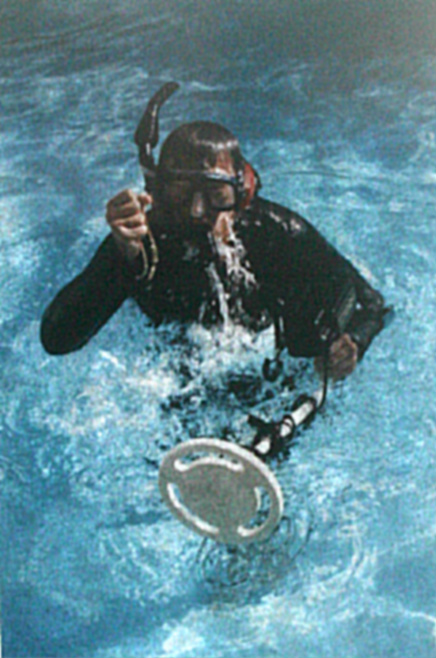
Surfacing With Gold Chain.

I've been posting a few clues to the Big Bend area of Florida that was affected by Hermine.  Treasure can be found in places that aren't celebrated so much for their treasures as the Treasure Coast.  Metal detecting will reveal interesting items almost anywhere man has been.  Some of the lesser known areas have a lot to offer to the detectorist willing to do some research and put in the time.  I like exploring new areas.  There are always new places to explore and there are always those out of the way places where there aren't a lot of detectorists and you have a chance of being the one to make the next surprising discovery.  It might be more difficult than following the crowds, but it can be very gratifying to find a new spot that you can have all to yourself.  It requires more work and patience, and skill is more important.

Here is a little of the story of Anclote.

Deep into the roots of Florida history, when Spanish conquistadors stalked the land, when pirates ravaged the Spanish main and plundered heavily laden galleons, when later buccaneers preyed on merchant shipping of the infant United States, goes the area where the little community of Anclote now stands.

On the north bank at the mouth of the Anclote river, this quiet, shaded town was the original home of the sponge industry in Florida before Tarpon Springs was ever settled.  Before the first Greek dived off his sponge boat based at Tarpon Springs, sponge “hookers” were fishing the sponge beds and selling them at Cedar Keys and farther north.

Popular legend has it that the early buccaneers watered their ships at the “Spanish Well,” a clear sparkling spring only 25 feet from the beach at the river’s mouth. Certain it is that Spanish explorers touched there.

The “Spanish Well” was probably discovered by Vasco da Gama and Pinida who landed in Clearwater Bay—the whole bay north to Anclote Key was called Clearwater bay—early in the 16th century...

The above excerpt is from an article appeared in the St. Petersburg Times on May 5, 1946.  It is one of a collection of articles on the history of Anclote.  Below is the link to those articles.


---

The most read post of August was the 8/17/16 Report - New Eight Escudo Found by Capitana Guys!  How Cobs Appear On The Beach.  The Alamo.  Tropical Depression Six Forms.

The most Google Plused post of August was the 8/9/16 Report - More Old 1715 Fleet Finds Including a Fascinating Gold Ring.  More On Old Button.

By the way, about that gold ring - I'm getting the feeling that it wasn't a finger ring, but a part of some artifact.  I'm just going by the way it was made and a gut feeling.

---

Claddagh rings are common finds.  Claddagh rings, as I've shown in the past, have been found on 1715 wrecks and are still very common in modern jewelry.

I ran across a web site advertising Claddagh engagement rings with expensive stones.  On the web site was this paragraph on how to wear a Claddagh ring and what it means.

Those who understand how Claddagh rings work will glance at your finger and make assumptions based on how you are wearing your ring. There are four options: single, in a relationship, engaged, and married. There’s no “it’s complicated” option, so you’ll have to leave that for Facebook! As can be expected, wearing the ring on your right hand indicates that you are either single or in a relationship. If the crown is pointing toward you it means you are single. If it is pointing away from you it means you are in a relationship. When the ring is worn on the left hand, the crown pointing toward you means that you are engaged, and away from you means that you are married.

Click here to visit that site.

---

Hermine hammered beaches from the Outer Banks and Delaware north to Cape Cod.  It looks like it could turn towards Massachusetts again.

The disturbance that I've been watching continues to work west.  It has passed over islands of the West Indies.

Happy Labor Day,
TreasureGuide@comcast.net

Thursday, May 19, 2016

5/19/16 Report - 1715 Fleet Silver Ring Shown in Deagan Book. Found Claddagh Ring. Danger of Cracked Rings.


Written by the TreasureGuide for the exclusive use of treasurebeachesreport.blogspot.com.

Not long ago I talked a lot about silver rings not being found on 1715 Fleet wrecks.  I did a little research and what I saw supported the idea that there were few, if any, silver rings on the 1715 Fleet.
There were, however, silver rings found at Spanish colonial land sites.  That was documented by Kathleen Deagan, a Distinguished Research Curator of Archaeology and Adjunct Professor of Anthropology at the University of Florida's Florida Museum of Natural History and one of the top researchers on the Spanish colonial period in Florida.  

In her book on Spanish Colonial artifacts, Deagan shows a silver ring that is reported to be from the 1715 Fleet.  Immediately below is part of a figure in her book showing the designs of some 1715 Fleet rings.  Notice F.  That one, and only that one, is described as being silver.  

Part of the crown over the heart is missing.


That ring is called a Claddagh ring.  It is very common type of ring, even today.

Here is one legend of the source of what we now call Claddagh rings.

Though there are several legends about the origin of Claddagh rings, the one believed to be most accurate involves a member of the Joyce clan from Galway who sailed to the West Indies, and who was captured and sold into slavery, working for a Moorish goldsmith in Algiers. During his 14 years imprisonment, he learned the goldsmith’s art and created the Claddagh ring design as a tribute to his love back in Ireland. When William III became king in 1650, he demanded that the Moors release all British prisoners. The prisoner Joyce brought back the jewelry design with him, and became a successful goldsmith in Ireland.

And from another source, here is more about Claddagh rings.  (Sorry I forgot the original source of both of these excerpts.)

Claddagh rings became widely known in America after Irish immigrants brought them over, mainly in the 18th century. They remain popular, both as wedding rings and decorative adornments. Many of the rings are now passed down through Irish-American families and heirlooms.

Here is a Claddagh ring that I once found on a Treasure Coast wreck beach.

Claddagh Ring Found On A Treasure Coast Wreck Beach.
I always thought this was silver, but I never tested it because I like the black patina, which is a little sparkly even though that doesn't show in the photo.  I didn't want to remove any of the patina.  I like it the way it is.

Here is a closer look at the illustration of design of the Claddagh ring that Deagan attributes to the 1715 Fleet.  She doesn't give any more detail on the source of the ring.


There are many similarities between the found ring shown above and the ring illustrated in Deagan's book. That isn't surprising.  Claddagh rings are Claddagh rings, and they haven't changed much over the centuries.

There are some differences too.  The hand positions and how the hand holds the heart is very similar on both rings.  The hands on both rings have slightly different cuffs.  The heart and crown is a little different on both rings.

While silver rings are very rare for the 1715 Fleet, there is a documented exception in the Deagan book.

The dug example shown today has no marks on the inside of the band or elsewhere.  A sterling mark or a makers mark can tell you a lot about the age of a ring.

This ring has a great black patina, but one of the most impressive things to me is the carved look. You can see it throughout in person.  In the photo you can perhaps see it best in the crown.

I might break down and clean it and test it to see if I can learn anything more about it.

---

Here is another item with a familiar ring to it.

On 5/10 I showed an encrusted ring (shown below) that I cleaned.  Here it is.

Old Dug Encrusted Treasure Coast Ring

After it was cleaned I could see some serious cracks in the metal.  I put it on just the other day for cleaning and it fell off.  It broke on three cracks and fell off.  If I was doing something when it happened I would not have even noticed it being gone.

The reason I bring this up is to alert you to how easily that can happen.  Any cracked ring can break and fall off at any time, so it might not be a good idea to put new finds on your finger until you have checked for cracks.  I have heavy gold rings with cracks too.  The same thing could happen.

---


The first day of the current Sedwick auction concluded yesterday.  The remaining lots will be sold today.  You can view the auction results online as it happens.  They move from lot to lot very quickly.

---


Nothing has changed on the beach.  Still a one-foot surf.  Probably more afternoon thunder storms.

Happy hunting,
Treasureguide@comcast.net

Friday, July 11, 2014

7/12/14 Report - Some Views On Metal Detectors and Metal Detecting & Claddagh Ring


Written by the TreasureGuide for the exclusive use of treasurebeachesreport.blogspot.com.

Gold Claddagh Ring Detector Find

As I've pointed out in the past, Claddagh rings are among the more common ring designs.  Claddagh rings have been made for centuries.  You'll find them in both silver and gold.  If you detect very long you'll find a few.


James F. has been detecting for around 45 years.  He started, like I did, down in South Florida.

Here are some of his intelligent and thoughtful views as expressed in a recent email to me.

I thought you might be interested in some of my views along the same lines. I agree that many of the high-end machines with all the bells and whistles are not for everybody, and it depends, a lot, on the type of hunting they are going to do and where they are going to do it. I, for one, still have at least one thirty-year-old machine still in use, but all things being equal, I have no love loss for the old machines, though they were the top of the technical ladder then, and we were quite mesmerized by their performance at the time. I run pretty much on all metal nowadays when searching any beach anyway...as the computerized E-Trac still gives you information on the target composition, (and runs on 28 frequencies simultaneously) thru both a digital value and audio, and the Excaliber, running on 17 different frequencies, gives you some pretty accurate tonalities along the same lines. My single frequency older machine goes bonkers near damp sand soaked with salty water...sure I can continually ground balance the thing, and set the discrimination way up so it somewhat ignores the mineralization, BUT I lose a good portion of my detecting range and thus the targets I seek. The old machine has one tone fits everything...just a beep on target acquisition...same beep on a gold ring, candy wrapper, bottle top, poptab, zinc, copper, silver you name it...thus you dig literally EVERYTHING. You can, of course, set the discrimination up high enough to blank out most of the trash, as well as blank out most of the jewelry. So I think the newer more capable machines are quite an advancement over the old days IF you take the time learn how to use their capabilities and practice a bit. At least that's my view...I do have friends that use some pretty old equipment and seem quite satisfied with the performance and finds they get in general, so there's that.

Thanks for sharing James.  

One of the key lines above is when James says it depends on the type of hunting they are going to do and where they are going to do it.    That is very true and very important. 

I don't disagree with anything that James says.

I had some exceptionally good detectors that were custom made for exactly my type of hunting.   Also I tend to use what I believe to be a fairly unique strategy, and that strategy has a lot to do with what I want out of a detector.

The metal detectors I used a lot back around thirty years ago were like those that I showed a couple of days ago.  They did one thing very well - detected small gold deep. Those detectors also detected coins and other things very deep in wet sand and salt water, as well as on dry land, but I specifically targeted gold.

They did null on iron, but that is the extent of the discrimination for those detectors.

I was not really interested in most coins.  I would give up bunches of coins for one piece of gold most any day.  That was part of my strategy and had something to do with how I hunted.  I'll elaborate on that in a future post.

I would quickly purchase either of the two old detectors that I showed the other day today if they were available at a reasonable price.  A more recent version of one of those is available today.  It is the successor to the Turbo, but it costs over $5000.  But that isn't the reason I don't buy it.  The problem is that only one person provides service for that detector, and I understand he is not good to deal with.  As a result I'll settle for a new major brand detector. 

If the guys that made my old detectors were still around, I would still be using one of their detectors today.

I remember back about twenty plus years ago I ran into a Treasure Coast detector dealer on a Treasure Coast beach.  He didn't know me at all.  He told me he would never use a detector made in a garage.  I just laughed and told him that is all I have used for the past ten or fifteen years.

I did own and on rare occasion use a couple brand name detectors for special situations back then, but 99% or more of the time I used those home-made or modified detectors.   I was targeting gold in wet sand and in the water and those old detectors blew away anything else that I had seen up to that time and were as good, or better in most cases, for that one purpose, in my opinion, than anything I've seen today. 

The thing is that those old detectors were constructed exactly for the type of hunting I did.  They suited how I hunted.  How I hunt, including the strategies I use, made those detectors a perfect fit for me.

I won't try to describe how deep they detected.  I didn't do precise measurements, and it wouldn't sound real to some of you anyhow.  Just let it be said that they did the job very well.  

The most important thing, however, that distinguishes my style of hunting, is my search strategy.  The search strategy that I typically use is the thing that makes discrimination and such features so unimportant to me. 

I'll try to explain my search strategy better some time in the future.


A statue purchased for two dollars is worth $150,000.

http://www.aol.com/article/2014/07/08/antiques-roadshow-small-statue-sells-for-over-150-000-dollar/20926672/


On July 12 we will have what is called a Thunder Moon or Buck Moon.  The moonrise will be around 8:30 PM Easter Time.   There will be a 4-foot plus high tide that will occur around 8:41 p.m. Eastern Daylight Time along the Florida East Coast. 

Here is the link if you want to learn more about the Thunder Moon.

http://space.brevardtimes.com/2014/07/next-full-moon-is-super-moon-in-july.html

On the Treasure Coast we're still stuck with a 1 to 2 foot surf, but we will have a good high tide.


I've been working on what I think will be a very good post.  Hopefully I'll have it ready in a day or two.


Happy hunting,
TreasureGuide@comcast.net