Showing posts with label spanish colonial. Show all posts

Wednesday, June 3, 2020

6/3/20 Report - Edge of Empire Symposium Topics. Mistakes I've Made and Learned From. Tropical Storm Cristobal.


Written by the TreasureGuide for the exclusive use of treasurebeachesreport.blogspot.com


Tropical Strorm Cristobal
Source: MagicSeaWeed.com.


Tropical Storm Cristobal looks to be  headed towards Louisiana.


Source: Ventusky.com


---.

I've been finding a lot of good information online.  Below is a link that will take you to articles on the following twelve topics.  You can read any and all of them online.


1. A group for the study of iberian seafaring – Filipe Vieira de Castro  7
2. The iberian caravel: tracing the development of a ship of discovery –  George R. Schwarz  23
3. Exploration and empire: iconographic evidence of iberian ships  of Discovery – Katie Custer  43
4. The nau of the Livro náutico: the textual excavation of a portuguese  indiaman – Alex Hazlett  63
5. The spanish navy and the ordenanzas of 1607, 1613, and 1618 –  Blanca Rodriguez Mendoza   79
6. Diego García de palacio and the instrucción náutica of 1587 –  Erika Laanela  153 7. Rigging an early 17th – century portuguese indiaman – Filipe  Vieira de Castro, Nuno Fonseca and Tiago Santos  177
8. Santo António de Tanná: story, excavation, and reconstruction –  Tiago Miguel Fraga  201
9. Spanish shipbuilding in the eighteenth century: the album  of the Marques De La Victoria – J. Bradshaw Coombes  215
10. Ship timber: forests and ships in the iberian peninsula during  the age of discovery – Pearce Paul Creasman  235
11. Nautical astrolabes – Gustavo Garcia  249
12. Design of a computer-based frame to store, manage, and divulge  information from underwater archaeological excavations: the pepper  wreck case – Carlos Monroy and Richard Furuta 275


Here is the link.

https://www.academia.edu/2026686/Edge_of_Empire._Proceedings_of_the_Symposium_held_at_the_2006_Society_for_Historical_Archaeology_Annual_Meeting_Sacramento_California?email_work_card=title


---

I was thinking of some of the mistakes I've made over the years and came up with a quick list of ten.  These are mistakes I regretted enough that I kept them in mind over the years and have avoided repeating them too many times.  Some are very simply yet costly.   The one I'll mention today is very simple, yet it is something I never want to repeat.

It occurred around thirty years ago.   I parked at a state park, and walked probably a good mile or so to get to a shallow water area in front of a high-end resort that I liked to detect.  The people gathered in a small area with a sandy bottom.   I guess the surrounding sea grass kept them from spreading out more, so that helped me.   It was a small exclusive resort so there wasn't a lot of people, and there weren't many coins or good items, for that matter, but I could usually pick up one good find.  It was  not easy to get too, but there was one fellow who worked at the resort who also regularly detected the area.  He was closely watching me and what I was doing when I dug up a gold chain in the very shallow water right in front of him.  I saw him react with disgust upon seeing the flash of gold in the sunlight when I lifted my scoop out of the water.  It was a very delicate 14K Italian chain with a small Jesus charm.  Very pretty.

Anyhow I stuffed the chain in my shirt pocket and started my long walk back to the car.  When I got to the car I noticed the chain was missing from my pocket.  Additional inspection revealed a small hole in the corner of my pocket.  I had to walk back most of that mile or so before refinding the chain partly exposed in the wet sand.  I learned that it only takes a very small hole for a thin gold chain to escape.  I also learned to check my pockets before putting any good finds in them.

There was also the time my wife thought she found a very good spot and was picking up a lot of coins.  She discovered she was picking up some of the same coins because they were falling through a hole in the leather marble pouch she was using.  We both had a laugh over that one.  At least it was just coins and she didn't have to walk a mile to find her losses.

---


Soaring and Mourning.

What a day of contrasts!  Saturday we saw the human spirit soar towards the stars and fall to the depths of hate and despair.  When the human spirit is free, it soars to the heavens, but when wounded, it burns cities.  The riots of this weekend reminded me very much of the Viet Nam war era protests  and riots when I was a psychology professor 50 years ago.  The only thing that surprised me this time, is that it didn't happen sooner.  The pressure was building before the George Floyd killing lit the fuse.

As Viktor Frankl, Holocaust survivor and psychiatrist, wrote: man's primary drive is not pleasure; it is the discovery and pursuit of meaningThe life of the spirit must be maintained along with that of the  body.  When the God-given rights of life, liberty and the pursuit of happiness are taken away, you can expect an explosion.   

I am not justifying or excusing illegal or destructive behavior - just taking a look at one psychological factor that contributed to the explosiveness of the situation and at the same time holds the solution.


---

The bush burned and was not consumed.
TreasureGuide@comcast.net

Sunday, April 5, 2020

4/5/20 Report - Pre-Columbian Indigenous Metallurgy and Tumbaga. An Old Find. FDOH Dashboard.


Written by the TreasureGuide for the exclusive use of treasurebeachesreport.blogspot.com.

Source: See Penn.Museum link below.

AD 1519, central Panama: the conquistadors were angry. They had promised the Spanish court a mass of gold in return for investing in their risky transatlantic voyage. But having failed to find the legendary gold mines of the region, they had resorted to looting the treasuries of the local chiefs and the grave goods of native cemeteries. Then came the shock. As the soldiers began to melt down the heaps of ornaments they had gathered up, they discovered that scarcely anything was made of pure gold. Rather, the metal was debased with large amounts of copper....

Here is the link for the rest of that article, Confounding the Conquistadors: Tumbaga's Spurious Luster.


---

You might also like the article entitled Pueblo Indians Adaptation of Spanish Metallurgy, which discusses a 17th century site.  Here is the link.


Here is one illustration from that article.


It reminds me  of some of the small pieces that I was picking up when cobs were found earlier this year.  Some of those were modern, but not all of them.

---

The Aztecs certainly had lots of gold, but nowhere near as much as the conquistadors believed. It turned out that all that glittered was not necessarily gold - much of it was an alloy called tumbaga.

The metallurgical skills of the pre-Columbian Indians went unrecognized for centuries prior to the pioneering work of Dora M. K. de Grinberg and others in the past fifty years or so. De Grinberg, an Argentinian archeologist working in Mexico, doggedly followed tenuous leads to uncover ample evidence that the ancient Indian metalworkers were far more knowledgeable than had previously been supposed...
Here is the link for that article.

https://www.mexconnect.com/articles/1238-did-you-know-lots-of-real-aztec-gold-was-only-tumbaga

---


Archaic Period Point Recently Found in Plowed Florida Field.
Find and photo by JamminJack.

A couple days ago I posted a photo of an axe or tool and had it mislabeled as an Archaic point.  I went back and made that correction in the old post.  This is actually the Archaic point that was found the same day as the other item.  It measures about two inches and was among the finds that Jack and his buddy found in a newly plowed field.

Jack said, I did some research and found there was an outpost and old post office (1800s) nearby... 

Thanks Jack. 

---

The Georgia governor despite a shelter-at-home order, opened the Georgia beaches, which like almost everything these days, was a very controversial move.

Here is the link.

https://www.foxnews.com/us/georgia-reopens-beaches-coronavirus-shelter-in-place-order

---

Here are today's Florida numbers from the Florida Dept. of Health dashboard.


You can use this link to access the interactive dashboard.

https://experience.arcgis.com/experience/96dd742462124fa0b38ddedb9b25e429

As you know the models depend upon data and assumptions, and the data, in my opinion is not very good.  There does not appear to be an overall highly consistent system and many states have not been reporting at all.

If you take the numbers from Germany, they have about a 1% coronavirus death rate, while the mortality rate for Spain and France is about seven times that.  That is a huge difference, which I believe must be due to measurement or reporting differences rather than population differences or differences in treatment.

Anyhow, you can keep up with the Florida statistics by using the FDOH dashboard.

You certainly can't say that coronavirus is irrelevant to metal detecting while the beaches are closed and we are under a variety of orders and advisements.

---


The Treasure Coast surf today is 3 - 5 feet and tomorrow is supposed to be 5 - 8 feet.

Be safe, be wise,
TreasureGuide@comcast.net

Saturday, April 4, 2020

4/4/20 Report - A Look At One Favorite Find. Spanish Colonial Metallurgy. Boar Hoard Found. Don't Get Arrested.


Written by the TreasureGuide for the exclusive use of treasurebeachesreport.blogspot.com.

Gold Christ Figure Find.

You will like some finds more than others.  Some people like old things, some like valuable things, some like coins more than other objects, and some finds might just appeal to you.  The find shown above is  one of my favorites for a variety of reasons.

I found it years ago at John Brooks beach.  I didn't appreciate it back then as much as I do today.  In fact when the sand fell away and it first revealed itself to me, I didn't even know for sure that it was old.  If you don't know much about something you can miss what is special about it.  Research helps, and over the years I developed a greater appreciation for the item.

The figure is larger than it looks - probably too large to be worn as a pendent.  Although I don't have exact measurements on hand, it must be about two or three inches high.  It was undoubtedly once attached to a cross at three points - the hands and feet.

One of the things I especially like about it, in addition to the heavily worn nose, probably worn flat by rubbing during prayers or times of stress, is the facial features that I've long thought resembled indigenous more than European features.  I thought that maybe a native or mixed-race worker formed the figure.  I do not have strong evidence to prove any of that, but that is what it looks like to me and how I feel about it.

After much research, I've decided that the figure looks like many older South American examples that I've seen, and shares many of the same features.  The older Spanish colonial examples I've seen were often attached to a cross by pins at the hands and feet.  The general form and lanky features seem to match those of the same period. They were usually attached to what we might consider an over-sized cross.  A modern crucifix is usually very little larger than the Christ figure, but on older ones the cross is often much bigger than the Christ figure.

It is unfortunate when you make a find that you are not prepared for.  You can make big mistakes.  You might not know what it is, you might not know how to clean or preserve it, and you might fail to appreciate it like you should.  That is why it is necessary to preserve and keep items that you do not know much about until you can thoroughly research them.

This item also has a lot of copper alloy like many items of the Spanish colonial period.  I should get it out and measure and document it better, including good photos.


You might also enjoy this post on tumbaga and Spanish colonial metallurgical techniques.

https://treasurebeachesreport.blogspot.com/2016/02/21416-report-tumbaga-why-citizens.html


I had been thinking of some of my favorite finds recently anyhow and ran across the following article that made me show this particular find today.

Here is the beginning of that article.

When Spanish invaders arrived in the Americas, they were generally able to subjugate the local peoples thanks, in part, to their superior weaponry and technology. But archeological evidence indicates that, in at least one crucial respect, the Spaniards were quite dependent on an older indigenous technology in parts of Mesoamerica (today’s Mexico, Guatemala, Belize, and Honduras).

The invaders needed copper for their artillery, as well as for coins, kettles, and pans, but they lacked the knowledge and skills to produce the metal. Even Spain at that time had not produced the metal domestically for centuries, relying on imports from central Europe. In Mesoamerica they had to depend on local smelters, furnace builders, and miners to produce the essential material. Those skilled workers, in turn, were able to bargain for exemption from the taxes levied on the other indigenous people.

This dependence continued for at least a century, and perhaps as long as two centuries or more, according to new findings published in the journal Latin American Antiquity, in a paper by Dorothy Hosler, professor of archeology and ancient technology at MIT, and Johan Garcia Zaidua, a researcher at the University of Porto, in Portugal...

Here is the link for the rest of that article.

http://news.mit.edu/2020/mesoamerican-copper-smelting-colonial-weaponry-0331

Very interesting article that is also relevant to coins and the mints.

It also lends credence, though nothing in the way of hard evidence, to my feeling that the Christ might have been made by an indigenous worker.

---

Hoard Unearthed by Boar Found by Couple.
Source: See Spectator.sme.sk link below


… A married couple during a hike to the Choč mountain near Likavka made a great discovery of silver and two golden coins from the turn of 15th and 16th century, My Liptov wrote.

The husband saw the coins in terrain that was dug out by boars. They did not touch it, but immediately contacted archaeologists. They waited for three hours at the spot....

For not disturbing the find before the authorities arrived, the couple was entitled to a reward of 100% the value of the hoard.

Here is the link for the rest of the article.

https://spectator.sme.sk/c/22093970/boars-dug-out-a-treasure-of-coins-from-the-turn-of-15th-and-16th-century.html?ref=av-right


---

A paddleboarder was arrested for flouting the California stay-at-home-order.

Source: See KTLA.com link below.


Here is the link for more about that.

https://ktla.com/news/local-news/officials-paddleboarder-arrested-at-malibu-pier-for-flouting-state-stay-at-home-order/


When authorities exercise their power inappropriately or abuse their power, that can hurt voluntary compliance because people will rebel against what they perceive as inappropriate or unjust.

---

Prayer warriors praying at an abortion clinic were arrested.  Originally the charge was for having a group of over ten people, but when it was pointed out there were not ten, the charge was changed to something else.

---

Some will use this crisis for their own purposes, political or otherwise.  Remain vigilant.

---

The Treasure Coast surf is supposed to increase to 3 - 5 feet Sunday and 5 - 7 feet Monday.

Stay vigilant,
TreasureGuide@comcast.net
Monday, July 29, 2019

7/29/19 Report - More On Finger Rings Including Those From Florida and Caribbean Spanish Colonial Sites. Weather in Caribbean To Watch.


Written by the TreasureGuide for the exclusive use of treasurebeachesreport.blogspot.com.

Gold and Emerald Ring Find.

This emerald ring is an old find.  I thought I'd show it again since I'm talking about determining the date of finger rings.  This one always seemed strange to me.  For a while I thought it might be a hybrid.  The strange mount seems to have a modern look..  It looks like maybe somebody took a piece of something, maybe a brooch or something, and mounted on a band to be used as a ring.  It just always looked like it didn't go together.

---


I decided to add to what I said yesterday about finger rings found at Spanish colonial archaeological sites of Florida and the Caribbean.  I'll refer to the Deagan book on Spanish colonial artifacts again.

Deagan states, A common style of finger ring during the seventeenth century was a  simple, thin, copper-alloy band with a raised square bezel, set with a colored glass or paste stone...

These rings, reported from several seventeenth-century contexts, are very similar in form to examples made from gold and precious gems known from the sixteenth century and earlier (see, for example those from the Armada wrecks in Stenuit 1972:274... )

I've shown some gold emerald ring finds of that basic design before.


Seventeenth Century Spanish Colonial Finger Rings with Box Bezel
From Deagan (Fig. 6.8)

She mentions that a lot of the copper-alloy rings were brought as gifts for the natives.  I've wondered if their presence on shipwreck beaches might have something to do with early native or other salvage workers.

18th century sites show a wider variety of rings. You might have noticed that I have not mentioned silver rings yet, but here is something else in the Deagan book.  She says,  Several eighteenth-century sites have produced silver or copper-ally rings featuring a large central stone set in a serrated bezel, flanked by from one to three smaller stones on each side. 

So the archaeological record seems to show the appearance of silver finger rings from Spanish Colonial Florida archaeological sites during the eighteenth century.


The following figure from the same book shows a design that is similar to the ring with turquoise stone that I showed yesterday, even though those shown in the figure 6.9 are made of copper alloy rather than silver.


Source: Deagan Spanish Colonial Artifacts Book.


As you can see, unlike many other types of artifacts, finger rings have not change drastically over the centuries.  There are trends and clues though.  In many cases it will take a detailed examination to tell the difference, and often there will be no conclusive evidence.

---


Dug Claddagh Ring.

Claddagh rings are common in both silver and gold.  This one is not a precious metal and did not come from a beach.  This one came from an area in West Virginia where 19th century as well as items centuries older were found, so it is hard to tell what its age might be.

There are no stamped markings on it.  Perhaps I'll clean it off and look at it more closely.

---


The National Hurricane Center map is showing a system in the Caribbean that could develop into a cyclone before long.

Happy hunting,
TreasureGuide@comcast.net


Sunday, July 28, 2019

7/28/19 Report - 200 Pounds of Found Ancient Coins. Space Debris. Finger Rings From Spanish Colonial Sites: Some Generalities.


Written by the Treasureguide for the exclusive use of treasurebeachesreport.blogspot.com.

Source: See Vietnamplus link below.

Over two-hundred pounds of ancient coins (some shown above) were found and confiscated by police.  They date back to 118 BC, but also included coins made between 621 and 1233.

Here is the link.

https://en.vietnamplus.vn/over-100kg-of-ancient-coins-discovered-in-yen-bai/156763.vnp

---


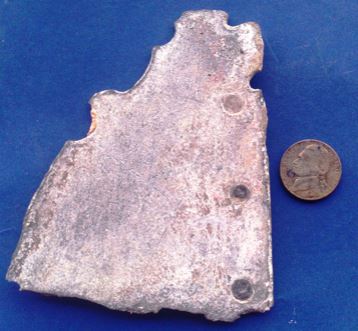
Jim F. found the above item and sent the following email.

Hi TG.

Was out detecting the beach up here in Cocoa a few days ago and got a whopping coin signal on the beach. Came up a 12-45, 12-47 on my Minelab E-Trac and was a good repeatable target...the kind you always dig no matter what. I was surprised when what came up was a very light piece of metal about 3-inches square, with some flush aerospace-type rivets installed along one side and melted carbon fiber on the back. A rather jagged piece of what I think is a piece of Aluminum-Lithium aeroshell from a Space-X Falcon 9 spacecraft. The ship was aborted in 2015 at 200,000 feet running a bit over Mach 2. Hundreds of thousands of pieces were blown to the four winds almost directly over Cape Canaveral. I've found bent and twisted fragments of Berylium Copper (used in rocket engine plumbing and cooling) when the tide is right. Not long ago the beach was "re-nourished" with tons of offshore sand, and I think this may have come from deeper waters. Never know what you are going to find at the beach. I think a lot of people would have thrown this away, not knowing what it really is.Like you always say, don't toss something away until you are really sure what it is! I found the clad nickle used for scale purposed not far from it...convenient.

Cheers!

Thanks Jim.  Nice find!

---

Earlier this year I mentioned the Orlando KellyCo store closing.  I just got a KellyCo brochure in the mail.  It seems they are now located in Knoxville TN.


You can find them online.

---

I've mentioned this before, but I often receive photos of old silver rings and people wonder if they might be from a shipwreck.  As I've said more than once, one of the very top long-time treasure salvage guys said that a silver rings have not been found on 1715 Fleet wreck sites.  Gold rings are not unusual from the same wrecks, as you undoubtedly know.

Silver rings have been found in good numbers on 18th century Spanish colonial archaeological sites though.  The lack of silver rings on the wrecks seems very strange to me.  Why would silver rings be fairly common from 18th century Spanish colonial sites, but not found on the 1715 Fleet wrecks?  I have a few theories, but get into my theories now.

I was looking at Kathleen Deagan's book, Artifacts of the Spanish Colonial Colonies of Florida and the Caribbean, 1500 - 1800, Volume 2, and wanted to post some interesting statements about jewelry from Spanish colonial archaeological sites.  Here it is.

Apart from glass beads, finger rings are the most frequently reported jewelry items on Spanish Colonial sites.  Simple bands of glass, jet, or metal (anillos) and rings with settings (sortijas) are present throughout the colonial period.  Precious finger rings of the sixteenth century were carefully sculpted and enameled, with high, decorated box mounts (Bury, 1984:7): however, this was not the case with the early finger rings from archaeological sites, which tend to be quite humble in both design and material.


You might recall that yesterday I mentioned finding a gold enameled ring on a Treasure Coast beach. At the time I didn't think of it possibly being Spanish colonial and didn't pay much attention to it.

Deagan also mentions that the earlier rings from Spanish colonial sites were humble in both design and material.  Here is a sample of some of those shown in the Deagan book.

Source: Deagan book cited above.

That isn't the best picture, but I think you can tell that they are rings are not really very different from many inexpensive rings that you might find from later centuries.   If you would find one on a beach, you might not think much of it.  There is very little to suggest that those rings are centuries old.

Here is one of many that I could have selected that isn't very different from those shown above.  In fact it is similar to the one on the extreme right in the photo above.  (I know you can't see that photo very well.  Sorry about that.)

Silver Turquoise Ring.
The turquoise is discolored (I mentioned something about how that can happen yesterday.).  In this case the discoloration is due partly to patina.

But this ring provides some good information if you look inside.  You can clearly read the "STERLING" mark.

At first glance I would take this ring as possibly being from the 1970s, but it is really not very different in appearance from rings made centuries ago.

I might be able to make out the other mark if I do some cleaning.

Sterling Mark on Ring Shown Above.

On the other hand, the very corroded silver band shown below shows no markings at all.  That could be due to the corrosion, but maybe it never had any markings.

Corroded Silver Ring With No Identifiable Marks Found on Treasure Coast.

I'll have more examples related to this topic in the future.

---

Source: nhc.noaa.gov

We now have one system with a 10% chance of becoming a cyclone in the next 48 hours.

The surf is still running one to two feet on the Treasure Coast.

Happy hunting,
TreasureGuide@comcast.net


Friday, May 3, 2019

5/3/19 Report - Beach Conditions on the Treasure Coast. Spanish Colonial and Pre-Columbian Jewelry Materials.


Written by the TreasureGuide for the exclusive use of treasurebeachesreport.blogspot.com.

John Brooks Beach Around Noon Thursday.
I visited a few beaches yesterday.  John Brooks had some cuts that I think probably were made the night before.  There were more to the north that you can really see in this photo.

Frederick Douglass Beach Thursday.
Frederick Douglass and the other South Hutchinson Island beaches that I looked at had no fresh cuts.  There were, however, some nice flat areas near the water's edge, like at John Brooks.

Frederick Douglass Beach Thursday Around Noon.
There was a lot of seaweed at Frederick Douglass and the other beaches I saw.

Fort Pierce South Jetty Beach.

There was really a lot of seaweed at Fort Pierce South Jetty.  It looked like it had cut a little earlier - maybe yesterday when the wind was still pretty much from the north.

Overall what I saw was not encouraging, however the flat area down by the water at low tide probably held a few targets if you wanted to put in a lot of time.

---

A couple days ago I mentioned the copper bracelet found by Terry S. and asked for thoughts and opinions.  I did a little research myself to see what I could find about Spanish colonial copper bracelets.  I started by consulting Kathleen Deagan's book, Artifacts of the Spanish Colonies of Florida and the Caribbean, 1500 -1800, Vol. II.  Deagan says, "Bracelets have been infrequently reported from Spanish Colonial sites, especially those dating to the seventeenth century or later."

Another source in Deagan's book commented on a notable lack of interest by the Spanish in bracelets from the seventeenth century until the eighteenth century when multi-strand bracelets of pearls or beads became popular.

It appears that glass bracelets are among the bracelets most commonly found.  Glass bracelets and fragments of glass bracelets were found in archaeological contexts at both La Isabella and Puerto Real.  The glass bracelets seem to be associated mostly with adolescent girls.

As for copper bracelets, the only ones mentioned by Deagan are bangle bracelets of "twisted copper wire" from sites dating from the sixteenth through eighteenth centuries.

Deagan mentions the gold bracelets found on the 1715 and 1733 wrecks.  It seems that gold bracelets are much more common from shipwreck sites than land sites.

A quick search of the Mel Fisher artifact database revealed NO copper jewelry finds.  Almost all jewelry finds in the Fisher database are gold.  There were a couple lead items listed that held emeralds.

Back in a 2016 post, I reported on a copper bracelet found by Captain Jonah and the crew of the Capitana along with other wreck artifacts.  That is the only specific example of a probable Spanish Colonial copper bracelet that I can point to right now.

A search of Pre-Columbian  metalworking in South Anerica revealed the following summary.

Metalwork appeared in general use around Chavin times, by 900 BCE, although the techniques known were limited to hammering, annealing, soldering and repousse working of sheet gold and silver. By Mochica times, every technique was used including casting - simple and cire perdue - alloying and gilding. By then, metal was used for utilitarian purposes in the production of weapons and agricultural tools as well as plate and jewellery. The Chimu of North Coastal Peru were especially known for a high degree of competence in metallurgy, producing quantities of gold and silver figurines, ceremonial knives, tweezers, earspools, plate, bowls and beakers, many decorated with fine repousse designs of gods, animals and mythical creatures. It was from them that the Incas and then the Spaniards acquired much of their wealth. At the Spanish Conquest (1519 CE), South and Middle America were still technically in the Bronze Age, having no knowledge of iron working.  (http://www.visual-arts-cork.com/history-of-art/pre-columbian.htm#metalwork)

We do know that copper was used in Pre-Columbian times to manufacture a variety of objects.  Bells, tools and masks are just a few examples.  But again, it certainly does not appear that it was used much, if at all, for jewelry.

See https://www.copper.org/education/history/60centuries/middle_ages/copperin.html.

I've found some copper bracelets on the Treasure Coast that could possibly be from a Treasure Coast wreck, but since they were beach finds and had no telling markings, I am not able to say much of anything about their source.

I have also found silver bracelets that I think are probably from a 1715 Fleet wreck, but I can't be absolutely certain about that.

Again I am reminded of the lack of silver finger rings found on 1715 Fleet wrecks.  The apparent disparity between submerged wreck and land sites might seem strange, but perhaps shouldn't be if the extreme concentration of wealth on those small ships is considered.  The material culture found on the treasure ships is unique in many ways.  What we sometimes find on the beach is a few odd bits of that scattered accumulation.

---

I didn't receive many opinions on the bracelet.

Bruce B. offered the following.

I don't know for sure, but the ring reminds me of Celtic ornamentation I have seen on bronze bracelets, though it could be Viking with perhaps the face of Odin. The shape, however, looks more Roman.   

Troy T. sent this message.  I read somewhere that Florida natives liked to use copper acquired from Europeans either through trade or from shipwrecks. They would re-work it into ornamentation and jewelry. I wish I had a good source to point towards but I don't remember exactly where I read it. I've made similar things before out of copper and brass wire. The markings are crudely punched and maybe also etched and could have been done with pretty simple tools so it could have easily been made by a native with stone or shell tools. Of course it just as easily could have been made by a bored sailor.

When I saw the design, the first thing I thought of  was a possible African influence.

---

I also enjoyed looking at many examples of Native American copper artifacts, which, by the way, also included bracelets.

https://www.mpm.edu/research-collections/anthropology/online-collections-research/old-copper-culture

---

I wanted to pass along one thing SuperRick recently said in an email to me.  Here it is.  

I want to thank everybody that sends you information to post and my good friends that I have made friends with thanks to the treasure hunter's cookout!

---

It looks like we are in for a few days of small surf. 

In a month or two I might be able to present a new find of a bunch of modern gold bullion coins. 

Happy hunting,
TreasureGuide