Showing posts with label Early Series. Show all posts

Tuesday, November 15, 2016

11/15/16 Report - Valuable 1715 Fleet Lima Eight-Escudo. Early Series Mexico Half Reale.


Written by the TreasureGuide for the exclusive use of treasurebeachesreport.blogspot.com


Lot 30 In The Recently Concluded Sedwick Coins Auction # 20

Here is the description of lot 30, which was the gold cob bringing the highest bid.


Lima, Peru, cob 8 escudos, 1713M, encapsulated NGC MS 63, finest known in NGC census, from the 1715 Fleet (stated inside slab). S-L28; KM-38.2; CT-25. 26.8 grams. Choice full cross-lions-castles and pillars-and-waves, two full and bold dates, lustrous, broad flan, a superb specimen all around, befitting the top honors. NGC certification #4431906-001. From the 1715 Fleet, and pedigreed to the Charles Eidel collection.

The winning bid for this eight escudo was $28,000.  With buyers premium and everything, the cost was $32,900.  The pre-auction estimate was only 10 - 15 thousand, so it about doubled the estimate.

The NGC encapsulated cobs seemed to do very well.  This one was MS 63.  Maybe it is worth having such coins slabbed.

It is a pretty coin.

A 1715J Mexican slabbed eight-escudo said to be from the 1715 Fleet did nearly as well with a winning bid of $24,000.  It was MS 63 also.

Not many coins dated 1715 made it onto the 1715 Fleet.

---

There weren't a large number of shipwreck artifacts in this auction, but the one that brought in the highest bid was an Atocha silver plate.  The winning bid was $14,000.

A couple of gold chains sold for around $7,000.

---

When is a half reale worth more than an eight-escudo?  Most of the time when it is a rare early series half like this one.
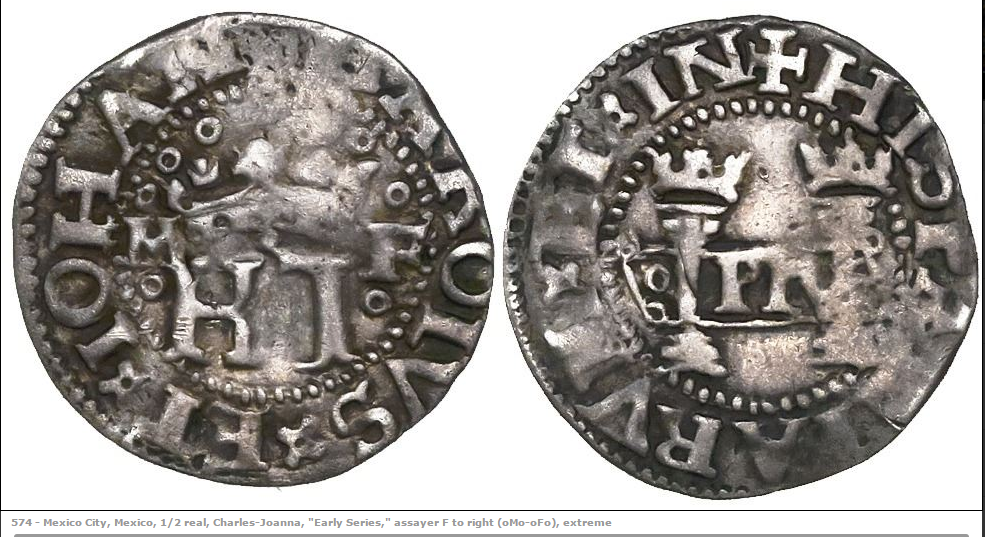
Lot 574 In The Recently Concluded Sedwick Auction.
Here is the description in the Sedwick auction catalog.  Notice that it is what I have called a "celebrity coin."  It appeared in a book.

Mexico City, Mexico, 1/2 real, Charles-Joanna, "Early Series," assayer F to right (oMo-oFo), extremely rare, ex-Huntington, Nesmith Plate Coin. Nesmith-13; S-M3; CT-172. 1.60 grams. Deeply toned AVF with full legends and inner details, particularly rare (two known) and interesting as showing a new die with clean F (not F/P), desirable pedigree. Pedigreed to the A.M. Huntington collection and Plate Coin #13 in Nesmith's book.


The winning bid was $6000.

---

We're going to have a relatively small surf for a few days.  The tides will be high though.

Happy hunting,
TreasureGuide@comcast.net

Saturday, November 15, 2014

11/15/14 Report - $587,000 Charles-Joanna Mexican 8-Reales, Beach Dynamics, Coins Washing Up On Beach


Written by the TreasureGuide for the exclusive use of treasurebeachesreport.BlogSpot.com.


Source of photo:  http://www.sedwickcoins.com/articles/Rincon.pdf

This is the 8 reales that brought in over $587,000 in the recently completed Sedwick Coins Treasure Auction 16.

Maybe you'll be the one to find the fourth.

-------------------


Back close to twenty years ago (I can't believe it has been so long.) Jensen beach was eroded back into the Seagrape trees by the walk-overs at the back of the beach.  Since then sand has been dumped on that beach many times.

Back when we had the hurricanes in 2004 (I think that was the year.) John Brooks was eroded back all of the way to the walk-over.  That kind of erosion doesn't happen very often.

There are periods of years when a beach will continue to erode and wear away.  And then there are periods of accretion.

When a beach gets eroded way back, you will often see a different kind of sand.  When Jensen was eroded way back, there was a course brown sand.  That, of course, has since been covered by fine white sand.

You should pay attention to the different types of sand because it can tell you if old layers are being uncovered.

The same thing goes for Turtle Trail.  Recent renourishment projects covered the beach with a fine white sand.  It is being lost, but by the time the old sand starts to emerge they will probably dump more sand to cover it up.

Here is a simple sketch of a beach cross section.  The blue line represents the water line.

Simple Beach Cross Section Illustration.
This is a wide low beach such as the one at John Brooks.  A different type of beach would be the beach at Turtle Trail that is more narrow and has a high cliff at the back.

In this diagram, let's say A (black line) is the old beach.   Then B (reddish line) represents the beach after very big erosion occurred.

Then the beach refills, up to the thin green line (C). 

Back in 2004, for example, John Brooks eroded a lot, taking the sand down to a low level, something like B above.  Then it refilled.  Since that time it eroded and refilled time and time again more near the front portion of the beach.  Cobs were found in layers of sand well above where the level of sand had been eroded in the past and way too far to the front of the beach to have come from the dunes.

Old coins will be washed out of the dunes and down onto the beach and even into the water at times.  That occurs more often on narrow beaches with high dunes behind.

I have no doubt that most of the shipwreck coins found on John Brooks in recent years were washed up onto the beach from the water since they were found in areas that were previously eroded much lower and too far from the dunes and too high to have come from the dunes.

--------------------------------

On the Treasure Coast the surf will be a little higher on Sunday, something like 3 or 4 feet.  Out about a week an 8 foot surf is predicted.  The long range predictions often don't work out though.  We'll have to wait and see.

Happy hunting,
TreasureGuide@Comcast.net

Friday, November 14, 2014

11/14/14 Report - 2014 Treasure Coast Finds. 8 Reale Sells For Over Half Million Dollars. 19th Century Wreck Found. Valuable Explorer's Notebook Found


Written by the TreasureGuide for the exclusive use of treasurebeachesreport.BlogSpot.com.

Some of Michael E.'s Favorite Finds This Year
Photo submitted by Michael E.


Here are some 2014 Treasure Coast finds by Michael E.

Conditions have been poor but if you put in the time and hard work you can still make good finds.

Congratulations Michael!


-----------------------

An Early Series Mexican 8 reale sold for over half a million dollars at the recent Sedwick Coins auction in Orlando.  Several 1715 Fleet coins and objects did very well.

Here are a few of the highlights.


--------------------------

Parts of a wooden ship were found on a New Jersey beach in October 2014 of this year by workmen building a sea wall to protect beach eroded by Hurricane Sandy. The ship could be a Scottish sailing ship that sank in 1850. Pieces of timber, a windlass, and other nautical parts were found. A marine archaeologist will examine the wreck to see if it's the historic ship that was the first to use a "life-car," a newly invented metal life raft that saved 199 people on the ship.

Here is the link to that article.

http://www.cbsnews.com/news/post-sandy-construction-uncovers-19th-century-shipwreck-in-new-jersey/

---------------

Some of the British explorers who accompanied Robert Scott on his 1910-1913 expedition to Antarctica died of starvation and cold. But others in the group survived by huddling in an ice cave and eating seals and penguins. A photography notebook kept by one of the survivors was found last summer (2014) encased in ice outside a hut used by the explorers. The notebook records information about photographs taken in 1911. The notebook has been restored and is being studied.

Here is a link to that article.

http://www.cnn.com/2014/10/28/world/antarctic-explorer-notebook/index.html

Melting ice or snow as well as receding shores, erosion and construction excavation can uncover history.

-------------------

On the Treasure Coast we'll have a calm surf for a couple of days and North winds.  The surf will bump up a little Sunday.

Happy hunting,
TreasureGuide@Comcast.net