Showing posts with label Lima. Show all posts

Thursday, May 28, 2020

5/28/20 Report - People Paying Well For Treasure. Gold Pancake. Lima 8-Escudos. Ducatoons. Hope.


Written by the TreasureGuide for the exclusive use of treasurebeachesreport.blogspot.com.

The first day of bidding in the current Sedwick treasure auction has concluded and the bidding was exciting.  A very high percent of the lots closed higher than the high end of the auction estimates. 

One of the first day over-achievers was lot 55 - described as a round gold pancake (below).


Here is the lot description.

Small, round gold "pancake," 11.94 grams, ex-Espadarte (1558), with Sotheby's catalog. About 3/4" in diameter and 1/8" thick. Cute little droplet of gold with no markings but some areas of encrustation, one side covered with the original sticker from the salvagers, scarce provenance. From the Espadarte (1558), with certificate #1035 from the salvagers, and pedigreed to our Auction #3, with original lot tag #58, also with catalog of the Christie's (Amsterdam) "Fort San Sebastian Wreck" auction of May 2004.

The docementation and provenance undoubtedly had a lot to do with the price that was realize.

The auction estimate was $400 - $600, but the item sold for $3332.00, which includes the buyer's premium. That is four or five times the auction estimate.


Among the lots that brought high bids were a couple of early 1700s Lima 8-escudos.  Two different escudos went for $38,675, (including the premium).  One had an auction estimate of $17,500 - $25,000 and the other had an auction estimate of 20,000 - 40000.

One lot that caught my attention when I first looked at the auction listings was lot 270 - a neat clump including a couple ducatoons.  That lot is described below.


That was another lot that sold for several times the high end of the auction estimate.  Actually it was nearly six times the auction estimate.

The economic shutdown didn't seem to hurt the auction results.

World coins and paper money lots will be auctioned today.

---


Douglas sent in a good tip.  Do a search of RPPC or real photo post cards on eBay or places like that.  You might add Florida as a keyword to your search.  Douglas sent this link to hippostcard.com for example.  You'll find some interesting views.

Here is an example.


---


Yesterday was an inspiring day for me.  I managed to catch some of the coverage of the SpaceX launch.  It was on at least one TV channel.

The launch was postponed, but if you watched the coverage leading up to launch time, you saw the excitement of past astronauts and some of their family members as they talked about how important it was for the country to get back into the space race.  They said it represented a new era in space exploration for this country.  We have been paying the Russians big money to give our astronauts a ride.  That is embarrassing.  A small private company, much smaller than companies like Boeing, managed to attack a problem and come up with a new improved solution, and they did it more quickly and inexpensively than was thought possible.  There is always a better way waiting to be found.

The launch represents the huge creative talent of the human spirit.  It shows what people can do when they are propelled by their dreams more than their fears.

There are dreamers and there are haters.  There are those who give hope, and even those who hope against success.

Yes, there is risk.  That risk was acknowledged and confronted.  There are those willing to take the risk of sitting on the tip of a bomb because their sight is set on what is above.  Success is not guaranteed, but if not this time, eventually it will come - as long as there are people with hope.

Some channels didn't even cover the launch.  It seemed like they wanted no part of anything positive.

I hope you are not wondering what this has to do with treasure hunting.  It is treasure hunting.  It is about facing fears and overcoming problems.  It is about technology and innovation.  It is about accomplishing more than was thought possible.  But most importantly, it is about the human spirit and the treasures that await.

May the God of hope fill you with all joy and peace as you trust in him, so that you may overflow with hope by the power of the Holy Spirit.

---

Today the surf will be about two feet and tomorrow just a touch higher.

Happy hunting,
Treasureguide@comcast.net

Friday, August 24, 2018

8/24/18 Report - On The Beaten Path. Clues To The Mystery Coin.


Written by the TreasureGuide for the exclusive use of treasurebeachesreport.blogspot.com.

Source: See dunmowbroadcast.co.uk link below.

I always look for erosion or earth removal that occurs as a result of construction, but there are other kinds of changes that can reveal good old detecting areas.  Here is an excerpt from an article that tells how an old pathway was discovered because of draught.

... Visitors will be able to see the excavation of the newly-exposed path, which follows a route walkers still use today, performed by a small team of archaeologists and volunteers on September 20 and 21.
The exceptionally hot and dry weather this summer caused scorching on the grass which led to the discovery of the path which could provide an insight into the history of the 2000-year-old forest, a former royal hunting forest....
The above photo shows a part of the path.  Notice the more compact and lighter color earth towards the bottom of the photo.  (I added the arrows.)

Here is the link if you want to read more of that article.

http://www.dunmowbroadcast.co.uk/news/visitors-at-hatfield-forest-have-the-chance-to-see-a-newly-discovered-ancient-path-1-5662568

If you want to find good new metal detecting spots, you should realize that they are all around you.  If you are a keen observer, you'll notice things that others won't.

Almost everywhere you go, people have been there before.  They were there a few decades ago and centuries ago.  If people spent much time in an area, the area will be permanently changed in some way.  In the story of the newly discovered path, the earth was compacted, which also affects vegetation.

Sometimes the signs are hidden, and as in this story, it takes a change of some sort to reveal the signs. Very often it is erosion that exposes signs of the past.  In recent days I also posted a article telling  how the wildfires out west uncovered ancient camps.  It doesn't matter if the changes are caused by man or nature, there might be good metal detecting clues exposed.

---

You know those elongated coins that you can make out of pennies at Disney World or other tourist locations?  Well, like with many things, there is a collectors club for them; TEC or The Elongated Collectors.

The web site is http://tecnews.org.  They have a quarterly newsletter for those who join and also a new Facebook page.

---

Coin For ID.
I posted this on 8/21/18 and asked if you could identify it.  I said I wanted to see who would get the answer first.   The winner is... Mitch King.

Mitch King was the first to offer a guess on the coin I posted on 8/21/18.  He said, A real quick guess without any research is it's a copy of an 8 Escudo and was probably plated gold at one time?

That is the consensus.  Congratulations Mitch!

You can clearly see two things on this coin - the mint mark and the denomination.  The mint is Lima, and the denomination is 8.  You can also see a P in the first column of the second row and an A in the last column.  You can't see the date, but here is the trick.

A reale of that type should show the letters PLV SVL TR in the second row.  An escudo would show P V A.  Therefore, the design is that of a escudo - not a reale.  But it doesn't look like it is gold.  As Mitch suggests, the plating probably wore off.

The first fake I ever found was like that.  It had the design of an escudo, but was not gold.  On top of that, it was very heavily encrusted.  I painstakingly removed the crust and and it took me quite a while to figure it out.

I should see if I can find my first fake.  It might be the same.

This was many years ago and I didn't have the experience or reference resources that I have today.  If I had only had it tested and found that it was a base metal, that would have answered the question more quickly, but I still had to free it from the crust.

---

No storms or big changes in beach conditions.

Happy hunting,
TreasureGuide@comcast.net

Thursday, November 2, 2017

11/2/17 Report - Top Gold Coin Prices For 1715 Fleet Lima 8-Escudo and Bust Mexico One-Escudo. Sebastian Inlet To Turtle Trail Report.


Written by the TreasureGuide for the exclusive use of treasurebeachesreport.blogspot.com.

The Sedwick Treasure Auction went live today.  There were some gold coins that brought very  good  prices.  I picked out a couple of those to post.

First is the 1715 Fleet Lima 8-escudo that I mentioned shortly after the auction catalog went online.  Here it is.  The winning bid was $32,500 with a $5,687 buyers premium added.


Here is the lot description from the Sedwick catalog.

Lima, Peru, cob 8 escudos, 1697H, "PVA" variety, very rare, encapsulated NGC MS 62, finest and only specimen in NGC census, from the 1715 Fleet (designated on label). S-L25; KM-26.2; CT-8. 26.85 grams. Broad flan with good full cross, clear king's ordinal II, bold full crown above full pillars-and-waves, minor peripheral flatness, frosty surfaces. This is one of only six dates (1696-1701) struck under Charles II, whose name on these coins appears simply as "C.II.," which are naturally highly sought for the type. One of two varieties for this date--with and without dots in the motto--but this is the only specimen of either variety in the NGC census. NGC #4485215-002. From the 1715 Fleet.

One of the other high priced gold coins from the first session was a Mexico City bust.  There were a few of those that did very well.

This one is a 1732 one-escudo.  The winning bid was $30,000 plus buyers premium.

Mexico Bust One-Escudo

Mexico City, Mexico, bust 1 escudo, Philip V, 1732F, extremely rare, encapsulated NGC MS 61, finest and only specimen in NGC census, ex-Rudman. CT-unl; KM-113. Quite choice in strike on a broad flan, in fact struck so strongly as to impart a minor flaw at rim 1 o'clock, the fields positively resplendent with high luster despite annular friction marks on obverse that appear to be the only reason this coin is not graded higher, nonetheless decidedly the finest known of only four in existence (one permanently impounded in the Banco de Mexico collection), and the only one listed in the NGC census. A gem of a coin whose extreme rarity can be summed up by this statement in CT: "some catalogs list the escudo of the date 1732... [but] we omit [it] for doubt of its existence." NGC #2784567-001. Pedigreed to the Isaac Rudman collection.

---


Darrel S. sent me the following photos of the Turtle Trail and Seagrape beaches yesterday.  About these beaches he said, Was able to check Wabasso, Sea Grape and Turtle Trail around 4:30pm. Tide was full at 6 on.

Beaches showed some shells but very mushy and heavy amount of dirt.


Darrel also sent the following photos of the beach south of Mclarty and south of the Sebastian inlet today.  About those beaches he said, Polluted river and ocean. Brown water and yellow foam. Hopefully, next week better.

Went to Wabasso, Ambersand, etc. Detected south of inlet, but way too much dirt and nasty water. Low was around 12:30pm.


 Thanks much to Darrel for the photos and report.

---

l was in Orlando this morning.  You probably heard about the butcher who sat on the meat grinder and got a little behind in his work.  That is how I was today.

The surf has been small, but will increase up to 3 - 4 feet by Saturday.

Happy hunting,
TreasureGuide@comcast.net

Tuesday, October 10, 2017

10/10/17 Report - 1715 Fleet Eight-Escudo. How High Will It Go? Evaluating Metal Detecting Zones.


Written by the TreasureGuide for the exclusive use of treasurebeachesreport.blogspot.com.


Lot  In Current Sedwick Treasure Auction # 22.
Source: auction.sedwickcoins.com
Here is the lot description.

Lima, Peru, cob 8 escudos, 1697H, "PVA" variety, very rare, encapsulated NGC MS 62, finest and only specimen in NGC census, from the 1715 Fleet (designated on label). S-L25; KM-26.2; CT-8. 26.85 grams. Broad flan with good full cross, clear king's ordinal II, bold full crown above full pillars-and-waves, minor peripheral flatness, frosty surfaces. This is one of only six dates (1696-1701) struck under Charles II, whose name on these coins appears simply as "C.II.," which are naturally highly sought for the type. One of two varieties for this date--with and without dots in the motto--but this is the only specimen of either variety in the NGC census. NGC #4485215-002. From the 1715 Fleet.

This is an exceptional cob that already has a bid of $20,000.The auction estimate was 20 - 40 thousand.

What is your guess on the final price?   Make a guess and send me your estimate.

Here is the link,

http://auction.sedwickcoins.com/Lima-Peru-cob-8-escudos-1697H-PVA-variety-very-rare-encapsulated-NGC-MS-62-finest-and-only_i28138985

---

I recently wrote about a stretch of beach and various metal detecting zones I identified along that stretch.  I mentioned how those areas differed.  Some differences were apparent by simple observation.  You could see the people, how many were there, what they were doing, what types of things they had, etc.  You could see the natural environment, including the sand, slopes, sea grass, etc.  But there were some things I had to check with my metal detector.  I sampled every area at least a little - some more than others. 

I had to pass by some areas to get to others.  Even if I didn't want to spend much time at a particular zone, I would at least pass through it quickly with my detector to check it out..  I always like to collect a little data to check my previous conclusions.  Occasionally I would run across an unexpected good find or something that might make me want to check a little more.

My main point here is that it is important to really get to know different areas and don't write them off too soon. Check things out, and improve your understanding of any area.

I highly recommend keeping detailed records.  I've said that before.  I never regretted keeping records, but often wished I had kept more.

Areas change over time.  You might want to compare observations over the years and it is difficult to remember everything over a lengthy time span.  Those fifteen zones I described were only along one 8 mile stretch, and I detected a lot of places other than that small area.  

It is nice to have a good long stretch with a variety of different types of zones.  When one zone isn't producing another might be.  You can select different ones to work at different times, depending upon what is going on.  And as you walk from one to another, you can always check those in between.

Different zones had different concentrations and types of targets.  That is something important to keep track of.  I once did a post on math for metal detecting.  You can probably still find it.

When the value of targets can be quantified, you can calculate the most likely value of your finds per time unit at the different zones.  That will help you compare and select detecting sites.  Some zones produce more finds, but on they might be low value finds so that your average find value might actually be higher at an area where you find fewer things.  The numbers will help you assess the situation much better.  It is amazing how a very few remarkable finds can quickly add up to hundreds or thousands of low quality finds.

Of course you can't go entirely by the numbers even though the numbers will help you get a good picture of the situation if you put in enough time and keep records.  Some people just want to go by feel.  Some people are just more interested in certain types of finds even though they might not be as valuable.  Some people just like old coins or other old things, for example.  On the other hand, a lot of people don't have the patience for the low-quantity zones even if there are some very high quality finds to be made there.

One of the zones I mentioned yesterday was supposed to have produced old shipwreck coins, according to one book..  I never found that to be the case, but by looking at the area I could tell that it would take a very good storm to wash old coins in even if the book was right.  The book, by the way was written by an author not known for the highest standards of accuracy.  That is another reason I tend to go by my own observations and data.  I try to experiment and test everything that seems important and questionable.  Having spent part of my career in science, it is just my nature.  One thing I emphasize and teach a lot is an empirical scientific approach to metal detecing.

More on metal detecting zones some other day.

---

I hope you will take time to respond if you have not yet responded to the blog poll.  I know of finds that were made that do not show up in the poll yet.  In fact there are some that I showed in this blog that are not represented in the poll yet.  I know that because the area the cobs were found still shows zero finds for that area.  Of course the poll isn't complete yet, so I expect it to fill in.

Thanks for your help.

---

Tropical storm Ophelia is out in the middle of the Atlantic and won't affect us.

We are back to three and four foot surf for the Treasure Coast.

Happy hunting,
Treasureguide@comcast.net

Wednesday, April 12, 2017

4/12/17 Report - Rare Four-Reale Expected To Sell For Nearly Five Thousand Dollars. Recent Cuts on the Treasure Coast. Ghost Ship.


Written by the TreasureGuide for the exclusive use of treasurebeachesreport.blogspot.com.


Source: See link below.

Here is one of the higher priced reales in the current Sedwick auction.  Said to be a rare variety, the auction estimate is $3500 - $5000.

Here is the lot description.

Lima, Peru, 4 reales, Philip II, assayer R (Rincon) to left, second denomination o-iiii to right, motto PL-VSVL-T, legends HISPA / NIARVM, extremely rare. S-L1; KM-10.1; CT-311. 12.45 grams. Broad flan with nearly full legends, bold full pillars and shield (the latter slightly doubled, slightly porous XF+ with nicely toned fields, full secondary denomination o-iiii to right of shield, a near-unique variety of which we have only ever seen one other (the Sellschopp and Heiss Plate Coin we offered in Auction #18, curiously made from a different pillars-side die).


http://auction.sedwickcoins.com/Treasure-World-U-S-Coin-and-Paper-Money-Auction-21_as47083?p=1&ps=50&ca=860005&so=1&q=&hi=0&vm=1


---

John Brooks Beach Yesterday Afternoon.
Above is what I saw at John Brooks Beach yesterday afternoon.  Below is what I saw at Walton Rocks just a little later.


Walton Rocks Beach Yesterday Afternoon.
 There is a lot you can see on this beach.  Towards the top just in front of the dunes is a little cliff that was created back some weeks ago.

Down the slope a little farther was a recent cut.  You can see it just above the heavy line of seaweed.

Then of course is the sea weed, and just below that you can see where new sand piled up.

Below the recent cut would be a good place to look wherever the new sand hadn't accumulated much.  It would have been better to be there before the seaweed and sand came up.

You can often see where new sand fills in after a beach cuts.  This is a good example.

Yesterday I mentioned how John Brooks has been cutting every other week or so,  It has been cutting and filling over and over, but not into anything old.

---

A 110-year-old ghost ship was found on a tributary to the Ohio.

Interesting read.  Lots of pictures.

http://www.viralforest.com/110-year-old-ghost-ship-in-the-ohio-river/


---

Looks like the Easter coin hunt isn't going to be as good as expected.  The predictions now are for four to seven foot seas instead of five to eight as earlier predicted.  

Looks like the prediction models are up to their old tricks.

Happy hunting,
TreasureGuide@comcast.net


Tuesday, November 15, 2016

11/15/16 Report - Valuable 1715 Fleet Lima Eight-Escudo. Early Series Mexico Half Reale.


Written by the TreasureGuide for the exclusive use of treasurebeachesreport.blogspot.com


Lot 30 In The Recently Concluded Sedwick Coins Auction # 20

Here is the description of lot 30, which was the gold cob bringing the highest bid.


Lima, Peru, cob 8 escudos, 1713M, encapsulated NGC MS 63, finest known in NGC census, from the 1715 Fleet (stated inside slab). S-L28; KM-38.2; CT-25. 26.8 grams. Choice full cross-lions-castles and pillars-and-waves, two full and bold dates, lustrous, broad flan, a superb specimen all around, befitting the top honors. NGC certification #4431906-001. From the 1715 Fleet, and pedigreed to the Charles Eidel collection.

The winning bid for this eight escudo was $28,000.  With buyers premium and everything, the cost was $32,900.  The pre-auction estimate was only 10 - 15 thousand, so it about doubled the estimate.

The NGC encapsulated cobs seemed to do very well.  This one was MS 63.  Maybe it is worth having such coins slabbed.

It is a pretty coin.

A 1715J Mexican slabbed eight-escudo said to be from the 1715 Fleet did nearly as well with a winning bid of $24,000.  It was MS 63 also.

Not many coins dated 1715 made it onto the 1715 Fleet.

---

There weren't a large number of shipwreck artifacts in this auction, but the one that brought in the highest bid was an Atocha silver plate.  The winning bid was $14,000.

A couple of gold chains sold for around $7,000.

---

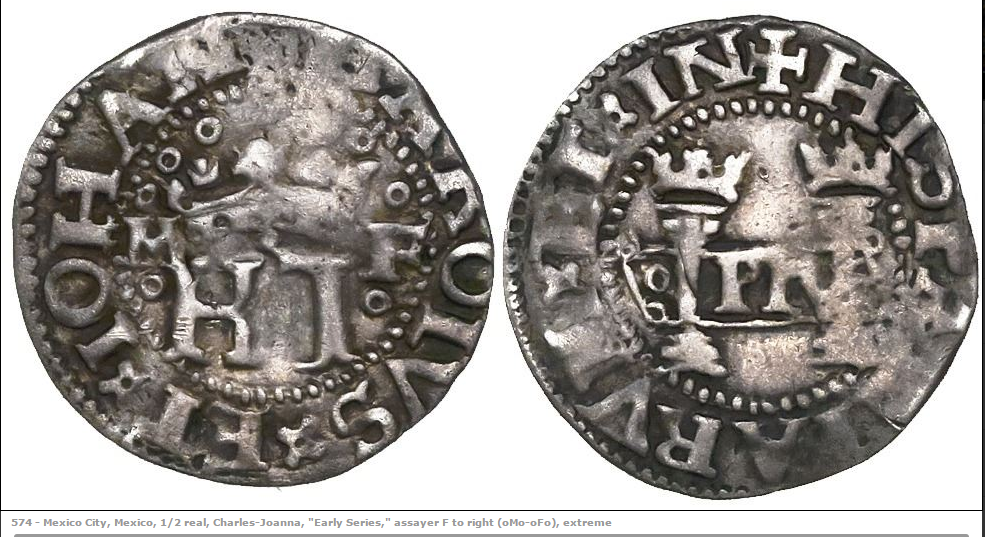
When is a half reale worth more than an eight-escudo?  Most of the time when it is a rare early series half like this one.

Lot 574 In The Recently Concluded Sedwick Auction.
Here is the description in the Sedwick auction catalog.  Notice that it is what I have called a "celebrity coin."  It appeared in a book.

Mexico City, Mexico, 1/2 real, Charles-Joanna, "Early Series," assayer F to right (oMo-oFo), extremely rare, ex-Huntington, Nesmith Plate Coin. Nesmith-13; S-M3; CT-172. 1.60 grams. Deeply toned AVF with full legends and inner details, particularly rare (two known) and interesting as showing a new die with clean F (not F/P), desirable pedigree. Pedigreed to the A.M. Huntington collection and Plate Coin #13 in Nesmith's book.


The winning bid was $6000.

---

We're going to have a relatively small surf for a few days.  The tides will be high though.

Happy hunting,
TreasureGuide@comcast.net

Wednesday, September 2, 2015

9/2/15 Report - Nice 1715 Fleet One Escudo. Buried Nazi Gold Train Found. First ECC Photo. Jamestown Discoveries.


Written by the TreasureGuide for the exclusive use of treasurebeachesreport.blogspot.com.

1715 Fleet One Escudo

Very nice one escudo from the 1715 Fleet.  This is referred to as a Type II in the Sewall Menzel book.

The date appears to be 1712, if I am reading it correctly.  Looks like it could be a 2 over 1.

The other side would have the cross potent.

The mint is Lima, and the assayer (M) would be Felix Cristobal Cano Melagejo.

---

This is an Indiana Jones mega-treasure story.  It appears that an armored train full of Nazi treasure has been discovered in a buried tunnel.  If you read the different accounts of this story it is hard to tell how much is true and how much is myth and how much is cover-up.  The different stories just don't stick together entirely.

Here are a couple of links.

http://www.theguardian.com/world/2015/sep/02/nazi-gold-train-poland-to-bring-in-army-to-help-in-hunt


http://my.xfinity.com/video/treasure-hunters-claim-to-find-nazi-treasure-train/517077059784/Comcast/Today_in_Video?cid=hero_sf_TIV

---

When the Jamestown Rediscovery Archaeological Project started, the hope was to find the site of the original 1607 James Fort, which had been written off for more than 200 years as lost to shoreline erosion.
Since then, the team has discovered the fort and more than a million artifacts in the ground...
This is an ongoing excavation.  They keep coming up with more every week it seems.  
http://wydaily.com/2015/08/28/local-news-jamestown-unearthed-recycled-breastplate-stoneware-found-in-probable-cellar/

CT Scan technology is being used to analyze artifacts to help identify the presumed important persons buried under the church.

http://news.cornell.edu/stories/2015/08/cornell-technology-identifies-artifacts-jamestown-graves

---

I have been hearing from people who are going to get a detector and start detecting and people who want to know the laws.  That happens every time after a big discovery.  People get excited and people that have never detected before get interested.

---

Yesterday I wrote about the Environmental Metal Detecting Movement and the proposed Environmental Clean-up Crews.

Here is the first picture from an independent volunteer of the ECC (Dan B.).

Removed By Dan B. From A Boat Launch Area.
Just an example of the type of work provided by the ECC.  Good work Dan!

For those of you thinking of going out and buying your first detector, you can find a lot more of these than gold coins.  Just a reality check.

---

Fred is a tropical storm and won't affect us.  It will dissipate in the middle of the Atlantic.


The Treasure Coast will only have something like a one foot surf through the weekend.

Happy hunting,
TreasureGuide@comcast.net

Thursday, August 13, 2015

8/13/15 Report - Lima 8-escudos: Rare and Not So Rare. Animas River Toxic Pollution. Kudos To Garrett Detectors.


Written by the TreasureGuide for the exclusive use of TreasureBeachesReport.blogspot.com.


1711 Lima 8-escudo Up For Sale On eBay.

You might remember the post I did on 7/28 showing a pile of gold coins found this year by salvors working the Treasure Coast.  I mentioned that I could see some Pillars and Waves cobs from Lima in that group.

A couple days ago I did a post about what is called the Jeweled Cross Series of gold cobs.  Those are early Mexico minted cobs.

Today I'll post a bit about Peruvian gold cobs.  They were produced from 1696 to 1750.  I'll only consider those up to 1715 in today's post, and I'll just consider 8-escudos for no good reason other than brevity.

Of course the first thing you'll notice about these cobs is the nice pillars and waves design.

Compared to Columbian and Mexican gold cobs, Peruvian gold cobs are usually relatively round rather than odd shaped,  well centered, and have a clear date and mint mark.  In general they are well struck.

The mint mark is in the top left and the mint mark top right, and the date is on the bottom row.  That makes it easy enough.

There are some Lima 8-escudos that are very rare and others that are relatively common.

The 1696 H, 1701 H, and 1709 H are the most rare Lima 8-escudos of the period that I am talking about.  H is the assayer initial.  There are only five or so known examples of each of those.

The most common of those up to 1715 are the 1711 M, 1712 M, and 1713 M.  I don't doubt that one of the main reasons they are more common is because those dates would have been ready to be shipped with the 1715 Fleet.


A 1711 M 8-escudo
currently
offered for sale on eBay


I would be surprised if there were none like this in the group salvaged this year.  And maybe there are a even a few of the rare dates.

I think I'll be able to show you more of this years finds before long.

For a good detailed report on Lima gold cobs of all denominations, here is a link to a good detailed report by Sedwick Coins.

http://www.sedwickcoins.com/articles/limagoldcobs.htm

---

Since posting about the jeweled cross series of gold cobs yesterday, I've heard from two people who have found one.  I might be able to post a picture of one of those in the near future.

---

One of the most scenic train rides you can ever take is the Durango to Silverton narrow gauge railroad.  If you ever get a chance take that train.  It goes past some amazing scenery as it follows the Animas River, which at one point you can see running through a famous gorge just as you enter a tunnel.  Then when you get to Silverton, it is like you just stepped onto a TV set.  The town looks like the old West the way you see it on TV.  You can see the old silver mine right outside of town, and there is still placer mining in the area.

Maybe you've heard about the Animas River in the news lately.  That is the river spoiled by millions of gallons of toxic waste spilled into the river by the EPA!  Yes, it is the same Environmental Protection Agency that is so zealously regulates and fines anyone from huge corporations to small scale recreational miners.  And it was their fault that this horrid mess took place.  They'll pay for some of the damage, but it will come out of our pockets.

Hopefully the beautiful Animus River and other streams downstream will recover quickly.  I can only hope so.  It is a shame to see such beautiful country spoiled like that.  When it gets cleaned up, I highly recommend visiting the area if you never have, and take the train to Silverton.  Oh, and they run a Christmas Special, just like the Polar Express that would be utterly fantastic if you have kids - or not.  When it comes to things like that I still am a kid.

---

If you send me pictures or anything by email it would be good idea to if you put like Do Not Post (DNP should do) or OK To Post on the top.  I usually don't post something if I'm not sure about it.  It would just make it a little easier for me if I don't even have to think about it.    Thanks to all.

---

Kudos to Garrett Detectors.  I had a problem with a slipping arm cuff.  I called and told them and they promptly sent out a new one, which I put on my detector, and it seems to work find.  Good customer response.

---

I watched a Youtube video in which a guy was going to test and compare an ATX and CTX 3030.   After watching about a minute I could tell that the guy didn't know how to use those detectors very well.  Sometimes the detector comparisons you see are worthless simply because the detectors aren't used well.  Some detectors are easier to use than others, but it is very easy to use the ATX poorly.  You can't tell much about a detector if you don't know how to use it.  I can't believe that fellow was buying these high end detectors and was so clueless about how to use them.

---

Happy hunting,
TreasureGuide@comcast.net

Tuesday, July 28, 2015

7/28/2015 Report - New Photos Of The Amazing Royal Found By Schmitt Family On Treasure Coast Wreck Site. Also Other Coins And Bottom Where Found.


Written by the TreasureGuide for the exclusive use of treasurebeachsreport.blogspot.com.

Royal Found By Schmitt Family On A Treasure Coast Wreck Site.


Yesterday I posted pictures of the million dollar treasure found by the Schmitt family on one of the Treasure Coast shipwreck sites. Those are pictures that appeared in the mainstream media.  Today I have some other pictures of the amazing Royal and other gold coins that you might not have seen elsewhere.

Here are some good close-ups of the Royal.

The Royal is really unbelievable. It shows an amazing strike and is in almost like new condition despite three hundred years on the bottom of the ocean.  Aside from a little surface silt, it just has a few scratches that I can see.

As you can tell, it is a 1715 OMJ, obviously from the Mexico mint and must have been shipped shortly after it was minted.

This Royal is very much like the 1715 Mexico 8 shown as a type 25 in the book Monedas Espanolas Desde Juana y Carlos A Isabel II 1504 A 1868.


It is often said that Royals were presentation pieces produced for the king.  I've seen that disputed by at least one very authoritative source.

Who cares who they were made for, they are beautiful coins in any case.

All of the news outlets have picked up the story and it is everywhere.

Below is another photo that you might not have seen in the media.  It shows the gold coins found by the Schmitt family, including other 8 escudos and various denominations.

The Royal is clearly the star of the bunch, but there are some other super nice gold cobs there.

Notice that there are some pillars and waves style escudos in that group.

A little of the dark clay or silt is adhering to some of them, but they are in great condition.

Notice the Pillar and Waves on many of those escudos.  Not all Mexico mint there.


Gold Coins Recently Found by the Schmitt Family On A Treasure Coast Shipwreck.
The above photos were sent to me by Captain Jonah Martinez.  Thanks much Jonah!  And congratulations to the Schmitt family.  Unbelievable!

Below is a clip from a video posted on the Orlando Sentinel web site (link below) showing the discovery of the Royal and other escudos.  The arrow points to the position of the Royal.

Clip from the video shown on numerous sites including the Orlandosentinel.com site linked below.


http://www.orlandosentinel.com/news/breaking-news/os-florida-family-finds-rare-gold-coin-20150727-story.html

I added the arrow to point out the position of the Royal before it was uncovered.  You can see other gold coins laying around there.

It is in a dip between rocks.  Notice the big rock sticking up in the left corner of the video clip.  It is a lot larger than what you can see.

The Royal is in a small depression in what appears to be a clay or similar cohesive silt-like material.  It is standing on end.  Other escudos are laying flat around there.

That hole would have been well protected.  If the cobs were found where I think they were, they were a few hundred yards out from shore where the bottom would seldom be affected by rough water.  The assumption of a relatively undisturbed bottom is supported by the presence of clay-like material.  You might remember that I once showed how the sand changes as you go from the beach and out to deeper water.  That coin would have been safe from most currents, and that certainly looks to be the case.  Very little sign of wear or anything, other than the few scratches.   I would not be surprised if those coins were in virtually the same location since they were lost 300 years ago.

---

I'll stop there today.  I was going to post some information relative to what many refer to the "classification" (sifting and sorting) of treasure by the waves and currents.  I'll get back to that some other day.

This would be a good time to mention an excellent web site on Pillar coinage.  In my opinion it is one o of the best, if not the absolute best.

Take a look.

http://www.columnarios.com/pillars/design.html

---

We'll have a very smooth surf on the Treasure Coast tomorrow (Wed.).  Some day we'll get some rough surf again, but I don't see anything in the next week or so.

Thanks for your responses to the blog poll.

Happy hunting,
TreasureGuide@comcast.net
Monday, April 13, 2015

4/13/15 Report - 1711 LIma 8 Escudo From 1715 Fleet. Lots of Sand on Treasure Coast.


Written by the TreasureGuide for the exclusive use of treasurebeachesreport.blogspot.com.

1711 Lima 8 Escudos In The Current Sedwick Coins Auction.
This 8 escudo is from the 1715 Fleet, and is encapsulated NGC MS 64, which is the highest grade certified for any Lima eight.   It is lot 28 in the auction.

You can see why it grades so well.  Very bold strike.  Look at the detail in the castle, for example.
A very bold strike and good luster.

You can see the three digits of the year 1711.  Also the mint mark in the upper left, assayer initial upper right, and denomination upper middle.

It comes with a Fisher photo-certificate.

It has an auction estimate of 20 to 40 thousand dollars, and already has a bid of $23,000.  I expect it to go much higher.

----

One Treasure Coast Beach This Morning Near Low Tide.
 
There were a couple of spots where the front beach was a little steeper where there were some modest coin clusters.  This beach was steeper than I expected.

The dry sand here showed evidence of heavy weekend use.  There was a bunch of junk strewn around and the sand looked like a football game had been played there.

I visited another beach this morning, one that is one of my favorites and found it to be worse than this beach.  It had accumulated about two feet of sand since the last time I was there.  As a result I was digging a lot of DEEP holes in very fine compact sand that was not easy to dig.  Thank goodness one of those deep holes paid off.  I must be getting lazy in my old age.

The Treasure Coast beaches are as clean as I've ever seen (target wise). People have evidently been removing the pull tabs, bottle caps, etc.  I wonder if I had anything to do with that?

When the junk targets are removed from beaches there is less and less benefit in using discrimination.

I mentioned just the other day how I had cleaned up one beach for myself and now even with zero discrimination, there is little junk to be detected.

Surf At One Treasure Coast Beach Near Low Tide This Morning.
One thing about the Excalibur is that it isn't too hot to iron.  That isn't what I was using today.  I was using a PI detector and there still was very little iron.

I've been really learning to make the optimal use of a detector that is fairly new to me.  I've spent a lot of time experimenting with it and the various settings and techniques.

I want to be able to use it to best advantage when a storm finally comes along that uncovers some older items on the beach.

I much prefer hunting a beach with features, including dips, cuts, holes, etc.  It is more interesting to me to hunt for accumulations even when it is easier to go for the recent drops.

Some spots accumulate coins and things consistently over a period of years or even decades.  Others seem to come and go more quickly.

I'll talk about that more some other time and maybe a few detectors as they shape up as beach machines.

I'll have to make some find photos later today.

Nothing more than a three-foot surf in the predictions for the Treasure Coast for the next week or so. We have to get a storm sometime.

That's all for now.

Happy hunting,
TreasureGuide@Comcast.net


Saturday, January 24, 2015

1/24/15 Report - Potosi Pillars and Waves Reales Date Designations. Gusty West Winds Saturday. Coins of the Lost Galleons Book.


Written by the Treasure Guide for the exclusive use of treasurebeachsreport.BlogSpot.com.

1726 Eight Reales Illustration and Photo
Source: Seawall Menzel book Cobs, Pieces of Eight and Treasure Coins
I recently received a picture of a very interesting Treasure Coast Potosi Eight-Reales.  As a result I did a little research to see what I could learn about the cob.  One thing I learned is that before 1700, and back until when the Potosi Pillars and Waves cobs were first produced in 1652, a two digit date was typical, while 1700 and later a three digit date was typical on such cobs.

As you might know, there can be many varieties for a cob made by a specific mint in any given year.  Since different dies were used and the same die reworked and reused over the period of time, the large number of existing varieties can be over-whelming, but each difference can provide an important clue that can be used to help date and identify the cob.

The Potosi Pillars-and-waves eight reale that I recently looked at had some features that were similar in many ways to the one shown at the top of this post, although it was not the same year.

You seldom if ever are able to see all of the design features on a salvaged or dug cob.  They just aren't that perfect.  Even if the strike is near perfect, years in the ocean or sand will take a toll.

Not long ago I discussed the subject of Royals and some questions regarding their true purpose.  Royals are cobs that are produced in exceptional quality and are often considered to be presentation pieces for the king, thus the name, however their true purpose is not so certain.  (See the previous post discussing the Sedwick article on that topic.)

The above illustration from the Menzel book shows a three digit date displayed on the bottom row between the pillars, in this case "726" indicating the year 1726.   Of course that date is later than 1715 and would not normally be found on 1715 Fleet wrecks or beaches, however it does illustrate one thing that I was interested in, and that is how the dates were displayed on Potosi Pillars and Waves eight-reales beginning in 1700.

As I said above, Pillars and Waves cobs manufactured in Potosi prior to 1700 showed a two-digit date between the pillars.  "52," for example, would indicate 1652. 

On the top row between the pillars in the example shown above, you see the mint mark "P," followed by the denomination, "8," followed by the assayer intial "Y." 

In the second row, "PLVSVLTR."  Plus Ultra can be interpreted as "more beyond," referring to the New World. 

In the example above, in the third row you have the assayer initial and mint mark plus a three digit date between the columns, as is typical of Potosi eight reales produced from 1700 on.

Just one additional note: Lima also produced Pillars and Waves cobs. 

-----

While on the subject of cobs, I just came across a book that I evidently forgot that I had.  It is a small paperback by Kathryn Budde-Jones entitled Coins of the Lost Galleons, second edition published 1993.

------

On the Treasure Coast the wind was coming from the South and West early in the day.   According to the buoy data, the waves didn't get much over three feet.  Later in the day the wind was more out of the West and North.

It doesn't look like we'll get much more than a two or three foot surf for a few days.  We do have a negative tide now.  That is one good thing.

_____

I've had a chance to give an ATX a few tests and one thing that I've seen that I like a lot compared to some other pulse detectors that I've used or tested is that a small thin gold ring gave a better signal than a clad dime.  That was observed under various conditions.

-------

Happy hunting,
TreasureGuide@Comcast.net

Thursday, April 3, 2014

4/3/14 Report - $50,000 1715 Fleet Escudo & History of 16th and 17th Century Spanish Florida


Written by the TreasureGuide for the exclusive use of treasurebeachesreport.blogspot.com.


The upcoming SedwickCoins auction catalog for the upcoming auction is now online.  I took a look through the catalog and a few things stuck out. 

The escudo with the highest estimated price is the one shown here.  It has a starting price of $25,000 and a pre-auction estimate of 25,000 to $50,000, which is the high estimate of the escudos.

The auction begins on May 1, and the first session will be the gold cobs.  There are 75 lots in that session.

There are several gold cobs with pre-auction estimates of up to $30,000.   There are also a number of escudos that are estimated to go below $2000.


Here is the catalog description for this rare Lima 8 escudo.

Lima, Peru, cob 8 escudos, 1701H, Philip V, extremely rare, from the 1715 Fleet. S-L25a; KM-38.1. 26.95 grams. Almost round, evenly struck and perfectly centered, this would be an exceptional specimen for any date, let alone one that is missing in Calico and the State of Florida collection (theirs is Charles II). In fact we can trace only one other example for Philip V, an AU 55 of demonstrably inferior strike but with perhaps slightly more evidence of the coins' having been created from a modified 1700 die. The present coin is at least AU 58 but bears areas of red staining and gray coral that preclude professional encapsulation. What is more important is that the strike is nearly perfect--well centered and even--and the effect in hand is sheer beauty. From the 1715 Fleet.

The shield shows in the top row and L for the Lima mint, an 8 for the denomination, and then the assayer initial.

The second row shows the abbreviation for Plus Ultra.

The third row shows the last three digits of the date.


The source of these photos and catalog description is the following link.

http://auction.sedwickcoins.com/Lima-Peru-cob-8-escudos-1701H-Philip-V-extremely-rare-from-the-1715-Fleet_i19334312


There are very few individual half reales offered in this auction.  Most of the reales in this auction are 8 or 4 reales.   The few half reales in the auction are mostly included in lots.

There also seems to be more maravedis for sale this time.

It seemed to me there weren't as many interesting artifacts this time either.

There is plenty to see.   It seems to me that like with most collectible categories these days, the more common items are losing value while only the rare and remarkable are appreciating.


The Unwritten History of Old St. Augustine consists primarily of  letters and reports from Pedro Menendez to the King of Spain.  The letters and reports were found in the archives in Seville.  It makes very good reading and provides a number of treasure clues and detecting leads.  It concerns the events of the 16th and 17th Centuries.

Included is information about lost ships, pirates, battles, and the natives, along with daily life in and around the colony.

Here is the link.

https://archive.org/details/unwrittenhistory00broo


Some of the first home sites of old St. Louis are being investigated.  Here is the link to that.

http://news.stlpublicradio.org/post/first-evidence-french-colonial-homes-discovered-under-poplar-street-bridge


On the Treasure Coast the tides are becoming more normal.  The surf is around three feet or so.

Who can't love this weather besides me?

The wind is out of the Southeast.   I hope that doesn't last long.  It could with summer coming up.


Happy hunting,
TreasureGuide@comcast.net


Tuesday, December 31, 2013

12/31/13 New Years Eve Top TBR Posts of 2013 & Potosi Cob Close-up


Written by the TreasureGuide for the exclusive use of treasurebeachesreport.blogspot.com.


As you might know I have some new equipment that I'm working with that allows me to produce better close-up views of coins and things.

Half Reale From Jupiter Beach Years Ago.


I was looking through some cobs online that were described as having sharp details.  I couldn't believe what they were describing as being "sharp."  They were poor.

Here is one that has what I would think are sharp details.  And it is a beach find.  Many beach finds, as I've shown, are very corroded.

This one was found years ago at Jupiter Beach.  I've shown it before, but I was able to get a better photo with my new equipment.

When found, the side with the monogram was covered with a thick sand conglomerate.  That turns out to be a blessing.  The conglomerate actually protected the cob and when the sand crust was removed, it turned out beautiful.

Unlike the half reals that I most recently posted, this one is not from the Mexico mint.  I've had a hard time deciding if it is from Lima or Potosi.  I'm leaning towards Potosi even though I've been told by a very knowledgeable person otherwise.

If you look at the horizontal bar between the P and S, it looks to me like the die was recut.  When a die would wear out, they would sharpen up the details.

Also, you can see what appears like a double eight at the bottom of the cob.  That is actually the ending S in Phillipus.  And you can see the Roman number III right after it.  So this one is from the era of Philip III.

The S appear to have been recut, but not in the right location so that when the die was used it appears like a double imprint.

My guess on this one is 1621 or 1622.  Can't tell for sure.

If you can add anything or straighten me out on this, please do.


Everybody does a top ten list for the end of the year.  I won't do a top ten list, but I'll do a top eight list. 

I took a look through this years posts to see which ones were the most viewed.  According to the Google statistics, some had many times the number of views than others.

Here are the eight most viewed TBR posts of 2013.

1.  9/13/1.  This post had thousands of views by itself and stood out as the most viewed post by far.  It was posted when there were two hurricanes in the Atlantic simultaneously.  It also presented the Kovel's list of most searched collectibles.

2.  10/24/13.  This post also had thousands of views.  It featured a 1715 gold rosary found years ago by the crew of the Virgalona.

3.  9/28/13.  This post featured beach conditions and a gold medallion.

4. 1/2/13.  Beginning the year of 2013 was this post about clues that would help a person identify the date of religious medallions.

5. 11/28/13.  You might remember this one.  It was done not long ago.   It was my Thanksgiving post about being thankful.

6.  11/27/13.  This post announced a beach conditions downgrade and had a photo of an old trian going through Fort Pierce.

7.  11/18/13.  This one featured Michael E.'s gold chain and medallion find as well as beach conditions predictions.

8.  10/20/13.   This one featured an over-dated eight escudo and discussed the value of genealogical research for detectorists.


As you can see most of the most viewed posts of 2013 were posted in the fall when the weather changed and beach conditions improved and more finds were being made.

One of the common topics of the most viewed posts were gold chains and medallions.

The post that was not posted this fall was the one that was posted last January and was also about medallions.

It is no surprise that more people read the posts when conditions are improving and when more finds are being made.  I was surprised that the post about "thankfulness" was in the top eight.  Maybe I should do more of that kind of thing.

The end of the year is a good time to look back at what you accomplished and didn't accomplish and adjust your methods and goals for the coming year.

Happy New Year,
TreasureGuide@comcast.net