Showing posts with label River. Show all posts

Wednesday, May 15, 2019

5/15/19 Report - River Boat Parts Exposed by Low Water. My Favorite Beaches From My Days In South Florida.


Written by the TreasureGuide for the exclusive use of treasurebeachesreport.blogspot.com.

Riverboat Parts Exposed During Low Water.
Source: See link below.


Take a walk along the Yukon River in Whitehorse these days, and you might spot things you rarely see — historical objects and structures that are typically well hidden under water or ice.
"Like, there's a log cradle here, or a crib, that was used to support sternwheelers when they were hauled out of the river in the winter," said Yukon government archeologist Ty Heffner, as he walked along the riverbank.
Water in the Yukon River system is very low this spring. Vast gravel bars flank the stream in many areas, and Heffner says lots of artifacts can now be seen in the mud and rocks.
That might include anything from old rusty nails and wooden logs and planks, to iron fixtures...
The article also states that some of the items you can now see along the river could be of historical significance.  I guess that might be true, but I wonder what kind of significance or how significant they might be.  It seems that archaeologists like to make everything over a few years old into something significant.  That makes it easy to make "significant" discoveries.
But how much can those items really add to the body of knowledge?  They already know there were steamers on the river, and they probably know a lot about those steamers and the stories of those steamers.  So what information can those parts add?  There might be some earth-shaking new information in them, but I really doubt it.


For me, there is a difference between interesting and significant.  Sure, you can study the  items and perhaps learn something from them, just like we do here all the time, but will it really add anything to the body of archaeological knowledge?  That is just a question.
I also wonder if whatever might be learned from those items will ever benefit the public.  Will the items be seen by the public, and will the results be published for the public.  In the mean time, the items rust and deteriorate.

Lowered water levels can always reveal interesting things, just like erosion.

https://www.cbc.ca/news/canada/north/yukon-river-historic-artifacts-1.513459
---

I woke up thinking this morning about my earlier days of metal detecting.  I was living in Hollywood when I really got started, and hunted coins at first.

My first serious detector was a White's that I got from a Sears catalog.  I sent it back for some reason and got a Fisher Aquanaut.  In one year with the fisher I found enough value coins to pay for the Fisher, just counting the face value of the coins.  As I recall, that was about $640.

Like a lot of things, I was pretty intense with my new hobby, and tried to see what I could accomplish.

I was living in Hollywood, so that was the beach I went to most at first.  It later became a beach that I would visit when I didn't have much time to go somewhere else.  There were a lot of targets there, and a lot of jewelry, but the targets weren't high value targets.  The gold rings were mostly bands without gem stones, and mostly 10K instead of something better.

Anyhow I was thinking about the locations I hunted.  Hollywood was the most frequent because it was closest to my home, but I spent a lot of time on beaches ranging from Key Biscayne to Fort Lauderdale.

A lot of the beaches down there were crammed with people, and I suppose they still are.

My favorites were Key Bicayne, North Miami Beach, Bal Harbour, Hallandale, and Fort Lauderdale.

There were a lot of good areas to choose from, and I'd hit one heavy for a while when it was producing and then focus more on another when things changed.  To rank my all-time favorite from back then, it would be Bal Harbour.

I occasionally went down the Keys, and of course up to the Treasure Coast.

I enjoyed Jupiter when the banks were eroding.  Virginia Key was also real good at times.

I had enough places to choose from that I would pick the one that was producing at the time.

There were specific spots that produced frequently.  At Fort Lauderdale, there were three spots that I liked to work.

I had jobs that allowed me time to get out and I detected almost everyday back then.  Both university teaching and consulting allowed time to get out.  Even when I traveled on business I took my detector and always like detecting in the Pensacola area and the lakes in the Minneapolis area.  There was a good bit of silver in the lakes, but not a lot of gold.

There was some good hunting at John Lloyd park for a short while.  I hit fifteen rings there in a four hour period one day.  I think that was the  number.  Maybe it was thirteen, but it was a lot.  I think I have a photo of that day's finds somewhere.  I understand that you can't detect there anymore.

---

Concerning the little vase referred to as a medicine bottle in the article I referred to yesterday, Bruce B. said he,  ... happened to see the first photo of a so-called medicine bottle. I say that because I happen to own some bottles just like it, but what they are are dollhouse vases, which the Spanish made for the female children of noble families throughout Europe as furnishings for their dollhouses. At least that's what it appears to be.  

Thanks Bruce.

---

Happy hunting,
TreasureGuide@comcast.net

Wednesday, August 9, 2017

8/9/17 Report - Hurricane and Storm Threat. Amazing Lightning Video. Detecting Watches and Surprising Metal Detector Responses.


Written by the TreasureGuide for the exclusive use of treasurebeachesreport.blogspot.com.

Source: nhc.nooa.gov

It looks like Franklin is going to hit Mexico as a hurricane.

The weather way out to the east of the West Indies on the map is the one that the local weather channels have been talking about in relation to Florida.  It isn't expected to develop until this weekend.  It is supposed to stay out by the Bahamas and maybe be more of a threat to the Carolinas. It seems to be heading more to the north now.

We have some new weather shown on the nhc map now.  It is already over the Bahamas but is disorganized and probably won't do much more for us than bring some rain.  It doesn't look like it will increase our surf.

I'm not expecting any significant change in beach detecting conditions any time soon.

---

What Happens When Lightning Hits a River
Source: See clip below.


You have to see this.  This is an amazing video.

https://kost1035.iheart.com/content/2017-08-02-what-happens-when-lightning-hits-a-river-watch/#.WYXtO2xYBml.facebook

It appeared to me like the lightning following a small stream or runoff down over the bank and into the river.

Anyhow, really cool video.

Be careful when there might be lightning around.

---

Some of my most valuable finds are watches. They are very common finds for me, even when I hunt heavily hunted areas.

You can't depend upon a detector to tell you that you are over a watch - at least not any detectors that I'm aware of.

Watches differ in size, shape and composition.  If the watch is laying with the face flat against the ground or looking up as shown as position B below, you'll generally get a pretty good signal.

If, however, as is often the case, the watch is positioned with the face perpendicular to the ground ( position A in the illustration below), the signal you get will vary a LOT depending upon a lot of variables including which direction you swing the coil.  I made a video that illustrates very clearly that you can get little or no signal when you swing your coil in the N/S direction over a watch that is laying on the ground like the one shown as position A.  It is really striking, and to me, the extent of the effect was surprising.  If I get my video uploaded you'll see it very clearly.

Swinging in the W/E direction and perpendicular to the face of the watch will result in a much better signal.  You might get a double signal as you cross over the watch and band, depending upon a lot of different things, but you'll certainly get a much better signal than when you move your coil in the N/S direction.


As I said, there are a number of variables.  The band can be in a variety of positions. The detector and mode will also affect the results.  I hope I get my video loaded soon.  I think you'll be amazed by what it shows.  I'll quit trying to describe what my video will show.

In the experiment reported above, I used "coin mode" on the Garrett Ace 150.  That might be the reason for the results. I'll do the same test using other modes to see how they differ.  I usually use all metals mode.  That might make all the difference in the world.  I'll see.

---

Some people think there is a coup underway in the U. S.

http://www.wnd.com/2017/08/after-the-coup-what-then/print/

---

That is all for now.  I'll try to get my video uploads worked out soon.

Happy hunting,
TreasureGuide@comcast.net


Tuesday, March 21, 2017

3/21/17 Report - Legendary Treasure Found In a River. Mystery Stuart Bottle Information Found. Still Up To Seven Foot Surf Predicted.


Written by the TreasureGuide for the exclusive use of treasurebeachesreport.blogspot.com.

A Few of the Thousands of Items Found.
Source: See link below.

CHENGDU, March 20 (Xinhua) -- A centuries-old legend that a vast booty of treasure belonging to the leader of a Chinese peasants uprising was lying at the bottom of a river has now been proven true.


After more than 10,000 items of gold and silver were recovered from the bottom of Minjiang River in Sichuan Province, archeologists confirmed Monday the tale of Zhang Xianzhong and his sunken treasure, dating back to the Ming Dynasty (1368-1644)...

Here is that link.

---

I finally got some information on the Stuart Bottling Works bottles that I've found.

In July 1913, James Elersly Weir, Jr., purchased a pitch pine wooden building owned by Joseph A. Lucas, a real estate developer, located on an isolated dirt road (Decker Street) south of Stuart; he had it converted into a bottling plant, Stuart Bottle Works. Soft drinks were bottled, sealed with large snap off caps and distributed in Stuart, Palm City, Jensen, Salerno, Hobe Sound, even to Fort Pierce and Jupiter. Weir only remained in Stuart a few years, joining family in West Palm Beach, in the plastering business and later, an auction house.

The bottling plant building was eventually owned by Ira L. Decker, who operated a concrete manufacturing business and was used primarily for storage. In the afternoon of Feb. 6, 1933, while Decker and local firemen were battling a brush fire nearby, the building caught fire. The wooden structure quickly went up in flames making it impossible for Ira to retrieve equipment, vehicles or machinery.

At least two bottles from the plant survive, clearly marked Stuart Bottling Works, one of which can be seen at the Stuart Heritage Museum.


The bottle is evidently older than I thought.  I thought it looked like a soda bottle.

Here is the link.

http://archive.tcpalm.com/news/historical-vignettes-some-of-martin-countys-firsts----part-2-ep-306511173-342350261.html

Thanks to Dean R. for the link.

--


Here are the MagicSeaWeed predictions for the Fort Pierce area.  Not too bad.  There is still a chance for something good to happen.

Unfortunately the tides are now pretty flat.  The wind has died down too.

Happy hunting,
TreasureGuide@comcast.net

Tuesday, September 16, 2014

9/16/14 Report - Couple of TC Beach Finds From Yesterday. How To Identify A Meteorite. 3000-Year-Old Sword Found In River By Teenager Washing Hands.


Written by the TreasureGuide for the exclusive use of treasurebeachesreport.BlogSpot.com.

Here are a couple of items found yesterday on the Treasure Coast. 

First a gold religious pendant, and below a silver ring.  They were found pretty close to each other.

Here is some good news.   A bump up in the Treasure Coast surf is predicted for  tomorrow - four to six feet.

According to the predictions, tonight the wind will shift and will be coming out of the northwest for a while, and tomorrow out of the west. 

As much as I'm eager to see something other than the one or two foot surf that we've had almost all summer, I'm disappointed to see that tomorrow the swell will be out of the east.   That doesn't suggest a lot of erosion.  Anyhow, it should be enough surf to move a little sand around. 

Another unfortunate thing is that the tides are getting flat again.    We just can't seem to get anything going this summer.   Surely Fall will bring some erosion. 


I've been playing around with a Dual Surf PI lately, and I'd say that a lot of people probably swing that one too fast.    If you use a pulse, or any detector for that matter, you might want to try slowing down your swing. You can fall into the pattern of wanting to cover a lot of ground and in the process miss some of the better targets.


Have you ever found what looks like an unusual stone with your metal detector?  I think all of us have.   Chances are that it is simply some sort of junk or melted metal, but there is a slight chance that it could be a meteorite.

Every once in a while I receive an email asking if some found object is a meteorite.  I'm not good at identifying meteorites, and would never attempt to do it form a photo alone, so please don't ask me to do that.


 Florida is not a great place for finding meteorites.  It is too wet, which causes meterorites to corrode.  It is too swampy and mostly covered by vegetation, which makes it difficult to find meteorites.   But they are occasionally found here.  I know of a few meteorites that have been found on Treasure Coast beaches.

They are difficult to identify - at least for anyone that doesn't have that experience or training.  There are, however, some things to look for. 

It should stick to a magnet.  It should be fairly heavy.  It might have a crust that was created by heat.  It should show evidence of melting and pock marks.   It should contain nickel, which is relatively rare on earth.

If you can't identify your possible meterorite, there is a place where you can send them to be tested and identified.

Here is a link to a web site that gives the basics for identifying a meteorite.  The company also provides a meteorite identification service and will buy meteorites.

http://www.aerolite.org/found-a-meteorite.htm

Like a always say, it is a good idea to keep mystery objects until you get them identified. 


A teenager was washing his hands in a river and hit a pointed object.  It turns out he found a 3000 year old sword.

Here is the link to that story.

http://news.xinhuanet.com/english/sci/2014-09/06/c_133625745.htm


Cabo San Lucas got hit by a big hurricane.   Cabo is a high-end resort for celebrities.  That would be a good place for metal detecting this week.   Hope everyone down there is well and they get their lives back in order soon.


That is all for today.

Happy hunting
TreasureGuide@comcast.net


Thursday, March 13, 2014

3/13/14 Post - Treasure Coast Beach Detecting Conditions Rating Increased One Notch.


Written by the TreasureGuide for the exclusive use of treasurebeachesreport.blogspot.com.

I warned this morning that there was a nice stiff wind coming from the North, and it might be worth taking a look to see what was happening to the beach.  The river is not a great predictor of what is happening at the beach, but it does give some information.

Well, based upon the wind and what I saw on the river, I went to the beach, and here are a couple of photos showing what I saw.

This Morning Just Before Low Tide.
This cut around two feet high or less.

Looking the other direction at the same beach, the cut was slightly bigger, for a good distance being about three feet high.

The surf, as you can see on the third picture wasn't that big.  I would guess that it was in the three or four foot range.  That certainly isn't a lot and it isn't the kind of wave size that people usually expect to create much in the way of cuts.

The erosion was very much to the East, on the very front of the beach.  That is the result of the small tides and three to four foot surf.

The cuts from some time back were maybe nearly thirty or more yards farther back on the beach.  You could still see some remains of some of those previous cuts.

This cut ran more or less continuously for probably two miles.

The beach in front of the cut, what there was of it, was relatively compact.   There were some small metal targets.  I'll show one or more after I get them tested.

At another beach a few miles farther south, there were no cuts, so don't expect every beach to have cuts, but some will.  You'll have to check around.

Two To Three Foot Cut Before Low Tide.
The wind was still brisk, and as happens when you get a North wind, the water was slicing away at the front of the beach, and that is why there were cuts.

Some people talk as though it is all about big waves, but the angle is just as important as wave size.

There also seemed to be a dip in front of the cuts in the shallow water.  That is another factor.  The sand bars were out a good piece.

Notice the curve to the beach in the above photo.  That is another important factor that contributes to the slicing angle of the waves here.

Waves Breaking On Front of Beach In Front of Cuts.

I might be slightly generous in my rating here, but I'm going to upgrade my beach detecting conditions scale to a 2.  Maybe it should be more like a 1.5.  Nonetheless I think it is the most improvement in conditions that I've seen for a while.
 
Conditions have been so consistently poor lately that I have been seldom giving a numeric beach conditions rating.  I therefore need to explain my rating scale for those who haven't been reading this blog for a long time.

The rating scale is a five point scale, with one indicating poor beach detecting conditions and 5 indicating excellent beach detecting conditions.

The conditions we had back in November when a good number of cobs were found rated as high as a 3, or maybe even a 4 for a short time, on my rating scale.  I think I was a little conservative on that one.  Anyhow, that gives you some sense of what the ratings mean without getting too complicated.

I'm glad to see some cuts for a change anyway.  2014 had been pretty slow.

Happy hunting,
TreasureGuide@comcast.net


Prepost posted earlier today.


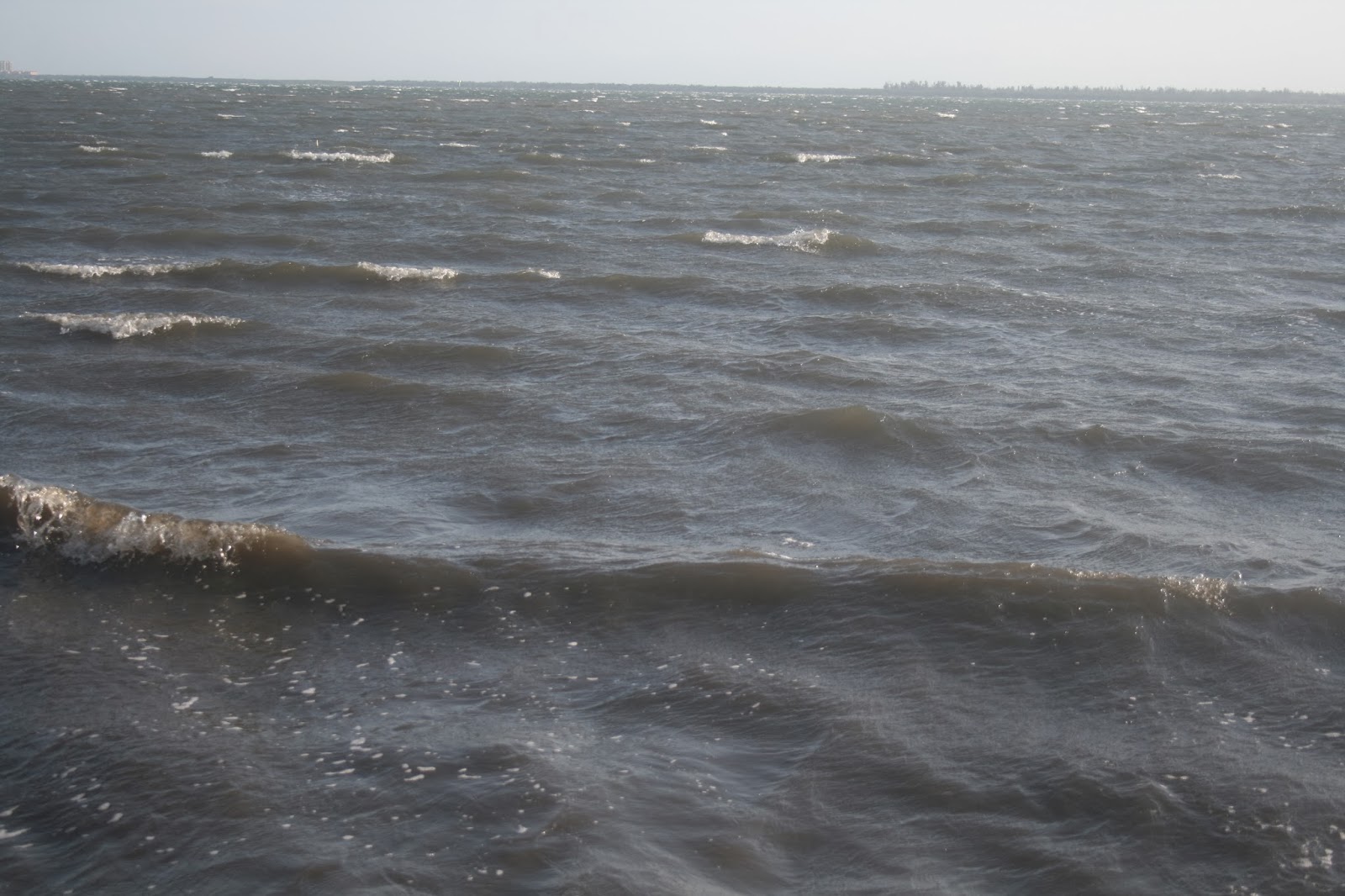
This is not my post for the day.  The wind picked up and was coming from the North so I wanted to let you know.

This isn't my post for the day, and this isn't the ocean.  It is the river.  You can see a good number of white caps.  I haven't seen the ocean yet today.  So later I'll have my actual post for you.


The surf is only supposed to be about four feet so I'm not expecting much, but I do want to check it out later.

Saturday, July 21, 2012

7/21/12 Report - St. Marks River & Heisman Club & Fish Teeth


Written by the TreasureGuide for the exclusive use of treasurebeachesreport.blogspot.com.


First, I'll let you try to figure out what this is.  I found it in the ocean when I dug up a ring.  There it was in the scoop with the sand and ring.  I didn't know what it was but thought it was unusual enough to keep until I found out what it was.  I'll give you the answer below.


I've received comments concerning the excellent resources that I've been posting lately.   I think they are very useful myself.   It always helps to have a broad awareness of the different types of old objects that you might dig up or just see while out there on the beach.

As you may know, the St. Marks River was an important highway in the early days of Florida, all the way back to the early 18th Century and even earlier than that.  The Florida Anthropologist printed a nice, but short, paper on an exploration of the St. Marks.   A swivel cannon, pistol, bayonet, and artifacts of various periods were found.  

They may have found the remains of an old fort as well as docks.  This is a not a new article, but still interesting. 

Here is the link.

http://ufdc.ufl.edu/UF00027829/00153/14j

The particular article I am talking about is on page 44-49 (by Fairbanks).

I always like looking at artifacts, especially those which have been identified to a particular time period.

The water level of the Mississippi River is dropping.

That will undoubtedly lead to a few new archaeological discoveries, as things become exposed.
http://news.blogs.cnn.com/2012/07/19/drought-sends-mighty-mississippi-river-levels-near-record-lows/?hpt=hp_c1

The point for us is to remain aware not only of any erosion, but also of lowered water levels.  Both can expose interesting things.


OK.  It's time for the answer to the mystery object above.  It is a fish tooth plate that would be used to grind shellfish or other prey, possibly from a fish such as a Redfish.

Here is a very different kind of  beach find.  It is a small lapel pin, obviously of modern origin.  I haven't yet found out what the Heisman Club is.   I don't think it would be worn by Heisman candidates, or winners, but I guess that is remotely possible.  I'd certainly like to hear from anyone that knows.


Well I've covered a lot of ground today - from fish teeth to 18th century artifacts to football memorabilia.


We just aren't getting any changes in detecting conditions.  The wind is still mostly from the south, and the seas smooth.

Low tide is a little after 4:00.


Happy hunting,
Treasureguide@comcast.net