Showing posts with label beach detecting conditions. Show all posts

Saturday, April 15, 2017

4/15/17 Report - The Huge Importance of Beach Conditions For Finding Treasure Coins. The Steep Slope Of The Finds Curve


Written by the TreasureGuide for the exclusive use of treasurebeachesreport.blogspot.com.


Finding old shipwreck treasure coins on the beach is a different type of hunting.  The vast majority of coins are found on a very few special days.  Those days are rare.  They don't occur every year.  They might only occur once every several years.  They are special times like during the Thanksgiving storm of 1984 or after hurricanes Francis and Jeanne.  Numerous finds are made during especially productive times like that. During those special times people can find more treasure coins in a few days than they might otherwise find during a entire year or more.

I don't remember the last time I issued a 5 rating on my Treasure Coast beach conditions rating scale, but I know it has been quite a while.  A 5 rating indicates excellent conditions like those I just described.  The dunes are eroded, the beach is heavily eroded and the sand in front of the beach has been moved.

The past couple of years have been very slow for finding old shipwreck treasure coins on the beach, and that is the only thing I'm talking about right now.  We had Matthew, and that opened up a few places and resulted in some good treasure coin finds, but not massive amounts.  Most finds occurred on just a few beaches, and not nearly in the numbers that were found after Francis and Jeanne.  You had to be at the right place at the right time.

I changed my beach conditions rating system not too long ago.  The change, in addition to better describing transitional conditions, also better reflects the rarity and huge impact of the very best conditions (5 ratings).

I changed my "2" rating so that it now indicates transitional conditions.  That rating indicates that sand has moved and conditions are improving, but finds are not certain.  More improvement over level 2 conditions will normally be necessary to predict that treasure coins will definitely be found.

The illustration at the top of this post attempts to show the general shape of the finds curve.  As conditions improve so do finds.  That is simple enough, but what I really wanted to show is the steep increase in number of finds during the very best conditions.  It is a dramatic increase, and the vast majority of finds are made during a very few days while conditions are best.

My illustration is not precise in any manner, but I do think it illustrates one the one thing that I am most trying to illustrate.

Level one conditions are in effect most of the time.  Level five conditions are rare.  They don't even occur every year, yet they still account for a large percent of the finds because of the large number found when they do occur.

The change of my two rating moves the entire scale weighting to the right and I think that was a good move.  My level 3 rating is now like more like my original level 2 rating.

1 and 5 ratings indicate times when detecting skill, while always helpful, is not as important as at other times.  During poor conditions, it doesn't matter if you are very skillful or not skillful at all, you are not going to find treasure coins on the beach.  There are always exceptions, of course, but those exceptions are extremely rare.

During level five conditions, skill is helpful, but you can find a lot without much skill.  During level five conditions people have actually put down their detector and ran around picking up coins laying on the surface like it was an Easter egg hunt.  The main thing is to be at one of those massively productive spots at the right time.

One of the difficulties during level five conditions is that beaches and bridges might be closed.  The other problem is all of the damage and all of the people that need help, which might be a higher priority.  It can be a time when more important things need to be done.  You most likely will find a lot if you are out a lot during times like that.

Skill is more important during the intermediate condition ratings.  The productive spots are more scattered.  Being able to read the beaches can help you find those scattered finds.  It is easy to miss a lonely half reale on a big beach.

Skill is also very important when it comes to artifacts.  Some people will never find an iron shipwreck spike simply because they discriminate out iron.  Maybe that is what they want to do, but I'm sure a lot excellent artifacts are unintentionally missed.

Another type of skill is adjusting when beach conditions are poor.  There are other types of hunting and other places to hunt if you do your research and are adaptable.  Those other types of hunting normally require a good amount of skill.

---

There has been a nice stiff breeze all morning.  The surf is supposed to be higher today.  The wind direction isn't the most favorable.  I haven't been able to check the beaches myself yet.

Happy Easter,
TreasureGuide@comcast.net

Wednesday, January 20, 2016

1/20/16 Report - Treasure Coast Beach Detecting Conditions Not Bad Despite Small Surf. New York Public Library Digital Collections.


Written by the TreasureGuide for the exlusive use of treasurebeachesreport.blogspot.com.


One Cut On The Treasure Coast This Morning Near Low Tide.

I've been busy for a few days and hadn't been out to check the beaches until this morning.

As you know, the surf hasn't been big.  The tides have been good and we had some north winds that made up for that to some extent.

The beaches that I saw on Hutchinson Island this morning weren't half bad.  I found plenty of heavily corroded and patinated clad coins and a few other things.


Fort Pierce South Jetty Beach This Morning.

I found one coin line that was about one third of the way up the slope between the low tide and high tide lines.

There were plenty of targets, and if you are hunting modern things, I suspect you could find some good hunting.

There might be a beach or two that is producing old stuff, but I didn't have the chance to check some of those spots, so I can't say for sure, but there is a chance.

Overall, conditions are much better than summer conditions right now, but not good enough for me to increase my Treasure Coast Treasure Beach Detecting Conditions Rating.  I'll have to check some other beaches tomorrow.

The three big factors are waves, tides, and the wind.  In this case we didn't have big waves, but had a good tide and some good north winds.

I saw erosion at three different beaches.  Two of those beaches also had sand piled up at the front of the beach.  One of those is shown immediately below.


Piled Up Sand On The Front of John Brooks Beach This Morning
In this picture, the piled up sand goes back to the light brown strip, which is made of a courser light sand.

There were few beach goers this morning.  I could see my tracks.  It reminded me of games we played up north in the snow.  I can't remember the name of that game now.  Maybe it was Duck, Duck, Goose or something like that.

I did see one other detectorist.  You can see her at the South Jetty Beach picture.

---

Part of Old Map Found In The New York Public Library Digital Collections.


I mentioned a bit about public domain yesterday.  When I started that discussion I meant to give you a good link for accessing a lot of public domain materials.  At the time I couldn't find the link, but found it later.  Here is the link to the digital collections of the New York Public Library.

http://digitalcollections.nypl.org/search/index?utf8=%E2%9C%93&keywords=treasure

Above is one example of what you can find there.  It takes a few minutes to learn how to navigate the site, but it is worthwhile.  You can find a lot of good material there.

The picture I posted yesterday was also from the New York Public Library Digital Collections.

---

I have deleted some of the old links from my reference link list and need to delete a few more that no longer work.  Old sites can be removed or renamed.  If you find any that no longer work, let me know.

Happy hunting,
TreasureGuide@comcast.net

Saturday, October 24, 2015

10/24/15 Report - Surf Decreasing and Beach Conditions Rating Dropped. More On Returned Ring. Conquest of Mexico.


Written by the TreasureGuide for the exclusive use of treasurebeachesreport.blogspot.com.


Ring, Charm and Coins Found by Warren D.
Photo by Warren.

I awarded Warren Dennison the TBR Detectorist of the Month Award in yesterday's post.  I wanted to follow up on that a little today.  There were a few things I wanted to emphasize.

After eight hunts, Warren found the ring "at low tide, low on the slope on the wet sand after following a trail of old coins..." He also found a piece of a charm.  It is not unusual to find coin lines low on the slope in the wet sand.

I talk about finding coin lines not so much because I want to find the coins, but because they can lead to other things, such as rings.  This is a good example.

It is good for all of us when someone does a good deed like Dennis did.  It happens more often than we hear, so I wanted to thank Dennis for telling us about it.

---

I am going to drop my Treasure Coast Treasure Beach Detecting Conditions Rating back to a 1.  That is a difficult call for me because conditions for finding old shipwreck items are still better than they were a couple of weeks ago and all summer.  It hasn't been a definite reversal with the beaches all filling in.  Still I am predicting that fewer cobs will be found now than earlier in the week, and it won't be as easy to find those few that remain.

Of course my ratings are based upon my best evidence.  There is a lot of guess work involved.  It isn't like getting on a scale and reading your weight.  Still, from all of the corroborating evidence that I've been able to gather over the years, including the results of the polls that I've conducted in the past as well as reports from other people, I'm convinced that my ratings have been fairly accurate.

As I've explained in the past, my five point scale starts with a 1 instead of a zero, because there is always some chance.    I'm willing to bet that a few more cobs will be found this weekend, but I'll also bet that it won't be as easy now.  There probably will be more people out this weekend.

For the most part, I would not expect the good holes to be getting replenished now.  Some beaches are filling a little, but that is not the only factor.  Another factor is that the easy finds have mostly been made.  One way you can improve your chances is to get away from the beach accesses and the most heavily hunted areas.  You might have to walk a mile or two.   '

For one example, if you walk south from Turtle Trail, you'll come to one flag pole, but if you keep walking, you'll come to a second flag pole.  After reaching the second flag pole, look way down towards the bend where you will see one tall palm tree with a small top sticking up above the others. You could try detecting the area down by the palm tree.  I'm not saying to do that now, because it has been checked now, but that is the type of area that will normally not be one of the most heavily detected.

There are a few ways that new coins can pop up in old hunted-out holes.  One is when someone comes along and does a better job of detecting.  Another is when just an inch or so of sand is move off the hole  in one direction or another.  It doesn't take a lot of sand being moved for a borderline detectable coin to be brought within range for a person that is detecting carefully.

Coins that were previously masked by something like perhaps a heavy streak of black sand can be more easily detected when the black sand is moved.

The thing to realize is that coins can show up in old worked-out holes after you might think they have all been removed.

And of course, when conditions are right, old holes can be replenished again and again and again.

---

Several days ago I posted a link to an article about a Spanish convoy that was destroyed.  Larry G. sent me the following email recommending a couple books about the conquest of Mexico.  Here is what Larry said.

If you haven't read it yet, I must recommend to you the books, conquest of Mexico, and conquest of Peru, by William H. Prescott. The remains from the slaughter of the Spanish convoy that is being excavated now is documented on p.498, though no mention is made of the Spanish women. The place was Tezcuco, which translates as "Place of Rest." Reportedly, the Tezcucans skinned the Spaniards and hung the skins, along with their accouterments, in their temple, but that the bulk of the loot, which included looted treasure, was sent on to the Aztec emperor.

By the way, the sacrifice of Spanish captives (as with all battle captives), and the eating of them, was something the Spanish would become very familiar with before the conquest was completed. The Spanish convoy above were certainly not the only Spaniards so treated, they are the exception only in that they were utterly destroyed,  the only Spanish force I can think of during the conquest that was annihilated.

When Cortes returned to the city, he made it his headquarters for the conquest of the capital and the heavily populated valley with numbers of large cities. Tezcuco itself was a very large and beautiful city, Mexico being a heavily populated land at that time, with thriving markets, trade, and industry, highly organized, with large police forces to keep the peace in the major cities. The Mexicans were especially fond of flowers, and the cultivation, sale and display of flowers was big business. The Aztecs maintained large parks, and gardens in their cities and their suburbs. The Spaniards were astonished by the beauty of the urban and suburban areas, of course with the grand architecture of the great temples dominating the scenes. Sadly, much of this was destroyed in the conquest,the lakes were drained. forests felled,  and salt leaching destroyed the soil and the great expanses of cultivated land in Mexico valley became wastelands. Populations dwindled to a fraction of their former number, right up until the 20th century.

The books give pretty precise information as to the location of battlefields around Tezcuco, and it would be very interesting to metal detect  and generally poke around those locations.

Thanks Larry.

---

Like I said, I don't expect the hunting to be as good this weekend as earlier in the week, yet I do expect a few cobs to be found.  The surf will be decreasing throughout the week.  That means the cliffs won't be eroding much more, but on the positive side of things, it might give you a chance to detect a little farther out on the beach than you could before.

The really good news is that the beaches haven't completely refilled yet.  In fact they've only refilled a small amount.  Hopefully they won't completely refill before the next period of erosion comes along.  And if we are really lucky, the level of sand will remain down all through the winter.  We had such a long period of accretion, now maybe we'll get a long period of decreasing sand levels.  It could happen.  At least we can hope.

Happy hunting,
TreasureGuide@comcast.net

Tuesday, December 9, 2014

12/9/14 Report- Big Waves Little Erosion This Morning. Beach Detecting Conditions Upgrade.


Written by the TreasureGuide for the exclusive use of treasurebeachesreport.BlogSpot.com.


Big Waves This Morning.
The water got far back on the beaches this morning.  The water was almost as high as during Sandy.  At John Brooks there was a shell line back just in front of the dunes.  I got excited when I saw the waves and how far he water got back on the beach, but there was no erosion.  It was pushing the sand up and back.

The video below shows what it looked like at Seagrape Trail.  The water was hitting the face of the cliff and causing it to erode, but that was all renourishment sand. And the sand that was falling off of the face of the cliff was staying in front of the cliff instead of being washed away.


It was very mushy in some places.  I sunk in the sand up to my knees a couple of times.   Mostly the sand was piling up.  There will be a few places where you'll find some cuts, but you'll have to hunt those few places out.

Most of he beaches from Vero north still had a good bit of renourishment sand.  I didn't notice any places were the old sand was being exposed.


Wabasso This Morning.
You can see the renourishment sand in front of the dunes here.  That is the problem with most of the Vero/Sebastian area.

Golden Sands park was closed.  A renourishment project was taking place there.  Treasure Shores is now open.


Amber Sands Looking North.
At some places it looked very much like it did after Sandy. 

Notice that in the picture above there is no erosion, just a slope, and there is still renourishment sand protecting the dunes.

I'm upgrading to a level two Treasure Coast Treasure Beach Detecting Conditions Rating, but that is all for now.

I suspect that a few shipwreck items will be found.  There might be a few things washed up.  The front beach is getting pounded.  It will be hard to get out on the front beach until the waves calm down. 

There might be a few cobs that appear on the flat beach, as they did after Sandy.


I'd like to hear from anyone who attended the Robert Marx seminar who can fill us in on any pertinent details or conclusions.


Happy hunting,
TreasureGuide@Comcast.net

Monday, December 1, 2014

12/1/14 Report - Treasure Coast Beach Detecting Conditions Downgrade. Reduced Surf Predictions. Fossil Shell.


Written by the treasureguide for the exclusive use of treasurebeachesreport.BlogSpot.com.


New Surf Predictions Posted For The Fort Pierce Area On Magic Seaweed Web Site Today.
Well it happened again.  Yesterday I said something like there would be only a 10% chance that we would actually get the 6 to 10 foot surf that was predicted for next week.  The Magic Seaweed surf prediction has already been reduced down to 4 to 6 feet for the same day.  I'm not always happy to be right.  I'd rather see a ten foot surf next week.

I also said I'd reassess my Treasure Coast beach detecting conditions rating today.  I'm no happy about that one either.  I took a look at three different beaches this morning.  All showed deterioration.  As a result, I'm back to a "1" (poor) beach detecting conditions rating.


John Brooks Beach Near Low Tide This Morning.
Here is one of the beaches that had a five foot cut a couple of days ago.  The cut is now about two feet.  Sand has filled in front of the cut.  The slope was mushy.  You can see some sea weed.

There was some firmness down by the water, which near low tide was about thirty yards from the cut.

A few miles away another beach showed similar conditions.

And here is a picture of Jensen Beach this morning.

Jensen Beach This Morning Near Low Tide.
Notice all the sea weed.  For those of you who like hunting shells  and things, there were some shell piles at Jensen Beach and Walton Rocks this morning.

Shell Fossil Found On The Treasure Coast This Morning.


I like this shell fossil.  There are two of them that you can see here.

There were also some pieces of conglomerate with crystalized shell in them, and some other small fossils too.

There was some rain at the beach this morning.  Maybe that is why the beach was so deserted, or was everyone shopping or something.  It was really quiet on the beaches that I saw this morning.

The thing I really didn't like to see is that the waves were hitting the beach almost directly from the East.  As a result I'm not expecting any real improvement any time soon even though the surf is still supposed to increase a little.


Sorry I don't have better news today.  I know we're all eager to see some improvement in the beaches.

Happy hunting,
TreasureGuide@comcast.net

Thursday, March 13, 2014

3/13/14 Post - Treasure Coast Beach Detecting Conditions Rating Increased One Notch.


Written by the TreasureGuide for the exclusive use of treasurebeachesreport.blogspot.com.

I warned this morning that there was a nice stiff wind coming from the North, and it might be worth taking a look to see what was happening to the beach.  The river is not a great predictor of what is happening at the beach, but it does give some information.

Well, based upon the wind and what I saw on the river, I went to the beach, and here are a couple of photos showing what I saw.

This Morning Just Before Low Tide.
This cut around two feet high or less.

Looking the other direction at the same beach, the cut was slightly bigger, for a good distance being about three feet high.

The surf, as you can see on the third picture wasn't that big.  I would guess that it was in the three or four foot range.  That certainly isn't a lot and it isn't the kind of wave size that people usually expect to create much in the way of cuts.

The erosion was very much to the East, on the very front of the beach.  That is the result of the small tides and three to four foot surf.

The cuts from some time back were maybe nearly thirty or more yards farther back on the beach.  You could still see some remains of some of those previous cuts.

This cut ran more or less continuously for probably two miles.

The beach in front of the cut, what there was of it, was relatively compact.   There were some small metal targets.  I'll show one or more after I get them tested.

At another beach a few miles farther south, there were no cuts, so don't expect every beach to have cuts, but some will.  You'll have to check around.

Two To Three Foot Cut Before Low Tide.
The wind was still brisk, and as happens when you get a North wind, the water was slicing away at the front of the beach, and that is why there were cuts.

Some people talk as though it is all about big waves, but the angle is just as important as wave size.

There also seemed to be a dip in front of the cuts in the shallow water.  That is another factor.  The sand bars were out a good piece.

Notice the curve to the beach in the above photo.  That is another important factor that contributes to the slicing angle of the waves here.

Waves Breaking On Front of Beach In Front of Cuts.

I might be slightly generous in my rating here, but I'm going to upgrade my beach detecting conditions scale to a 2.  Maybe it should be more like a 1.5.  Nonetheless I think it is the most improvement in conditions that I've seen for a while.
 
Conditions have been so consistently poor lately that I have been seldom giving a numeric beach conditions rating.  I therefore need to explain my rating scale for those who haven't been reading this blog for a long time.

The rating scale is a five point scale, with one indicating poor beach detecting conditions and 5 indicating excellent beach detecting conditions.

The conditions we had back in November when a good number of cobs were found rated as high as a 3, or maybe even a 4 for a short time, on my rating scale.  I think I was a little conservative on that one.  Anyhow, that gives you some sense of what the ratings mean without getting too complicated.

I'm glad to see some cuts for a change anyway.  2014 had been pretty slow.

Happy hunting,
TreasureGuide@comcast.net


Prepost posted earlier today.


This is not my post for the day.  The wind picked up and was coming from the North so I wanted to let you know.

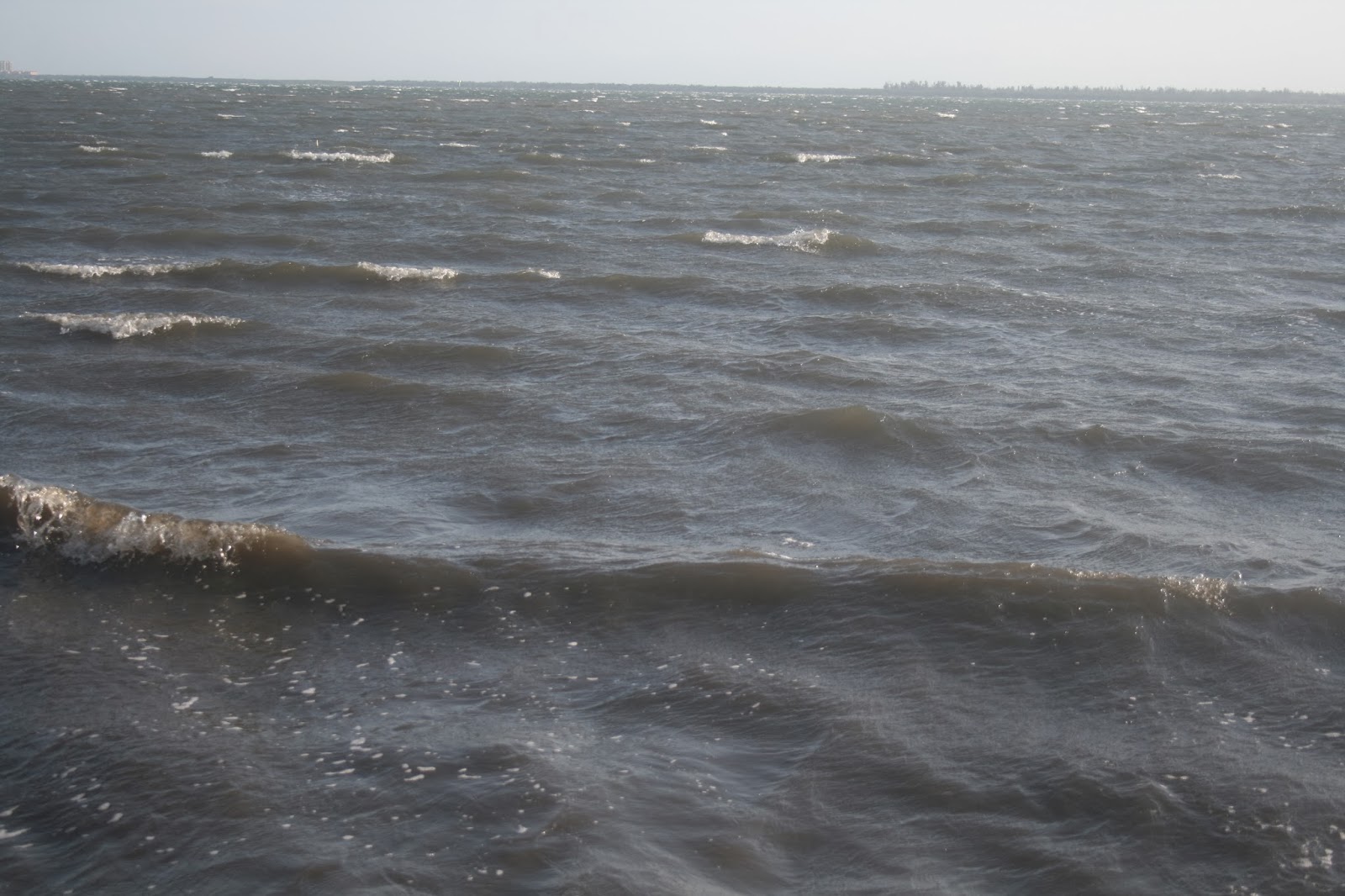
This isn't my post for the day, and this isn't the ocean.  It is the river.  You can see a good number of white caps.  I haven't seen the ocean yet today.  So later I'll have my actual post for you.


The surf is only supposed to be about four feet so I'm not expecting much, but I do want to check it out later.

Sunday, November 3, 2013

11/3/13 Report - Indicators for Predicting Beach Detecting Conditions & Getting Leads From Old Home Movies


Written by the TreasureGuide for the exclusive use of treasurebeachesreport.blogspot.com.


Here is the TBR FOD.

It is a nice heavy 18K band.  I like the nice buttery look of 18K.


When I originally started this blog the primary purpose was to help you make good use of your time by knowing when beach detecting conditions would be good and when they would be poor.  I developed my Treasure Coast Beach Detecting Conditions Rating Scale, which is a five-point scale with 1 indicating poor conditions and 5 excellent detecting conditions.  Conditions have been so consistently poor for so long that I quit giving a daily report.  Shortly after I began the blog I also started to talk about a lot of other things, such as finds.   Some of that other stuff, can also tell you something about beach detecting conditions, even if not as directly.

Lately my attention has been on the surf predictions.  It looks like we very well might get a significant change in beach detecting conditions, and not just for a day or two.  This is as hard to predict in advance as the weather. 

It looks like the weather has begun to change.  I noticed yesterday from the waves on the Indian River that the wind was now coming from the North.

You can often get some idea of what is going on at the beach by looking at the Indian River.  You can tell for example, how the wind is affecting the water, including the direction and strength.


Surf Chart for Today and the Coming Week.
From MagicSeaWeed.com.

I noticed yesterday that the Indian River was showing the effect of a change in wind direction.  The waves on the river were small, but now coming from the North.  That hasn't been the case for a while.  Most recently the waves on the river have usually been coming from the east or southeast.

A lot of white caps on the river is  a good sign that there will some growing waves on the ocean.  Of course the river doesn't tell you perfectly what is happening on the ocean, but it will give you some information.   When the Indian River is smooth, the chances are that the ocean is smooth too, and vice versa -  not always, of course, but more often than not.

I even noticed some small erosion along the west bank of the Indian River yesterday.  I'd say about of foot of sand was moved away from in front of the west bank where I noticed it.

Here is some of what the National Weather Service says for Nov. 3.

.HAZARDOUS MARINE CONDITIONS FOR SMALL CRAFT TODAY THROUGH THE
MIDDLE OF THE WEEK...

...WINDY CONDITIONS WITH BUILDING SURF AND MODERATE BEACH EROSION
EXPECTED EARLY THIS WEEK AT THE COAST...

TODAY...SHORT RANGE MODELS SHOW INCREASING PRESSURE GRADIENT BEHIND
THE FRONT THAT MOVED THROUGH THE AREA YESTERDAY. NORTHERLY LOW LVL
FLOW WILL BECOME NNE/NE LATER THIS AFTERNOON. WILL SEE BREEZY TO
WINDY CONDITIONS DEVELOP UNDER MOSTLY SUNNY SKIES TODAY.

EXPECT N-NE WINDS TO INCREASE TO 15-20 MPH AREA-WIDE TODAY WITH SOME GUSTS TO 25-30 MPH THIS AFTERNOON IN THE LAKE WIND ADVISORY AREA.  

THERE WILL BE A STRONG LONGSHORE SOUTHWARD FLOWING CURRENT AT THE BEACHES WITH ROUGH
SURF DEVELOPING THIS AFTERNOON. 

TONIGHT...SFC HIGH PRESSURE WILL BUILD DOWN THE ATLC COAST
STRENGTHENING THE LOW LVL ONSHORE FLOW FROM THE NE.

If you look at MagicSeaWeed or some of the other surfing web sites, one of the first things you'll notice is that the high tides are high and the low tides are getting lower.  Recently, the low tides have  not been going down much.  That should help beach detecting next week.

The next thing to notice is how high and for how long the surf will be up.  As you can see from the chart above, Sunday a two to three foot surf is predicted and Monday a four to six foot surf is predicted.  But the most encouraging thing is that not only will the surf be higher, it will remain fairly high for an entire week if the predictions are correct.  And all of that with some good tidal changes.

That is the longest period of higher surf that I remember for maybe a year or more.

I often say that it doesn't take a hurricane.  A good northeaster that sits out there in the ocean and churns for a while can be just as good.

It can take a while for the sand to be moved.  There is now a lot of summer accumulation.

Also look at the wind charts.  We're expecting first north winds and then northeast winds for a good while.  That is promising too.

All told, the predictions are now very encouraging.  But, as you know, it is difficult to predict the weather and predicting beach detecting conditions is even more difficult.  We'll soon see if the surfing web sites are correct.  In any case, the predictions are the most encouraging I've seen for quite a while.

Just an Interesting Picture
From Reutters News Service.

They had a big storm over in England a few days ago.  Here is a photo from that.

Undoubtedly some new disscoveries will be made over there as a result of the storm.


I recently discovered another source of good detecting leads - old home movies.

Back in the fifties or sixties people were making home movies using cameras such as the Super 8.  Today you might discover some of those old home movies, but not be able to find a working projector to view them.   An alternative is to send those films to a service to have them transferred to DVD.   It isn't terribly expensive and can end up being very enjoyable.

You can also try to get an old used projector or film viewer.  That can be done on eBay or places like that.

Anyhow, once you find some old film and are able to look at it, you'll often find pictures of old beaches, parks or structures that not longer exist.  It can be a good source of leads.

If you want to discover some new places to detect, try a little research.


Here is an interesting article on what happens when you send email.

http://usnews.nbcnews.com/_news/2013/10/31/21267720-how-the-feds-snoop-what-happens-when-you-hit-send-on-your-email?lite

The last sentence of that article is misleading.  Mail is monitored too.


Happy hunting
TreasureGuide@comcast.net