Showing posts with label Tortugas Wreck. Show all posts

Wednesday, November 30, 2016

11/30/16 Report - Turning A Whatzit Into a Thatzit. Help Solve The DB Cooper Mystery. Reports From the T. C.


Written by the TreasureGuide for the exclusive use of treasurebeachesreport.blogspot.com.
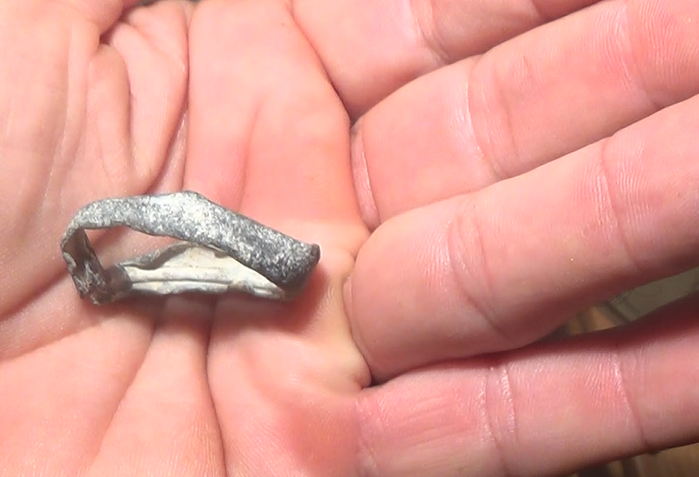
Dug Lead Whatzit.

What do you think it is?  I'll get back to that below.

---

Darrel S. sent the following message.

Golden Sand still closed. Not much found other some junk jewelry and tabs! Beach was in 2 parts. 1st part wall 6 feet high and flat to 2nd part. 2nd wall dropped off with very low pockets or scoops. Flat out into low tide surf. The rope that we saw at Turtle Trail was past the steel wall towards Orchid Resort. 3 employees were cutting it with machetes and removing it from the beach. That is long way to travel from where we saw it on Sunday. I found 3 nice Cowrie shells. Been a long time that any good ones have been seen in this area.

Darrel and friends detected Round Island Park today and found a good bit of scrap iron and some coins.  He said it wasn't as worked as he expected.

Thanks for the reports Darrel.

---

The public is being asked to help solve the DB Cooper case.

True Ink founder Geoffrey Gray says he received the case files—including evidence assessments and interviews with jet passengers—while researching a 2011 post on the hijacker, later branded DB Cooper, but couldn't review them all, per the Washington Post.

"We have access to all these original DB Cooper case files and we want help from the public, citizen sleuths to help solve this case," he says. Authorities have had almost no leads in the decades since Cooper boarded the flight from Portland, Ore., to Seattle on Nov. 24, 1971. The only physical evidence is a cache of about $6,000 from the heist found along the banks of the Columbia River in 1980, and theories abound. One retired FBI agent suspects he landed in a lake and died. Others believe Cooper was really Richard McCoy, who copied Cooper's crime in 1972 and was later killed in an FBI shootout, notes Fox 13 (Or perhaps Cooper was a grocery manager from Michigan.)...


Here is the link for the rest of that article.

http://www.newser.com/story/234717/db-cooper-case-could-still-be-solved-with-your-help.html?utm_source=part&utm_medium=foxnews&utm_campaign=rss_science_syn

Thanks to Dean for that link.

---

Did you figure out what the item shown at the top of the post is?

I dug the item not too long ago and thought I knew what it might be but I really wasn't confident about it at all.  It stayed in my TBR (To Be Researched) pile for a while. Today I did a little research and now am pretty sure that I know what it is.


Source: Odyssey Virtual Museum
See link below.


I thought it was a lead bottle collar.  If you look at the inside of the ring it has a ridge which spirals away from one edge.  A lead cap would screw onto it.

Here is what the Odyssey Virtual Museum says.

A total of 127 fragments of glass were excavated from the “Tortugas” shipwreck, including square-sectioned case bottles. The bases of these bottles are all medium olive green in color and contain air bubbles. Glass rims and neck sherds were recovered still attached to 14 lead screw collars and caps that originally sealed some of the “Tortugas” ship’s bottle mouths. Data suggests a minimum presence of 16 square-sectioned bottles on the ship...

The two-piece permanent lead collars and caps that originally closed the bottles’ mouths feature everted sides and a horizontal shoulder surmounted by a short vertical mouth. Each collar, 1.4-1.9cm high, is subdivided into two seamless elements: at top a narrow screw thread (W. 1.5-1.9cm, Th. 0.2cm) consisting of three convex external edges between two inner recessed threads for receipt of a lead cap, and below the main section (max W. 2.1-3.3cm, bottom W. 1.9-2.9cm, Th. 0.2-0.4cm) that originally covered and protected the glass bottle neck and rim. The two zones are separated by a horizontal ledge, furrowed on the lower edge. The bottom edge of the inner diameter, reflecting the bottle’s neck diameter, ranges from 1.2-1.7cm. The collar was a permanent component cast over the bottle...

Here is the link if you want to learn more about lead bottle collars and caps from shipwrecks.

http://odysseysvirtualmuseum.com/products/Lead-Screw-Collars-and-Caps.html

---

We're having great weather lately.  I'm not expecting any improvement in conditions in the next couple of days.

Happy hunting,
TreasureGuide@comcast.net

Tuesday, September 6, 2016

9/6/16 Report - Surf's Up. Blog History. Silver Cobs of the Buen Jesus Nuestra Senor de Rosario. One Interesting Question.


Written by the TreasureGuide for the exclusive use of treasurebeachesreport.blogspot.com.

Source:nhc.noaa.gov

The surf is supposed to be up to around six feet on Tuesday.  Things might get stirred up a little. We'll get a bit of a northeast wind.

The disturbance I've been watching is now in the Caribbean Sea.  It looks like it will stay well to the south of us.  Storms that hit the East Coast normally turn north before this.

I've been talking about the weather a lot lately.  That is closer to the original intent of this blog.  When I started the blog, the idea was to let you know when beach conditions would be good.  

When I began detecting, I lived down in South Florida and hunted mostly modern jewelry. Conditions were less important there because there were so many beach goers that you always had a decent chance of finding something good, even when beach conditions were poor,  And you could always hit one of the man-made swimming beaches or the volleyball courts.  There were a lot of choices and you always had a good chance of finding something good.  More often than not you could find some type of gold. Later I got interested in hunting the Treasure Coast, but that required a couple hours of driving. Never knowing what the beaches looked like, there were wasted trips.  I'd make the drive and then when I got there, chances were that the beach conditions were poor.  

I think it has been made abundantly clear, beach conditions are very important for finding treasure coins on the Treasure Coast.  Just look at the quantity and quality of shipwreck finds that were made after hurricanes, whether you are talking about the legendary Thanksgiving storm or the hurricanes of 2004.  You have a much greater chance of making such finds on the beach after a storm like that.

There are years when comparatively little is found on the beach.  Weather is hugely important in hunting the Treasure Coast shipwreck beaches.  That is why I started this blog and mostly what I did when I started the blog.  I gave my beach conditions rating everyday.  When we got into some of the less productive years, I began to only give my rating when conditions changed significantly.  It got tiring when I had to give the same old "poor" rating everyday for months on end.  As a result, I started talking about other treasure related news and topics.

I think 2004 is right up there with the Thanksgiving storm when it comes to beach treasure finds. Maybe that is a topic for discussion.  I'm sure some will think one or the other was better, but then there aren't many that were around for the Thanksgiving storm.

I like variety.  I like finding all types of treasure.  I like finding old bottles, fossils and sea glass and other types of things in addition to shipwreck treasures.  That has always been my way.  I think you learn a lot by trying different types of hunting, and I find different types of treasure hunting interesting.

Some of my favorite finds are when I find a new type of treasure. One of my favorite finds was a raw beach nugget from a shipwreck beach.  I liked that because I had never found one before and I hadn't done any nugget shooting.  I like finding new (to me) types of treasure.

I've never read about it, but some of the best bottle hunting imaginable happened after the hurricanes of 2004. The west side of the Indian River lagoon was paved with bottles.  There were thousands.  Of course, the majority were nothing special and you had to pick through them to find the interesting, old and valuable ones.  Some were from the 1800s.  The bottles disappeared after a while.  I first got interested in finding bottles after I found my first ones after Hurricane Andrew when I still lived in South Florida.  

---

I found a really good study by Odyssey Marine on the silver coins of the Tortugas Shipwreck, which is thought to be the 117-ton Buen Jesus Nuestra Senor de Rosario, one of the vessels sailing with the 1622 Tierra Firme treasure fleet.  As such, it is a sister ship to the Atocha and Margarita.  The paper is The Deep-Sea Tortugas Shipwreck, Florida (1622): the Silver Coins  by Carol Tedesco.  It is a pdf file and takes a little while to load.

One of the what I consider the mysteries of the 1715 Fleet is the disparity between the typically small denomination cobs found on some of the beaches compared to the larger denomination cobs found by salvagers in the water.   Some beaches produce a very high percentage of small denomination cobs, such as the half reales found on beaches like Bon Steel and John Brooks.

The Odyssey paper makes some comments that are related to that discussion.  Here is a an excerpt.

In the case of the 1622 shipwrecks the Atocha and Margarita, 8 reales denomination coins are most numerous, followed by 4 reales, with 2 reales denominations relatively rare and 1 reale denominations scarce. For example, of the silver coins recovered in 1985 from the Atocha site, 0.001% (110) were 1 reale denominations, 15.0% (17,088) were 2 reales denominations, 21.8% (24,853) were 4 reales denominations, and 63.1% (71,808) were 8 reales denominations (Malcom, 2001). This makes sense since small denominations may have been most desirable for local trade, but shipping cargos long-distance in large denomination form was most efficient. Because the Tortugas shipwreck coin collection included a fairly high percentage of ‘unknown’ denomination coins, a decision was made with Odyssey artifact data specialist Eric Tate to distinguish between higher denomination coins of 8 or 4 reales and lower denomination issues. This study demonstrated that nearly twice as many ‘unknown’ coins were higher denominations varieties: • Total ‘Unknown’: 130 • Unknown (either 4 or 8 reales): 28 • Unknown (either 1 or 2 reales): 15 • Unknown (unidentifiable): 87 As stated previously, the Tortugas shipwreck coins were discovered loose and scattered under light sediment cover in deep waters (not in coin chests or conglomerations; Fig. 6), and exhibit a degree of erosion typical of exposed coins associated elsewhere with high-energy marine environments. 

So why the large number of small denomination cobs found on some beaches?  Could it be that the small denomination cobs are more likely to be washed up onto the beaches because of their small size while the larger cobs tend to remain in the water.?  To me that is a reasonable idea.  It is not unusual to find small denomination cobs in close association with shells - sometimes even in with scattered shells.  That is certainly not the only possible explanation.

If the small denomination cobs were meant more for local trade and not favored for long-distance shipping, could the small denomination cobs be personal property.  Certainly that is a possibility.  But that doesn't say why they would be so commonly found on the beaches as compared to large denomination cobs.  Perhaps survivors took more effort and were better able to save their own property.

One thing I am considering is what might have happened after the salvage crews arrived.

Another interesting thing to me is the nice caches of excellent large denomination cobs, (I've shown some of those lately).  They are in much better condition than the typical beach half-reales, which are often way under-weight due to corrosion.  The cobs from those caches have the appearance of being secreted away rather than being washed up after years of washing around in the sand and surf.

Those are just a few thoughts for now.

Here is the link to the Odyssey report.

http://www.shipwreck.net/pdf/OMEPapers30-2013_001.pdf

---

Happy hunting,
TreasureGuide@comcast.nets

Wednesday, August 3, 2016

8/3/16 Report - Tortugas Wreck Mortar. Zika Virus in Florida. What You Can See In A Cockle Shell. Tropical Storm Earl.


Written by the TreasureGuide for the exclusive use of treasurebeachesreport.blogspot.com.


Yesterday I showed a couple of mortars that the Capitana crew recently found. Here is a mortar found on the Tortugas Wreck, thought to be from the 1622 Terra Firme Fleet.  It appears to be about the same size as those I showed yesterday.  This one was displayed by Odyssey Marine, and is one of two found on the Tortugas Wreck.  The fact that the ones found on the Tortugas Wreck and the ones found recently were found in pairs might be significant.  As I said yesterday, they could be used for pharmaceutical, culinary or for other and possibly multiple purposes.

The Odyssey web site says "These utensils are commonly interpreted as surgeon’s mortars, undoubtedly due to their depiction in paintings such as Interior of a Dutch Pharmacy by the School of Terborgh dated to 1665 and in The Surgery by Gerard Thomas, 1663-1720. However, these objects enjoyed an equally broader function for basic food preparation. The precise "Tortugas" type of bronze mortar is extremely common in still life works by the Seville school in the Golden Age, typified by Diego Velázquez’s Kitchen Scene with Christ in the House of Martha and Mary of 1618, Christ at Emmaus of c. 1620 and Two Young Men at a Table, assigned a date of 1623-24 ."

The one shown here today was located just beyond the hull in the starboard stern.  This one is heavily decorated.

The Odyssey web site also says, "The origin of the "Tortugas" wreck’s bronze mortars and pestles is unverifiable, but a letter written in 1549 in Seville reveals that a metal mortar weighing 9lbs cost 1½ real per pound and a pestle 2 reales. Since the record is concerned with how “To transport the containers from Triana to the apothecary shop” (in this instance perhaps revealing usage for grinding medicinal herbs), production within Seville may be hypothesized."

The alabaster one shown yesterday could well have a different origin.

Here is the Odyssey link.

http://www.shipwreck.net/tortugasartifacts-treasures.php

---

You have probably heard of the Zika virus.  It is a virus being spread by mosquitoes in Florida, specifically the Miami area.  People who are pregnant or thinking of having children are particularly at danger.  CDC provides a number of precautions, including not traveling to the Miami area if you are pregnant.

In any case you will want to avoid mosquito bites and take steps to prevent mosquitoes from breeding.

Here is a link for more specific information.

http://www.cdc.gov/zika/intheus/florida-update.html

---

They say if you listen to a conch shell you can hear the ocean.  Of course it is not the ocean you are hearing, unless you are at the ocean.

When you find a cockle shell, you might want to look into it.  Here is what I saw in a cockle shell.

I highlighted what I saw with paint so you could see it too.


---

We now have a tropical storm named Earl (shown below).

Source: nhc.noaa.gov
Earl won't affect us much.  The projected path takes Earl across the Yucatan, Belize and into Mexico.

We are supposed to have a one to two foot surf for the next several days.

Happy hunting,
TreasureGuide@comcast.net