Showing posts with label silver coins. Show all posts

Friday, June 19, 2020

6/19/20 Report - Metal Detecting Hobby Makes Contributions to Archaeology. Digging Gold Mining Camp. Old Postcard Treasure.


Written by the TreasureGuide for the exclusive use of treasurebeachesreport.blogspot.com.


Viking Era Coin Found by Detectorist.
Source: See news.err.ee link below.


Another archaeological find has been made on the island of Saaremaa, just weeks after a major haul including a 1,700-year-old gold bracelet came to light.
The recent find dates from a later era, the viking period, ERR's online news in Estonian reports, and includes a large number of silver coins, according to both the Heritage Protection Board (Muinsuskaitseamet) and Saaremaa Museum.

As with the earlier treasure trove, the latest find was the work of a metal detector hobbyist, who, in line with Estonian law, informed the authorities.

"We are grateful for the licensed hobby detector, who reported the findings to the Heritage Protection Board, which can now preserve some of the crucial history of Saaremaa," Saaremaa Museum stated on its social media page...

Here is the link for more about that.

---


Postcard Postmarked June 10, 1875.

This post card is postmarked June 10, 1875. It was written to Thomas Gillespie of Stephenstown, Ohio, by Charles Louis Loos, who was a noted professor of ancient languages at Bethany College. I've been to Bethany, which was not far from West Liberty University (formed in 1837) where I once taught. The town of West Liberty was named in the late 18th Century as the westernmost point of the new liberty provided through the Declaration of Independence.

Source: Wikipedia.


Back of Same Postcard.

Notice the signature from the Wikipedia site and the postcard- very good match.


The one cent that it cost to send this postcard in 1875 would be roughly equivalent to 20 cents today.  Not bad.

To me this is an interesting piece of history that found its way to me.  I enjoy ephemera as much as any type of treasure.  Unfortunately you can't find it on the beach, but I've found a lot of it.  

You can learn a lot of history from old books and postcards.  I especially enjoyed this postcard because I was able to research the person and already knew about the places.  It bears the handwriting of a famous and historic person.  

Reading old script isn't easy, but with some difficulty I was able to make it out.  Whether you are trying to decipher documents from the Spanish archives or something else, reading old script in any language can be a challenge.

I have a lot of old books and postcards.  A good number of the books I puchased at thrift stores years ago for one dollar a piece, but a lot of the old books and postcards just found their way to me.  I guess it was just because I appreciated them.

---

Here is a link to an article about digging through the remains of a old Chinese gold mining town.


---

Trivia question -  What language is aare the word for treasure?  Hint: the Finnish word aarre is very similar.   You'll find the answer in a June 2019 post.

---

It looks like the Treasure Coast will have a week or more of one or two foot surf.  The tides aren't big either, and there are no tropical storms to pay attention to now.

Happy hunting,
Treasureguide@comcast.net

Saturday, May 2, 2020

5/2/20 Report - Hembleden Hoard. Metal Detectivists. Local Beaches. Mystery Item Solved.


Written by the TreasureGuide for the exclusive use of treasurebeachesreport.blogspot.com.

Gold Coins of The Hembleden Hoard
Source: ancient-origens.net (See link below.)


Four amateur metal detectorists partaking in a four day long rally in Buckinghamshire, England, have unearthed over 550 rare gold and silver coins, including 12 ‘extremely rare’ gold coins from the time of the  Black Death.

Estimated to have been stashed more than 600 years ago according to an article in The Daily Mail, the coins are estimated to be potentially worth £150,000 ($195,000). This is the biggest recovered gold hoard since the 2011 mid-17th century discovery of 52 coins in High Ackworth, West Yorkshire and the most valuable silver hoard discovered since the 617 coins dated to the early 10th century unearthed near Harrogate, North Yorkshire...

Here is the link to that article.


According to the Daily Mail, the findings are worth an estimated £150,000 (or $195,000).

The cache of coins was discovered by a group of four men during a detectorists rally called “Detectival”, where hundreds of amateur metal detectorists gather to scour hundreds of acres of English countryside in hopes of discovering artifacts just like the rare coins that were discovered.

In addition to the rare coins, the detectorists found 12 extremely rare gold coins from the Middle Ages, which are estimated to be worth $130,000 each...

Here is that link.

https://allthatsinteresting.com/hambleden-hoard

---

South Hutchinson Island Beach Friday.


Frederick Douglass Beach Friday.


South Hutchinson Island Beach Friday.

Jerry P. visited some South Hutchinson Beaches Friday.  Here is what he said.

I’m sending you some pics of the beach conditions south of the inlet this morning.

I got to Frederick Douglas around 7:30 and stayed through the low tide. Worked the beaches from 1/2-mile south of FD to 1/2-mile north of John Brooks.

Worked the cuts, scallops & shell lines then the water edge during low tide. Not many good targets, mostly fishing tackle and can slaw. But man it was good to be back on the beach after a 2-1/2 month layoff due to Covid-19.


Our beaches in Palm Beach County are still closed, so that’s when I decided to drive north. The tides were good for the early morning hunt and the day was simply Beautiful😎


Thanks Jerry, Looks like there was no problem with social distancing.
----

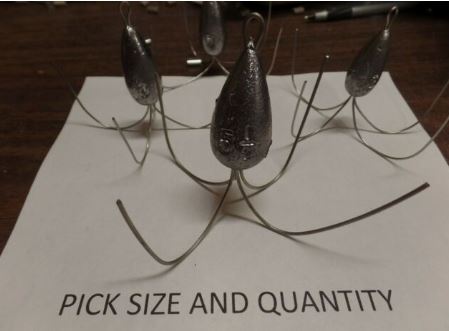
It looks like the sinkers I showed yesterday are the type with the extensions for grabbing into the sand.  Thanks to Phillip E. for the following picture.


I think that is it.

---

I always wondered how the people of Germany could allow or participate in the things that went on during World War II.  I didn't realize how it could get to that point, but after the past couple of months, I can understand it.  Not that this is anything like that, but I can see how people are motivated by fear, bombarded with endless repetition, forbidden dissension, and eventually horrific acts justified in service of the greater good.

---

One day this week there were almost 19,000 page views on this blog.

I feel like this blog is a bit like my home.  I express what I think or feel, but I don't ask anyone to stop by.  I just leave the door open.


Right now I'm waiting for the Virtual Kentucky Derby.  Was there a couple years when I was going to the University of Louisville.


The surf will be about two feet for a couple days.  I'm thinking about how I want to approach my summer hunting,

Happy hunting,
Treasureguide@comcast.net


Monday, March 23, 2020

3/23/20 - Tokens and Conductivity Numbers. More on Cleaning Coins.


Written by the TreasureGuide for the exclusive use of treasurebeachesreport.blogspot.com.

Selection of Tokens Used in Experiment.

As I mentioned not too long ago, I took my Equinox detector down to a very trashy spot along the Indian River Lagoon and started picking through the trash.  There is so much trash that it is very difficult to metal detect there at all.  If I was conducting a serious hunt there, I would do some site preparation and remove a lot of the trash, but picking through the trash provided a couple of benefits.  I learned more about the detector and especially the conductivity numbers by going over so many different types of targets and so much trash.

The conductivity numbers aren't of much use when you have a great hot spot -  you just dig every target.  But if you are trying to pick through trash and don't have much time, or you have some type of physical problem or limitation, you might want to do whatever you can to make the best use of your time and energy.  You probably know that I generally recommend digging everything (I won't get into all of that again now), but there can be times when it pays to discriminate.

I know the common conductivity numbers for most common coins as well as silver cobs, so I decided to experiment with a category of targets that are similar to coins, but not exactly the same.  I selected the tokens shown above from a bag of found tokens for the experiment.  The sample included (left to right and top to bottom) the following tokens: Time Out, Cloverleaf, Ice Machine, Say No To Drugs, Chuckie Cheese, Parking, Race O Rama, Cine Mark, Zone, Metro Transit, Garden State Turnpike, and Broad Causeway.

Here are the conductivity numbers I got for the test targets listed in the same order - 26, 22, 22, 22, 24, 24, 22, 23, 22, 21, 14 and 19.  Of course there was some variability.  Not all the numbers were rock solid.  But that is a fairly small range considering the differences in size and metallic composition of the tokens.  The largest token gave the highest number, but it also seemed to be made of a lighter metal.  The smallest token did not give the smallest conductivity number, although it did give the second lowest conductivity number.  Nearly eight percent of the tokens fell within the range of 21 - 24, which is a small range, and all of the tokens resulted in numbers ranging from 14 to 26.

I can think of a larger token that I could have and perhaps should have have tested.  I bet it would have produced a higher number.  Maybe I'll do that.

The range of good targets that you can encounter in the field is huge.  Gold rings can produce anything from single digits to very high numbers.  The gold ring numbers overlap with the numbers produced for coins, silver cobs and tokens.  Overall, I find the conductivity numbers somewhat useful in some situations, but when I want to make sure I don't miss anything that might be good, they are of little use.  If you are searching for a specific item or specific category of items, the conductivity numbers can be helpful.

---

I didn't know the silver coin cleaning topic would run on for so long.  I've personally used the procedure described by Bill P. for a long time with excellent results, but there are some little tweaks that people sometimes make.


A Coin Cleaned By The Muriatic Acid
Photo by JamminJack.

JamminJack said electrolysis wasn't working well on the coin shown above, but the Muriatic acid did the job.

Like with electrolysis there are a lot of  little differences in how people use the Muriatic acid .  Containers are one thing that people play with.

JamminJack said The best way I found was getting a wood clothespin and clip on edge of coin. Lay it in container so you can retrieve and stir the coin.

I often use the top of a spray paint container, as shown below.

Top of Spray Paint Can 
For Cleaning Coins With Muriatic Acid.

There are some things I like about using a spray paint can top.  One is the small inner cup.  If you have one or two half reales, just fill the small inner compartment.  You normally don't need any more acid than is necessary to cover the coin - at least to start.  No sense using a lot of it when you don't need it.

The inner cup also allows you to separate items if you are doing more than one.  That can be important if you are not absolutely certain of the metallic composition of one of the items and want to keep it separate.

But the thing I like most is you can lean the coins against the walls so that every surface of the coin is exposed to the acid.   I've just always found that type of container available, disposable and convenient.  I have a pair of needle nose pliers with rubber coated tips that I sometime use to remove the coins, but it is just as easy to pour the acid into another cup, and then rinse the coins before removing them.  The same acid can be poured right back into the cap if you want to continue the acid immersion and don't need to change the acid.

JamminJack said, The best way I found was getting a wood clothespin and clip on edge of coin. Lay it in container so you can retrieve and stir the coin.  

Good idea.

I'll just add one or two more thoughts on this topic today.

Below is a closeup view of an acid-cleaned four-reale.  I just began use of a baking soda paste but hadn't done much of it, maybe rubbing just a very few times before taking the photo.

If you look at the high (shiny) surfaces you can actually see the direction of my last swipe.  It is most clear on the finger just below center pointing right.  The stroke was top to bottom or bottom to top.  You can see the streaks of some of the soda paste that I hadn't wiped off.


Closeup of Surface Of Silver Reale After Acid Cleaning and A Little Rubbing With Baking Soda Paste.

You might think of it as a good thing or a bad thing, depending upon how you want your coin to look, but when you rub the coin with a baking soda paste, the most pressure will obviously be applied to the raised areas.  You might like that because it creates a shinier surface on the high spots and brings out the details more.

One thing I very recently discovered is that by covering the coin in a baking soda paste wrapped in aluminum foil and leaving it overnight (which I did by accident), the brightening was more uniform than when it was rubbed.  I was impressed by how well that worked, but it is up to you if you like that better or not.

---


I've been looking for pictures of centuries old screws.  Anyone know where I can find some photos?


Have you noticed that on the Yes To The Dress program that the popular mermaid style dresses often look more like manatee style dresses when they try them on?


It looks like nothing but 2 - 3 foot surf on the Treasure Coast beaches for a few more days.

Be well,
TreasureGuide@comcast.net

Friday, March 20, 2020

3/20/20 Report - More Experiences Cleaning Found Silver Cobs. Sneezing Into The Infosphere. More Beaches Closed.


Written by the TreasureGuide for the exclusive use of treasurebeachesreport.blogspot.com.

Eight Reale Found About a Year Ago.
Find and photo by Terry S.

One of the main points I want to make today is that all encrustation is not the same.

Another thing I want to mention before I really get started is that Bill P's method of cleaning silver coins first appeared in this blog about ten years ago.  It somehow got deleted and so I was glad he wrote it up again for posting this year.

I have used Muriatic acid for cleaning coins for I'd guess at least thirty years.  The first instance I recall, I ruined an upholstered dining room chair, which is what made it so memorable, I guess.  Although Muriatic acid (hydrochloric acid) will ruin things like that, I have never done damage to a silver coin or medallion using that acid.  Bill assured me it was safe on silver before I was sure of that.  It has proven out like Bill said, but you have to make sure the object is silver, because other metals will be affected differently.  For example, Muriatic acid will eat away at the surface of a bronze item, but my experience has proven Bill right and I have left silver items in Muriatic acid for days with no bad result.  However, just to make absolutely sure nothing bad is happening, I still monitor progress.  It is possible, for example, to have an object made of some other metal or alloy and not know it.

Terry took this encrusted eight-reale that had been sitting around for a year of so and "dipped" the coin in a 50/50 solution of Muriatic acid, followed by a water rinse and then used a baking soda paste.  Below are the results.

Same Eight-Reale Shown Above But After Cleaning.
Photos by Terry S. 

With a quick dip producing such good results, Terry was ready to try the acid treatment on his more recent find.

Terry said, Here is the early 1500’s coin after we dipped in the muriatic acid. When we put the first coin in the solution it bubbled like mad and the solution even changed color. When we put this coin in there was very little action and very few bubbles. I even tried the saliva and tin foil and didn’t see much improvement and finally resorted to a baking soda paste and a tooth brush with some results but no where near the results we got with the 8 reale.

Some more of the encrustation came off but no where near what needs to be removed...
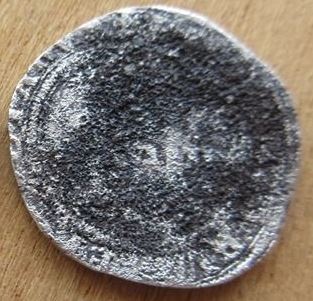
A Recent Find Uncleaned.
Photo by Terry S.

Some coins will require a longer immersion than others.  Many, if not most, will require more than a dip.  I've had some that required days.  It depends upon the type and amount of encrustation.

I've also had coins that were not affected at all by immersion in Muriatic acid.  They had a dense clay crust that the acid would not penetrate.  But that is unusual.  When the crust was broken, it fell off nicely and showed the impression of the features of the coin as if the crust had been a plaster cast.  To repeat the point I started with, all encrustations are not the same.

I personally feel very confident about immersing coins known to be silver in Muriatic acid for long periods, but just to be sure I didn't make some kind of mistake or something, I still check the progress occasionally.

The coin shown immediately above would probably benefit from a longer soaking.  Assuming the coin is really silver, I'd be more concerned about a toothbrush than the acid.

---

Just to give credit where it is due, Bill P. is the one that wrote the detailed instructions I posted for using Muriatic acid to clean silver coins.  I originally posted those instructions about ten years ago but lost the post, so republished the instructions again in this blog not long ago.   When I was still occasionally using other methods, including electrolysis, Bill encouraged me to use Muriatic acid instead of electrolysis.  After years of additional experience, I can say Bill was right all along and deserves much credit.

Thanks Bill!

---

Social media sneezes words, images and ideas into the infosphere.  Some catch on and get retransmitted and become part of the common vernacular.  Some are used only in smaller specialized communities.

I've always been interested in psycholinguistics and trends in language patterns and usage.  I've mentioned my distaste for ambiguous over-used terms such as "existential threat," for example.

I remember using the equivalent of what we now call email and forums back in the late 1970s, when I was working for a company that had a very advanced international computer network.  I remember  thinking about conducting studies on how computer networks affect how people communicate.  Unfortunately I didn't do those studies.

Since I've been doing this blog I've seen the language used by the metal detecting community evolve.  It is natural for language patterns to evolve, but I believe this blog has played a significant roll in that evolution.

I remember when I was interviewed by a reporter from CNN and used the word detectorist.  She stopped and said, "Did I hear you use the term "detectorist.""  At that time the word was not as commonly used as it is today, and I believe some of that has to do with this blog.

As I recall, most people used the word "real" instead of "reale."  I thought "real" could be confusing, and I also thought the Spanish word seemed more authentic, so I always wrote the word with the final e.  It seems that spelling is now much more common than it was ten or twelve years ago.

I also never saw terms such as "coin line" used in the earlier metal detecting literature.  It certainly was not defined in the detailed way that I defined it. I've tried to find that term used in the detecting literature before I defined it in this blog and have not found any earlier instances.

Even if I could not claim that this blog has introduced new terms and ideas, I can definitely say that it has advanced the discussion in numerous ways.

---

The Washington Post is yelling "fire" in a crowded theatre and loving it!

If you listen to the media reports - and it's hard not to - it is beginning to sound more like an unbelievable horror movie.  A recent Washington Post story, Coronavirus Will Radically Alter the U.S., describes an overwhelmed healthcare system and 1.1 million American deaths.  No matter what you think of the Post, the story stokes fear while the subtle rewording in the headline suggests a thinly veiled satisfaction that President O'Bama's promise to fundamentally transform America will finally be ushered in by a catastrophe too good to waste.

---

Every thing seems new to people who haven't seen anything like it before, which is why studying history adds important context.

The Spanish Flu (January 1918 – December 1920) was an unusually deadly influenza pandemic, the first of the two pandemics involving H1N1 influenza virus with the second being the swine flu of 2009.  The Spanish flu infected 500 million people around the world, or about 27% of the world population of between 1.8 and 1.9 billion. The death toll is estimated to have been anywhere from 17 million to 50 million, and possibly as high as 100 million, making it one of the deadliest epidemics in human history. Historical and epidemiologic data are inadequate to identify with certainty the pandemic's geographic origin.

The world was very different then.  A much larger part of the population lived in rural areas, and the medical profession was much less advanced.  My grandparents survived that one.  They mostly took whiskey and sugar, and put a sign in their window or on their door saying they were quarantined.

Then the swine flu, 2009 - 2010, killed nearly 12,500 in the U.S., but we heard almost nothing about it compared to Coronavirus.

---

Many beaches have been closed.  Unfortunately I can't provide an updated list, but  I heard more were closed last night.

This might be a good time to explore new areas, do some testing or research finds.

Be blessed,
TreasureGuide@comcast.net

Thursday, October 10, 2019

10/10/19 Report - Metal Detectorist Finds Hoard. Sebastian Inlet Bridge To Be Closed. Couple Odd Finds. More Surf.


Written by the TreasureGuide for the exclusive use of treasurebeachesreport.blogspot.com.

Source: See News.err,ee link below

Another archaeological find has been made on the island of Saaremaa, just weeks after a major haul including a 1,700-year-old gold bracelet came to light.
The recent find dates from a later era, the viking period, ERR's online news in Estonian reports, and includes a large number of silver coins, according to both the Heritage Protection Board (Muinsuskaitseamet)  and Saaremaa Museum.
As with the earlier treasure trove, the latest find was the work of a metal detector hobbyist, who, in line with Estonian law, informed the authorities.
"We are grateful for the licensed hobby detector, who reported the findings to the Heritage Protection Board, which can now preserve some of the crucial history of Saaremaa," Saaremaa Museum stated on its social media page (see also gallery below)...

Two separate hoards were found. One of these dating to the second half of the 10th century, contained silver coins which came via the Viking trade route which crossed the Baltic from the present-day Swedish island of Gotland, to Saaremaa's southern coast, and then on to Lääne County and on to present-day Tallinn...
Here is the link for more about that.


https://news.err.ee/988737/another-saaremaa-archaeological-haul-includes-viking-era-silver-coins


---

The bridge on A1A over the Sebastian Inlet is scheduled to be closed for 18 months beginning in 2020 or 2021.  The closure for repairs to damage caused by Dorian will result in a 40 mile detour for some motorists.

Here is the link.

https://www.mynews13.com/fl/orlando/news/2019/10/07/bridge-over-sebastian-inlet-to-be-replaced

Thanks to Jerry P. for that link.

---

I previously mentioned that the last time I was at Turtle Trail I found a number of greened clad coins.  One (shown below) had a strange small hole in it.

Holed Quarter Dug at Turtle Trail.

Closer View of Same Hole Shown From Other Side.
Is that quarter familiar to anyone?  I know that some have made holes in coins to attach a string for testing.

---  

Here is a closeup.  Can you guess what it is?

Can You Guess What It Is?
I would never get it, but it is a closeup of the surface of a blue glass insulator that has what looks to the naked eye to be just an imperfection in the glass.   When I looked at it more closely though, the lines are not just excess glass, they are actually embossed into the glass.  What it looks like to me is the imprint of a string or thin wire that was in the mold when the glass insulator was made.  If it was a coin, it would be called a strike-through error.

---

Source: nhc.noaa.gov

It looks like none of those systems will affect us much.

The tides are pretty flat now.  I'd like to see a good low tide.  I've been waiting for that for a good while.  

Source: MagicSeaWeed.com.

It looks like we'll get some more surf on Friday and Saturday, however I'm not expecting any significant change in beach conditions.  It looks like more of the same.

Happy hunting,
TreasureGuide@comcast.net
Wednesday, June 26, 2019

6/26/19 Report - Some Cleaned Silver Coins. Jackie Robinson Bat Found. Metal Detecting Around People: Tips and Precautions.


Written by the TreasureGuide for the exclusive use of treasurebeachesreport.blogspot.com.

Silver Coin Cleaned by Muriatic Acid 

Yesterday I posted photos of the surface of a couple coins that I was going to clean using Muriatic Acid.  I immersed three silver quarters and five silver dimes about a 10% solution for about a day.   All eight coins were in the same container together for the same amount of time.

Above you see the cleaned 1942 quarter,.  Below you see part of the same 1942 quarter (right) before it was cleaned.

Surfaces on Recently Dug Dime and Quarter That I'll Be Cleaning.
That quarter came out better than the others.  Below is another 1942 quarter that I cleaned in the batch.  It didn't come out as well.

Another 1942 Quarter That Was Cleaned.

It looks like the second 1942 quarter might benefit from additional cleaning.

And below is the third quarter that was cleaned in that batch.  It is in worse condition.

Cleaned 1947 Quarter.
The surface on this one is very rough.

I also cleaned some Roosevelt and Mercury dimes in the same solution.

1946 Dime After One Day in Diluted Solution of Muriatic Acid.
This dime (above) still has some surface scale that I think will come off with additional cleaning.

I'm going to put it back in the solution for a while to see how the surface corrosion reacts.

Here are a closer views of the surface of that dime.

Closer View of Surface of Same 1946 Dime.
We'll see the effects of additional time in the solution maybe tomorrow.

Another 1946 Dime
I did another 1946 dime.  That one (above) has a badly pitted surface.  I don't think additional cleaning will do much for it.

Here is a Roosevelt dime that is nearly unidentifiable.

Roosevelt Dime - Date Unknown.
The third Roosevelt dime came out just as bad as the Mercury dimes.

Now to the Mercury dimes, which did not come out very well.

Mercury Dime - Date Undetermined.
Additional treatment of this Mercury dime might remove some more surface materials, but I don't think the appearance will be improved,

Almost Unidentifiable Mercury Dime.
The last Mercury dime is terrible as well.

The first quarter turned out fairly nice, but the rest are bad.

None have any numismatic value.  Coin collectors are very particular about condition, and these ones aren't even close.

---

A man found a valuable Jackie Robinson baseball bat in with a bunch of worthless bats and tells the seller.  They quickly removed the bat from the garage sale.

Here is the link.


If I was the owner I would reward the man for his honest kindness.  He could have easily bought the bat for almost nothing and kept the profit for himself.

Kindness is often not rewarded.  I don't know how many times I returned a found gold ring or something and received not so much as a thank you.  You have to wonder about people.  Are the not capable of showing gratitude?

I'm not saying you should return items and show kindness for the reward, but I'd think that people would like to reward those that freely do things for them for no particular reason other than being honest and kind.

In fact, as I've told before, I've had people on multiple occasions try to claim finds that did not belong to them.  If they see you find something, they'll say that they lost it.  Or they'll tell you I lost a ring, if you find it, it belongs to me.

Here are some things I do.

First, get a good description of the item, including details that would not be obvious to any casual observer, such as a date inscribed in the ring.

Define the area you are going to hunt, and if in sand, draw a boundary and keep everyone out of it while you search.  Explain that you have to be able to swing the detector and have to cover every inch and you want to be able to see where you have and haven't been.  You can't have people in the way.  That also helps makes it possible for you to get a look at found items before everybody else.

When hunting in the water, if other people are trying to see what you are digging up, when you raise your scoop, as it nears the surface, shake it violently, raising a cloud of sand that will conceal the item until you stick your hand in the scoop and find it by feel and put it in your pocket before anyone else sees it.  You can then move away from people and inspect it when you can do it privately.

The goal is to get items for the rightful owner - not for crooks.

---

A couple days ago I heard from Captain Jonah.  He has been having boat problems, but expected to get out soon.

Happy hunting,
TreasureGuide@comcast.net

Tuesday, June 25, 2019

6/25/19 Report - Musket Gun Barrel Mold. Cleaning Coins. Benefit of Metal Detecting. Gold Prices. Way to Remove Rust.


Written by the TreasureGuide for the exclusive use of treasurebeachesreport.blogspot.com.

Encrusted Musket Barrel as Found.
Find and photo by Will R.

If you saw yesterday's post early, maybe you didn't see the link I added later in the day.  That link was to a old post in which Will R. talked about some nice finds and how he made a mold of the gun barrel shown above.  Here is what Will said.

I love your last post. I ran into a similar situation last year. I was detecting a private site on the intercoastal when I found a brass butt plate, then the side plate and one of the ramrod tubes. Then it hit me... where's the barrel? Soon I found the barrel because it had one of the ramrod tubes stuck in the EO chunk. I took it home and did as I do with most EO's and put it in a tub of fresh H2O. The next day I noticed the end of the EO was oozing sludge. I figured this was the end of the barrel. I gently flushed the end of the EO with water and then I knew I had rare opportunity. This was a perfect mold of the metal barrel that once was there. I carefuly flushed the rest of the mud and sludge out and made sure it was clear of all metal. Now here's where the fun began. I used fiberglass resin and made a perfect mold of the barrel. Here are some pics of it. You're welcome to use them if you like.


Finished Copy Made From Mold.
By Will R.
If you used the link yesterday, you might have already seen this, but I thought it was worth posting again for those who might have missed it.

---

Surfaces on Recently Dug Dime and Quarter That I'll Be Cleaning.
I'm going to use diluted Muriatic acid.  I'm doing four dimes and three quarters, all having a black patina very much like the dime and quarter shown in the photos above.  Some are a little worse than others, but all are similar.

You hear that you should never clean coins.  There is no danger with these coins since they have no collector value other than the melt value.  They are already damaged beyond what any body would pay a premium for.  Therefore there is no danger of actually hurting the value.

Make sure you know that is the case before you clean any coin.  In the case of possibly valuable coins, definitely don't clean them until you know for sure.

I hope to have some photos for you as things progress.

---

I heard another way to remove heavy rust from iron objects.  On the Antiques Roadshow it was said that a fellow found a clump of rust and buried it in his barn in horse manure.  It looked like it did a good job of removing the rust from what turned out to be a medieval key.

---

The price of gold has been really flying for the past week or two.  It went up another $28 per ounce in the past couple of days.  That puts it close to $1430 and moving.

---

I've commented about some of the fake elements of some of the "reality" treasure shows.  I realized the other day that I actually hope that some of the other so-called reality shows are fake.  It would be sad to think that people are actually like that.  I could list a number of shows that I've seen enough of to actually hope that they are really fake.

---

It's been established that people who spend more time in parks and other natural settings tend to report higher levels of health and happiness, but new research shows there's actually a magic number for it.

According to a study published this week in the journal Nature Scientific Reports, spending 120 minutes a week strolling a tree-lined street or sitting by a lake can greatly enhance a person's overall sense of well-being. Less time didn't yield any significant benefit, the research showed...


Here's the link.

https://www.greenwichtime.com/news/article/People-who-spend-more-time-outdoors-lead-more-14025910.php

As always you can quibble with the conclusions and details of the article, as I'm so prone to do, but isn't that one thing we all like about metal detecting or treasure hunting.  You have to be out there.

There is something about feeling the sun, wind and rain.  I like being barefoot.  I like feeling the grass or sand beneath my feet, and will accept the risk of fire ants or other dangers.  I like when it is stormy and nature is getting a little frisky.  You feel nature even more.

On the other hand, there is the garbage and pollution littering the out doors.

Millions of tons of plastic enter the oceans every year, polluting our seas, littering our beaches and endangering wildlife.

Plastic can take centuries to break down, and instead of quietly disappearing beneath the waves, it has a way of coming back to haunt us.

Almost 1 million shoes and over 370,000 toothbrushes were among more than 400 million pieces of plastic recently found washed up on a remote group of islands in the Indian Ocean.

Great chunks of plastic have been found inside the stomachs of everything from seabirds to whales, while tiny microplastics are eaten by fish and other sea creatures, ending up as part of the food chain...
See https://www.cnn.com/2019/06/24/health/plastic-pollution-rivers-oceans-scn-intl/index.html

The litter makes me a little sad.  It intrudes on nature, and makes it a little less "natural."  Litter seems to intrude upon nature and removes some of the healthy-giving and aesthetic benefits.

One of the side benefits of the dig-everything and take-everything philosophy that I encourage, is that it leaves the environment a little better than you found it.

---

The price of gold continues to rise, going up another $28 per ounce in the past couple of days.  That puts it close to $1430.

Happy hunting,
TreasureGuide@comcast.net