Written by the TreasureGuide for he exclusive use of treasurebeachesreport.blogspot.com.
Today I'm going to post an email I received from Clint. I might do a series of similar posts from ole timers who are willing to share. I'll call it Ole Timer Talk (OTT). There is no specific age or time period I'm looking for. I'd say at least before the 21st century, as a minimum. I've done a few of these in the past, but just decided to make it a regular thing if I can.
One thing that was different when I started metal detecting is that there was a lot less communication and a lot more secrecy. There were clubs, but no one was going to tell you much unless you were their trusted treasure buddy. It is so much easier to get information today and the metal detecting community is much more informed because of it. Ole timers could be just as skillful and successful in the past, but they generally had to learn a lot more on their own. Even though they were very skilled, I don't think they were generally as broadly informed. Maybe that is just my own perception, because I was a lone wolf and thoroughly enjoyed experimenting and learning on my own, but I know I made a lot of mistakes and still regret some of them.
Times change, and that is one reason that it is good to record the experiences of the past, especially those that were never widely shared before. Anyhow, I'm thinking I will start a series of posts like this if their are enough ole timers that are willing to share their favorite or not so favorite experiences. I don't know if there will be many or few or if they'll be often or rare, but I'll start it off today.
If you want to know what it was like, here is how one man experienced it..
Hi.
I would like to relate to your audience remembrances of hunting the treasure beaches of Treasure Coast in 1984 and 1991.
In 1984 near Thanksgiving, I left sunny mild Sebring for a day of fishing at Vero Beach…I also carried my Whites PI1000 as a alternate in case fishing was lousy.
Halfway to Vero, It became windy and cloudy. Two miles from Vero and the Palm tree fronds were almost horizontal from the wind.
I decided to heck with fishing…headed to Turtle Beach Access. Upon arriving, I was blown away by the number of people who were trying to get down to the beach but the waves were crashing into the Berm and you could see debris ( dock parts, palm trees, large wooden boat trash) just flying south in the current as the tide rose and the waves got higher. Then some guys made it into the water but were being slammed into the berm and some were hit by debris. That ended hunting for a few hours.
Later that day, people could hit the beach but not really sure what was found. I do know that the berm was 4 feet high before I left to find a motel.
Next day, I made it to the beach and the berm was 8 feet high and the beach was flat. People were searching and I found my first Spanish coin…a 1/2 reale in very good condition. I will never forget the feeling when I turned it over and saw the cross.
No real finds yet so I returned to the Motel. Police were turning away people that did not reside on Johns Island but I had the motel info and I was allowed to pass.
The third morning, I made my way to Turtle Beach access again. It was a retreating tide but winds still avg. 57 MPH. tide was way out and there had to be 100 people on the beach.
My PI1000 suddenly stopped working (later found out the coil was soaked inside). I watched people scooping up all kinds of stuff and others digging up cannon. The beach had all kinds of ship wreck artefacts laying there. The Berm was now 12 feet high and possibly 20 feet back.
I cannot remember his name but I stood by a fellow with a Seahunter XL500PI who was trying to retrieve a signal in ankle-deep water. His second scoop netted a pair of pliers from the wreck. Following up on that signal he received another from the same hole and came up with a beautiful 8 escudo coin. I remember we both exclaimed an expletive at the sight of it.
Suddenly a wretched guy carrying a machete came up to us and said something to the effect that "a guy could get hit with a machete for that"… and we both made a retreat …fast!
I was bummed out because people were finding stuff everywhere and I had NO DETECTOR. I was watching two guys dig out a small cannon and someone named "Bull Durham" came buy swinging a detector and found a gold coin in the sand pile created by the two cannon retrievers. I finally decided to go home. As I was leaving, I saw three big lumps of concretion at the base of the berm. They must have weighed 80 lbs each. About the size of a beer keg. I decided to take one home and struggled to get it to the car. Thought if it was something maybe I would come back in a few days and get the others (yea, RIGHT!LOL).
I took the "keg" home, soaked it in Muriatic Acid for 3 days and washed the material left in the plastic trash can. I Freaked out…there were 270 hand wrought ship spikes, 4 - 4escudo gold coins, and a handful of silver 4 and 8 reales. I made a gorgeous display of the ship spikes (some were in circles and some were S-shaped). This was the ships carpenter"s keg of nails. There were pieces of American Cedar and two pieces about 6 inches long of metal Banding. I went back to Vero 4 days after the storm and …yep…the other concretions were GONE!!
Since 12 feet of beach was washed out to sea, anything left at that level was covered over in 2 weeks. The only way any remaining treasure that was on that beach and out past low-tide could now be found is for the beach to erode further than 12 feet down which would probably be near rock bottom according to some old-timers I talked to.
I moved to Lake Worth in 1987 and started learning about beach and wave patterns. Watched how people reacted to waves and patterns of swimming and horseplay. I studied wave interaction at the tideline. and then I started finding lots of lost jewelry and coins. I even was able to find $20 bills floating just under the surface of the water, which led to me finding the metal bill holder in several instances.
I searched Jupiter Beach and Lake Worth beach exclusively and learned all the patterns there. I walked along the beach one winter day searching with my Seahunter XL500 and could easily recognize the sound of gold, but while I listened, my eyes roved. I spied a 6 inch portion of a pencil thick gold chain sticking up and moving about halfway between low and high tide mark. People were walking by it, oblivious to it. I pulled it up and it had a gold Maltese Cross as a pendant. I found gold nugget rings at the base of berms just laying there exposed.
In Winter 1990-1991, I met an old retired guy at LW beach and he was there every day. We were basically the only two working that beach on most days. In that particular time frame, a longshore current must have cut through from LakeWorth through to Jupiter Beach and for a month, He and I each filled a box with hundreds of old WWII era coins and (of course) modern coins. BUT…a case in point, one day we met at LW beach and the tide was rising with wind blown winter waves. We would meet at the beach center and walk in opposite directions for the length of the beach at the waters edge where the waves washed up, turn around and walk back to the center and show each other our finds, then turn around and repeat…for at least 10 times. I found at least 15 gold rings with stones and 5 wedding bands, 2 necklaces. He found near the same but I think he found more.
That easy picking abruptly ended when the cut out further finally filled in. One thing I noticed was on a sloping beach, sometimes I would see what looked like a yellow pencil rolling up the beach with a wave and rolling down the beach following a wave. I would grab these items (3 in my time in Florida - 3-1/2 years) and they turned out to be gold Herringbone necklaces. Apparently, the nature of a herringbone lends itself to be straightened out by tiny grains of sand filling in the spaces (joints) and then the necklace can follow a wave. Also, I learned that when there is seaweed in the surf on a rough day, that as the wave crashes into the beach carrying seaweed, any necklace that gets roiled in the wave- weed combo gets caught up in the weed and winds up at the high tide line as sea wrack. Always run your detector (and eyes) over the wrack line.
As for the coins I found…I sold them in Maryland to get funds to buy a home.
I retired from the VA in 2010 in SC and drove to all my favorite beaches to detect. I was shocked to discover that I could NOT search in the water within 3000 yards of a shipwreck. Most beaches were sanded with renourishment sand. I went to LW beach and searched in the water. I could not understand why the beach out in the water was full of potholes (thousands it seemed), then I realized that with gold prices so high, people had descended on the swimming beaches and wrecked havoc out in the water.
I left and never returned. I will soon relocate to NC and be closer to Virginia Beaches and DelMarVa (Coin Beach). I then can use my MineLab CTX 3030 and even search rivers in inland areas for lost stuff at river crossings (will require Library and Historical research).
Best of Luck to all who endeavor to the refrain of…"Today's the DAY" !!!
Thanks for sharing Clint!
---
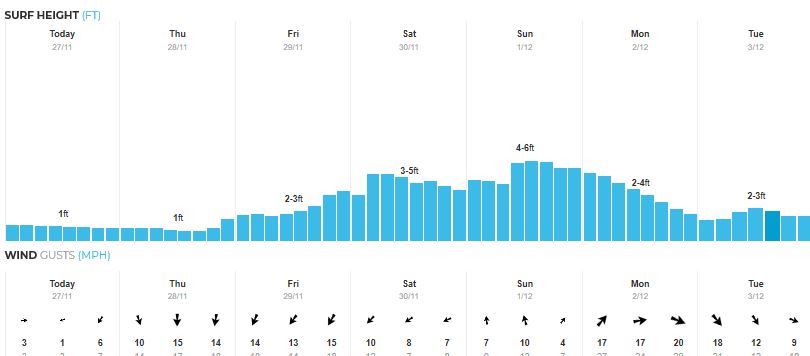
The surf tomorrow will just a little bigger - something like two to four feet. The wind will be from the east. Beautiful beach weather.
Send me your Ole Timer Talk. I can't guarantee I'll post every one that I get. I'll just exercise my own judgment, which can include a lot of different factors. Its nothing personal if I don't post a particular submission. I just post what I feel like talking about. Remember this is just a fun volunteer activity for me. Maybe I won't even get another submission.
.
Happy hunting,
Treasureguide@comcast.net