Showing posts with label deadeye. Show all posts

Wednesday, November 27, 2019

11/27/19 Report - Concreted Three-Hole Deadeye Once Found on the Treasure Coast. Broad Breasted White Turkey Not On Pilgrim's Menu.


Written by the TreasureGuide for the exclusive use of treasurebeachesreport.blogspot.com.


3-Hole Deadeye With Small Part of Concretion It Was Extricated From.
Photo by GB

I received the following note along with several photos of a three-hole deadeye from GB.  The concretion containing the deadeye was found on one of our treasure beaches as described below after Hurricane Mitch in 1998.

Here is what GB told me.


… I was approached by a young couple vacationing here who had found an object on the beach and after pounding with a hammer brought me the object inside and a major part of the accretion. Having some experience in minor conservation of beach finds, it was immediately, in my eyes, something special. They offered it to me and I gave the wife a pair of 1/2 reale earrings in exchange...


The item is: 8 1/2" in diameter, 4 1/4" thick, weight 68.6 ounces (4.28 lbs),eye holes 1" diameter, edge channel width  1 1/4"  and edge in channel circumference 22 3/4".


The larger loaf shaped base was fabricated from plaster of paris and a little dirt and shells for display purposes. 


That is one beautiful find and a great piece of history.


Front and Back Views of the Remaining Concretion.
Photos by GB.

Two Views of the Same Deadeye
Photos by GB.
Congratulations GB!  Thanks for sharing.

If  you don't know what a deadeye is, here are a couple pictures that I found on Wikipedia.


Three-Hole Deadeye With Mounting Hardware.

And below is a photo of a three-hole deadeye that gives an idea of how it would have been used.


Source: Wikipedia.com

----

When you think of Thanksgiving you might think of turkey.  I do.  If you are old enough you might remember tracing your hand in school and making the drawing into a turkey.

Turkeys, like people, have changed with the times.  The turkey you eat tomorrow is probably not the type of turkey the Pilgrims ate.  Today's turkeys, like the people, are fatter.  But that isn't the only difference.
The breed’s white feathers can be owed to selective breeding.  According to Julie Long, a researcher at the U.S. Department of Agriculture, dark spots can sometimes be found on turkey meat due to pigmentation of colored feathers. Most consumers would likely consider turkey meat covered in dark spots to appear unsightly. So, it has become common practice to breed turkeys in order to achieve colorless plumage, which results in meat void of these spots.

The Broad Breasted White dominates today’s turkey market. However, this genetic selection comes at a cost. Traditional turkey breeds are slowly disappearing as the Broad Breasted White continues to be the most popular choice for Thanksgiving dinner.

Frank Reese raises turkeys on his farm in Lindsborg, Kansas. He is a member of a declining population of farmers that raise heritage turkeys. These are the breeds that date back to the 1800’s. According to Reece, the Standard Bronze is what was eaten at the first Thanksgiving and was the bird that fed America from 1850 until 1950, when genetically engineered breeds began to grow in popularity.

---
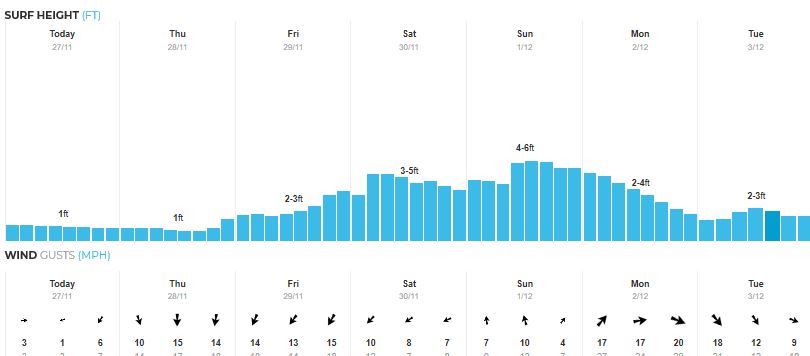
We are still having some good high tides.


Source: MagicSeaWeed.com

Another front is expect to come through in a few days and the surf will increase.

Have a happy Thanksgiving,
TreasureGuide@comcast.ent

Wednesday, August 14, 2019

8/14/19 Report - Mystery Find and Shipwreck Rigging Artifacts. Thesis on Rigging of La Belle. Discrimination Use.


Written by the TreasureGuide for the exclusive use of treasurebeachesreport.blogspot.com.


A few days ago I posted this find by Glen S. who wanted to know what it is and wondered if it could be a part of a ship's rigging.  The object is about a foot and a half in length.

Ron J. provided the first response saying that the large concreted object could be a "through-deck ring-bolt" used to run a line through to control any number of things like a cannon, cargo, sails, etc.

DJ said it might be a deadeye strap.  Many of those are found pictured in the reference I'll refer to below.

Joe D. said Glen S's item looks like the attachment part of an anchor, or a rigging attachment?

DJ provided a link to an excellent thesis on artifacts found on LaBelle which sank in the 1860s.

The thesis says, Nearly 160 artifacts associated with La Belle’s rigging were excavated in addition to hundreds of lengths of rope and cable. This amount of surviving rigging places La Belle’s artifacts among the few significant 17th-century rigging assemblages such as Vasa and Kronan. La Belle’s assemblage stands out still more because of its large percentage of iron hull fixtures, with the result that approximately 30% of the blocks and deadeyes in the reconstructed rig are represented by recovered artifacts...

Here is the link to that study with many more examples.


I've selected three illustrations from that study to show below.

First is a deadeye strap, then a futtock plate, and then a ringbolt.


Example 1.


Example 2.


Exanple 3.


Taking a look at the photo of the found object, the ring appears to be either articulated or the object bent.  It seems to me that articulated is a good possibility.  Example one and other similar artifacts shown in the thesis are articulated.   The length of the found object is just under one and a half foot.
The ringbolt shown immediately above is 41.5 cm.  That converts to about 1.3 feet - pretty close to the length of the found object.

Ron wondered if the item might be a part of a ship's rigging.  It appears that it could be, but ringbolts and similar objects are also used for applications other than nautical, so we can't say for sure.  Additional nautical finds in the same area might help.

The LaBelle thesis shows a lot of  interesting artifacts and provides a lot of good information on 17th century ship's rigging.  You might want to take a look at that document.

One example in the thesis (fig. 23, if I correctly recall) had a large piece of wood still attached.  Wood being attached means the item could be found a distance from any ballast or other items from the same wreck, if a shipwreck is indeed the source.

Thanks to all those who responded to the request for thoughts and opinions.  Although we cannot say for certain that Glen's find came from a shipwreck, I think we all learned something, and I hope we helped Glen.

---

Just a quick note on what I said about the Minelab Equinox metal detector test that I did the other day with the steel pennies.   As I said, in the default field mode, steel pennies produced no auditory signal or conductivity number.  However, what I neglected to say is that the default field mode discriminates out the bottom fifth of the items on the conductivity scale.  That means that iron will be discriminated.  The thing I should have mentioned is that you can easily change the discrimination level so you do get a signal from iron.  I used the field mode but turned the discrimination off this morning and the steel pennies produced a low tone and a -8 on the conductivity scale.

You might remember that I didn't know if the coin I was trying to identify was a corroded steel penny or perhaps a German coin.  After changing the discrimination setting and testing with the steel penny, I threw out a 1980s German coin.  I didn't pay particular attention to which denomination it was, but it was a small one from the 1980s.  The German coin produced a -6 on the conductivity scale.  I never liked those German coins.  They really fall apart.  At least they are a little better than our zinc pennies.

There are a lot of features and adjustments you can make with the Equinox.  I'll probably never use many of them.  Being from the old school, I always wonder why people take so much time checking and double checking readings when you can dig something up in two seconds.  There are people that will argue with me about that, but it is often quicker to simply dig it.  If you have a bad back or just hate digging junk, you might, however, prefer to check, even if it takes you longer before you dig.

There are also those who will say, all I have to do is glance at the conductivity reading and I can skip pennies, pull tabs, or whatever it is.  That's fine, but sometimes good things give a reading that doesn't look much good.  If you skip all of the -8 readings, for example, you'll skip a lot of trash, but you will also skip steel pennies and other things.  Again that is fine, if that is your strategy.  It depends upon the situation and what you want to do.  I would do it too under some circumstances, but you should be aware of the risk and make the decision strategically.

---

I'd like to be able to metal detect Little St. James Island.

---

Shipwreck in Aegean Sea.
Source: See LiveScience link below.

Divers Find 2,000-Year-Old Shipwreck Graveyard Near Tiny Greek Island

Here is that link.

https://www.livescience.com/ancient-shipwrecks-found-in-aegean.html?utm_source=taboola&utm_medium=display&utm_campaign=organic


---

There are no change in Treasure Coast beach conditions, and no signs of storms forming.

Happy hunting,
TreasureGuide@comcast.net