Showing posts with label drought. Show all posts

Sunday, June 30, 2019

7/1/19 Report - Native American Copper Artifacts and Finds. Drought Uncovers Palace.


Written by the TreasureGuide for the exclusive use of treasurebeachesreport.blogspot.com.


Copper Native American Artifacts Found by Detectorist.

This copper cache was recovered by Oliver Anttila while using his metal detector at a small secluded beach on Thunder Bay, Ontario, Canada. It was the sixth cache he had found on the bay and contained 122 pieces including a 6 5/8 inch awl, several conical and square socketed points, two crescent knives, and over 100 hammered copper nuggets prepared as preforms for future tools. (From PeachStateArcaheologicalSociety web site.  See link below.)
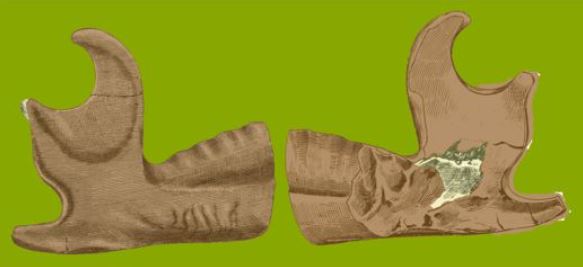

Illustration by C. B. Moore showing a copper-covered mammal jaw bone from the Mt. Royal site in Putnam County, Florida.


Not all metal artifacts found in Florida are of European origin.  Native Americans had sources of copper in the north and traded widely.  Some Native American copper artifacts have been found in Florida, including the one shown above, which was found at the Mt. Royal site, which is west of Bunnel.


Wikipedia says, The Mount Royal site was occupied beginning about 4,000 years ago. The site was largely unoccupied from 500 BCE until AD 750. Mount Royal was occupied again after 750, and after 1050 it grew into the main town of an important chiefdom with connections to the Mississippian culture. The town lost importance after 1300, but a settlement, called Enacape, was still there when Europeans entered the area in the 1560s. The Spanish mission of San Antonio de Enacape was located in the town from 1595 until after 1656.

Below is a reconstructed headdress very much like one found by C.B. Moore at the Mt. Royal site in Putnam County, Florida.  

Reconstruction of Headdress Made With Native Copper.
In the 1890s C. B. Moore traveled the rivers by houseboat and made arrangement to investigate mounds.

Although it is unlikely you will find anything as extravagant as those shown above, you can find Native American artifacts on Florida beaches.  In this blog, I've shown some Native American artifacts that were found on the Treasure Coast beaches.


I'd recommend taking a look at the PeachStateArcheaologicalSociety web site to become familiar with a variety of copper Native American artifacts.  It is an excellent web site.

There is much more to see there, such as these items.

Copper Fish Hooks and Knives.
Here is the link.
http://peachstatearchaeologicalsociety.org/index.php/20-copper-artifacts

You might remember that Irma uncovered thousands of Native American artifacts.

The first Native American artifacts I ever saw and recognized in nature in Florida was by the natural bridge that is now in Arch Creek Park in North Dade County.  The bridge was on a path used by Tequesta and early settlers.  The park now has a small museum.

I first learned of the site when I saw a photo of Thomas Edison collecting artifacts on a mound under a banyan tree.  The banyan tree and mound was still there.

Before the park was as developed as it is today, there was a trailer park on most of the property, but it was removed before I was there.

I have a friend that found some significant Hopewell Culture copper ceremonial artifacts up north.

---

You might also want to take a look at the National Archives web site.

https://www.archives.gov/

---

A 3,400-year-old palace has emerged from a reservoir in the Kurdustan region of Iraq after water levels dropped because of drought...

Here is that link.


Expect another week of one-foot surf.

Happy hunting,
TreasureGuide@comcast.net

Saturday, August 25, 2018

8/25/18 Report - "Copy" Treasure Coins, Iron Conservation, Hunger Stones Appeared.


Written by the TreasureGuide for the exclusive use of treasurebeachereport.blogspot.com.

I was researching a token and ran into a forum where a lady from Florida posted these photos and said her grand daughter found the coin on her way to school and wondered what it was.


To the right you can see the word "COPY"  on the coin (upside down).

Many reproductions or fakes will be marked like that, but many will not.  Sometimes the mark is small, inconspicuous or worn off.  I've shown examples of that in the past.

On the same topic, the coin that I originally showed on 8/21/18 and again yesterday, the person who found it took it to a pawn or jewelry shop as I suggested and had it tested.  It was found, as we suspected, that it did not test to be either silver or gold.

Concerning the cannon ball that was recently found by Fred B., it should be properly conserved.  Iron that has been in salt water will need to be soaked in pure water until the salts leach out.   I neglected to tell Fred that.  Thanks to Scott C. for reminding me.   I sent Fred an email right after I got Scott's email.  Hopefully Fred knew to do that, but for all of you, if you don't properly conserve iron objects, they will fall apart.

The best resource on how to conserve objects is the TAMU Conservation Manual.  Here is the link.

http://nautarch.tamu.edu/CRL/conservationmanual/ConservationManual.pdf

I know it is long and detailed, but it has all the information you will need to conserve almost any type of object.  No body wants to see a favorite find fall apart.  It is worth doing it right.

You saw the cannon ball, but Fred has another conglomerate that shows parts of a lead sheet and a spike.  Would anyone be able to do an x-ray to see what else might be in there.  Fred is considering not opening this one, but doesn't know what else might be in it.

---

Just yesterday  I posted about an old path that was revealed by a severe drought.  Here is something even more interesting that was revealed by a drought.

Hunger Stones Revealed by Drought.
Source: See Apnews.com link below.
Due to this summer’s drought in Central Europe, boulders known as “hunger stones” are reappearing in the Elbe River.

The low water levels in the river that begins in the Czech Republic then crosses Germany into the North Sea has exposed stones on the river bed whose appearances in history used to warn people that hard times were coming.

Over a dozen of the hunger stones, chosen to record low water levels, can now be seen in and near the northern Czech town of Decin near the German border.

The oldest water mark visible dates to 1616. That stone, is considered the oldest hydrological landmark in Central Europe, bears a chiseled inscription in German that says: “When you see me, cry.”

Here is the link.

https://apnews.com/9512be71cc8f40a7b6e22bc991ef2c6c

---

No storm or big changes in beach conditions yet.

Happy hunting,
TreasureGuide@comcast.net

Thursday, May 24, 2018

5/24/18 Report - Storm Forming. Drought in Southwest. More on San Jose Shipwreck


Written by the TreasureGuide for the exclusive use of treasurebeachesreport.blogspot.com.

Souce: Ventusky.com
Here is the big new for me today.  Ventusky.com is showing a nicely formed storm with sustained winds of around 60 mph hitting the Florida Panhandle around Sunday (See picture above.).

Notice that if that is correct, the wind on the Treasure Coast will be from the south.  The surf will only be about two to four feet this weekend.

----

ALBUQUERQUE, N.M. (AP) — Rivers and watering holes are drying up, popular mountain recreation spots are closing and water restrictions are in full swing as a persistent drought intensifies its grip on pockets of the American Southwest...

Here is the link for the rest of that story.

https://www.kob.com/news/drought-on-tap-to-intensify-over-us-southwest/4918667/?cat=642

I recently commented on how rain can help detectorists make finds. So can drought. When lakes and rivers drop more ground becomes accessible and things can be uncovered.
---

Site of the San Jose
Source:msn.com (Link below)

The San José, the largest galleon and the flagship of one group of Spanish ships that started sailing in the 16th century, was big and — thanks to 62 bronze cannons engraved with dolphins — deadly enough to deter or destroy ships, whether pirates or rival nations.

Except when it didn’t. On June 8, 1708, during the War of the Spanish Succession, the San José’s gunpowder ignited during a battle with British ships, sending 600 doomed sailors to the bottom of the Atlantic Ocean — along with gold, silver and emeralds from mines in Peru, a total haul valued at some $17 billion in today’s dollars..

And here is the link for the rest of that one.

https://www.msn.com/en-us/news/world/a-robot-submarine-found-the-‘holy-grail-of-shipwrecks’-it’s-worth-billions/ar-AAxIFK1?ocid=spartandhp

It seems like all the media outlets are doing a story on this one the past few days.


Happy hunting,
Treasure Guide@comcast.net

Monday, June 15, 2015

6/14/15 Report - Big Events & The Times. Hurricane Drought. Detecting On The Edge.


Written by the TreasureGuide for the exclusive use of treasurebeachesreport.blogspot.com.

It seems that 2015 is a year of a lot of big anniversary events.  I think I posted not long ago a link to an article about how the world changed in 1965.  To save you the math, that was 50 years ago.  It was a time of change and transformation.  And personally, it was a pretty big year.

Crises Magazine said, Different writers here and there have talked about 1965, fifty years ago, as a year of transition. It was a year in America when trends came into focus, culture was altered, and life changed—politically, socially, culturally, morally, and in the Catholic Church. Perhaps historian James T. Patterson provided the most detailed elaboration on these developments and their implication for the country in his bluntly titled book from a song of the time, The Eve of Destruction: How 1965 Transformed America. I found the article interesting, maybe you will too.   Here is the link.   http://www.crisismagazine.com/2015/1965-the-dawn-of-our-current-age

In treasure hunting, 2015 marks the 300th anniversary of the 1715 Fleet disaster and 30th anniversary of  the discovery of the Atocha.
 Another article had the following to say.  This year we celebrate 200 years of the victory of the Battle of New Orleans!  The British were defeated by the good people of New Orleans, Louisiana during this Battle.   On January 7-8 while all the men were fighting the battle,  the women gathered in the evening with the Ursuline Sisters to pray before the statue of Our Lady of "Prompt Succor" ( Means Quick Help.) The next morning a Mass was offered and the nuns promised to have a Mass of Thanksgiving annually if they were victorious.  That Thanksgiving  Mass is still celebrated to this day at the National Shrine of Our Lady of Prompt Succor on State St.   There were many odds against  Andrew Jackson and his men but after winning the Battle of New Orleans, Andrew Jackson publicly acknowledged that the American victory was won by heavenly intervention. 

You can read the rest of that article by using the following link.  http://holymotherchurch.org

2015 is also the 70th anniversary of the Nagasaki atomic bomb, the 20th anniversary of the release of Windows 95, and 10th anniversary of Hurricane Katrina.

Hurricane Katrina was ten years ago.  And that was the last year that a major hurricane hit the United States.  It has been that long. Time flies.

Talking about the amount of time since the last major hurricane, the Advocate says, The gap is something of a record that has not occurred since the 1870s, according to information compiled by researchers at LSU.

The article continues, There have been hurricanes that have caused widespread damage such as in 2012 when Hurricane Sandy, a Category 2 storm hit the East Coast, and Hurricane Isaac, a Category 1 storm in Louisiana, but neither storm reached Category 3, 4 or 5 status as measured by wind speed (http://theadvocate.com/news/12162292-123/9-years-since-last-major)...

When you go out and look at the Treasure Coast beaches, you'll see some very sandy conditions - not only has the sand been accumulating on the beaches but also in the shallow water close to shore.  In Florida we haven't had anything to really move much sand for quite a while.  Even Sandy didn't cause much erosion.  It was more of a high tide event down here.

I guess it looks like we are due.  I really can do without a major hurricane.  A good storm that sits off the coast and churns for a while can do the job.

-----------

I often hear people complaining about how difficult it is these days.  They talk about all the competition, and they talk about how every beach is over-hunted.  They talk like in years past all you had to do was walk out there and things would fall into your scoop.  They don't know.  Most of them weren't even born then.

There were more detectorists than you would know about back in the old days.  There was no social media.  You didn't know about Tom, Dick and Harry and what they found even if they were out there hitting the beaches everyday.  There was no email, and there were no blogs, or forums.

You didn't hear about the top guys anyhow.  The LOOK AT ME Kardashian generation wasn't born yet.  The guys were much more secretive, especially the best ones.  Some of them are still around, and you still don't hear about them.  I know one that is as good as anyone, and certainly better than any of those that you read about on the internet.  His water skills are amazing.  He was actually a Navy Seal. As a result he hunts locations, times and waters where others don't.

There were some very intense hunters in the old days.  I once mentioned a fellow that hunted every low tide for weeks on end.  No break.  I haven't heard about him for quite a few years.

I knew others, one of which would come crawling up out of the ocean every morning as the sun rose.  I saw him a few times, including once up at Vero, even though he was a South Florida hunter.  He didn't say who he was, but I had been around enough and knew.

Everybody learned and perfected their skills pretty much on their own back then.  There was very little sharing of information.  You couldn't go on the internet and read about where to hunt, where not to hunt, how to use your detector, etc. etc.

And for those of you who like the new detectors and new technologies, we didn't have all of that.  If you want to go back to the old days go buy a used detector from past decades and see how you like using that instead of your latest and greatest

Don't think there wasn't competition in the old days.  There was more than you know about or hear about.

I never hunted South Beach much.  I never spent much time where the crowds hunted.  Like some of the others back then, I didn't like being observed.

The heavily hunted areas are heavily hunted for a good reason, but there are always other hot spots that aren't heavily hunted.  You have to spend some time to find those spots.  And they may come and go, but they were out there back then and they are still out there.

Some hot spots are not well known because they only open up periodically.  Some are not well known because they are hard to get to, but when you have over forty miles of densely populated coastline, I'll guarantee you that there are hot spots out there that you can still have pretty much to yourself if you are willing to spend some time prospecting.  It might take a while, but it can be done now just as it was done decades ago.  There are always those following the crowd and then there are those detecting on the edge.  If you are on the edge you won't be bothered by the competition.

Happy hunting,
TreasureGuide@comcast.net