Showing posts with label fish hooks. Show all posts

Tuesday, June 30, 2020

6/30/20 Report - Calm Surf and Sandy Beaches. Treasure Coast Fossils. Fishing Artifacts.


Written by the Treasureguide for the exclusive use of treasurebeachesreport.blogspot.com.


Typical Sandy Treasure Coast Beach.


The Treasure Coast beaches have been accumulating sand for weeks now.  In the photo you can see where the waves are crashing on a sand bar and then washing sand in, during high tide, up on the beach.

Waves Breaking on Bar

If there is a dip inside the bar, the waves will break on the bar and then disappear if the dip is deep enough.  Where there is less of a dip, the waves will continue in.  You can easily look out and see where the dips are.  


Waves Breaking on Sand Bar.

The dip shown in the above photo had a lot of loose sand and shells in it.  The water was clear and you could see what look like waves of sand on the bottom.  It was far from washed down to bedrock.


John Brooks Beach Yesterday Morning.

---

Recently I posted a photo of a fossil snake vertebra that I found on a Treasure Coast beach.

Here is an article discussing the evidence that men ate snakes long ago.  Notice the reptile vertebra  pictured in the article (below).


Source: LiveScience.com link below.
Here is the link.

https://www.livescience.com/ancient-humans-ate-snakes.html

---

Here is another small fossil vertebra found on a Treasure Coast beach.  It is in great shape and is very different than the snake vert.  I don't have any idea what type of animal it might have come from.


Two Views of Small Fossil Vertebra 
on US quarter for size comparison.

If anyone can tell me the animal, I'd love to know.  It doesn't look like the fish verts that I'm familiar with.

---

Here are a couple stone-age fish hooks found at an inland site that was once a lagoon.  Between 1932 and 2020 the land was drained.  You can see that the fishhook that was excavated before the land was drained is in much better condition than the one excavated from the drier earth.


Source: See ScienceNorway link below.


Here is the link for the article about the excavation of fish bones and fishing artifacts from a stone-age site.

https://sciencenorway.no/archaeology-history-stone-age/archaeologists-have-found-astonishingly-well-preserved-gear-from-a-fisherman-who-lived-5000-years-ago/1705054

---

As they mentioned on the Dino Hunters TV show, bones have to have the right conditions to fossilize.  After an organism's soft tissues decay in sediment, the bones are left behind. Water seeps into the remains, and minerals dissolved in the water seep into the spaces within the remains, where they form crystals.

---

Source: nhc.noaa.gov

An area of low pressure off North Carolina has a small chance of developing into a cyclone in the next 48 hours, but it is expected to head northeast.

The surf remains small on the Treasure Coast.

Happy hunting,
TreasureGuide@comcast.net


Sunday, June 30, 2019

7/1/19 Report - Native American Copper Artifacts and Finds. Drought Uncovers Palace.


Written by the TreasureGuide for the exclusive use of treasurebeachesreport.blogspot.com.


Copper Native American Artifacts Found by Detectorist.

This copper cache was recovered by Oliver Anttila while using his metal detector at a small secluded beach on Thunder Bay, Ontario, Canada. It was the sixth cache he had found on the bay and contained 122 pieces including a 6 5/8 inch awl, several conical and square socketed points, two crescent knives, and over 100 hammered copper nuggets prepared as preforms for future tools. (From PeachStateArcaheologicalSociety web site.  See link below.)


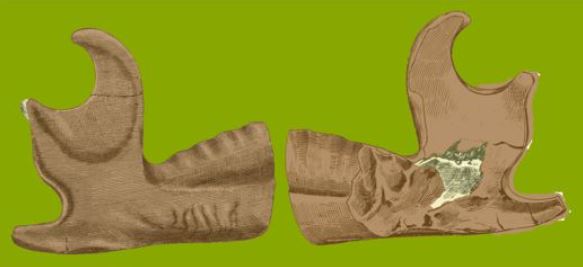
Illustration by C. B. Moore showing a copper-covered mammal jaw bone from the Mt. Royal site in Putnam County, Florida.


Not all metal artifacts found in Florida are of European origin.  Native Americans had sources of copper in the north and traded widely.  Some Native American copper artifacts have been found in Florida, including the one shown above, which was found at the Mt. Royal site, which is west of Bunnel.


Wikipedia says, The Mount Royal site was occupied beginning about 4,000 years ago. The site was largely unoccupied from 500 BCE until AD 750. Mount Royal was occupied again after 750, and after 1050 it grew into the main town of an important chiefdom with connections to the Mississippian culture. The town lost importance after 1300, but a settlement, called Enacape, was still there when Europeans entered the area in the 1560s. The Spanish mission of San Antonio de Enacape was located in the town from 1595 until after 1656.

Below is a reconstructed headdress very much like one found by C.B. Moore at the Mt. Royal site in Putnam County, Florida.  

Reconstruction of Headdress Made With Native Copper.
In the 1890s C. B. Moore traveled the rivers by houseboat and made arrangement to investigate mounds.

Although it is unlikely you will find anything as extravagant as those shown above, you can find Native American artifacts on Florida beaches.  In this blog, I've shown some Native American artifacts that were found on the Treasure Coast beaches.


I'd recommend taking a look at the PeachStateArcheaologicalSociety web site to become familiar with a variety of copper Native American artifacts.  It is an excellent web site.

There is much more to see there, such as these items.

Copper Fish Hooks and Knives.
Here is the link.
http://peachstatearchaeologicalsociety.org/index.php/20-copper-artifacts

You might remember that Irma uncovered thousands of Native American artifacts.

The first Native American artifacts I ever saw and recognized in nature in Florida was by the natural bridge that is now in Arch Creek Park in North Dade County.  The bridge was on a path used by Tequesta and early settlers.  The park now has a small museum.

I first learned of the site when I saw a photo of Thomas Edison collecting artifacts on a mound under a banyan tree.  The banyan tree and mound was still there.

Before the park was as developed as it is today, there was a trailer park on most of the property, but it was removed before I was there.

I have a friend that found some significant Hopewell Culture copper ceremonial artifacts up north.

---

You might also want to take a look at the National Archives web site.

https://www.archives.gov/

---

A 3,400-year-old palace has emerged from a reservoir in the Kurdustan region of Iraq after water levels dropped because of drought...

Here is that link.


Expect another week of one-foot surf.

Happy hunting,
TreasureGuide@comcast.net