Showing posts with label flint. Show all posts

Friday, April 3, 2020

4/3/20 Report - Alternatives to Metal Detecting. Putting Treasure Back. Hoard Uncovered. Seeking and Finding: The Necessity.


Written by the TreasureGuide for the exclusive use of treasurebeachesreport.blogspot.com.


Tool - Possibly Paleo.
Photo submitted by JamminJack

4/4/20 correction: I originally described the above item as an archaic point, but JamminJack tells me it is close to six inches long so could be an axe or something else and may be paleo.  Also, it was found by Jack's buddy.


Some people have been doing other kinds of hunting since the beaches have been closed.  I received the following message from JamminJack.


I have been getting back into arrowhead hunting. The field was plowed last week, and was able to find two bags of flint and two archaic period points during one day visit.


Crockpot Shard.
Find and photo by JamminJack.


Today my buddy was already out and found the scraper (not shown) just as he was going back to his car. The scraper is close to 5 inches. 

Small Bottle.
Find and photo by JamminJack.

I found the ceramic crockpot piece and small bottle. Bottle about 2 inches...

Good signs for metal detecting too.  This is obviously a site that was populated or visited by different groups for quite a while.

I know I have that exact same bottle somewhere.

---


Underwater archaeologists have returned 52 pre-Hispanic ritual objects to the place where they were found: the bed of one of the two crater lakes of the Nevado de Toluca volcano.

Members of the underwater archaeology team at the National Institute of Anthropology and History (INAH) deposited the mostly spherical and conical resin objects on the bed of the Lake of the Moon earlier this month.

The objects, believed to have been made by the Matlatzinca people between the 13th and 15th centuries and placed in the lake by pre-Hispanic priests, are stored in a specially-made container that allows water and sediment to flow over them. As a result, they are protected from deterioration.

The trove of objects is the first in situ underwater archaeological archive in Mexico, according to an INAH statement. The decision to preserve the objects in their place of origin complies with recommendations in the 2001 UNESCO Convention on the Protection of the Underwater Cultural Heritage...

Here is the link for more about that.

https://mexiconewsdaily.com/news/archaeological-objects-deposited-in-lake/

---

While removing the floor of the church in Obišovce near Košice, the foundations of the old church were uncovered. After this discovery, the archaeological company Triglav conducted research that took place at the beginning of February 2020, the Regional Monuments Board Košice reported.

During this work, the archaeologists discovered a unique treasure trove of coins, kept in a ceramic mug and covered with a small stone slab, under the original stone floor close to the western entrance of the church.

The hoard consists of more than 500 coins, most of them mining salary plates. The silver coins were wrapped separately, probably in linen clothing. The coins date the treasure to 1702 at the earliest...


Here is the link for more about that.


---

Even when they don't yet see it, treasure hunter's know there is something good out there to be found.  Treasure hunter's by nature must be optimistic.  Not only do they believe that there is something good out there to be found, they also believe that it can be found, and they can do it.

You might have misinterpreted something I said.  It happens, but I never meant to imply that we should not take the threat seriously or that any individual should not be responsible in every action.  It is just the opposite.

I believe that men are not only created with inalienable rights, but they are also created with  minds capable of finding wonderful solutions.  Humans are creative.  That is how they have survived and thrived.

Yes there is evil - great evil, but eventually, through great vision, effort and hardship, mankind generally wins.  Innovators do not blindly accept authority.

You might call me an optimist.  I am a treasure hunter in some small way, although my seeking is not always limited to objects.  Sometimes my seeking is in the stars, or in the thought-ways of the mind.  I like astronomy, and I like thinking.

Some may think we will fail.  I think there is a better way.  I believe that there are ingenious solutions waiting to be found.  I believe in tirelessly seeking those solutions and, remaining open to alternatives ideas, always believing that we can do it, and knowing that we have not only survived in the past, but also improved.

I encourage striving and seeking the smarter and better way.  Thinking is the ultimate weapon.   We can not simply accept fear, sloth, inertia and blind dependence, but must always seek the better solution - the better way.

I seldom believe that what I am told or where I am is the end of the matter.  I  tend to believe that there is usually another and better way to be found, and I believe that it can be found, but only if we believe and strive.

 ---

The Treasure Coast surf predictions have changed a little.  Now Sunday should see something like a 4 - 6 foot surf and Sunday, a 5 - 7 foot surf.   That isn't quite as much as was predicted a few days ago.

Happy hunting,
Treasureguide@comcast.net

Wednesday, December 4, 2019

12/4/19 Report - Flintlocks Found on Treasure Coast 1715 Fleet Beaches. Metal Detecting Lesson Learned Hard Way.


Written by the TreasureGuide for the exclusive use of treasurebeachesreport.blogspot.com.


Yesterday I ended up talking about the wheellock and the fact that none have been found around Florida.  At the time they were used, they were thought to be unreliable and were not used much in the New World by the Spanish.

Next came the flintlock, the miquelet being an early version of the flintlock.  

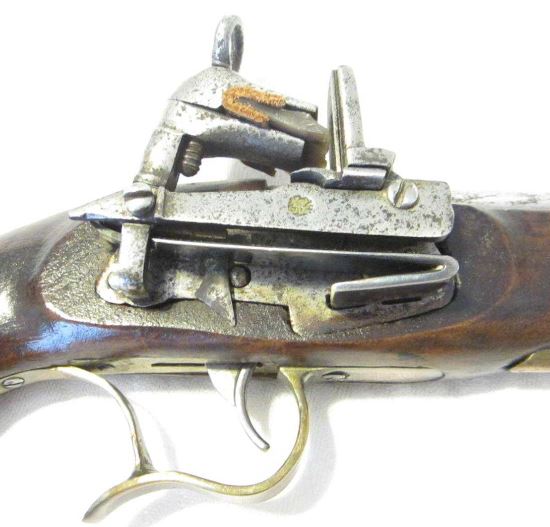
Lock of Miquelet Pistol.

You can easily see the flint being held in the lock by what in this case looks like maybe a piece of leather where you would often see a piece of lead.

You can often tell a Spanish flintlock from those made in other countries.  Spanish made miquelets were more boxy, while those made by some of the other countries were more curved and graceful in appearance.

Don't forget that Spanish galleons were provisioned by equipment from many countries, so if something isn't Spanish that doesn't mean that it didn't come from a Spanish treasure ship.

If you want to know more about the parts of a miquelet lock, click here to see a good video.

So what has been found in and around Florida waters?  First here is what Noel Wells' book Small Arms of the Spanish Treasure Fleets says about that.

As I said yesterday, matchlocks have been found on the 1622, 1715, and even the 1733 wreck sites, and never, according to Wells, has a wheellock been found in or around Florida waters.

* 24 French cavalry pistols (flintlocks) were found on one 1715 shipwreck site.  Some were totally encrusted.

*A miquelet musket stock (broken in the area where the lock would have been) was found on a 1715 fleet site.

* A 1660s era miquelet pistol from a 1715 site which is in the McLarty museum collection.

* In 1990 a trubuco musket was recovered from a 1715 site.

* In 1993 treasure divers found 2 encrusted muskets on a 1715 Fleet site.

* Around the year 2000 a beachcomber at a 1715 Fleet beach found a complete encrusted English flintlock lock that had never been fitted to a weapon.

Those are the ones I found listed in the wells book.  I might have missed one or two.  Of course there must be others.

For example, in my blog I reported on musket parts and a barrel mold that was found by Will R.  You can find information on that find in my 12/4/12 post and my 6/25/19 post.  Will was able to create a cast of the barrel.

I also remember one being found in the Sewall's point area, although I did not find right off where I reported on that one in my blog.

There are others for sure.  I found what I believe is most likely a piece of a silver side plate.

Piece of Silver Side Plate?

Here is the link to the post where I previously posted that.

https://treasurebeachesreport.blogspot.com/2012/07/72312-report-1715-fleet-ornate-silver.html

I once found a photo showing a side plate almost exactly matching the shape and design on the one that I found.  I don't know where that is now but there is a somewhat similar one shown in my old Dixie Gun Works catalog.

I clearly remember the first musket find that I made and have told that story before.  I found the rusted hammer and jaws of a musket on a steep hillside.  I can remember digging it up like it was yesterday, even though at the time I didn't know for sure what it was.  It was my first hunt in a historic area like that, and I didn't pay too much attention to the rusted twisted piece of metal that I just uncovered, and left it where it was.  In just a few short minutes, I found the flint.  I also didn't keep that.  I totally regret that to this day, but I just didn't have the knowledge and didn't know what I was doing. Sometimes you are just not ready for a find.  You can make good finds and not even know it if you don't have the necessary knowledge.  It would have been better if I found those items today rather than many years ago.  If I appreciated the items for what they were when I dug them up, I would have hunted the area better and I would have followed up by doing the research to better identify them. You can also ruin a find by not knowing how to conserve and store it.  Years later, I can now say that the musket lock and flint I found on that hillside was most likely English.

I've become painfully aware of how slowly I gain knowledge from experience and how that knowledge only makes my long history of ignorance that much more regretful.  Being a person that tends to learn independently rather than being quick to take advantage of the knowledge of others, much of my learning comes from making mistakes over the years.   One thing I've learned the hard way is that I could have saved myself a lot of wasted time and grief by being more organized and detailed in my documentation and record keeping.  I've said that before, but it is something I find myself very often regretting that I did not do.  I have objects that I can't easily find when I want to, and I've read things that I can not longer find when I want to.  I guess you can't avoid that, but being highly organized can help.

---

The tides are pretty flat now, as is the surf.

Happy hunting,
TreasureGuide@comcast.net


Friday, November 13, 2015

11/13/15 Report - Metal Detectors Saving History. Wooden Spears and Sabre Tooth Cats. Artifacts. Increasing T.C. Surf.


Written by the TreasueGuide for the exclusive use of treasurebeachesreport.blogspot.com.

Source: Bureau of Land Management Press Release (See link).
The Bureau of Land Management Cody Field Office partnered with the Office of the Wyoming State Archaeologist (OWSA) on a research project this past summer to find evidence of U.S. Army bivouacs associated with the Nez Perce National Historic Trail (NPNHT) near Clark, Wyoming. 


The NPNHT follows the path of Chief Joseph and the Nez Perce as they tried to escape the pursuing U.S. Army during the Nez Perce War of 1877. The 1,170 mile long route begins at Wallowa Lake, Oregon and ends at the Bear Paw Battleground in Montana. One segment of the trail follows the Clarks Fork of the Yellowstone River out of Wyoming and into Montana...

Here is the link for the rest of the story.

http://www.blm.gov/wy/st/en/info/news_room/2015/november/04cyfo-nezperce.html

Metal detectors play a big roll in saving the past.  You can see that illustrated in the above picture.

If the armies of amateurs were properly mobilized, imagine how much could be found.

There is so much more to be found almost everywhere.

I recently was on a hunt on an old Indian path and wagon trail up in West Virginia that I've hunted several times before. I've seen others detecting the same path in the past.   I only hunt there once or twice a year when I get up north.  Finds continue to be made.  I just use my little Ace 250, which is my primary travel detector for inland sites, yet every year there are old objects still being discovered.

I'll have a few pictures of some of those in the near future.  I also need to research some of those.

---


Human ancestors living in Central Europe between 320,000 and 300,000 years ago may have used wooden spears to fend off fearsome, meat-eating rivals — saber-toothed cats.

From 2011 to 2013, a team led by paleontologist Jordi Serangeli of the University of Tübingen in Germany found five teeth and a partial leg bone from two of these roughly 200-kilogram predators at a site where researchers previously discovered ancient wooden spears...

Here is the link for the rest of that article.

https://www.sciencenews.org/article/ancient-hominids-used-wooden-spears-fend-big-cats

---

I got a chance to see one fellow's super collection.  Here are some of the items.


Check out that huge flint digger at the bottom of the second picture.

---

The surf will be increasing on the Treasure Coast up to 4 - 6 feet by Sunday and possibly much bigger by the end of next week.  It looks promising at this point.

Happy hunting,
TreasureGuide@comcast.net

Wednesday, July 30, 2014

7/30/14 Report - Fine Bunch of Stone Tools Found. Site For Learning About Stone Tools. Cyclone Likely to Develop in Atlantic.


Written by the TreasureGuide for the exclusive use of treasurebeachesreport.BlogSpot.com.


Photos of Finds Submitted
By One Reader From South Africa
I got an email from a reader in South Africa that found these stone tools.  I only have a vague familiarity with that sort of thing.  I wondered if anyone knows if they have a Portable Antiquities Program like England or what the laws are in South Africa.  He has some very nice finds but doesn't know what to do.

Here are some of his pictures.


 He said something about what he thinks is a Spanish shield on an item from the same location.  I didn't see a picture of that.

Maybe some of you guys that know about stone artifacts can offer some comments.


I don't do this very often anymore, but I did it today.  I added another site to my reference link list.  That site will give you a very good introduction to stone tools and a few other objects.  If you want to be able to identify a stone tool when you stub your toe on one, this would be a good site to look at.

I think every detectorist should know a little bit about a lot of things, and this is one of those things.

Check it out.

http://pages.ucsd.edu/~dkjordan/arch/tools.html#chopper

Very good site for learning some basics.  It is now listed on my reference list as Stone Tools: An Introduction.


Don't throw anything away in the field if it MIGHT be interesting.  I've done that too many times.  I still regret discarding some things that I tossed aside years ago.  It is important to recognize items in the field, but if you aren't sure what something is or might be, hold onto it until you can really inspect it and do some research.  You can always throw something away later, but you might never find it again if you toss it aside too soon.

The most recent item that I discarded was a piece of flint that I dug when I was up north digging another target.  I should have kept it.  It wasn't an arrowhead, but it might have been another tool or partly worked.  I don't know now.  That is why I regret not keeping it.

It reminds me of the time many years ago when I dug a musket flint.  I was just beginning detecting and tossed it away.  That seems stupid to me today.  Shortly after tossing the flint I found the rusted part of the musket that held the flint.  Should have kept that too.  Live and learn.  Those are a couple of things that I threw away that today I wish I hadn't.


From the stone age to the digital age.  Early personal computers are selling for big dollars.  An Apple-1 (the company's original model) sold at auction in November 2010 for more than $213,000.

Here is a link to an article on collecting for financial investment.

 http://www.bankrate.com/lite/smart-spending/collecting-items-as-an-investment.aspx#ixzz38nRTfF8e


On the Treasure Coast we still have that one-foot surf and winds from the West today.

Low Pressure Area Likey To Become a Cyclone.

This low pressure area will likely become a cyclone (70% chance).

Who knows where it will go from there.  It is still a long way out.


I've been impressed lately how hunting the same site over and over again can continue to produce finds long after it would seem that you have covered everything, especially when you change detectors.  Some detectors that are very good at the beach are not so good on developed inland sites where there may be power lines, underground cables and other sources of interference and junk.


In the future I'll do some more tests with various detectors.


Happy hunting,
TreasureGuide@Comcast.net


Wednesday, January 26, 2011

1/26/2011 Report - Flint Pocket Pistol Found on Treasure Coast & Charles II Half Reales


Treasure Coast Beach Metal Detector Find by Mike H. in 2009.

Mike, who submitted the photo said, "...included is a picture of a very small flint model pocket pistol, the rivets are still visible. I found this near turtle crossing north of Vero Beach."

That is an interesting find. Mike coated the pistol with Rust-oleum Clear Coat to preserve it and that accounts for the shiny appearance in the photo.

That is one interesting find. Congratulations Mike!


Yesterday I posted pictures of stylized Charles and Philip monograms as they would appear on half reales form the 1715 Fleet.

The design for many half reales of the period included a date. Due to the small size and irregular shape of half reales, the date is often not found. There are other clues help you narrow down the date though.

On the Charles II Mexican half reales, if you can see anything to the left of the monogram, you might see the mint mark and assayers initial, which would be an O over an M over a G. The OM is the mint mark (Mexico) and the G is the assayer's initial.

Mexican Charles II Half Reale Found on 1715 Fleet Beach.

On this example, I think you can see most of the assayer's initial (G) to the left of the monogram. And perhaps the "R" inside the "C" of the monogram. From the examples I've seen, the left side of the "A" in the monogram is more slanted than what you see on the Lima and Potosi minted half reales, which would also have the last three digits of the year directly under the Charles monogram.

On the Charles II half reale that I showed yesterday you couldn't see to the left of the monogram and therefore couldn't see any of the mint mark or assayer's initial.

Anyone who studies cobs knows that it is a vast field. There are so many variations and minor details that can be significant.

For example, one thing that will help you distinguish between Lima and Potosi half reales is that on the Lima Charles II half reales the circle around the monogram is composed of more circular or round dots while those on the Potosi half reale of the same period is composed of more comma-shaped dots.

I like to learn what I can about dug cobs, but it is really a bit overwhelming.


A nine-year-old stopped his grandfather from throwing away a Neolithic axhead. The grandfather was throwing stones for the dog when the boy recognized the flint tool.

Here is the link to that story.

http://www.thisistotalessex.co.uk/news/Scout-s-honour-Neolithic-discovery/article-3115412-detail/article.html

I'm sure that a lot of you have discarded very nice finds. I've done it myself. That is why I say to keep anything that might be questionable until you get a positive identification.

Forecast and Conditions.

The low tide this morning was lower than usual. I was able to search out further than usual but still couldn't dig up that one object I've been working on.

Although conditions are still poor for finding shipwreck coins, the low tide area might turn up some artifacts. I dug some iron objects that were obviously old, but encrusted and unidentifiable.

One area that was cut very nicely a couple of weeks ago and yielded a number of gold items as well as coins was cutting again, but was not back down to the productive layers yet. That could happen if the same area keeps eroding.

There are a lot of scalloped areas out there, but they are so high on the beach and in such sandy areas that I don't think you'll find them very productive.


Happy hunting,
TreasureGuide@comcast.net