Showing posts with label lock. Show all posts

Wednesday, December 4, 2019

12/4/19 Report - Flintlocks Found on Treasure Coast 1715 Fleet Beaches. Metal Detecting Lesson Learned Hard Way.


Written by the TreasureGuide for the exclusive use of treasurebeachesreport.blogspot.com.


Yesterday I ended up talking about the wheellock and the fact that none have been found around Florida.  At the time they were used, they were thought to be unreliable and were not used much in the New World by the Spanish.

Next came the flintlock, the miquelet being an early version of the flintlock.  
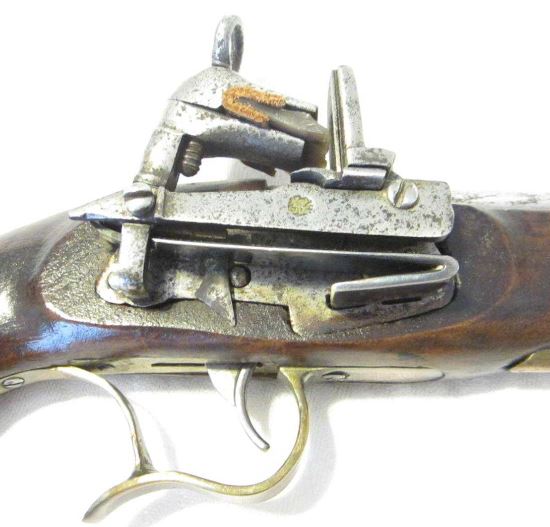
Lock of Miquelet Pistol.

You can easily see the flint being held in the lock by what in this case looks like maybe a piece of leather where you would often see a piece of lead.

You can often tell a Spanish flintlock from those made in other countries.  Spanish made miquelets were more boxy, while those made by some of the other countries were more curved and graceful in appearance.

Don't forget that Spanish galleons were provisioned by equipment from many countries, so if something isn't Spanish that doesn't mean that it didn't come from a Spanish treasure ship.

If you want to know more about the parts of a miquelet lock, click here to see a good video.

So what has been found in and around Florida waters?  First here is what Noel Wells' book Small Arms of the Spanish Treasure Fleets says about that.

As I said yesterday, matchlocks have been found on the 1622, 1715, and even the 1733 wreck sites, and never, according to Wells, has a wheellock been found in or around Florida waters.

* 24 French cavalry pistols (flintlocks) were found on one 1715 shipwreck site.  Some were totally encrusted.

*A miquelet musket stock (broken in the area where the lock would have been) was found on a 1715 fleet site.

* A 1660s era miquelet pistol from a 1715 site which is in the McLarty museum collection.

* In 1990 a trubuco musket was recovered from a 1715 site.

* In 1993 treasure divers found 2 encrusted muskets on a 1715 Fleet site.

* Around the year 2000 a beachcomber at a 1715 Fleet beach found a complete encrusted English flintlock lock that had never been fitted to a weapon.

Those are the ones I found listed in the wells book.  I might have missed one or two.  Of course there must be others.

For example, in my blog I reported on musket parts and a barrel mold that was found by Will R.  You can find information on that find in my 12/4/12 post and my 6/25/19 post.  Will was able to create a cast of the barrel.

I also remember one being found in the Sewall's point area, although I did not find right off where I reported on that one in my blog.

There are others for sure.  I found what I believe is most likely a piece of a silver side plate.

Piece of Silver Side Plate?

Here is the link to the post where I previously posted that.

https://treasurebeachesreport.blogspot.com/2012/07/72312-report-1715-fleet-ornate-silver.html

I once found a photo showing a side plate almost exactly matching the shape and design on the one that I found.  I don't know where that is now but there is a somewhat similar one shown in my old Dixie Gun Works catalog.

I clearly remember the first musket find that I made and have told that story before.  I found the rusted hammer and jaws of a musket on a steep hillside.  I can remember digging it up like it was yesterday, even though at the time I didn't know for sure what it was.  It was my first hunt in a historic area like that, and I didn't pay too much attention to the rusted twisted piece of metal that I just uncovered, and left it where it was.  In just a few short minutes, I found the flint.  I also didn't keep that.  I totally regret that to this day, but I just didn't have the knowledge and didn't know what I was doing. Sometimes you are just not ready for a find.  You can make good finds and not even know it if you don't have the necessary knowledge.  It would have been better if I found those items today rather than many years ago.  If I appreciated the items for what they were when I dug them up, I would have hunted the area better and I would have followed up by doing the research to better identify them. You can also ruin a find by not knowing how to conserve and store it.  Years later, I can now say that the musket lock and flint I found on that hillside was most likely English.

I've become painfully aware of how slowly I gain knowledge from experience and how that knowledge only makes my long history of ignorance that much more regretful.  Being a person that tends to learn independently rather than being quick to take advantage of the knowledge of others, much of my learning comes from making mistakes over the years.   One thing I've learned the hard way is that I could have saved myself a lot of wasted time and grief by being more organized and detailed in my documentation and record keeping.  I've said that before, but it is something I find myself very often regretting that I did not do.  I have objects that I can't easily find when I want to, and I've read things that I can not longer find when I want to.  I guess you can't avoid that, but being highly organized can help.

---

The tides are pretty flat now, as is the surf.

Happy hunting,
TreasureGuide@comcast.net


Wednesday, April 10, 2019

4/10/19 Report - Pre-Columbian Metallurgy and Gold Analysis. More On Terry's Gold Artifact. Avoiding Treasure Hunting Wild Goose Chases.


Written by the TreasureGuide for the exclusive use of treasurebeachesreport.blogspot.com.


What do you see in the above picture?  Some people will see a vase.  Others will see two faces.  You can see both, but you will generally see one first and stick with that until your focus changes.

The point is that who you are will determine in part what you see.  Perception involves more than simply what is there.  How you perceive things will be influenced by your history.

Your brain interprets what your eyes see.  As a result, different people see things differently.  People reveal something about who they are by what they see.  Perception is not as passive and simple as we tend to think.  That is the basis for the entire field of projective testing (a method of personality testing used in psychology that includes ink blot tests and word association, to name just two).

Almost everything presents something of a projective test.  That is something people can't entirely avoid.  They might think that what they see is what is out there in the world, but there is also a degree of interpretation. Past experiences, learning and memory play a roll in perception. Social scientists go to great length to keep their own biases from affecting their experiments.

This is a complex topic, but I'm going to try to keep it brief.

Treasure hunters approach the world with a perspective that is a little different from other people.  When they dig up something that is ambiguous to a degree, their unique perspective comes into play. That is just what humans do.

When a treasure hunter digs up a key or lock, one of the first things he might think of is a treasure chest, even though there are many other types of keys - those used for toys, clocks and music boxes, for example.  You see that type of thing all the time.  I see it all the time on some of the TV treasure shows.

Treasure hunters have a tendency to see coins in ambiguous lumps.  One of the most common questions I get is about those lumps of rust that are found on the beach.  People wonder if they might be old coins.

It is natural for a TV show that wants to attract viewers to manufacture drama.  The participants are rewarded for it.  That is how they get face-time.

Some people will see gold in any flash of yellow.  They'll see Spanish treasure galleon spikes in any old spike, or a cutlass in any long thin flat object, or a spear point in a cribbing spike.  It is natural for a treasure hunter to be excited by such things, but hopes and dreams won't solve the problem. 

You won't see the slow tedious work of archaeology or any other science on TV.  The pursuit of truth is too slow, and nobody wants to watch it.  It requires too much discipline.

Our hopes and desires influence our perceptions and interpretations.  Everybody has a unique perspective that they carry with them.  That is natural, but it is something that a scientist, or anybody that wants to find truth, needs to limit and control.  They go to great lengths to be objective.  Let the data speak - not your wishes.

If you are hoping to get clues from the things you find, you want to avoid wild goose chases.  An incorrect interpretation can be very costly.  It is better to avoid quick conclusions and continue to entertain competing theories and suspend judgment until you have a wealth of evidence, and even then remain open to changing your mind when new evidence is presented.

---

Yesterday one of my topics was XRF analysis, which determines the metallic composition of tested items.  It is a useful way to analyze items such as coins and artifacts.

I just found the following table giving the metallic composition of various types of gold.


Color of Gold                              Alloy Compositions Containing Copper

Yellow Gold (22 kt)                    Gold 91.67%, Silver 5%, Copper 2%, Zinc 1,33%
Red Gold (18 kt)                         Gold 75%, Copper 25%
Rose Gold (18 kt)                       Gold 75%, Copper 22.25% Silver 2.75%
Pink Gold (18 kt)                        Gold 75%, Copper 20%, Silver 5%
Gray-White Gold (18 kt)            Gold 75%, Iron 17%, Copper 8%
Light Green Gold (18 kt)            Gold 75%, Copper 23%, Cadmium 2%
Green Gold (18 kt)                     Gold 75%, Silver 20%, Copper 5%
Deep Green Gold (18 kt)            Gold 75%, Silver 15%, Copper 6%, Cadmium 4%

You can use the following link to go to the article that provides the above table along with a technical discussion of Pre-Columbian depletion gilding.  It was published in Mechanics, Materials Science and Engineering in 2017.


There is a lot in that article that you might find interesting.  Here is a very brief excerpt from the article just to give you the idea.

Because all the metals that reached Europe were melted back into their constituent metals in Spain, there is only an example of such a load, a group of over 200 tumbaga bars, discovered in the remains of an unidentified shipwreck (around 1528), off Grand Bahama Island. This shipwreck was found in 1993... 

---

Terry S. has continued to research his gold pendant-looking find.  He recently talked to a very accomplished world-wide expert about it.  I'll pass along what Terry was told, as Terry explained it in an email.  The following is what Terry said.

… He then told me that these were often low karat gold anywhere from 8 karat on up. I told him that the one I found was 22 karat and he said then it was probably made well before the Spanish arrived probably 1 to 2 hundred years before the 1715 Spanish fleet. He told me he knew of a sunken 1600 ship that was filled with this type of jewelry. He explained there were 3 ships that were filled with trade items, blankets, beads and other items of interest to the natives. They had orders to trade for this type of gold jewelry from the Aztec, Inca or Maya Indians in Mexico and Central and South America. Only two of these ships returned to Spain. He told me where he believes this ship sank and went on to say that this is the only sunken ship that he knows of that is filled with this type of native jewelry. 

When trying to identify any piece like this there is always room for error but I think I can be pretty comfortable in saying I have a small piece of history. I believe that it is probably from a Aztec or Inca funerary mask or another ceremonial gold jewelry piece.


Thanks Terry.  I hope you'll keep us up to date on any additional developments.

I saw a few more pictures of funerary masks with very similar attachments to Terry's mystery item.  I'm also reminded of the funerary mask find reported in my 1/24/19 and 1/27/19 posts. That was found in the Melborne area and was said to be associated in some way with a  4 billion dollar shipwreck that was being sought.  There was no evidence of such attachments on that mask, but it was not complete.  It was initially reported as Incan, which, was reported by another source as being wrong. With the inaccuracies and controversy, that story got to be pretty messy.

---

I have some other topics I've been working on.  One has to do to the slope of a beach.

I also have a detecting spot that I'm dying to check out when the conditions are right.

I should have gone into engineering.  I need a digging/sifting robot.

We won't have much surf for a couple of days at least.

Happy hunting,
TreasureGuide@comcast.net

Tuesday, June 27, 2017

6/27/17 Report - Getting To Know Your Detector/Coil Combination. A 250-Year-Old Lock. Surveillance.


Written by the TreaureGuide for the exclusive use of treasurebeachesreport.blogspot.com.


A few days ago (/10/17) I talked about the cone of sensitivity for different metal detector coils.  I showed that for some coils, the area of sensitivity is more cone shaped.  For a cone-shaped coil, the maximum depth is obtained when a target is under the center of the coil.  You get less depth when a target is out near the edge of the coil.

The illustration above shows the theoretical cone of sensitivity for two different types of coils - a concentric coil and a DD coil.  According to what you will typically read or hear, the area of sensitivity under a DD coil will not be as sharply cone-shaped as it will be for a concentric coil.  When looking at the area of sensitivity from the side you can see that it is more blunt from a side view.  The area of sensitivity is supposed to be narrow for a DD coil when viewed from the front or back.

The depth you will get with a DD coil for a target under the center of the coil will be similar to the depth that you get when the target is near the edge of the coil.  The importance of that is that you will be getting greater depth under a wider span of the coil, making overlapping of sweeps less important because you are getting good depth under the entire area of the coil (front to back).  When using a concentric coil, failure to overlap sweeps would mean missing more deeper targets that fall closer to the front or back edge of the coil where you get less depth.

I am not one to go by theory or what everybody says or even by what the manual says.  I test things out.

In my 6/10 post, I encouraged you to use a test object to map out the area of sensitivity for your coil and detector.  Doing an air test, pass a test object under the center of the coil and see how deep the object can be detected.  (That is how most air tests are conducted.)  Then pass the object out towards the edge of the coil and see how deep the object is detected, and then do the same thing with the object farther out near the edge of the coil.  You will get a good idea of how much depth you will get under the center of the coil and farther away from the edge of the coil.

Mostly we talk about the area of a coil's sensitivity from front to back.  DD coils are often said to have a narrower area of side to side.  That is supposed to result in better target separation.  You should be able to distinguish between two targets that are beside each other.

With my tests I definitely found that one detector/coil combination had a much sharper cone shaped area of sensitivity than another.  As expected the concentric coil had a sharp cone shaped area of sensitivity, and the DD coil had a more blunt shaped area of sensitivity, as shown in the illustration.  I did not, however, find that the side to side area of sensitivity was narrow.  It seemed about as blunt as the front to back sensitivity.  So much for what the manual says.  Although that test did not correspond to what the manualsaid, my tests corresponded very well with what I experienced in the field.  This particular detector/coil combination does not provide good target separation even though it involves a DD coil.  Targets sound big.  And a bunch of small close targets sound very much like one big target.  How much of that is electrical engineering and physics and how much of it is psychosensory, I don't know, but that isn't important to the detectorist.  The important thing is how you perceive it in the field.

My main point is to experiment so that you really get to know your detector and how it responds.  Get to know both its strong points and its weaknesses.  Read the manual, but test everything out for yourself.  You might find that what you have been reading or hearing does not seem to be true for your situation.

---

Source: See link below.

MACKINAW CITY, MI - A 250-year-old lock was discovered at Colonial Michilimackinac earlier this week.

Staff at the historic fort and trading post in Mackinaw City discovered the intact, 2.75-inch long and 2.25-inch wide brass artifact while excavating a fur trader's home on the site.

Lynn Evans, curator of archaeology at Mackinac State Historic Parks, said the piece was likely used to lock a small trunk or chest sometime between 1760 and 1770. The lock is a rare find, even for a place full of hidden treasures like Fort Michilimackinac...


Here is the link for the original article.

http://www.mlive.com/news/grand-rapids/index.ssf/2017/06/revolutionary_war-era_lock_une.html

----

Some of you will consider this off-topic.  Thats ok.

BAE, a British company that has been widely criticized for sharing communications surveillance software to countries with human rights abuses.  The software is capable of tracking virtually ALL computer communications.

I saw a TED talk, which I wish I could find again, on Evident, a software package about which it has been said, "You'd be able to intercept any internet traffic," a former employee told the BBC. "If you wanted to do a whole country, you could. You could pin-point people's locations based on cellular data. You could follow people around. They were quite far ahead with voice recognition. They were capable of decrypting stuff as well."

I just think a computer user should be aware of the digital environment they inhabit and more generally the world they live in.  

Treasure hunters used to be very much interested in treasure maps, codes, covert activities and the like.  Doesn't seem to be the case so much anymore.

Watching the hearings on TV, one thing that impressed me is the number of things that they feel they have to keep secret from the citizens of the country.  Very much like archaeology, but a byproduct of terrorism instead of looting.  

Here is one link if you are interested in this type of thing.

http://www.bbc.com/news/world-middle-east-40276568

---

On the Treasure Coast we have more smooth surf for days or weeks.  The tides are pretty good now, with some nice low tides.

Happy hunting,
TreasureGuide@comcast.net