Showing posts with label fossil bone. Show all posts

Saturday, October 12, 2019

10/12/19 Report - A Couple Miscellaneous Reader Finds. Learning From Auctions. Trade Beads. Subtropical Storm Melissa. Rough Surf.


Written by the TreasureGuide for the exclusive use of treasurebeachesreport.blogspot.com.

Odd Eisenhower Dollar
Find and Photo by Jerry P.

A couple days ago I showed a clad quarter with a hole in it that I found.  That reminded Jerry P. of this odd find he once made in Melborne.  Any ideas on why it would be punched or drilled like that?

---


Fossil Find by Dustin L.
Photo by Dusin.

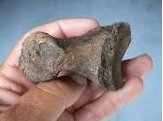
Dustin L. recently found this fossil bone and wondered what it might be from.  I'm not good at identifying fossil bones, but it looks to me like it might have been split to obtain the marrow.  Obviously it is from a rather large animal.

---


Lot 1221 In The Current Sedwick Auction.


These trade beads are lot 1441 in the current Sedwick Auction.  You can learn a lot by browsing the Sedwick Auctions.  The lot description shown below tells you about a US trading post destroyed by the Seminoles, for example.

Necklace made of hundreds of tiny glass trade beads in many colors, recovered from the site of the US trading post on the Caloosahatchee River near Ft. Meyers, Florida, that was massacred and destroyed by Seminole Indians led by Chief Holatamico (better known as Billy Bowlegs). 8 grams, 26" long. A long string of tiny, plain beads in many different colors (mostly orange, red and yellow), often referred to as "Harney Massacre" beads in reference to Lieutenant Colonel William S. Harney, who was manning the site when the Seminoles attacked. Housed in a Riker box with printed history and with photo-certificate.

A few days ago I posted a photo of an alligator across from the old mound by Fort Pierce.  Many trade beads have been found in that area.  Many of them were found on private property.

---


Here is the latest big find from Oak Island.  I just received this photo from Bill G.

Big Find From Oak Island.
Submitted by Bill G.

Due to the size, they thought it might be Viking.

---


Subtropical Storm Melissa
Source: nhc.noaa.gov


The only thing on the National Hurricane Center map right now is Melissa, which is a tropical storm headed out to sea.

On the Treasure Coast we are having some high surf.  I'll try to check it out before long.


Source: MagicSeaWeed.com

Happy hunting,
TreasureGuide@comcast.net

Monday, October 1, 2018

10/1/18 Report - Treasure Beach Reports. Another Kind of Treasure. High Surf Coming.


Written by the TreasureGuide for the exclusive use of treasurebeachesreport.blogspot.com.

Ambersands Beach Yesterday Afternoon.
Alberto S. sent some beach photos that he took yesterday afternoon.  You'll notice that the beaches look very much like the pictures I posted from South Hutchinson Island yesterday morning.

The beaches seem to look very similar from South Hutchinson Island up to Sebastian.  There are a few small scallops but no cuts to speak of.   There is also a lot of sea weed at the top of the sloping sand beaches.

Wabasso Beach Yesterday Afternoon.
Turtle Trail Yesterday Afternoon.

Alberto said Seagrape looked the same as the other beaches.

Thanks for the photos Alberto!

The waves have been hitting from the east for quite a while without any nice angles.

I was ready to go out this morning but had a low tire to tend to.

---

Every once in a while one of my old posts is discovered and read by tons of people.  The one that was being heavily accessed the past couple days is the one about Treasure Coast sea shells with calcite crystals.

https://treasurebeachesreport.blogspot.com/2015/05/52815-report-unique-beach-treasures.html

I assume a link to that post was posted somewhere else.  Even more rare and interesting in my experience is the fossilized bone containing calcite crystals.

Fossilized Bone Containing Calcite Crystals.

That goes right along with what I've been saying about being a complete beach hunter - not just a detectorists.

There all kinds of treasures to be found on the beaches.  They can be millions of years old and very rare and interesting.

---

Source: MagicSeaWeed.com.

As you can see, we're going to have more high surf.  Hopefully we'll get some good angles or the water will hit the dunes somewhere.

Tropical Storm or Hurricane Leslie is still hanging around out there.

Happy hunting,
TreasureGuide@comcast.net

Monday, October 16, 2017

10/16/17 Report - Impressions of the Garrett ATX Metal Detector After A Lot of Usage. Fossil Bone.


Written by the TreasureGuide for the exclusive use of treasurebeachesreport.blogspot.com.

I thought I'd give my impressions of the Garrett ATX with 10x12 DD coil after using it for quite a few hours.  A lot of metal detector reviews are done after a few hours of experience with the metal detector.  You can't tell anything from that.  And I've explained the many problems with air tests, test gardens and other attempts to quickly assess and summarize metal detectors.

It took me a long time to learn to use the ATX well.  Like with any metal detector, it is not difficult to turn it on and go, but that doesn't guarantee that you are getting anything close to best performance.  Ignorance can be bliss.  You can use a metal detector for a long time and feel that it is doing well without really testing things out and making sure you are getting the best performance out of the detector.

How well a metal detector performs depends a lot upon the person using it.  I think that is especially true with the ATX.

I can't tell you exactly why it seemed to take me so long with the ATX.  I guess in some important ways it is just different from some of the detectors I've used in the past, but it did take me longer to become confident that I was using it well and getting great performance out of it.

One of the first things you will notice about the ATX is how heavy it is.  It is heavy.  It swings lighter than it is, yet it is still heavy and I can't think of a heavier metal detector that I have used.

The first thing you might notice performance wise, is its sensitivity to iron.  It is easy to end up digging very deep holes for iron targets and tons of holes for very small pieces of iron.  Again, operator skill comes into play.

There is an iron check function, but it doesn't identify iron in a lot of cases.

If you want a detector that gives a lot of discrimination or target ID, this is not the detector for you.  This is what I call a power detector.  It detects.  It detects deep targets and small targets.  There is a lot of digging with this detector.  If you are a skilled operator, and I do mean skilled, you can cut down on the digging, but it does require a skilled operator.

The ATX can pick up a lot of electrical interference around power lines, cables etc., but the frequency scanner does a good job of selecting a frequency to adjust noisy environments.

It is a deep seeking detector and responds very well to small gold and silver targets.  It is better than most detectors if you use it well, can handle a heavy detector and are not afraid of detecting some junk targets.

I'm not going to give you air test results or anything like that.  I've talked about the problems with such tests in the past.  I will say, it will detect small and deep targets very well if you use it well.

It is difficult to explain why it took me so long to feel like I mastered the ATX, but I would not describe it is a turn-on and go detector.  Part of it was the fact that I really explored and tested the various operating modes and settings.  

With the coil and configuration I use, pinpointing is not quick and easy.  With most detectors, I can pinpoint fairly well without taking the time to stop and switch to pinpoint mode.  The ATX seems to give such a big broad signal to anything but the smallest targets, that pinpointing seems to take longer.  I really have never used a detector before that I had to take so much time pinpointing.  The ATX pinpoint mode is good, it is just that in the past I seldom had to slow down and use pinpoint mode so much.

With the ATX I like to manually ground balance, especially in wet sand.  I pay more attention to ground balancing and spend more time ground balancing with the ATX than I have ever done with any other detector.  

Non-motion mode will give you some added depth, but it takes a fairly skilled operator to use the non-motion mode in wet sand or shallow water.  The ATX will give you excellent depth on deep and small targets. 

There are a variety of reasons it took me so long to feel that I mastered the ATX.  Part of it is because of the detector itself.  It was partly because it is significantly different than a lot of the detectors I've used extensively in the past.  And part of it is that I just wanted to make sure that I explored everything and was getting the best out of the detector and its various modes and settings.

To summarize, the ATX will detect deep targets and small targets as well or better than any detector I have used, however it is not the easiest detector to learn and it is not the easiest detector to use.  It is definitely not a good detector for a beginner, and it is definitely not for everybody or every situation.  If I primarily wanted to make sure I was not missing deep or small targets, it would be my choice.  If I was hunting the average dry beach, I would probably not select the ATX.  There are other detectors that would do a good job and make the task easier.
---

A couple of days ago I showed  the following picture and asked what kind of fossil bone you thought it was.

Fossil Bone Find.

Below is a larger but similar bone.  It is a sloth toe bone.  From what I've seen, it could be a sloth toe bone, but that is just my wild guess.

Source: internet photo.

---

Just a 2 - 4 foot surf on the Treasure Coast right now.  That might increase a little in a few days.

I had to take a family member to the hospital this weekend, but all seems back to normal now.

Happy hunting,
TreasureGuide@comcast.net


.

Friday, October 13, 2017

10/14/17 Report - Fifth Century Gold Coin and Rings Found. Where Treasure Coins Have Been Found. Fossil Find.


Written by the TreasureGuide for the exclusive use of treasurebeachesreport.blogspot.com.

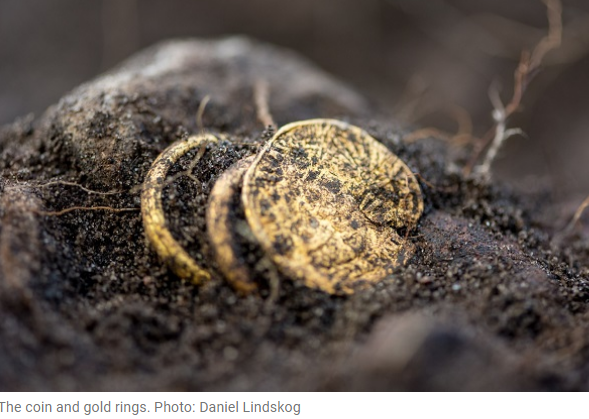
5th Century Gold Coin and Ring Finds.
Source: thelocal web site link below.


My main topic today is the recently completed blog poll.  The conclusions are limited for a variety of reasons.  I was not able to post a long detailed question because of how the blog poll app works.  As a result I could only ask one question, and I could not get very detailed or specific.

Not long ago some one suggested that I conduct a poll something like this one. The question they posed was a little different though. It was something more like, "How many treasure coins have you found at the different shipwreck beaches in the last five years?"  That is a very different question than the one I posted. At first glance it might seem more similar than it really is.  There are reasons that I decided to do it the way that I did.

If I were to do this poll again, I would probably use some other time period than the five-year period that I chose.  This time around a ten-year period would probably have been better.  The five year period unfortunately put Hurricane Sandy, one of the productive times during that time span, not clearly in or out of the five year period. Not remembering specific dates, some people probably included Hurricane Sandy finds while others did not.

The locations listed in the poll were not defined in a precise manner either.  That leaves a lot of room for interpretation.  For example, the area defined as "between Turtle Trail and Rio Mar" might be considered to begin at the Turtle Trail access, or it could include a mile or two to the south of that.  It is not clear how respondents looked at that.

I didn't want to ask where people found the most treasure lately.  Most treasure hunters do not want to give away their hot spots.  I thought that by going with the five-year period, that would reduce that concern since people wouldn't be telling where they made their most recent finds.  That really didn't relieve the desire for secrecy concerning where people have been finding things.  Some people told me straight out that they didn't want to give that information out to the general public.  I understand that completely.  That is undoubtedly whey so many of the respondents were people who had not found any treasure coins.  They had nothing to hide.

Understanding all of the limitations of this poll and the limitations on the conclusions, it still wasn't a waste.  Perhaps it was most informative for less experienced detectorists and those that haven't made that first treasure coin find yet.  The poll results say one thing very clearly: treasure coins can be found a lot of places, including on the Treasure Coast and elsewhere.

You have to realize that the poll numbers do not indicate the number of coins found at each location.  The numbers indicate the number of people who found coins at each location.  That is a big difference.

As a previous blog poll showed, if a person finds one cob, it is very likely that they found more than one.

Given the short-comings of the poll itself, along with response bias, you can't take too much from the poll results.  There is no one beach or location that really sticks out as being a real hot spot.   The range of vote or responses for any one Treasure Coast location was 0 to 4.  That is not a wide range, and considering the limitations that I've already mentioned, you can't make much out of the fact that one location has more votes than another.

From the poll results we can see that a good number of treasure coins were found outside of Florida and outside the country.  With our heavy focus on the Treasure Coast, we might forget that there are other important areas where shipwreck treasure is found.  In the U. S., there are places like North Carolina, Texas, and other areas of Florida, including the West Coast.

As I mentioned before, I know of finds from areas listed in the poll that had no responses.  In other words, there were known finds that were not reported in the poll.  So, like I said, the voting was suppressed and can only be accepted very generally.

Here are the final numbers from the poll question, "Where did you find gold or silver shipwreck treasure coins or cobs in the last five years?"

Didn't find any.
  54 (72%)
Cocoa/Mellborne
  3 (4%)
Bonsteel
  0 (0%)
Sebastian Inlet to Ambersands
  0 (0%)
Golden Sands/ Treasure Shores
  0 (0%)
Wabasso
  2 (2%)
Seagrape/Turtle Trail
  4 (5%)
Between Turtle Trail and Rio Mar
  1 (1%)
Rio Mar
  0 (0%)
John Brooks/Frederick Douglass
  3 (4%)
Jupiter
  2 (2%)
Other Florida
  3 (4%)
Not in Florida
  7 (9%)

Votes so far: 75
Poll closed 

---

Treasure Coast Fossilized Bone Find.
Can you guess what kind of bone this is?

I found it about three weeks ago.  I just got the picture downloaded.

---

Concerning the 5th Century coin and ring finds shown at the top of the post, here is a brief excerpt.

The coin was made in honour of Western Roman Emperor Valentinian III, who ruled between 425 and 455. The emperor is depicted on one side of the coin, with his foot resting on the head of a barbarian – a common motif in coinage from the period. A similar coin commemorating Valentinian III was found three years ago...
Here is the link for the rest of the story.

https://www.thelocal.se/20171011/gold-coin-sheds-new-light-on-5th-century-swedish-island-massacre

---

Happy hunting,
TreasureGuide@comcast.net

Friday, June 30, 2017

6/30/17 Report - Metal Detector Auditory Signals and Visual Displays - What They Won't Tell You. Beaches Today. Correction.


Written by the TreasureGuide for the exclusive use of treasurebeachesreport.blogspot.com.


Here are a couple Treasure Coast beaches as seen this morning near low tide.  Not much to look at.  I saw no erosion other than a few inches here and there.  

There were a lot of new turtle nests.  Not much else of interest.

I could see one spot that looked like it might be worth detecting.  There were no cuts, but the beach had been receding there for quite a while.  I plan to get back to it some time in the future.
This Morning Near Low Tide.
Beach conditions remain basically unchanged.

---

I apologize and resign.  I was wrong.  I think so anyway.

I went back and read an old post because I noticed that a lot of people were reading it after I referred to it in a more recent post.  After reading the old post, I was about to pull my hair out.  The post was about the fossil bone with a drilled hole and cut marks.  When I referred to that fossil in the old post, I talked like someone found the fossil and drilled and cut it.  I don't know why I believed that.  It is much more likely that the bone was drilled to obtain the bone marrow when it was fresh.  I remember Fred Dengler, my old buddy and fossil expert, telling me that at some point.  Why I believed it might have been drilled and cut after it was already fossilized is beyond me.  I guess it is remotely possible, but it just doesn't seem likely to me now, especially after remembering what Fred told me.

Maybe I shouldn't take it so hard.  You're supposed to live and learn, and if you never change your mind you probably aren't learning anything.  That is some consolation.  And it is sort of neat to think of having something that somebody cut and drilled maybe thousands of years ago.

---

Which is best: listening to the auditory signal from your metal detector or watching a visual display?

First I want to make a few things clear.  There are a couple important basic concepts.  They are the concepts of sensation and perception.  I'll use the following definitions.  Sensation is input about the physical world registered by your sensory receptors such as the eyes, ears, mouth, nose, and skin.  Perception, on the other hand, is the process by which the brain selects, organizes, and interprets sensations; it is often influenced by learning, memory, emotions and expectations.  In other words, sensation occurs more in the sensory organs, while perception involves more brain.

The auditory and visual processing systems are very different.  The auditory system is a sequential processing system, while the visual system is a parallel processing system.  If you know about parallel processors in computers, you'll understand that.

To illustrate, if you are in a large room where a lot of conversations are taking place, you can only really listen to one at a time.  If you think you are listening to two conversations, you are probably sampling - taking bits from one then the other and then putting the conversations together from the samples you took from each.  That is sequential processing.  It is like a single stream of information flowing through one pipe or hole.

Vision involves parallel processing.  You can look at the entire room and see hundreds of people at once.  A lot of the processing is actually done in the retina before it is sent to the brain.  It is not so much like a small stream flowing through a small keyhole.  It is more like an entire screen. Not only do you see the forest but also all the trees.

Signals always occur in a field of noise.  There is internal and external noise.  The sound of the wind and waves would be examples of external noise, and tinnitus, ringing in the ears, is an example of internal noise.  You can also be distracted by various irrelevant sights and sounds.

Two of the most basic characteristics of sound is intensity, or loudness, and frequency, or pitch. When you listen to a metal detector signal, you will mostly be listening for a change in loudness and tone. The detector, of course, produces some noise. depending upon how well it is set up and how well you are using it.

When you watch a graphic display or meter, there can be a variety of types information displayed, most often including things like some indicator of target depth and the type of target.

Most people will probably get more useful information from detectors that provide visual displays. Some of the information can incorrect or misleading, but it will provide a good bit of useful information.

If I had a simple answer to the question I posed, I'd say that most people will probably find the visual information useful.  Visual displays can provide a lot of information.  Theoretically they can provide all the information of an auditory signal and more.  Although some submersible systems provide a light to indicate a signal, all of the major metal detectors provide an auditory signal.

The detector can do a lot of the processing for you and a visual display can provide a lot of really good information in an easy and meaningful form.

An auditory signal can also provide a lot of good information besides indicating if a target is present or not.  I like reading ground effects.  You can do that if you don't balance or set up your detector to eliminate all ground signals.

I do want to say, however, that some people can learn to extract a lot of information from an auditory signal - perhaps much more than you might think, but it does require both a keen aptitude and a lot of experience.

In the end, the user still has to make good decisions.  No metal detector can make the most important decision for you.  It will not tell you where to put your coil.  If you don't put your coil over good targets, none of that other information matters. A lot of the information for that important decision will come from visually scanning the landscape and referring to your acquired knowledge base.

---


Happy hunting,
TreasureGuide@comcast.net