Showing posts with label calcite crystals. Show all posts

Wednesday, June 17, 2020

6/17/20 Report - Florida's Most Collected Gems. Fishing For Treasure.


Written by the TreasureGuide for the exclusive use of treasurebeachesreport.blogspot.com.

Florida Calcite Fossilized Clam Crystals.
Calcite crystals in fossilized clam shells are said to be the most collected Florida gems. I've talked about that and Ruck's Pit in previous posts but decided to make a few photos after finding one of my photos being used by Google or Bing or whoever it was describing fossilized shells.  They didn't give credit either, so they used copyrighted material without any mention whatsoever of the source.  But the photo was good, and evidently useful, so I thought I'd make a few more.


An internet search showed the photo below, which was originally posted in the above post.  It was made using ultraviolet light to show the fluorescence.  It wasn't an easy photograph to capture.  I guess I'll have to learn to label my photos better.

Fossilized Shell With Crystals Photographed in Ultraviolet Light.

Geologyin.com says, The calcite geodes [at Ruck's Pit] were also of special interest, as they had formed as large aggregations of dogtooth spar growing inside fossilized clams (bivalve mollusks) and whelks (gastropod mollusks). As far as is known, this type of dogtooth spar geode is unique to the Fort Drum Mine.  However, I've found them on Treasure Coast beaches. In fact, the one shown immediately above was found on South Hutchinson Island, and it is far from the only one that has been found there.


I even once showed crystals that formed in the hollow of a fossil bone.

Here is one more photo of a crystalized shell that I just took in natural light.

Fossilized Clam Shell Crystals.
---

Here is a link to a good article about the damage done by fish trawlers to shipwreck sites and the items that come up in the nets.

https://www.academia.edu/3597737/Sean_Kingsley_Out_of_Sight_Out_of_Mind_Fishing_and_Shipwrecked_Heritage?email_work_card=view-paper

Here are just a couple examples from that article.


Not only do the trawlers bring up the kinds of things you might expect. like olive jars and pottery, but also heavy and large things like cannons.

---

There is a fairly large statue of a mermaid in the Indian River that is not very recognizable because it is covered with oyster shells.

---


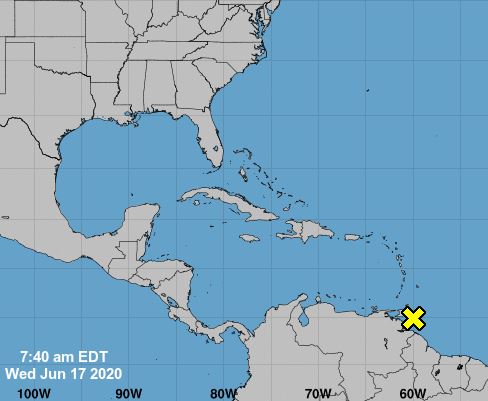
Source: nhc.noaa.gov

As you can see, there is a new system down by South America that could develop.  It is that time of year.

On the Treasure Coast today the surf is very small - only one or two feet.  The tides are not big, and the primary swell is ENE.

Happy hunting,
Treasureguide@comcast.net

Monday, October 1, 2018

10/1/18 Report - Treasure Beach Reports. Another Kind of Treasure. High Surf Coming.


Written by the TreasureGuide for the exclusive use of treasurebeachesreport.blogspot.com.

Ambersands Beach Yesterday Afternoon.
Alberto S. sent some beach photos that he took yesterday afternoon.  You'll notice that the beaches look very much like the pictures I posted from South Hutchinson Island yesterday morning.

The beaches seem to look very similar from South Hutchinson Island up to Sebastian.  There are a few small scallops but no cuts to speak of.   There is also a lot of sea weed at the top of the sloping sand beaches.

Wabasso Beach Yesterday Afternoon.
Turtle Trail Yesterday Afternoon.

Alberto said Seagrape looked the same as the other beaches.

Thanks for the photos Alberto!

The waves have been hitting from the east for quite a while without any nice angles.

I was ready to go out this morning but had a low tire to tend to.

---

Every once in a while one of my old posts is discovered and read by tons of people.  The one that was being heavily accessed the past couple days is the one about Treasure Coast sea shells with calcite crystals.

https://treasurebeachesreport.blogspot.com/2015/05/52815-report-unique-beach-treasures.html

I assume a link to that post was posted somewhere else.  Even more rare and interesting in my experience is the fossilized bone containing calcite crystals.

Fossilized Bone Containing Calcite Crystals.

That goes right along with what I've been saying about being a complete beach hunter - not just a detectorists.

There all kinds of treasures to be found on the beaches.  They can be millions of years old and very rare and interesting.

---

Source: MagicSeaWeed.com.

As you can see, we're going to have more high surf.  Hopefully we'll get some good angles or the water will hit the dunes somewhere.

Tropical Storm or Hurricane Leslie is still hanging around out there.

Happy hunting,
TreasureGuide@comcast.net

Sunday, July 29, 2018

7/29/18 Report - Florida's Most Collected Gems. Time to Consign. Louisiana Tax Token.

Written by the TreasureGuide for the exclusive use of treasurebeachesreport.blogspot.com.

Fossilized Seashell with Calcite Crystals Found on a Treasure Coast Beach
Photographed in Black Light.
I've shown other fossilized shells from the Treasure Coast in the past, but this is a particularly nice one.  This picture was clipped from a video of the shell taken in black light.

Calcite crystals represent the most commonly-collected mineral from Florida. As most of Florida is underlain by Tertiary to recent marine limestones, the potential for crystal finds exists just about anywhere these limestones are exposed – most prominently in active limerock quarries. 
A handful of localities have historically produced the bulk of collector-quality Florida calcites. These localities occur within specific regions, including the area around Marianna in the Panhandle, the Lecanto – Brooksville area in West-Central Florida, exposures of Miami Oolite in the Broward / Miami-Dade region of Southeast Florida, and scattered East-Central Florida exposures from shallow excavations. These excavations notably contained calcified mollusks, from localities in the Orlando area, south Brevard and central Indian River counties, and of course, Rucks Pit in Okeechobee County. Many other occurrences have been documented, including calcite replacing corals from Key Largo, a number of shallow occurrences from dredged canals and rock pits the Everglades and Southwest Florida, and even from limestone dredged from about 60 feet beneath the St. Johns River in Jacksonville. The “flos-ferri” variety of aragonite (polymorphic with calcite) has been found in a quarry north of Ocala...

The text from a site that sells fossilized shells where most prices are in the hundreds of dollars.

Here is the link.


I always remind people to notice other things that they see when they are on the beach detecting. You can find quite a variety including but not limited to ancient artifacts, sea glass, fossils and valuable sea shells.  When conditions aren't ideal for finding one type of treasure you might be able to find another if you are alert and aware of the possibilities.

---

If you want to sell some finds, a new Sedwick auction will be held in November.  You can consign now.


---

Jorge Y. did some great research and found the identity of yesterday's mystery item. It is a Louisiana tax token.  Here is what he found.


I am surprised by how old it is.  And they were only used for two years.

Here is the link of the listing found by Jorge.


https://www.louisiana-trade-tokens.com/taxtokens.html

Thanks Jorge!

---

There is no tropical activity in the Atlantic of interest.

No big changes in beach conditions.

Happy hunting,
TreasureGuide@comcast.net


Thursday, May 28, 2015

5/28/15 Report - Unique Beach Treasures. Fossil Shells With Calcite Crystals


Written by the TreasureGuide for the exclusive use of treasurebeachesreport.blogspot.com.

Sometimes you can find fossils on the beach that are a million years old.  That hasn't been the case much lately though.  Conditions have been too poor, and like with cobs, some of the best places  have been covered with renourishment sand.

Whelk Shell Fossil Photographed in Black Light.


Did you know that naturally formed gems have  been found on the Treasure Coast beaches?  I'm not talking about those that have been lost at some time.   I'm talking about gems that formed and were never before touched by man.

They aren't diamonds, rubies, or emeralds either.  What I'm talking  are fossils shells filled with crystals.  I'm talking about fossil shells that are thousands or millions of years that have turned into crystal gardens.

You've probably heard of Ruck's Pit.  I'm not talking about those either, but the web site for the Fort Drum Crystal Mine (present name for Ruck's Pit) tells something about how they form.  Here is what it says.

The crystals form inside of the clam shells by a long process. "The calcite is dissolved from the fossil sea shells by acidic groundwater and then transported downward where it then reprecipitates inside the shells of the clams (called quahogs) and occasionally other mollusks," explained Means. Means further explained that the calcite crystals actually form just below the water table in water that is supersaturated with calcite (calcium carbonate).


Talking about Ruck's Pit again, the web site says, The deposit is actually a nearshore marine deposit that represents a former shoreline, " said Harley Means, assistant state geologist, Florida Geological Survey, Florida Department of Environmental Protection. Means explained that sand and fossil seashells found in the mine are thought to be several million years old...

Here is the link to the Fort Drum Crystal Mine Web Site.
http://www.thefortdrumcrystalmine.com/
You can visit the Fort Drum Crystal Mine to search for fossils for $45 per person until June when the price increases to $60 per person.
Long before global warming the sea was much higher than it is today.  Things come and go.
Back to the beach.   There are deposits of calcified fossil shells found at other places besides Ruck's Pit.  An occasional shell with calcite crystals can be discovered on the beach.  The one shown at the top of this page is one example.

Same Whelk Shell Shown Above
Closeup In Regular Daylight.

In this blog I've shown both fossil shells and bones found on Treasure Coast beaches that contain calcite crystals.  One neat small fossil bone that was found on a Treasure Coast beach has calcite crystals in the hollow of the bone.
Certain minerals fluoresce in ultraviolet light.  That is what you see in the picture at the top of the page.  It isn't easy to photograph objects under black light, but I think you can see some of the rich purple and yellow fluorescence in that photo.

I have also used a black light to find certain fluorescent gem stones such as rubies and garnets.  The black light really makes them pop.

Paleodirect.com sells fossils and shows one calcite crystal fossil conch shell on the site.  I found the following description of that fossil shell instructive.
Here it is.

ULTRA RARE GEM-GRADE YELLOW CALCITE CRYSTAL-FILLED FOSSIL CONCH SHELL
Okeechobee County, Florida, USA
PLEISTOCENE PERIOD:  1.81 million years - 10,000 years ago
Fossils that have been formed or filled with gem grade minerals are amongst the rarest and most beautiful of all.  The highly uncommon geological occurrence of a well-preserved fossil formed out of stunning gemstone grade minerals is why these specimens are so passionately coveted by both fossil and mineral fanciers, alike.  They make up the rarest of fossils and almost always sell for several thousands if not, tens of thousands of dollars.

In south Florida, there is a gravel shell pit that this strange phenomena can be found - crystals in fossils!  The occurrence of calcite-lined shells is this site's hallmark but the calcite ranges from a light coffee color to a drab burnt honey hue.  Intense yellow gem-grade specimens such as this are not found at the mine but have been found in the same formation of a nearby undisclosed site.  A fossil of this quality, completeness with crystals of this clarity and intensity is no less rare than finding fine grade gemstones of any type from any site in the world - actually rarer since this is a perfect crystal specimen AND a fossil. 
  
This is a small Busycon species gastropod fossil from the last North American Ice Age Period.  The entire shell's internal cavity has been fossilized with the whorl and inner chamber filled with bright lemon yellow gem-grade calcite crystals.  Nearly the entire shell has been completely replaced with translucent glowing calcite as seen in the above images.  Busycon was a predatory marine whelk that fed mainly on bivalves by attaching itself to its prey with its foot and slowly rasping a hole in the shell of its unfortunate victim.  Whelks can move great distances and can go against tidal currents with the use of its powerful foot.

This specimen was part of an extremely limited find that was made by the quarry geologist NOT at the working mine but at a location nearby that is not part of the commercial operation.  This find was very limited, discovered and collected in the early 1980's and specimens of this nature have never been located since.  This color and quality certainly does not occur at the working quarry.  Of the few rare examples that have hit the market, prices have exceeded $1000.  The color and lack of crystal damage on this beauty easily top those $1000+ examples. This is the only one we will ever offer as it was a rarity unto itself for us to even acquire it.  If you want a stunning and rare mineral AND fossil specimen all wrapped up in one, you could hardly find a more affordable and yet beautiful example.  Guaranteed NO REPAIR and NO RESTORATION.  This beauty is AS FOUND!

The deposit that this prize specimen was collected from offers an abundance of well-preserved fossil marine shells.  Its coquina matrix dates to the Pleistocene and is part of the 'Nashua Formation' being composed of cemented marine fossils with calcite.  


That description is from https://www.paleodirect.com/pgset2/ga034.htm

Not only have I seen fossil shells with calcite crystals on the beach, I have also seen some in the Indian River.  I don't know how they got there.  They could have been dumped there with road fill for Indian River Drive, but I don't really know.

---

People say all the time that you can't take it with you when you die, but there is an exception.  The only thing you can take with you is what you give to others.

----

Happy hunting,
TreasureGuide@comcast.net