Showing posts with label indian head. Show all posts

Monday, April 6, 2015

4/6/15 Report - Spanish Colonial Higa. Red Cent Indian Head Pennies. $100,000 Hot Wheel Toy.


Written by the TreasureGuide for the exclusive use of TreasureBeachesReport.BlogSpot.com.
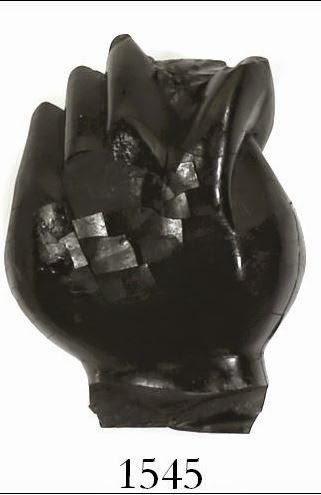

Carved Jet Higa
Source: Current Sedwick Coins Auction Catalog.


This carved jet higa is lot 1545 in the current Sedwick Coins auction.  Jet is black wood.  It is broken and incomplete.

Higas (sometimes figas) are common Spanish colonical artifacts and have been found on wrecks of the 1715 Fleet.

Higas are charms or talismans meant to ward off evil.

They are made of various materials, including jet, ivory, and various other materials.

Below is a higa that was found by using a metal detector on a Treasure Coast beach.

That one appears to be made of ivory and has a silver cap and loop.

One that looks nearly identical is listed with a photo in the the Mel Fisher artifact database.


Higa Dug On Treasure Coast Beach
----

Not worth a red cent!  You might have heard that expression.  Maybe not so much anymore, but I've heard that expression many times in the past.  I always thought it meant "not worth much of anything," but red cents can actually be worth something.

What is a red cent?  If you've dug a lot of coins you've probably dug some pennies that look red.  I have.  I've seen red wheat pennies as well as memorials.

I've read that the color is determined by different copper oxides.

I once believed that any patina on a coin was bad.  That isn't necessarily so.  Some patinas actually add value. 

A rainbow toned silver US coin can be worth 10 or 20 times more than a similar untoned coin. 

By toning I'm referring to the natural aging process, not encrustation or corrosion. 

Back to red cents.

Indian head cents are popular collectibles.  The following article from numismaticnews.net says, “There’s a big jump in value for red Indian Head cents. The 1890 is scarce in a high grade with red color. That’s an underappreciated rarity."

Here is a link if you want to read more about the value of Indian Heads and red cents.

http://www.numismaticnews.net/article/good-to-see-red-with-indian-head-cents

The next time you dig up a  red cent in nice condition, check it out.  It might be worth more than you think.

You might also want to go back and look at the nicer pennies and other coins that you've stored away,  and look for those with especially nice patinas.

----

Source of photo: Comcast link below.
Is this Hot Wheels VW Beach Bomb Rear Loader really worth $100,000?

Use the following link to find out. 

If you've been metal detecting very long and dig things besides coins you've probably dug a few Hot Wheels.  Of course it isn't likely that you'll find one this valuable, but you can find one worth a few bucks.  It can be fun to research the toys you do dig to see what they might be worth. 

It is always good to know what kinds of things might have some value.  Sometimes you might be surprised.

http://xfinitytv.comcast.net/watch/Pawn-Stars/7196250346352115112/421517891940/Hot-Wheel-of-Fortune/videos?skipTo=58&cmpid=FCST_hero_tv_pawnstars

----

On the Treasure Coast the higher surf that was predicted turned out to be only up to around four feet.  Not only is that disappointing, but the wind is South/Southeast.  That won't help much.

Not much hope in the predictions for this week either.

Hope you had an great Easter,
TreasureGuide@comcast.net

Sunday, September 30, 2012

9/30/12 Report - Million Dollar Penny, Indian Head & Mystery Item Identified


Written by the TreasureGuide for the exclusive use of treasurebeachesreport.blogspot.com.


Here is a 1903 Indian Head penny that was recently dug at the same mainland site that I've been talking about.  It seems it was almost new when lost.  You can see the detail in the feathers and even read the word Liberty on the head band.


Coins dug on the mainland are often in much better condition than those dug on a beach or in the ocean.  The salt water can cause a lot of corrosion.


How much is a penny worth?  It seems like there are a hundred ways to turn that into a trick question, but there is one penny that sold for a million dollars.

So what is so special about that penny?  It is a 1943 brass penny, one of only a few that got into circulation.

Here is the link to the story on the million dollar penny.

http://abcnews.go.com/blogs/headlines/2012/09/rare-1943-penny-sells-for-1-million/


Do you think one of these could have slipped through your fingers? Another good reason to inspect all of your finds.


Thanks to Trez and Robert K., both of  whom gave me a link that led to a good web site showing what the mystery items I posted yesterday are and how they were used.  

You can go to that web site by using the following link.

http://www.railroadiana.org/hw/pgSealers.php

Here is one paragraph from that web site that tells how the lead seals were used.

Among the more more interesting and unusual pieces of railroad hardware that can show up in the collectors market is the sealing tool or "sealer". This was a device that was used to produce an embossed, lead seal that secured boxes, pouches, and doors of various kinds. Since the seal had to be broken to open the container or door, it was a means of both preventing tampering and demonstrating that none had occurred. Being made of lead, seals were very durable and can still be found along railroad rights of way. There are even reports that some have been recycled as fishing sinkers!

I thought it looked like a seal and surprised myself by being right.  I'm pretty confident now that is what it is and have seen other examples dug by other people, including some bearing exactly the same numbers and letters.   I've seen other dug examples from various railroads, including Canadian and Russian as well as other US railroads, and even a Civil War period example.

Other people commented that the items might be tie markers.  Although I've read a little about tie markers, I haven't seen photos of examples yet.  

I've always like trains and railroads and can see how this would be a nice area to collect.

As far as time period for the boxcar seals, which is what I'll call them for now, I would guess early 1900s.  They have to be after 1895, but I don't know how much later.  I have seen newer boxcar seals, and they are different.  The ones I posted are more like the Civil War ones than they are like the newer ones that I saw.

I would also like to determine the significance of the number "182."  I know that the FEC Railroad had a train numbered 182, but don't know if that is what the number on the seal stands for.  I have also seen a photo of a FEC seal with the number "140" on it.

You can see how I like the research process and figuring out things as much as I like digging things.  It is a process, and you learn a lot in the process.

Another thing I wonder about is the various conditions of the examples.  Three were cut.  Two appear to be blank.  And one was flattened out. 

I wonder if the flattened one was ruined in the process of stamping, flattened when it was removed, or flattened by some kid that found it, or what.  Maybe I'll learn enough in the future to flesh out some more of the history.  That is fun to me.

These boxcar seals were made by punching with a die, similar in a way to how the shipwreck bale seals were made, and also similar to how cobs were produced.  You learn about one thing, and you can often apply something from it to something distantly connected.  That is why I recommend doing a lot of different types of hunting.  You'll learn new things that you can apply elsewhere.

If I didn't know about bale seals, I doubt that I would have guessed that these items were seals.  It always helps to recognize finds in the field.  I've missed my share of clues in the field and thrown away things I wish I would have kept.


If you read yesterday's post early, I need to let you know that the date of the upcoming fundraising cookout will be November 3 instead of November 10 at the Pennwood Motor Lodge in Wabasso.


The wind is primarily from the south/southwest today, and the seas are down around 2 - 3 feet.  That will  remain unchanged for a few days, and the wind will shift from the south to east about Wednesday. 

The beaches are pretty sloppy, some are accumulating sea weed.

Low tide today will be around 3 PM.


Happy hunting,
TreasureGuide@comcast.net

Thursday, February 2, 2012

2/2/12 Report - Beach Conditions Back to 1 Temporarily


Written by the TreasureGuide for the exclusive use of treasurebeachesreport.blogspot.com.

1879 Penny Found in County Park That Was Dedicated in 1970.

Find and photo submitted by James F.

Just because a site doesn't appear to be old doesn't mean it isn't.

A few days ago I mentioned how sites often have older layers under them. The same things that make them attractive now were also found attractive by people in times past.

The 1879 penny was found in a trench being dug for a drainage pipe. I'll elaborate on that some time.

James wasn't expecting much from this park except maybe some newer items, but he was told by a guy he met in the park that the area was used as a park way back to near the Civil War period.

You can sometimes get some good tips from people you just happen to meet.


The wreck of a British merchant ship that was torpedoed by a German U-boat off Cape Cod during World War II has been found. It is thought to have hold a cargo of platinum bars worth more than $3 billion and other precious items.

Here is the link to that story.

http://www.huffingtonpost.com/2012/02/01/port-nichelson-shipwreck-_n_1247835.html

Of course various parties are lining up to claim the

Thanks to Don B. for the link.


Artifacts dealer Christopher Kortlander is trying to regain possession of war bonnets, medicine bags and other items confiscated during government raids on his privately-operated Custer museum. Although the government has failed to prove its case against Kortlander, it has not returned all of the confiscated items and has not made restitution for damages and abuse.

Here is the link to that story.

http://www.centredaily.com/2012/01/29/3070950/custer-dealer-seeks-return-of.html#storylink=cpy

By the way, the year the penny was minted (1879), is only three years after the battle of Little Big Horn.


I added a new poll to the blog. Take a look. It will give us a good idea about what people have been finding.


Treasure Coast Treasure Beach Conditions and Forecast

Well the front passed through and we're back to southeast winds again.

I'm giving a beach conditions rating of 1 (poor).

That rating could change soon though. Although seas are now down around two feet, it will start building Friday, and, according to current predictions, will get up to around six feet on Saturday. That could result in further erosion to those spots that were eroded a few days ago.

Time will tell.

Happy hunting,
Treasureguide@comcast.net

Sunday, December 5, 2010

12/5 Report - Mourning Ring and 1877 Indian Head


Silver Possible Mourning Ring Found On a Treasure Coast Shipwreck Beach.

I think this might be a mourning ring. Mourning rings often held a hair or something and were worn in memory of a deceased loved one. They were especially popular in Great Britain in the 17th through 19th centuries. Often there was an enameled skull somewhere on the ring.

The ring shown in the photo above is silver and seems to have glass over some other type of hard surface. Whatever was held under the glass has evidently deteriorated or disappeared. Sometimes there were miniature portraits under the glass.

It is one of those things that I don't know very much about. I've never personally seen a good similar example to go by.

Below is a photo of a mourning ring containing a woven hair pattern. Of course it has never been exposed to salt water and is in very good condition.

I just don't know about the above example - if it really is a mourning ring or not, and I don't know if it came from a wreck or not. I suspect not.

As always, if you have any thoughts on this I'd like to hear them.


Good Example of a Mourning Ring.

Have you ever heard of a coin that is worth more as a MS-65 than a Proof 65 coin. There is one. It is the 1877 Indian Head Cent. And in MS-65 conditions, worth about $13,000.

Check out your Indian Head finds.

If you'd like to know more about the 1877 and why it is so valuable, check out this link.

http://numismaticnews.net/article/1877_cent_seen_as_one_to_hold_on_to/

A few days ago I gave a link to a site that discussed some of the military training that took place on Hutchinson Island during WW II.

You can still see many signs of that activity. For one thing you'll see concrete foundations where watch towers or other structures once stood. There is one such foundation just north of John Brooks Park just south of the condos.

A variety of junk can be seen to litter the area there. Some of it has been picked up or covered up in recent years.

There is also a concrete foundation on the beach south of the condos I'd say a couple hundred yard or more that has been uncovered on a couple of occasions. People with PI detectors often mention that there detector goes crazy up there. It is because of the buried foundation and rebar.

You can see another concrete foundation about a hundred yards north of the Blind Creek access at the back of the beach. And there are a few others that I can think of.

That is to mention just a few.


There is one of the Treasure Coast shipwreck treasure beach maps now listed on ebay that has a bid and will conclude on Monday. One day remaining.


Not much has changed on the beaches the past few days and I don't have much new to say about that today. I'd still be checking out the low tide areas. Also you might want to hunt out some of those WWII sites. I showed a nice found canteen a few days ago.

I know I keep saying this but shipwreck cob hunting has to improve someday before long.

Until then watch for the non-metallic items and other artifacts.


Happy hunting,
TreasureGuide@comcast.net