Showing posts with label ivory. Show all posts

Thursday, June 11, 2020

6/12/20 Report - Miscellaneous Sampling of Treasure Coast Fossils: Some Being Millions of Years Old. Evolution of Horses of North America. Labeling Finds.


Written by the TreasureGuide for the exclusive use of treasurebeachesreport.blogspot.com.

Rhino or Teleoceras Skull Cap Fossil

I decided to show a different kind of Treasure Coast find today.   I often tell you to keep your eyes open when you metal detect.  You can find different types of things - some of them being really old.  One example would be fossils.

I think the fossil shown above is my favorite Treasure Coast fossil fins.  A real fossil expert told me it was a rhino or teleoceras skull cap from the Miocene period (25 - 5 million years ago).  I had no clue what type of animal it  came from but got an expert and friend of this blog to identify it for me.

I guess I like that one best simply because I find it difficult to think of anything like a rhinoceros being in Florida.

I think most detectorist like to find old things, but we are usually thinking in terms of maybe hundreds of years rather than millions of years.

Fossil Great White Shark Tooth.

A lot of people like shark teeth, and fossilized shark teeth are fairly common on some Treasure Coast beaches.  This one was found on the banks of the Indian River.  I wasn't fossil hunting when I found it.  In fact when I first saw it I thought it was a piece of glass.  And it is in very nice condition.

Below are a few more examples.


Camel Phalange Fossil.

If you are like me, you don't readily think of camels being on the Treasure Coast either, but above is what I'm told is a fossilized camel phalange.

Below are a few more examples.


Whale Inner Ear Bone.


Alligator Scute.

Fossilized Ivory From Mammoth or Mastadon.

I once saw a nice section of a tusk sticking out of the Treasure Coast sand.


Fossil Bone With Shark Teeth Marks.

Some fossils will show something a little extra.  Maybe it shows that it was worked by man or perhaps another animal left its mark like the bone shown above, which shows what appears to be teeth marks.

Keep your eyes open while metal detecting.  You might see something older or more interesting than what you were looking for.

I'll add one tip here.  It goes along with the mistakes I've been talking about in some of my previous posts.  Label your finds with as much as you know about the identity of the item and also the place and details of the find.  You might think that you'll remember all about it, but time takes its toll.  As you can see from the above photos, I had some of these labeled, and I am glad of that.  Some were not labeled.  That is a mistake I made a lot.  Don't put it off.  You might remember the details for some finds, but you might regret forgetting the details of others.


Fossil Hoof.
Concerning the item shown immediately above, I suspect it is a horse hoof, but I never got it checked out.  I'm sure an expert could give me the details, but at this point I simply don't have enough information to label it with any precision or certainty.

You might be interested in the history of horses in North America.  If so here is a link.

https://www.statelinetack.com/content/general-information/the-prehistoric-horses-of-north-america/

Horses changed a lot over the millions of years.


Horse teeth fossils are very common finds on the Treasure Coast, as are turtle scutes.

Bison, deer, peccary, sloth, snake, fish, wolf, bivalve and mollusk, coral, crab and wood fossils are some of the others fossils that have been found on the Treasure Coast.

If you are interested in finding fossils and haven't done it before, I'd recommend paying a professional guide to take you for a day trip to the Peace River.  It is worth the money, and you'll learn a lot.  I did it once several years ago.

---

The surf is going to be around two feet today, and the tides are now small.

Happy hunting,
TreasureGuide@comcast.net


Saturday, July 29, 2017

7/29/17 Report - Gold Coin and Ivory Icon Found. Changing Products and Markets With Discovery of the New World. Pirates.


Written by the TreasureGuide for the exclusive use of treasurebeachesreport.blogspot.com.

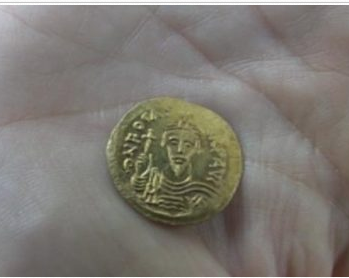
Ancient Gold Coin Discovered
Source: See sofiaglobe link below.

...News of the find of the ivory icon comes a few days after the finding of a rare gold coin from the time of the Byzantine emperor Phocas, which the dig team believes proves that the Rusokastro – also known as the “Red Fortress” was working in the sixth century CE.

Commenting on the finding of the ivory icon, Milen Nikolov, head of the Regional History Museum in Bourgas, said that ivory was extremely valuable, “much more valuable than gold in the Middle Ages”...

Ivory Icon.
Source: See link below.
Here is the link for the rest of that article.

http://sofiaglobe.com/2017/07/26/archaeology-ivory-icon-rare-byzantine-gold-coin-found-at-bulgarias-rusokastro-fortress-site/

One thing thing that I took from the article is that when we look at an old find we have an idea of its value but our the way we look at the item and the way we value the item might be very different from the way the item was valued back in the day by the people that made, used or lost the item.

As the above excerpt points out, ivory was much more valued than gold back in the Middle Ages.

Things change.  I've observed changes in market values of certain items in just the past twenty years due to the internet.  The discovery of the new world resulted in huge changes too.

Beginning in the 1600s, sugar and tobacco offered people on both sides of the Atlantic new flavor sensations. Exotic and expensive, they made some planters in the Americas, merchants in England, and ship owners who connected them immensely rich. The price was the forced labor of millions of African people. The work of field hands on plantations in the Americas changed the lives of consumers elsewhere...

That excerpt comes from a very nice history site that you might want to look at.  It has some good information and some nice illustrations.

Here is the link.

http://americanhistory.si.edu/onthewater/exhibition/1_3.html

If you look around at that web site you will find that it has a section on pirates, which you might also want to see.  Below is one of the illustrations from that section.

A Few Shipwreck Artifacts.
Source: See piratechart link below
Here is some of the text that goes with this illustration.

  • Nails

    Nails were a multipurpose fastener aboard ships. In addition, a handful thrown into the muzzle of cannon served as an effective antipersonnel weapon or sail shredder during a battle.
  • Lead patch

    Lead patches of various sizes and thicknesses are common finds on the wrecks of wooden ships. They were used for patching holes in the decks and hulls.
  • Cask and barrel hoops (casting)

    On sailing ships, barrels were the most common containers for food, cargo, and other storage. These fragments represent a nest of barrel hoops. On many ships, the barrel hoops and staves were stacked and stored belowdecks; the barrels were only assembled as needed.
  • Lead sounding weight

    Blackbeard eluded the British by using his knowledge of local waters to sail into shallow areas where bigger warships could not safely follow. He lowered this sounding lead over the side to learn the water depth under his vessel. The depression in the bottom was filled with tallow or wax to sample the bottom. Knowledge of the bottom conditions was needed for anchoring.
Like I said, you might want to check that web site out.

---

The tropical disturbance the I mentioned a day or two ago has disappeared and there is nothing else brewing in the Atlantic or Gulf.

We still have a one foot surf.  The tides are more moderate now too.

Happy hunting,
TreasureGuide@comcast.net


Saturday, May 16, 2015

5/16/15 Report - Another Closer Look At Two Old Finds. And One Recent Modern Find.


Written by the TreasureGuide for the exclusive use of treasurebeachesreport.blogspot.com.


I felt like taking another look at some old finds today.

First is this unusual silver cross.  I've shown it before, but never got the marks figured out.  Maybe someone can help.

I can't quite make out the word at the top and don't know what to make of the other marks.

I see none of the marks you would expect to see, such as 925 or sterling or anything like that.

Any help would be greatly appreciated.

-----

I've shown the following higa before.  It was found on a shipwreck beach, it is like one shown in the Mel Fisher artifact database.  It has no identifying marks that I've been able to find.

I decided to look it over very carefully under magnification to see if I could find any marks that I might have missed.


While I didn't find any identifying marks I did see some features that I thought were interesting.  I was glad that I took a closer look at it.


Here is a close-up view.


Notice the carving on the fingers.   I believe that it is carved ivory.

Notice below what appears to be the cementum rings.


The item also fluoresces yellow.  Ivory copies or substitutes generally appear dull purple in black light, according to the following reference, if I got it right.  I'll have to study it more carefully.

As far as I have been able to determine, this item is probably ivory.   Here is a link to a very good reference that provides instruction on identifying ivory and its substitutes.

http://www.cites.org/sites/default/files/eng/resources/pub/E-Ivory-guide.pdf

I'm still not confident in this.


I could see how the silver ring was formed.


And also the detail along the edge of the silver cap, which I never noticed before.


I was glad that I looked at it one more time even if I didn't find any markings.  I didn't find anything to suggest it is not ivory.

I always enjoy learning about finds.

---

Now for a recent modern finds.


Here is a somewhat unusual small ring.

It is 14K with sapphire and two small diamonds.

It is clearly marked 14k so there is no mystery to this one.

Almost looks like and evil eye ring.

Could be.

-----


On the Treasure Coast the surf was a little rougher today.  The good thing is the nice negative low tides.

Happy hunting,
TreasureGuide@comcast.net


Monday, April 6, 2015

4/6/15 Report - Spanish Colonial Higa. Red Cent Indian Head Pennies. $100,000 Hot Wheel Toy.


Written by the TreasureGuide for the exclusive use of TreasureBeachesReport.BlogSpot.com.


Carved Jet Higa
Source: Current Sedwick Coins Auction Catalog.


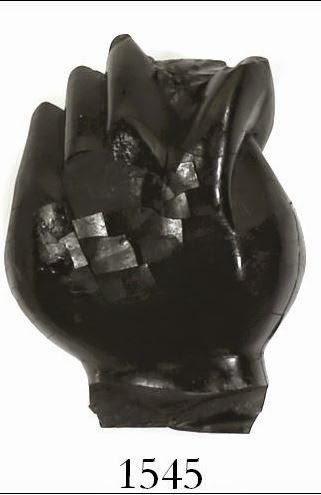
This carved jet higa is lot 1545 in the current Sedwick Coins auction.  Jet is black wood.  It is broken and incomplete.

Higas (sometimes figas) are common Spanish colonical artifacts and have been found on wrecks of the 1715 Fleet.

Higas are charms or talismans meant to ward off evil.

They are made of various materials, including jet, ivory, and various other materials.

Below is a higa that was found by using a metal detector on a Treasure Coast beach.

That one appears to be made of ivory and has a silver cap and loop.

One that looks nearly identical is listed with a photo in the the Mel Fisher artifact database.


Higa Dug On Treasure Coast Beach
----

Not worth a red cent!  You might have heard that expression.  Maybe not so much anymore, but I've heard that expression many times in the past.  I always thought it meant "not worth much of anything," but red cents can actually be worth something.

What is a red cent?  If you've dug a lot of coins you've probably dug some pennies that look red.  I have.  I've seen red wheat pennies as well as memorials.

I've read that the color is determined by different copper oxides.

I once believed that any patina on a coin was bad.  That isn't necessarily so.  Some patinas actually add value. 

A rainbow toned silver US coin can be worth 10 or 20 times more than a similar untoned coin. 

By toning I'm referring to the natural aging process, not encrustation or corrosion. 

Back to red cents.

Indian head cents are popular collectibles.  The following article from numismaticnews.net says, “There’s a big jump in value for red Indian Head cents. The 1890 is scarce in a high grade with red color. That’s an underappreciated rarity."

Here is a link if you want to read more about the value of Indian Heads and red cents.

http://www.numismaticnews.net/article/good-to-see-red-with-indian-head-cents

The next time you dig up a  red cent in nice condition, check it out.  It might be worth more than you think.

You might also want to go back and look at the nicer pennies and other coins that you've stored away,  and look for those with especially nice patinas.

----

Source of photo: Comcast link below.
Is this Hot Wheels VW Beach Bomb Rear Loader really worth $100,000?

Use the following link to find out. 

If you've been metal detecting very long and dig things besides coins you've probably dug a few Hot Wheels.  Of course it isn't likely that you'll find one this valuable, but you can find one worth a few bucks.  It can be fun to research the toys you do dig to see what they might be worth. 

It is always good to know what kinds of things might have some value.  Sometimes you might be surprised.

http://xfinitytv.comcast.net/watch/Pawn-Stars/7196250346352115112/421517891940/Hot-Wheel-of-Fortune/videos?skipTo=58&cmpid=FCST_hero_tv_pawnstars

----

On the Treasure Coast the higher surf that was predicted turned out to be only up to around four feet.  Not only is that disappointing, but the wind is South/Southeast.  That won't help much.

Not much hope in the predictions for this week either.

Hope you had an great Easter,
TreasureGuide@comcast.net

Thursday, June 26, 2014

6/26/14 Report - 16th Century La Plata Mint, 18th Century French Weapons Recovered, Jesuit Missions, & T. C. Silver & Ivory Higa


Written by the TreasureGuide for the exclusive use of treasurebeachesreport.blogspot.com.

Encrusted 18th Century Weapons Salvaged From Alexandria
Note: An incomplete post was showing up earlier.  Sorry for the mistake.


You will often see encrusted items.  Here are some 18th Century French weapons recovered by divers near Alexandria, Egypt.

You can see the trigger and trigger guard on the one third from right.

Immediately below is the link for more of the story and the source of the photo.

http://english.ahram.org.eg/NewsContent/9/40/104416/Heritage/Ancient-Egypt/French-weaponry-found-by-Russian-dive-team-in-Egyp.aspx


The other day I showed a Potosi minted coin found by the crew of the Capitana on the Green Cabin wreck site.  While we determined that the cob is from Potosi, there was actually another mint that produced cobs that were indistiguisable from Potosi cobs.  The short-lived La Plata mint produced 134,000 reales in face value from Dec. 20, 1573 to March of 1574 using dies and other tools and equipment sent from the Potosi mint.

Both the La Plata mint and Potosi used the mint mark of P, and Rincon was the assayer for both.  Since they used dies from Potosi and since the mint mark and assayer initials were the same for both, it would be virtually impossible to distinguish between cobs made at those two mints.  Howver, only the Potosi mint made eight-reales.  La Plata manufactured only the lower denominations.

I obtained that information from Stuart Menzel's book Cobs, Pieces of Eight and Treasure Coins. 


Here is a nice map of the early Florida missions from teachingflorida.org.  The link for the map and other informatin can be found below.  It is worth checking.


http://teachingflorida.org/primaryresources/missions-of-spanish-florida


You can't do much with ivory these days.  Below is a paragraph form Kovels Komments on the issue.

Example of Found Higa or Figa
Lawmakers in New York State have voted to outlaw the sale of items that are over 100 years old and made with more than 20 percent elephant ivory, mammoth ivory or rhinoceros horn. These rules for antique ivory are stiffer than those of the federal government (see the June 20 New York Times article.) There is great confusion about the new laws. I recently asked a museum curator if he could accept a 112-year-old humidor made of a piece of an elephant tusk mounted with Gorham silver and marked with the date. He didn't know. The federal law says old or new ivory can't be accepted by a museum, and we know many antique pieces have been destroyed in Colorado. Recently, antique musical instruments with ivory inlay were exempted.

You might wonder what that has to do with Treasure Coast treasures.  There have been a few ivory pieces found on the Treasure Coast shipwrecks.   One is an ivory and silver higa found on a beach years ago.  I believe there was a nearly identical one found on the Atocha.

If you don't know what a higa is, it is a charm to ward off evil eye or curses.  Higa's have been made and used for centuries.

On the Treasure Coast detecting conditions haven't changed.  The only difference is that the surf will be about a foot bigger the next few days.

Happy hunting,
TreasureGuide@comcast.net