Showing posts with label small. Show all posts

Saturday, December 21, 2019

12/21/19 Report - Cortes Anchor Found. Old Railway Track Explored. A Couple Recent Finds From Treasure Coast.


Written by the TreasureGuide for the exclusive use of treasurebeachesreport.blogspot.com.

It is not exactly one of those days when a whisper of wind turns into a hollow scream and normal men scurry to their hidey-hole, but at least there is some stirring in the air and surf.  It is better than the slow and steady accumulation of dead sand over the summer.  It wouldn't take much for things to turn good, but it might not do that.

Below are photos of a find made by John B in the Vero area along with a nickel for comparison.   John says the object is slightly larger in diameter than the nickel but thinner.   I assume he hasn't tested the metal yet.  If he did, he didn't mention it.

Find (left) by John B.
Photos by John B.
John was asking for ideas on the object.

---

I was talking about small objects that I dug in the past couple days.  Below is another one.

Dug Find on Dime.


Here is a closer look at the other side of the object.


Other Side of Same Object
It is very thin.  When I picked it out of the sand I didn't think it looked metallic to me, in part because it is so thin.  The signal made me expect something bigger.

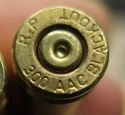
I think could be the end of a bullet.  Maybe something like the one shown below.


What do you think?

I also found something a little bigger.  It is a heart very much like one found in Kathleen Deagan's book on Spanish Colonial Artifacts.  In fact I found one exactly like it before, and also one of silver.  I thought I had photos of it on my thumb drive, but they weren't there when I got ready to post them.  Maybe I can get that done some other time.

--


MEXICO CITY: Archaeologists have discovered two iron ship anchors off Mexico’s Gulf Coast that they say date back 500 years and could have belonged to Spaniard Hernan Cortes’ fleet, which landed in 1519 before overthrowing the Aztec empire...

Cortes famously burnt the first ships he and his crew used to sail to Mexico, forcing his small army of treasure-hunters to march inland...

Two new television series are also stirring new interest in the history, one released last month by TV Azteca called “Hernan,” and another planned to be developed by famed Hollywood director Steven Spielberg entitled “Cortes” that stars Oscar-winner Javier Bardem...


Here is the link for more about that.
https://arynews.tv/en/anchors-mexico-spanish-conquest/

---
An extensive archaeological excavation of Scotland's first railway track is planned for next year.
Wooden rails from the 297-year-old Tranent-Cockenzie Waggonway were uncovered in a dig in June this year.
Part of a cobbled horse track for the ponies which pulled the wagons up to coal pits at Tranent in East Lothian was also discovered.
A community project hopes next year excavation might unearth some of the timbers used to lay the railway...

Here is that link.

https://www.bbc.com/news/uk-scotland-50728225


---

We still have some good wind and a five to seven foot surf.  The wind, though, is from the east.


Source: MagicSeaWeed.com.

Only a few more detecting days before Christmas.

Happy hunting,
TreasureGuide@comcast.net

Tuesday, March 18, 2014

3/18/14 Report - Mini Sub, Small Unidentified Objects, What To Know About GPS Enabled Camera Images & Modern Pirates


Written by the TreasureGuide for the exclusive use of treasurebeachesreport.blogspot.com.

Spy Master One Man Mini Sub
http://www.spycatcheronline.co.uk/one-man-mini-sub.html

Here is a nifty device that will allow you to scooter around underwater.

It is the Spy Master mini sub.

Here is the link for more information.

http://www.spycatcheronline.co.uk/one-man-mini-sub.html


I like finding very small items.  I know if I am finding the smalls, larger items will be easy enough.  It also tells you that you are using your detector effectively.

Here are some of the small items I found in a grouping on a beach.  They weren't exactly close, but they only were found in a relatively small patch.

I saw another detectorist pass through the patch without seeming to detect them.

A Few Of Several Small Bits of Metal Detected On A Beach.
I haven't identified the metal yet.  They are heavy, not magnetic and could be lead, but I haven't finished testing yet.

Those, of course, will slip right through a scoop and will test your vision as well as your detecting.

If you find a good patch of dense metal items it is worth checking the area very well.

I have found gold in with concentrations of lead enough times to make it worth double checking.

Yesterday I showed a gold nugget that was found on a shipwreck beach in the same area as these items.


Speaking of neat technologies, did you know that if you use a smart phone or other GPS enabled camera, it can keep a record of where the photo was taken.  That can be handy for future reference, but if you want to share your photos on the web and do not want anyone to be able to determine the exact location where the photo was taken, you should know that that information can be included in the image file.   Concerning that,  Bill M. sent me an email.  Here is what he said.

, ... Photos uploaded to the web can sometimes give the exact GPS location of where the photo was taken.

Just today I found an example of someone who posted a photo of a metal detector find, and unbeknownst to the person who uploaded it, that photo included the exact GPS location of where the item was found.

...I checked the photos you've posted at Treasure Beaches Report, and they only show that the photos were from the Picassa album.  But no other details are shown.

Still, you have to be careful, especially when shooting photos of locations that you might want to keep secret.

 Thanks for the reminder Bill.

I don't directly upload image files that I receive without doing some conversion first.

If you want to find out what information is stored with photo and video images from smart phones and GPS enabled cameras you should check out the file properties.  That will show you what data is stored with the photo.  If you find anything that you don't want to be included with the photo, such as the GPS coordinates, you can remove that data.

This web site will show you how to remove unwanted data.

http://howto.cnet.com/8301-11310_39-20072723-285/how-to-remove-personal-data-from-image-files/


Navy Seals captured a pirated oil tanker.  There are still pirates.

http://www.nytimes.com/2014/03/18/world/middleeast/libya-oil-tanker.html?hp&_r=0


The surf is still small on the Treasure Coast.  Last night the wind was blowing pretty strong form the West.

The surf is predicted to increase in a day or two but not by a huge amount.

Happy hunting,
TreasureGuide@comcast.net

Tuesday, November 12, 2013

11/12/13 Report - Very Small Half Reale, How to Recover Targets In a Rushing Surf, Million Dollar Items


Written by the TreasureGuide for the exclusive use of treasurebeachesreport.blogspot.com.

As I've been saying, cobs have been found.  As I said, I even heard of an escudo find.  I like to hear about finds and receive pictures of finds.  It helps me do a better job with the blog.

At one spot this week the cobs that were found were small and light.  The one below on the left, which I showed before, is about a half a gram.  The one on the right is a really small one and weighs even less.  It is also a half reale, or should I say fragment, and should weigh more like 1.7 grams.

Cob Shown a Couple of Days Ago With Another Smaller Cob
Found at The Same Beach

On the small one, in the top photo you can see the middle of the cross -  mostly what in the picture is seen as the vertical arm.

In the bottom photo, the other side of the small cob shows very little detail, but you can see what appears to be part of the bottom part of the S on the bottom part of the cob.

I mentioned before the round dot to the right of the S on the other cob (left), and I think I've read about a dot like that before but can't find any pictures of any similar cobs right now.  Does anyone know more about the circle?  If so I'd like to hear from you.

You probably know my position on small finds.  When you are getting small items, that is a good thing, because it tells you that you are probably not missing much.  I always say, focus on the smalls and the bigs will take care of themselves.

The smalls give off signals that are similar to deep items too.  So if you are finding small objects, chances are good that you are also finding deeper objects.  The signals for both, of course, will not be as loud as for big or surface targets.

As I've said before, when you are at the right place at the right time, most objects, especially coins, will be found near the surface.  I've discussed that before so I won't go into it more now.

A small item like the item on the right can slip through the holes of a scoop.  One of the dangers of working close to or in rough water is that when an item does slip through a hole or out of the front of a scoop, moving water can easily wash it away, never to be found again.  As a result, if you get a signal from what appears to be a small item, take extra care in recovery.  Don't let a wave wash it away.

Here are some things to do if you are working in an area like that.

Quickly pinpoint the object precisely and be ready to quickly put your foot on top of the object to prevent it from being washed away.

When you get the object in your scoop, consider moving up the slope and away from the water before sifting.

Keep sweeping over the object to make sure to it is still in place as the water rushes over it.

If you miss it with your first scoop, or if it washes through or out of your scoop, quickly try to relocate it before it washes farther away.  Track it as it moves.

Watch the way the water is moving items so you know which direction an item will move if it does get moved by the water.  Sometimes items will move up the slope, at other times down the slope, and at times either north or south.  Watch how the water is moving items before you get a signal, so you know which direction they'll be moved by the water before it happens.

Light thin objects such as aluminum will be moved farther more quickly by the water.  It won't take much water action for you to lose something like that in moving water.  If you know how the water is moving objects, you have a good chance of recovering it anyhow.

It is not a bad idea to toss a penny in the moving water before you start and see how it moves.  Then you'll have a good idea which way a lost target will move.


People pay a lot of attention to a lot of things, but one thing that is very much over looked that I have talked about it the effect of the size and shape of the object.  Coin shaped objects, for example, present a lot of surface area to the sand, and do not sink as quickly, as for example, rings.  They also present little vertical surface area to the rushing water.

Everybody tends to talk about weight, but shape is just as important in determining how objects move in water.  Take a look at my 8/5/13 report to read about an experiment proving that.


Bejeweled Faberge Figurine Worth over $5 million.


A Faberge hardstone figure was found last summer during a search of the attic of a Rhinebeck, N.Y., house included in an estate. A small, plain box was opened and inside was the rare carved figure sitting on silk lining labeled with the Faberge emblem. A December 1934 bill of sale from Hammer Galleries was also found. Armand Hammer bought many Russian treasures with the help of the Soviet government, which needed cash in the 1930s. The 7-inch-high figure of the bodyguard to Empress Alexandra was made of jasper, sapphires, nephrite, sardonyx, purpurine, gold, enamel and cachalong (a type of opal). It was estimated at $500,000 to $800,000 but sold for a record $5,980,000. The buyer was a Russian jeweler who buys for his store and for private clients. The auction was held Oct. 26, 2013, by Stair Galleries in Hudson, N.Y.


The above article is from Kovels.com.


Also from Kovels.com.


Close to 1,400 modernist artworks "confiscated" by the Nazis have been discovered in Munich. A tax collector's search for an 80-year-old man's assets raised questions, and the artworks were found in a dark room in his apartment. Some have already been identified as being among 16,000 known pictures confiscated as "degenerate art" by the Nazis. The newly discovered pieces, by Matisse, Picasso, Chagall, Klee and other famous artists, are now being studied by experts. The 80-year-old, who inherited the paintings, drawings, prints and lithographs from his father--an art collector friendly with Nazi leaders--may have sold a few pieces to cover his living expenses.  Finding the original owners and returning the works of art will be a major legal problem.


I'm expecting an increasing surf the next couple of days, maybe up to seven feet again.  That could open up the windows of opportunity again.

Keep watching the surf predictions.  Besides the size of the surf, watch the wind and wave direction and the tides.  All of that put together will help you get an idea about when it might be a good time to check out the beach.  Of course, I'll also try to keep an eye on things and keep you informed.


I'll be posting a poll before long to see how much was found this November, which I think was the best month of detecting that we've had on the Treasure Coast for quite a while.  I'll bet that more was found this month than last year when Sandy passed the Treasure Coast.

If you appreciate this blog, contribute.  Send pictures, comments, questions, or whatever.  I try to read all emails and am always glad to have your participation.  

Some have asked why I don't allow comments in the blog.  The reason is that I have a hard time keeping up with them.  People respond to things posted years ago and I can't keep up with it all.   I might try screened comments someday.  If I can handle it, then I'll keep it.


Happy hunting,
TreasureGuide@comcast.net


Sunday, September 15, 2013

9/15/13 Report - Larger and Smaller Gold Finds, Bigger Surf Coming Soon


Written by the TreasureGuide for the exclusive use of treasurebeachesreport.blogspot.com.


Gold Beach Detector Find
This morning was rainy with a lot of thunder and lightening.  I don't know if that will continue all day or not.  Probably not.

One promising thing that I see in the forecast is the 4 - 6 foot surf that is predicted for Wednesday.  We haven't had anything that big for quite a while - seems like it has been all summer since anything like that.   4 - 6 feet is sort of low to borderline for  improvement in beach detecting conditions.  And, as I've said, many times, depends upon other factors such as the direction of the wind and waves.  At least I think we can expect a little stirring and some small erosion.  I doubt that it will improve beach detecting conditions much, but we'll have to wait and see.

On the hurricane front, Humberto has weakened but is expected to strengthen again.   Ingrid is still expected to track into Mexico.

Lots of floods in Colorado.   That reminds me of El Dorado Canyon near Boulder Colorado  That is someplace you might like to visit if you are ever out that way.   It attracts world-class rock climbers from all around the world.  The sheer rock cliffs are amazing.  There is a neat old cave there as well as other interesting historic sites.

Small Gold Beach Find.
Heavy rains can unearth things - even some on the local beaches.  It will wash the face of any cliffs and of course on inland sites it can create erosion and soak the ground for better detecting.

Rain and thunder also can cause people to hurriedly leave the beach.  That can result in losses.


Here is another gold beach find.  It is very small.  It would only fit the finger of a little girl and is very thin.

Compared to the much more bulky gold ring shown above, this one would not give nearly as strong a signal and would be very easily missed like the small gold chain that I showed a few days ago.

I would bet that a lot of people would miss this one.  It wouldn't take much to miss it.


One thing I think I forgot to mention yesterday about the junk find, is that you should also pay attention to any signs that an item was lost some time ago.   Beaches change over time.  Where a particular beach might be popular and visited by one group of people for a while and then go down hill, there can be different eras when a beach has higher and then lower quality items.  Look for any good clues that you can get from either  finds or research, and try to learn what the different eras are for different beaches.   Sometimes hotels are new, popular and thriving, and then they'll get run down, and then sometimes be revived and become popular again.

Just because a beach is not attracting and good crowd now doesn't mean that it never did and vice versa.

I know of several resort hotels that have gone the full cycle, going from the playground of the rich and famous, then getting run down and then being revived again.  That can mean different layers or zones that produce items of varying quality.   The recent drops can be either high or low quality, while there are other layers or zones with the opposite.

An old area that seems to produce nothing much good can be a good place to find high quality items when the older stuff is stirred up or uncovered.

The bigger ring shown at the top of the post came form a run down area that was once a much more popular place.

Again, get to know your beaches - as they are now AND as they once were.   You'll find the most competition at the placs that are popular now, not at the places that were popular in the past.

Today through Tuesday the surf on the Treasure Coast is predicted to be 2 - 3 feet.   Then Wednesday 4 - 6 feet.

Low tide this morning was about 11 AM.


Happy hunting,
TreasureGuide@comcast.net