Showing posts with label data. Show all posts

Sunday, July 5, 2020

7/5/20 Report - Waves, Liquifaction and Sand Movement on The Beach. NHC Map Lighting Up. Access to Technology and Data.


Written by the TreasureGuide for the exclusive use of treasurebeachesreport.blogspot.com.

Wave Photo by Clark Little Photography
Source: clarklittlephotography.com.
Although it seems like coins and rings and things sink in the sand, they don't sink in undisturbed dry sand without some disturbance of the sand.  You can easily prove that for yourself.  Just take a bowl or container of sand and place a coin or ring on top of it.  You can come back days later and clearly see that the item did not sink.

When you say a object sinks in sand, that seems to me to imply gravity as the primary force, which is misleading because the sand has to move to allow the object to "sink."  Maybe to you that is not an important distinction, and I can accept that, but for me, I'd rather place more emphasis on what has to happen with the sand.  That is what we have to know more about in order to be able to explain how an object will sink at the beach.

Clark Little takes amazing photographs of waves, like the one shown above.  If you visit ClarkLittlePhotography.com you'll see many great photos.

The above photo, besides being beautiful, shows some very interesting things.  Notice the brown area that the person is standing in.  There is brown all around the person, and there is also a brown vertical column in front of the camera.

The brown around in front of the wave shows that a lot of sand has been suspended by the turbulence.  And the brown vertical column, shows how sand has been picked up into the wave.  It seems clear that a lot of sand is being moved in that photo.

We don't often see a wave that big on the Treasure Coast, but the same thing happens with smaller waves, though to a lesser extent.  On the Treasure Coast we don't get waves like that, but the waves we do get will do the same thing - move sand.  And sometimes the waves do get pretty big.

Here is another great photo by Clark Little.  Once again, you can see the sand being sucked up into the wave.


Photograph by Clark Little.
Source: ClarkLittlePhotography.com.

As I've said many times, different materials and objects require different amounts of water force to move.  With a waves shown in these photographs a lot more than sand could be moved.

Here is an interesting explanation from Wikipedia explaining how sand fleas bury themselves.

Emerita is adept at burrowing, and is capable of burying itself completely in 1.5 seconds. Unlike mud shrimp,  Emerita burrows tail-first into the sand, using the periopods to scrape the sand from underneath its body. During this action, the carapace is pressed into the sand as anchorage for the digging limbs.   The digging requires the sand to be fluidised by wave action, and Emerita must bury itself in the correct orientation before the wave has passed to be safe from predators.

As the tides changes, Emerita changes its position on the beach; most individuals stay in the zone of breaking waves. This may be detected by the physical characteristics of the sand. As the tide falls, the sand is allowed to settle; when Emerita detects this, it uses the temporary liquefaction from a breaking wave to emerge from its burrow, and is carried down the beach by the wave action. Longshore drift also drag Emerita laterally along a beach.

Crashing waves cause liquification of the sand.  It burrows into the liquified sand, which settles when the tide recedes.

When you are talking about objects sinking into the sand, a number of things are going on.  Like I said above, it requires some disturbance of the sand.  In some cases that disturbance might be little more than sand moving away, while the denser objects remain.  When the sand is liquified, denser objects can actually sink into the sand, but that requires special conditions.  It does not happen unless the sand is being disturbed in one way or another.

In the near future, I plan to discuss some of the other variables and forces pertaining to how objects sink or appear to sink into sand.

---

Neural networks and AI could be a lot of help to the treasure hunter, but it would require a lot of research and development work, and access to the technology and data. For me the most valuable thing about going through years of higher education was access to technologies, labs and data.  I could  have done without the classes and lectures.  In fact, the thing in education that probably changed my life the most was discovering computers in 1969.

I started with batch processing, which involved punching computer instructions on punch cards, which were then submitted to the computer center.  You'd go back to the computer center in a day or two to get the output (you think your computer is slow).  As often as not, what you got was a listing of the many errors in your program that had to be identified and corrected before submitting the program again and waiting another day for the output.

I'll never forget the day I discovered a teletype machine that allowed me to use interactive BASIC to enter programs.  You'd hit a key and wait about two seconds before seeing the character typed on the computer paper on the teletype in front of you.  The delay in response took some getting used to but it was miles ahead of batch processing.  You know the rest - personal computers and then the internet.

If the general population had access to the most advanced technologies and data, progress would be accelerated many times.  If people had access to the raw data and information, there would be all kinds of genius geeks looking at the data.

A lot of things are accomplished by amateurs despite the barriers.  That is very true with archaeology.  Professionals have their own domain to protect and they seldom appreciate the talent that is sitting out there in the world.  Did you ever get a job when you were way beyond the person that would be your boss?  It won't happen.

In a very rare event about a week ago, a reporter actually asked a follow up question of Dr. Fauci, that elicited some useful information.  Dr. Fauci had mentioned in a very general way that something wasn't working, and the reporter asked what that was. Whoooaa - a reporter actually doing their job. Dr. Fauci said that contact tracing wasn't working because certain populations weren't responding to the calls.  In a moment of unguarded candor, he described those populations, but I won't.   I knew that very useful information was too politically incorrect to ever be mentioned in public again.  It wasn't.

Do you realize that a lot of the people at the top of the health agencies have been there longer than Moses wandered the wilderness?

The point I'm making is that the public only gets filtered information at best.  I'd love to see more good data put out there for the public to access.  Just yesterday I noticed a TCPalm headline that said something like 80% of corona cases are from minority populations.  I found some demographic breakdowns on the Florida Dept. of Health site and their numbers suggested nothing like that headline.

I don't do Facebook or Twitter.  I'm not much interested in the party line, the slogans, mantras, talking points or retweeted retweets.

I do very much like the idea of using neural networks and AI for contact tracing, but am personally more interested in tracing ideas and treasures than viruses, although that would be fun too if the data collection was more systematic and well defined.

---

Source: nhc.noaa.gov

Seems like the National Hurricane Center map is becoming a little more active.  Maybe we'll get some nice waves someday before long.

Tropical wave five is moving away from us and there is another area that has a small chance of developing in the next couple of days.

Happy hunting,
TreasureGuide@comcast.net

Wednesday, April 15, 2020

4/15/20 Report - 1944 Metal Detecting Experiences. Keeping Detecting Records. Using Statistics.


Written by the TreasureGuide for the exclusive use of treasurebeachesreport.blogspot.com.

Illustration From 295 Combat Engineer Battalion History.


If you want to really learn history, one of the best things to do is research your own family.  You'll be surprised by the stories you'll find.

Here is how the young men of America were using metal detectors in 1944, as described in the history of the 295th Combat Engineer Battalion.

July, 1944. Normandy Campaign.   We didn't have much time to step back and admire that road.  There was too much to be done.  The Krauts had done their spring sowing early and well.  Mines were everywhere.  There were mines in roads, around roads, under dead cattle, and under dead doughboys.  We had to clear them.  

There's nothing quite so nerve-wracking as mine clearance.  One man walks along waving his mine-detector in the area before him.... suddenly the electric impulse from the apparatus detects something metallic lying in the ground.  A second man, walking in the footsteps of the first, cautiously digs his bayonet into the ground, feeling for the mine.  We must be very careful not to dig too hard.  

The mine is then uncovered and either de-activated or removed, or else blown where it lies.  There are booby traps to add to the discomfort and fear.  The krauts had lots of new tricks and ways to kill, but we were careful, and we had learned our lessons well in training.

It wouldn't have been so bad if there were always mines where the detector picked up something, but there would be days when only pieces of shrapnel were found, and days when miles of sweeping was accomplished, with nothing found at all.  The temptation to rush and become a little careless was always present.  Then we would hear stories of men who had rushed and we became careful again.  We swept mile after mile of road, scores of fields, and myriads of twisting footpaths.

There was a stretch of road near Villieres-Fossard which had been swept previously by three other engineer units and it was reported that vehicles were still hitting mines there, a  half-track being the most recent casualty.  "B" Company swept it and studied the pattern as reported by mines found in previous attempts at clearance.  They found three French mines and one German Tellermine still there.  The shrapnel was so thick in this sector that they still couldn't pronounce it cleared with assurance, so they got a bulldozer in there and cut off several inches of road surface and sept it again, then pronounced it cleared.  No more vehicles hit mines in that area.

Here is the link for more history on the 295 Combat Enigneer Batallion.

http://lct376.org/us295th/

And you complain about trash!

The young men of America, from coal mines, farms and city streets, went to foreign lands and saw unspeakable things nearly 76 years ago.  Many never mentioned them again when they came back home.

My father was clearing mines too, but from a minesweeper.

Thanks to my wife's research skills and patience, I've been lucky learn many interesting family stories, such as the one above and more.  They include Indian scouts, Revolutionary War battles, Civil War battles, and some very colorful stories that I might present some other time.

I tell you that to encourage you to research your family history.  While locked down in your house, besides developing comorbidities that put you at higher risk to COVID-19 as a result of the enforced sedentary lifestyle, you might as well do a little research.  You might also get some good clues for metal detecting sites.

---

Data can be useful.  I highly recommend keeping data on your ventures.  I was lucky to find some of my earliest records on my metal detecting finds.  Below is one page of that.

My Records of My First Metal Detecting Outings.

Having been a researcher before starting metal detecting and having a natural inclination to observe, collect data and analyze things, I started keeping records right off the bat.

I think this is my second page after I began metal detecting.  Here is what I found.

On 9/26, near the beginning of the entries I had $7.53 total face value of coin finds, and on the back of the page the last row shows that by 1/3 I had found a total of 2653 coins with a total face value of $197.48.  including 432 quarters, 622 dimes, 300 nickles and 1299 pennies.  Dollar coins and halves were not included in the total value (because of their relative rarity).  Foreign coins were recorded by not counted.  Jewelry was recorded too.  I see some Susan Anthony dollar finds, for example. The math seems to be off by less than a dollar.
As I said, I recorded the number of coins from each decade for each denomination.  Most of the hunts resulted in coins from the 60s, 70s, and 80s.  As I scan the records, I see that the first time I got many coins from the 20s, 30s and 40s was when I made a trip to Pennsylvania and West Virginia.

My record keeping evolved, and I learned things such as which sites produced the most coins and gold, the average time in the field it took to find a gold ring, how many coins I would find relative to each gold ring, the relative number of coins and rings found in the water as compared to land, which sites were most productive on average, etc.

Those records were from my time in South Florida.  Results on the Treasure Coast these days would be different.

For more on assessing the relative profitability of different detecting sites see my 1/11/19 post.

https://treasurebeachesreport.blogspot.com/2019/01/11119-report-few-important-facts-about.html

---

It seems I was not clear, so I went back and modified the following.  I added underlining and additional comments.  The recently added comments are in square brackets.

General impressions are fine some of the time, but statistics can reveal a lot if the data collection techniques are valid and reliable.

I found an interesting article entitled, Let’s Visualize State-by-State Shutdown Effectiveness on COVID-19.  It is not in a peer reviewed journal, and I am not saying that the data or conclusions are valid, but the study does ask the type of question that needs to be asked, and attempts to address that question with statistics.

[So why do I present this study if the conclusions are not the point?  One reason: The study gives an example of the type of researchable question that could be addressed with real data, which is what I'd like to see done.]

Here is a short excerpt from the article to give you the idea.

I graphed the projected total deaths (past and future) using the IHME model versus how long it took a State to shut down from the time it started seeing people dying (when it reached 0.5 deaths per million).

[Notice that the study uses projected total deaths, not actual death statistics.   My point is that important questions can be addressed by using real data, although, as I've expressed before, I also have reservations about how cause of death is being coded.]


One would expect that the faster a State shuts down, the less deaths it would incur, but that’s surprisingly not what we find. There is virtually zero correlation between speed of shut down and expected death totals.

[Again, the conclusions were reached using projected death statistics, not actual real world data.  I'd like to see important research questions addressed using real data.]

Here is the link if you are interested.


Again, I have not really looked at this research thoroughly yet, and I am not saying that it is valid (in fact I can think of one confounding factor right off the top of my head) but the study does suggest that statistical techniques can be used to inform significant real world decisions.

In metal detecting or other more serious business, you'll do better if you collect valid data rather than go on general impressions.  If you are open minded, you might be surprised by what the numbers actually tell you.

---

Thursday evening there will be a short period of seven or eight foot surf and ENE winds.  That might be interesting.

The tides are small.

Happy hunting,
Treasureguide@comcast.netr

Wednesday, April 10, 2019

4/10/19 Report - Pre-Columbian Metallurgy and Gold Analysis. More On Terry's Gold Artifact. Avoiding Treasure Hunting Wild Goose Chases.


Written by the TreasureGuide for the exclusive use of treasurebeachesreport.blogspot.com.


What do you see in the above picture?  Some people will see a vase.  Others will see two faces.  You can see both, but you will generally see one first and stick with that until your focus changes.

The point is that who you are will determine in part what you see.  Perception involves more than simply what is there.  How you perceive things will be influenced by your history.

Your brain interprets what your eyes see.  As a result, different people see things differently.  People reveal something about who they are by what they see.  Perception is not as passive and simple as we tend to think.  That is the basis for the entire field of projective testing (a method of personality testing used in psychology that includes ink blot tests and word association, to name just two).

Almost everything presents something of a projective test.  That is something people can't entirely avoid.  They might think that what they see is what is out there in the world, but there is also a degree of interpretation. Past experiences, learning and memory play a roll in perception. Social scientists go to great length to keep their own biases from affecting their experiments.

This is a complex topic, but I'm going to try to keep it brief.

Treasure hunters approach the world with a perspective that is a little different from other people.  When they dig up something that is ambiguous to a degree, their unique perspective comes into play. That is just what humans do.

When a treasure hunter digs up a key or lock, one of the first things he might think of is a treasure chest, even though there are many other types of keys - those used for toys, clocks and music boxes, for example.  You see that type of thing all the time.  I see it all the time on some of the TV treasure shows.

Treasure hunters have a tendency to see coins in ambiguous lumps.  One of the most common questions I get is about those lumps of rust that are found on the beach.  People wonder if they might be old coins.

It is natural for a TV show that wants to attract viewers to manufacture drama.  The participants are rewarded for it.  That is how they get face-time.

Some people will see gold in any flash of yellow.  They'll see Spanish treasure galleon spikes in any old spike, or a cutlass in any long thin flat object, or a spear point in a cribbing spike.  It is natural for a treasure hunter to be excited by such things, but hopes and dreams won't solve the problem. 

You won't see the slow tedious work of archaeology or any other science on TV.  The pursuit of truth is too slow, and nobody wants to watch it.  It requires too much discipline.

Our hopes and desires influence our perceptions and interpretations.  Everybody has a unique perspective that they carry with them.  That is natural, but it is something that a scientist, or anybody that wants to find truth, needs to limit and control.  They go to great lengths to be objective.  Let the data speak - not your wishes.

If you are hoping to get clues from the things you find, you want to avoid wild goose chases.  An incorrect interpretation can be very costly.  It is better to avoid quick conclusions and continue to entertain competing theories and suspend judgment until you have a wealth of evidence, and even then remain open to changing your mind when new evidence is presented.

---

Yesterday one of my topics was XRF analysis, which determines the metallic composition of tested items.  It is a useful way to analyze items such as coins and artifacts.

I just found the following table giving the metallic composition of various types of gold.


Color of Gold                              Alloy Compositions Containing Copper

Yellow Gold (22 kt)                    Gold 91.67%, Silver 5%, Copper 2%, Zinc 1,33%
Red Gold (18 kt)                         Gold 75%, Copper 25%
Rose Gold (18 kt)                       Gold 75%, Copper 22.25% Silver 2.75%
Pink Gold (18 kt)                        Gold 75%, Copper 20%, Silver 5%
Gray-White Gold (18 kt)            Gold 75%, Iron 17%, Copper 8%
Light Green Gold (18 kt)            Gold 75%, Copper 23%, Cadmium 2%
Green Gold (18 kt)                     Gold 75%, Silver 20%, Copper 5%
Deep Green Gold (18 kt)            Gold 75%, Silver 15%, Copper 6%, Cadmium 4%

You can use the following link to go to the article that provides the above table along with a technical discussion of Pre-Columbian depletion gilding.  It was published in Mechanics, Materials Science and Engineering in 2017.


There is a lot in that article that you might find interesting.  Here is a very brief excerpt from the article just to give you the idea.

Because all the metals that reached Europe were melted back into their constituent metals in Spain, there is only an example of such a load, a group of over 200 tumbaga bars, discovered in the remains of an unidentified shipwreck (around 1528), off Grand Bahama Island. This shipwreck was found in 1993... 

---

Terry S. has continued to research his gold pendant-looking find.  He recently talked to a very accomplished world-wide expert about it.  I'll pass along what Terry was told, as Terry explained it in an email.  The following is what Terry said.

… He then told me that these were often low karat gold anywhere from 8 karat on up. I told him that the one I found was 22 karat and he said then it was probably made well before the Spanish arrived probably 1 to 2 hundred years before the 1715 Spanish fleet. He told me he knew of a sunken 1600 ship that was filled with this type of jewelry. He explained there were 3 ships that were filled with trade items, blankets, beads and other items of interest to the natives. They had orders to trade for this type of gold jewelry from the Aztec, Inca or Maya Indians in Mexico and Central and South America. Only two of these ships returned to Spain. He told me where he believes this ship sank and went on to say that this is the only sunken ship that he knows of that is filled with this type of native jewelry. 

When trying to identify any piece like this there is always room for error but I think I can be pretty comfortable in saying I have a small piece of history. I believe that it is probably from a Aztec or Inca funerary mask or another ceremonial gold jewelry piece.


Thanks Terry.  I hope you'll keep us up to date on any additional developments.

I saw a few more pictures of funerary masks with very similar attachments to Terry's mystery item.  I'm also reminded of the funerary mask find reported in my 1/24/19 and 1/27/19 posts. That was found in the Melborne area and was said to be associated in some way with a  4 billion dollar shipwreck that was being sought.  There was no evidence of such attachments on that mask, but it was not complete.  It was initially reported as Incan, which, was reported by another source as being wrong. With the inaccuracies and controversy, that story got to be pretty messy.

---

I have some other topics I've been working on.  One has to do to the slope of a beach.

I also have a detecting spot that I'm dying to check out when the conditions are right.

I should have gone into engineering.  I need a digging/sifting robot.

We won't have much surf for a couple of days at least.

Happy hunting,
TreasureGuide@comcast.net

Monday, April 2, 2018

4/2/18 Report - Beat Up Old Gold Band. Munitions Found On Beach. Oldest Foot Prints. Thousands of Artifacts.


Written by the TreasureGuide for the exclusive use of treasurebeachesreport.blogspot.com.


Rough New Gold Band Find.
When the rough water subsides and you have a good negative tide, it gives you a chance to get out farther in the dips below the cuts.  You can sometimes get some leftovers that way, including some occasional gold.

This band is really rough, as I think you can see.  It was partly encrusted before cleaning.  Looks like it has taken a beating.  No markings on the inside at all.

---

A century after World War I ended, discarded munitions from that and other wars continue to make their way onto beaches around the country.

Items ranging from tiny fuses to full-scale mines are displaced by beach replenishment projects, sucked from the ocean floor and pumped ashore, or by strong storms that uncover them.

The most recent discovery came earlier this month when seven WWI rifle grenades were found on the beach in Mantoloking, New Jersey, which is undergoing a beach replenishment project to undo damage from Superstorm Sandy more than five years ago...


Here is the link.

https://www.popularmechanics.com/military/weapons/a19641774/a-century-after-wwi-the-weapons-of-old-wars-keep-turning-up-on-beaches/

Thanks to Doug for that link.


---


About 13,000 years ago, two shoeless adults and a child squished their bare feet through wet clay near the water's edge, leaving footprints that still exist today.

The footprints, recently unearthed by anthropologists on an island in British Columbia, Canada, are the oldest known human track marks in North America, according to a new study, and provide more evidence that humans were thriving on the Pacific Coast of Canada at the end of the last ice age, said study lead researcher Duncan McLaren, an anthropologist at the Hakai Institute and the University of Victoria, in Canada....

Source: https://www.livescience.com/62153-oldest-human-footprints-in-north-america.html

___


Nearly 10,000 Native American artifacts — a rectangular ceramic vessel, tool fragments, arrowheads, and other projectile points — have been discovered at two archaeological excavation sites in Camden.
Along with the hearthstones, animal bones, and remains of plants likely used for food, medicine, and fuel found during the excavations, the materials may shed light on the lives of indigenous people who camped along the Delaware River as early as 4,000 years ago...
Source: http://www.philly.com/philly/columnists/kevin_riordan/thousands-of-native-american-artifacts-unearthed-in-camden-archaeological-dig-20180321.html

---

There has been a lot in the news lately about data being mined from Facebook for use in advertising, political campaigns and disruption of countries.  Here is an article that will help you find out some of what Facebook knows about you.

https://www.howtogeek.com/346197/ever-wonder-how-much-facebook-knows-about-you-here%E2%80%99s-how-to-see/

It amazes me that Facebook, which started as a blatantly sexist application used by judge women's physical characteristics and is run by a bunch in California who you'd think would be not only opposed to such blatant sexism and stereotypical behavior, but who would also stand for the individual's rights, yet that is not the case when they can make a profit off of it.  One big bundle of hypocrisy!

---

It looks like the increase in surf that was expected for the end of the week will be very modest, only reaching 2 - 4 feet.

Happy hunting,
TreasureGuide@comcast.net

Thursday, June 1, 2017

6/1/17 Report - 2700 Year Old Artifacts Discovered. Number of Shipwrecks Discovered. Cognitive Analysis of Shipwreck Location Data.


Written by the TreasureGuide for the exclusive use of treasurebeachesreport.blogspot.com.

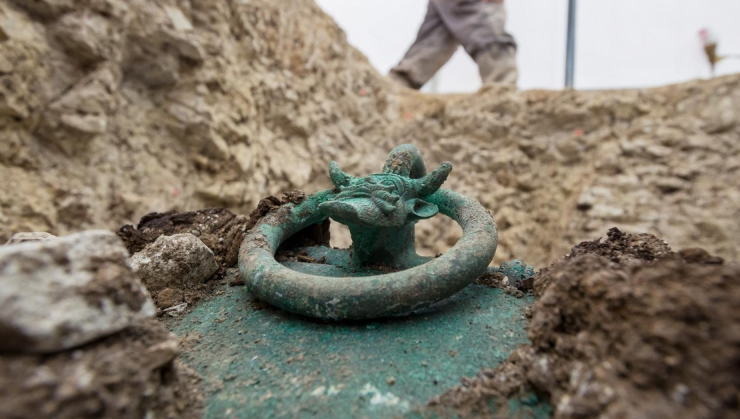
Photo by Denis Gliksman, Inrap.
See International Business Times link below.

After finding well-preserved Greek and Etruscan artefacts, the French state ordered a more detailed exploration of the area. The archaeologists ended up discovering beautiful artefacts from the 5th century BCE, starting with a bronze cauldron ornamented with the head of the god Dionysus.

The remains of the prince were found a little later laid out on his chariot. The skeleton was still wearing the same fine golden jewellery he was buried with.

This was considered to be the most important archaeological discovery made in France in recent decades - comparable to the 1953s discovery of the cave belonging to the so-called "Lady of Vix."

To see more photos and read more about that, here is the link.

http://www.ibtimes.co.uk/lavau-celtic-prince-2500-year-old-royal-tomb-starts-reveal-its-secrets-1623933

---

Photo from the Greek Reporter.
See link below.

The remains of ancient coastal structures and a port, a large number of shipwrecks dating back to various eras and significant smaller finds were found in underwater archaeological excavations conducted by the Ephorate of Underwater Antiquities at the island of Delos from May 2 until May 20, the Culture and Sports Ministry announced on Monday....

Here is that link.

http://greece.greekreporter.com/2017/05/30/culture-and-sports-ministry-significant-finds-from-underwater-excavation-at-delos/

---

Here is the abstract from article published in Frontiers of Psychology (2015; 6: 1615) that looks at the cognitive processes of evaluating and assimilating various types of evidence to locate shipwrecks.

The research described in the present article was implemented to define the locations of two World War II shipwrecks, the German raider Kormoran, and the Australian light cruiser HMAS Sydney. The paper describes the long and complex trail that led through inefficient oceanographic prediction to ambiguous historical prediction involving a single report and on to precise cognitive prediction based on nine reports from more than 70 survivors, a process that yielded a single target position or “mean” just 2.7 NM (nautical miles) from the wreck of Kormoran. Prediction for the position of the wreck of Sydney opened with wishful thinking that she had somehow reached the coast more than 100 NM away when cognitive analysis of the survivor's reports actually provided the basis for accurate prediction in a position near to the wreck of Kormoran. In the account provided below, the focus on cognitive procedures emerged from, first, a review of a sample of the shipwreck hunts, and, second, growing awareness of the extraordinarily rich database available for this search, and the extent to which it was open to cognitive analysis. This review touches on both the trans-disciplinary and the cognitive or intra-disciplinary issues that so challenged the political entities responsible for supervising of the search for the wrecks of Kormoran and Sydney. One of the theoretical questions that emerged from these debate concerns the model of expertise advanced by Collins (). The decomposability of alleged forms of expertise is revealed as a fundamental problem for research projects that might or might not benefit from trans-disciplinary research. Where expertise can be decomposed for operational purposes, the traditional dividing lines between experts and novices, and fools for that matter, are much harder to discern, and require advanced and scientifically informed review.

Here is the link to that academic article. (Another one that isn't light reading.)

https://www.ncbi.nlm.nih.gov/pmc/articles/PMC4623394/

---

We've been having a south wind.  Its really hot now.  Still we have a small surf along the Treasure Coast.  The tides are moderate.

Happy hunting,
TreasureGuide@comcast.net

Tuesday, March 18, 2014

3/18/14 Report - Mini Sub, Small Unidentified Objects, What To Know About GPS Enabled Camera Images & Modern Pirates


Written by the TreasureGuide for the exclusive use of treasurebeachesreport.blogspot.com.

Spy Master One Man Mini Sub
http://www.spycatcheronline.co.uk/one-man-mini-sub.html

Here is a nifty device that will allow you to scooter around underwater.

It is the Spy Master mini sub.

Here is the link for more information.

http://www.spycatcheronline.co.uk/one-man-mini-sub.html


I like finding very small items.  I know if I am finding the smalls, larger items will be easy enough.  It also tells you that you are using your detector effectively.

Here are some of the small items I found in a grouping on a beach.  They weren't exactly close, but they only were found in a relatively small patch.

I saw another detectorist pass through the patch without seeming to detect them.

A Few Of Several Small Bits of Metal Detected On A Beach.
I haven't identified the metal yet.  They are heavy, not magnetic and could be lead, but I haven't finished testing yet.

Those, of course, will slip right through a scoop and will test your vision as well as your detecting.

If you find a good patch of dense metal items it is worth checking the area very well.

I have found gold in with concentrations of lead enough times to make it worth double checking.

Yesterday I showed a gold nugget that was found on a shipwreck beach in the same area as these items.


Speaking of neat technologies, did you know that if you use a smart phone or other GPS enabled camera, it can keep a record of where the photo was taken.  That can be handy for future reference, but if you want to share your photos on the web and do not want anyone to be able to determine the exact location where the photo was taken, you should know that that information can be included in the image file.   Concerning that,  Bill M. sent me an email.  Here is what he said.

, ... Photos uploaded to the web can sometimes give the exact GPS location of where the photo was taken.

Just today I found an example of someone who posted a photo of a metal detector find, and unbeknownst to the person who uploaded it, that photo included the exact GPS location of where the item was found.

...I checked the photos you've posted at Treasure Beaches Report, and they only show that the photos were from the Picassa album.  But no other details are shown.

Still, you have to be careful, especially when shooting photos of locations that you might want to keep secret.

 Thanks for the reminder Bill.

I don't directly upload image files that I receive without doing some conversion first.

If you want to find out what information is stored with photo and video images from smart phones and GPS enabled cameras you should check out the file properties.  That will show you what data is stored with the photo.  If you find anything that you don't want to be included with the photo, such as the GPS coordinates, you can remove that data.

This web site will show you how to remove unwanted data.

http://howto.cnet.com/8301-11310_39-20072723-285/how-to-remove-personal-data-from-image-files/


Navy Seals captured a pirated oil tanker.  There are still pirates.

http://www.nytimes.com/2014/03/18/world/middleeast/libya-oil-tanker.html?hp&_r=0


The surf is still small on the Treasure Coast.  Last night the wind was blowing pretty strong form the West.

The surf is predicted to increase in a day or two but not by a huge amount.

Happy hunting,
TreasureGuide@comcast.net