Showing posts with label two sides. Show all posts

Saturday, September 10, 2016

9/10/16 Report - Three Tropical Disturbances. One Very Near and One Heading This way. Cob With Two Very Different Sides. Scarce Half Reales.


Written by the TreasureGuide for the exclusive use of treasurebeachesreport.blogspot.com.


Source: nola.com
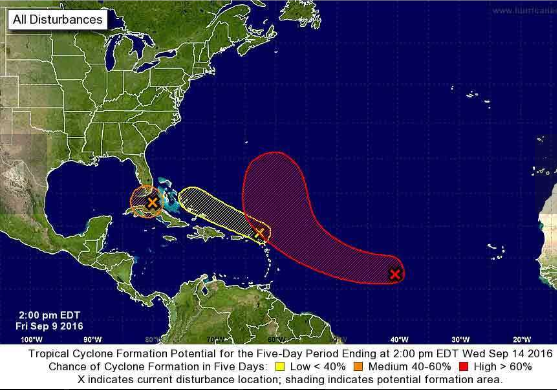
We have three systems to watch now.  The one that shows the most immediate potential (red) seems to be heading well out to sea.  That could change, of course.

The system shown in yellow appears to be heading right at us.  It has a 10%  chance of becoming a cyclone in the next two days .Of course, it could strengthen.

The one just south of us an north of Cuba has a 20% chance of becoming a cyclone in the two few days.

That is a lot of nearby action.  It could get interesting very soon.

---

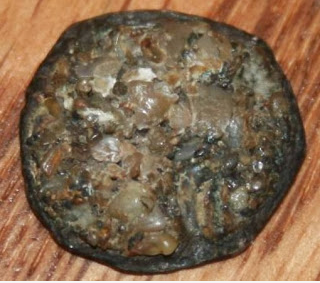
Yesterday I was talking about cobs that have much better detail on one side than the other.  Here is an example that came from Jupiter Beach.  The crust shown below was very hard and fused to the surface. It was nearly impossible to remove mechanically.

Half Reale Showing Crust Covered Side As Found.
Below is the other side of the same cob.

Same Half Reale As Found .
Due to lighting, the side shown immediately above had even less corrosion than appears to be the case in the picture.  Yet the details on this side were not much better than what is shown above.  That is pretty much how it looked after cleaning.

Below is the crust-covered side after the crust was removed using Muriatic acid.  Very sharp details - almost like mint I would think.  The other side was not nearly that nice.

Crusty Side After Cleaning.
Other cobs show no detail on one side and near complete detail on the other.  I might show an example of that in a day or two.

---

Here is a interesting paragraph from Odyssey Marine Paper 30.

As stated, an initial study of the Tortugas shipwreck’s silver coins lists a single ½ reale coin from the Mexico mint (Flow, 1999: 88), but the report contains no corroborating photograph. Although ½ and ¼ reale denominations were produced intermittently throughout the Spanish Colonial period, there is no record of either having been recovered from the Nuestra SeƱora de Atocha or the Santa Margarita. If the attribution is not erroneous (bearing in mind the potential for substantial metallic erosion within the marine environment), and a single ½ reale coin was indeed recovered from the Tortugas shipwreck, like most of the gold coins on these shipwrecks it would have functioned as the pocket money of an individual and would be one of the most rare coins in the 1622 collections.

---

There are definitely a couple weather systems that could affect us now.

Happy hunting,
TreasureGuide@comcast.net

Friday, September 9, 2016

9/9/16 Report - Two Systems Hurricane Trackers Are Watching. Deep Sea Fishing Effects On Shipwrecks. Cobs With One Good and One Bad Side.


Written by the TreasureGuide for the exclusive use of treasurebeachesreport.blogspot.com.

Two Atlantic Disturbances To Watch.

As you can see there are now two systems that we need to watch, both of which seem to be headed to the east of the Treasure Coast.

The second (red) has a higher chance of becoming a cyclone in the next couple of days.

Both of these could bring us some north/northeast winds.  There is no big increase in surf predicted yet.  In fact the predictions are showing mostly a two-foot surf for the next few days.

---

You might think that deep sea wrecks rest undisturbed.  That is not usually the case.  Various types of fishing trawlers and things rake through wreck sites, scattering the remains and breaking artifacts.

Many pictures and examples are shown in an Odyssey Marine study.

One of Many Pictures Showing Effects of Deep Sea Fishing.
Here is the link.

http://www.shipwreck.net/pdf/OMEPapers4Final_000.pdf

---

In recent weeks I've talked about cobs found as a cache that were in remarkable condition.  Many cobs found on a beach will be very much corroded and some will be so corroded that it is difficult or impossible to tell for sure what they are.

In the past I've found some cobs that were in very good or excellent condition on one side and very poor condition on the other side.

Below is a grading system used in one Odyssey Marine paper.

Grade One coins display little or no visible ocean wear, show little or no roughness or pitting, and, therefore, look much as they did when new. Both sides are in Very Good to Excellent condition and the obverse and reverse features resulting from the original strike are defined and easily identifiable.

Grade Two coins were partly exposed to the elements. The coin may not be completely intact or it may look more ‘sand-blasted’ than a Grade One, but the quality is still Good and most of the features resulting from the original strike are easily identifiable.

Grade Three coins are in Fair overall condition, but ocean wear is very apparent. Many Grade Three coins were typically located on the outer layer of a shipping chest and, therefore, the side of the coin that faced into the chest will be of Grade One or Grade Two quality. The opposite side, exposed to the elements following the wooden chest’s deterioration, is completely worn away. Other Grade Three coins might incorporate ocean wear distributed across both sides of the coin. On Grade Three coins, obverse and/or reverse sides will still offer easily identifiable characteristics that have definition.

Grade Four coins are still identifiable as Spanish Colonial coins, but they have been subject to much wear and tear and the markings are faint and have little or no definition.

Grade Five coins are just above a fragment in quality, but can still be identified as a coin taking into consideration factors such as shape and provenience. • A Fragment is a piece of silver recovered among concentrations of coins, but with no markings to identify it as a coin.


Here is the link for that source.

http://www.shipwreck.net/pdf/OMEPapers30-2013_001.pdf

They talk about one way that cobs end up being good on one side and poor on another side. They are referring to cobs that were salvaged from the sea and probably never spent any time on a beach.

One cob I'm reminded of was found on a beach and appeared to have been just washed out of the dunes.  It had a sand and shell crust covering one side.  That side was not visible at all because of the crust when it was dug.  The other side was not covered and displayed fairly good detail.

When the sand/shell crust was removed, that side then showed remarkable detail - much better than the exposed side.  The crust protected that surface of the cob, while the other side was worn down by washing around on the beach.

I'm not certain why one side was covered with a crust while the other side wasn't.  I do believe that that cob spent many years in the dunes.

How a cob corrodes can depend upon what it is next to.or touches.  I once did a couple of posts on surface analysis of cobs and talked about galvanic corrosion.

You can go to the following post to read about that.

http://treasurebeachesreport.blogspot.com/search?q=surface+analysis

---

Happy hunting,
TreasureGuide@comcast.net

Monday, September 23, 2013

9/23/13 Report - Why Do The Two Sides of One Coin Sometimes Corrode So Differently? Florida State Parks & More


Written by the TreasureGuide for the exclusive use of treasurebeachesreport.blogspot.com.

Big One Penny

I dug this big Queen Elizabeth penny the other day.  It isn't old, only 1967, which is only four years off of what the state considers to be a historic artifact, as simple as that might sound.  It isn't valuable by any sense of the imagination.  In the online references it is listed as bronze.

When I first dug it up I thought it was a half dollar.  I couldn't see the other side at all and didn't take the time to really look at it very good.  I just tucked it away thinking it was probably a half dollar.

The reason I mention it is because the two sides of the penny were very different.  I'm not talking about design but the patina and corrosion.

The side you see in the photo is basically how it looked when it was dug.  The opposite side though, was covered with a thick green crust that obscured all of the coin.

Why would two sides of the same coin look so different?   That was my question.

I've seen a similar thing happen before.  I saw it on a half reale that was dug down at Jupiter some years ago.

That half reale is shown below.

Dug Half Reale With Sand/Shell Crust

Different metals corrode differently and you can often tell something of the composition of the coin by how it corrodes.  Copper and bronze will often have some green on them, like the penny above had.

This half reale though just had a crust of sand and shell on one side and the typical black appearance of a sea seasoned cob on the other. 

When the cob was dug I could easily see the cross etc. on the other side.


You can see the other side pretty much as it was dug below.  There is some crust on the other side, but very little as compared to the side shown above.

Other Side of Same Half Reale
It is possible that the heavy crust only accumulated on one side and not the other.  Or I guess it is possible that there was a heavy crust on both sides but the crust on one side was worn off after the cob got uncovered.

I think the first theory is most likely.  I think that the very heavy crust was formed on one side maybe because of how the cob was positioned for all those years.


The heavy crust turned out to be a benefit because it kept the detail of the cob from being worn down.

See photo below showing detail revealed when the heavy crust was removed by acid.

Like I said, the bronze penny also had two very different sides.  The one side had a heavy green crust while the other side is as shown above.

Unfortunately  I didn't think to take a photo of the green crust before I removed it.

Same Half Reale Showing Detail Preserved by Crust.
Another possibility besides one side reacting differently because of its buried position, or the surface being cleaned by movement of sand and water after being eroded out of the bank, is that the coin or cob could have been buried next to something that protected it either physically or electrogalvanically.

What is your idea?

Here is a photo of the half reale showing the side that was heavily encrusted after the crust was removed.  Notice how well the heavy crust protected the cobs surface and preserved the detail.


..................................................................................

I believe that the cobs that were recently found and shown in this blog were actually pushed up onto the beach weeks ago, not recently.  From the circumstances, William thinks that might well be right.

I also felt that was true of some of my recent finds.  

If you hunt the over hunted places, you won't find things like that, but they can remain for a long time after washing up in locations that are less frequently hunted.

.........................................................................................

I just just read yesterday somewhere that Sebastian Inlet State Park is the second most visited state park in Florida.  That is quite a distinction.   The McClarty Museum is part of that.

 Right off I don't know which is first most visited.

Here is a link that will introduce you to all of Florida's State parks.

http://www.floridastateparks.org/thingstodo/default.cfm

Which have you been to?

An Audubon Society report said the following.   Florida’s park visitors provide a critical economic boost in the communities where they are located – and that’s more important now than ever. For every 1,000 people attending a state park, the total direct impact on the local community is more than $43,000, a 2008 DEP study found. 


Trying to find out which was the most visisted, I found a 2012 listing in HolidayTripper that didn't have the same order.  Here is what they had.

The most visited state parks in order are:
  • Honeymoon Island State Park, Dunedin
  • Gasparilla Island State Park, Boca Grande
  • St. Andrews State Park, Panama City Beach
  • Lovers Key State Park, Fort Myers Beach
  • John Pennekamp Coral Reef State Park, Key Largo
  • Anastasia State Park, St. Augustine
  • Bill Baggs Cape Florida State Park, Key Biscayne
  • Sebastian Inlet State Park, Melbourne Beach
  • Stump Pass Beach State Park, Englewood
  • Bahia Honda State Park, Big Pine Key

After researching some more I found that Honeymoon Island consistently shows up as number one.  I've seen different things for Sebastian Inlet, but is always listed among the top few.

How many of those have you detected?  I can only list three.  There is one on there that I detected many more times than Sebastian.  I've mentioned it in past posts.


Low tide on the Treasure Coast will be around 5:30 PM today.

We'll be having a 1 - 2 foot surf for a few days.

Happy hunting,
TreasureGuide@comcast.net