Showing posts with label silver reale. Show all posts

Wednesday, October 9, 2019

10/9/19 Report - Mystery of the Strange Looking Coin. Sedwick Auction. Observations on Several of the Metal Detectors I've Used.


Written by the TreasureGuide for the exclusive use of treasurebeachesreport.blogspot.com.

Interesting Lot in the Current Sedwick Auction Catalog.
Take a look at the above item.  What do you think it is?  Looks strange, doesn't it?

I was looking through the current Sedwick auction catalog and noticed the item shown above.  It is referred to as an "imitation cob."   Below is the lot description.

Caracas, Venezuela, 2 reales "imitation cob," date as 142 date (early 1800s), struck over a Spanish bust 2R (milled edge), rare, NGC XF 40. ,KM-C13.1. Well-centered pillars, off-center cross (with often off-the-flan M visible to right), faint toning around details, but most important aspect is that the edge shows traces of the rectangle-circle milling from a bust 2R (first we have seen). NGC #4841431-006.

So it looks like somebody for some reason turned a milled Spanish 2 reale into a fake cob, and didn't do a very good job of it.  The elements on the coin are very crude.  Was it made to fool people?  Maybe it was just somebody fooling around.  The date doesn't make sense at all.  There is a story behind that, but I can only wonder what it is.

Here is the link to the imitation cob.  


There is another imitation cob in the catalog that is very much like the one shown above.

Here is the link to the Sedwick auction site.  

https://auction.sedwickcoins.com/auctionlist.aspx

You need to register to bid.

Among the more interesting pieces, in my opinion, were the gold finger bars.  The finger bars had some of the highest auction estimates of the entire auction.  They were in the third session.   Look around lot 80 or 81.

I really think there will be a lot of reales that don't sell.    There is something for everybody though.

----

I wanted to rank the metal detectors that I've owned and used over the years.  I found out it wasn't easy to do that.  There are a lot of factors.

This isn't an objective ranking or comparison.

My favorites though are the Noga and MacDonald modified Nautilus detectors.  They were excellent at finding gold on the beaches and in the water.  That is what they were made for.  They nulled on iron, which I liked.   If I'd been hunting relics instead of gold at the time, it would have been a different story.  But they worked very well for what I was doing at the time, and back then I was doing it a lot and had a lot of success with it.  One story that I recall and that illustrates how those detectors worked, was when I detected a small gold bead very near the access at Turtle Trail.  I could easily detect the bead, but I could find it.  I put a handful of sand containing the bead on the coil and still couldn't see the bead.  I moved the sand around and the detector gave a signal.  The sand was course and a color that matched closely to that of the bead, but I eventually found the bead.

Herb claimed his detectors were better than the Noga ones, but I'm not sure that was true.

I know some of the coils for those detectors were hotter than others.

They were very easy to set up and use because they were made for one type of hunting and didn't require or allow much adjustment.

The reason it is so difficult to rank the detectors, is that most of them have things that I like and find very effective, but also negatives.

I'd tend to rank the Garrett GTX second among those I've owned, but it is very heavy, difficult to learn to use well, and loves iron.  Those sound might sound like serious problems, but when you learn to use it and if you aren't bothered much by trash, it is a powerful detector.  I have confidence that I won't miss much of anything with that detector.

Of course the best detector for you always depends upon what you want to do with it, and your style and even your personality.  There are some people who would never ever use the GTX.

In the middle of the pack are many others.  High in the middle of the pack I'd put the other Minelab detectors that I've owned, including the Excalibur and Sovereign.  

I used the Excalibur for several years.  It worked well, but I used it differently than most people.  I always used the pinpoint rather than the discrimination mode.  If I'd been able to get either the Noga or MacDonald detectors at that point, I would have been using them.

I'd rank the Fisher 1280 right up there with the Excalibur.   I used the 1280 a lot and found a lot with it.  It was a good detector and very reliable.  I eventually sold it for about as much as I bought it for.  Long before I sold it, I found enough coins to more than pay for it, not counting any jewelry.  I was keeping good records at the time and knew exactly when my coin finds went over the purchase price, which, if I correctly recall, was about $640.

The 1280 was also the detector that found my first silver and gold rings.  One of the things I learned while using that detector is the danger of using too much discrimination.  Overall, it was one of my favorites.

Maybe I rank it higher because it was the detector that I learned a lot from and it found me a lot in my early days of metal detecting.

I'd rank the Royal Sabre after that.  For such an old detector, it has a lot of nice features, but it I'd use it in dry sand or dry land only.

Then maybe the Stringray.   I had trouble with the Tesoro Stingray from the beginning.  I sent it back about three times and it was returned with the same problem.  They wanted to blame it on underwater cables or something in the area, so I told them to send me another one to try in place of the original one to see if it was the location or the detector's fault.   The replacement detector worked fine.  The original Stingray had a grounding problem and the replacement was hardwired.  

When I eventually sent the replacement in for repairs years later, they said it wasn't under warranty because it had been modified.  That is one way for them to get out of their Lifetime Warranty, but they should have had records showing it was the detector as I received it from them. 

When it worked, it was not the deepest seeking detector, but was good at detecting small gold.  It was never anything other than a back-up detector for me.

After that I can't say much good about the other metal detectors.  I probably didn't know enough about the White's CoinMaster to rank it fairly.  The same might also be the case for the Garrett pulse detector.  So I won't say much negative about them.  I know the CoinMaster didn't get a fair chance.  I just didn't know much about metal detectors or metal detecting when I had that one.

I know there metal detectors out there that might be better.  I'm just reporting my observations and feelings on some that I've owned and used.  The ranking is scientific and it isn't objective, but some of you might find my observations somewhat useful anyhow.

I didn't include anything about the Equinox today.  I plan on doing more precise testing on it.  So far I like it a lot.  It seems like an effective detector that could be useful in many situations.  Right now I'd rank it above the Excalibur and in some ways above the GTX.  I don't want to say much more about it yet, but it looks like I will be using it a lot in the future.

---

The surf is going to be about 3 - 4 feet for a couple days.  I'm not expecting much change to the beaches for a while.

Happy hunting,
TreasureGuide@comcast.net


Minelab Equinox. 
I'm just leaning the Equinox, but it appears to be an easy to use and adequate metal detector for a variety of situations.   I expected the visual displays to be more useful, so that was a bit of a disappointment.  You can avoid trash, but in the process can miss a lot of good targets.

Tuesday, September 24, 2019

9/24/19 Report - Using Target ID Numbers. Three Tropical Storms. Green Cabin Wreck Coin.


Written by the TreasureGuide for the exclusive use of treasurebeachesreport.blogspot.com.

Three Tropical Storms.
Source: nhc.noaa.gov
Now we have three tropical storms in the Atlantic: Jerry, Karen, and Lorenzo.  None are supposed to come our way.  Also there is a little system down by the Yucatan.

---

It appears that the Mexican reale found after Dorian and said to be found near the Disney resort came from the Green Cabin wreck - the 1618 wreck of the San Martin.  I think that is what the certificate issued by the West Bay Trading Company says.  It also must say that the coin is from the late 1500s.  I can't really read it all.

Coin Certificate
Photo submitted by Kenneth T.
Somebody recently asked me how to get an artifact certified.   I didn't know that the West Bay Trading Company issued certificates, and I still don't know if they would certify a dug artifact.

Many of the certificates of authenticity that you see on eBay or similar sites are made by whoever is selling the item and are worth no more than the reputation of the person or company that issues them.

You might remember that I mentioned people parking along the road and going to the beach between Wabasso and Seagrape Trail right after Dorian.

---

I've been informally field testing the target ID readings on the Equinox metal detector and trying to determine the usefulness of the numbers. I have concluded that you can NOT safely decide whether to dig or not just on the basis of the ID meter readings - at least not if you do not want to miss something good.  The readings do seem to provide some information though.  I am still very much in the dig it up and look at it camp, but I also understand that some people hate to dig trash and aren't bothered by what they  might have missed.

Joe D. has commented on the usefulness of using the signal tones of the Equinox, and I've observed that you can really reduce the amount of junk (defined as non-coins) you dig by using the tones alone.

Here is a section from the Equinox Manual, which you can find online.

Source: online Equinox manual.
Notice that "Aluminum, Gold" is in the 11 - 20 range, which is also where you'll find nickels, pull tabs and bottle caps.  Also tiny gold nuggets, gold nuggets and larger gold nuggets range from close to 1 up to about 30.  That is a huge range and very much agrees with some YouTube videos showing that gold rings can show up almost anywhere on the scale.

Providing some information (in other words, increasing the probability of a correct ID) the ID numbers can be more useful when combined with other sources of information.

Lets take one other source of information - information about the site itself.   Targets are not randomly distributed, and you can make good use of whatever information you have acquired about a site.  For example, many sites have one or two prominent types of junk.  It might be nails or pull tabs or bottle caps.  But that information, when combined with the target ID numbers can be useful.

Lets say you are finding a number of bottle caps of a particular type.  They might show as a narrow range of target ID numbers -  lets say 21/22, for example.  Some pennies will produce those numbers too, but pennies are of low value, so it is no big deal to miss some of those.  After you have found a few bottle caps showing as 21/22, and you conclude you are in an area where those types of items are common, the probability is greater that when you do not dig a 21/22 item, that you will be missing a bottle cap, or at least something not real valuable.   The likelihood of a correct rejection has been increased by combining your the target ID number with your knowledge of the most probable targets in that area.  Furthermore, if you can gain additional knowledge from the audio signal, such as a dual tone, which you can get with some kinds of bottle caps.   That additional information can also help you increase the probability of a correct target ID.

There are a variety of other types of information that you could and perhaps should use, but I could go on for a very long time about that.  The point is that combining different types of sources of information can help you improve your target ID and improve the probability of a correct dig or reject decision.  Notice that I said "probability."  You won't be completely accurate every time.  There is still the possibility of making a big mistake.  How comfortable you are with that will have a lot to do with your strategy.

Unfortunately I've forgotten most of what I once knew about probability theory and statistics so I can only talk about this in general terms now.

Knowledge of different sites can be very helpful.  You have closer to a random distribution of targets in the dry sand, however the distribution in dry sand is still far from random.  More targets will be lost where there is more activity, such as volley ball courts, and of course, there will generally be more targets where there are more people, and the targets will be more valuable where there are more wealthy people, and there will be more gold where people from certain cultures assemble, etc., etc.

In the wet sand the target distribution is determined more by the forces of nature.  Of course human and socio-cultural factors are also involved, but there are definite patterns that can be discerned.  I've talked about those a lot in the past.  The bottom line is that you can improved your pre-dig target ID by using a variety of sources of information.

One additional note: although I'm talking about the Equinox, you can generalize to other similar metal detectors that provide target ID numbers.

---

The surf will be decreasing for a few days.  That can allow you to get out into ground that you haven't been able to metal detect for a while.

Happy hunting,
Treasureguide@comcast.net

Saturday, November 3, 2018

11/3/18 Report - $100,000 Gold Coin and $70,000 Silver Cob. Old Auto Frame on Vero Beach Used by Detectorists in Years Past. Man Saves Whale.


Written by the TreasureGuide for the exclusive use of treasurebeachesreport.blogspot.com.

Source: Sedwick Coins Treasure Auction # 24.

You might be surprised to learn that the coin that received the highest bid in the first session of the current Sedwick Coins Treasure Auction wasn't from the Atocha, Margarita, 1715 Fleet or any famous shipwreck: it was a 20th century 50-peso coin from Cuba.

Here is part of the auction description.

Cuba (struck at the Philadelphia mint), specimen 20 pesos, 1915, unique, NGC SP 63, finest and only known in NGC and PCGS censuses. KM-21; Fr-1. Struck on a special planchet with higher rims and smoother fields, the resulting (prooflike) luster a treat to behold, perhaps missing a higher NGC grade for a couple tiny rim-nicks on the reverse but at least recognized for its specimen status. NGC #4499455-006. 

The winning bid was $110,000, not counting the buyer's premium.

Other Cuba coins of the same period also did extremely well.

In the second session (silver cobs) there was one coin that stood out head and shoulders above all others.  The winning bid of that lot was $70,000.  The cob, shown below, is an experimental three reale in the Early Series.

Source: Sedwick Coins Auction # 24.
Here is the lot description.

Mexico City, Mexico, 3 reales, Charles-Joanna, "Early Series," assayer R (Rincon) at bottom between pillars, with waves, three-dots denomination, all-Gothic lettering except O, NGC VF 30, finest and only example in NGC and PCGS censuses, ex-Rudman. Nesmith-5b/5; CT-unl; S-M1. 9.74 grams. A classic and highly important issue, this is the first of the experimental 3-reales denomination (see article below), and it is arguably the finest in style, making for a very attractive and artistic design. It is also among the earliest coinage of this mint and the entire New World. The presence of water lines (“waves”) below the pillars is a feature that does not return until the “Late Series” a few years later. Exceptionally broad flan with full details, lovely toning and choice strike, one of only two problem-free examples known of this extremely rare and mysterious "with-waves" variety (the other impounded in the Banco de Mexico collection), worthy of inclusion in the finest of collections.

Some Boliva reales, a heart-shaped cob and some Panama cobs also did well in the same session, but nothing close to the above cob.

Some people aren't much interested in auction results, but I think it is good to browse the auctions so you know something about the various types of treasures that are out there in the world and what makes some more valuable than others.  You can learn a lot by looking through the auction catalogs and listings.

The final live sessions of the auction will conclude today.  You can watch the bidding online.

---

Mitch King wrote concerning the picture at the top of yesterday's post.

I know right where that picture was taken. For years we used that car as 
a gauge for how much sand was on the beach. That car sank down several
feet thru the years. Then the car was visible the chance of finding
silver coinage was very good. The car remained there till sometime after
the 2004 hurricanes when I believe it was removed. The location is just
south of Humiston park in Vero beach. If you look in the back ground you
can see the street drain pipe that is extending into the ocean. The
reddish building at the top is where the old "Crab Shack" was. There is
a whole new building there now constructed after the 2004 hurricane season.


Thanks Mitch. I remember seeing the frames there myself. ---- I just saw a rerun of the Oak Island Curse TV show. I noticed once again that the spike given to Lori, the art historian, was clearly not the same one that she showed when she returned with her verdict.  If you want to compare them for yourself, take a good look at the head of the spike(s).

---

Fisherman saves humpback whale.

https://www.nbcbayarea.com/news/local/Fishermans-Rescue-of-Entangled-Whale-Caught-on-Camera-499221291.html

---

.

Another Fall front came through yesterday.  In my opinion, the nice cool weather is excellent for walking the beaches.  

We are going to have some nice high tides.  We have northeast winds now, and even though the surf is not supposed to be very big, I'm betting there are a few small cuts around the Treasure Coast.

Happy hunting,
Treasureguide@comcast.net

Sunday, September 11, 2016

9/11/16 Report - Oldest Multi-Year European Settlement in North America Found. Two Sides of the Same Cob and What's That Mark.


Written by the TreasureGuide for the exclusive use of treasurebeachesreport.blogspot.com.

Source: nhc.noaa.gov

We have one disturbance that seems to be headed this way, but it will probably not become much of anything.

The surfing web sites aren't predicting anything much bigger than a three foot surf for the Treasure Coast for the next couple of weeks.

---

The search is over. The longstanding mystery is solved. The location of the oldest established European multi-year settlement in the United States is indeed in the heart of Pensacola.

Discoveries by local historian Tom Garner in October and research afterward by University of West Florida archaeologists confirmed where Don Tristan de Luna established his Spanish colony in August 1559 – six years before the St. Augustine settlement and nearly 48 years before the English settled in Jamestown, Va.

The historical site is in an urban downtown neighborhood within view of the two shipwrecks linked to the Luna expedition in Pensacola Bay. UWF declined to reveal the exact location to protect the neighborhood and integrity of the site...

Here is the link.

http://www.pnj.com/story/news/2015/12/17/we-found-lunas-colony/77449884/


---

Yesterday I showed a silver cob with one side that was much better than the other.  Here is a cob that on one side shows some detail, even though it is heavily corroded, while the other side shows no detail.

Potosi Two-Reale, Assayer R.
Other Side of Same Reale
As you can see, the second side has been wiped clean like a Clinton server.

An Odyssey paper that I referred to the other day, mentioned that cobs found on the outside of a conglomerate, corrode more than those that were on the inside of a conglomerate.  I suspect that the same thing might be true of the two side of a cob.  One side would be exposed, while the other side would be more protected.

As I also mentioned recently, galvanic corrosion might also be a factor.

On the same cob, I've been wondering about the little bulls-eye shown in the picture below.  The red arrow points to it.


Anyone have any thoughts or ideas about that?   I'd like to hear what you think.

Note the touch of iron to the right of the bulls-eye where iron leached onto the cob.

---

Of course the big news today is the fifteenth anniversary of the 911 disasters.  It doesn't seem that long ago.

TreasureGuide@comcast.net

Saturday, September 10, 2016

9/10/16 Report - Three Tropical Disturbances. One Very Near and One Heading This way. Cob With Two Very Different Sides. Scarce Half Reales.


Written by the TreasureGuide for the exclusive use of treasurebeachesreport.blogspot.com.


Source: nola.com
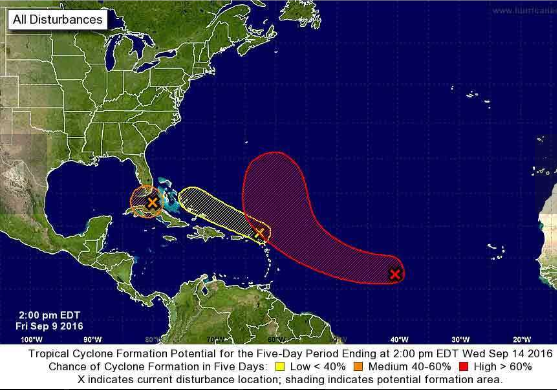
We have three systems to watch now.  The one that shows the most immediate potential (red) seems to be heading well out to sea.  That could change, of course.

The system shown in yellow appears to be heading right at us.  It has a 10%  chance of becoming a cyclone in the next two days .Of course, it could strengthen.

The one just south of us an north of Cuba has a 20% chance of becoming a cyclone in the two few days.

That is a lot of nearby action.  It could get interesting very soon.

---

Yesterday I was talking about cobs that have much better detail on one side than the other.  Here is an example that came from Jupiter Beach.  The crust shown below was very hard and fused to the surface. It was nearly impossible to remove mechanically.

Half Reale Showing Crust Covered Side As Found.
Below is the other side of the same cob.

Same Half Reale As Found .
Due to lighting, the side shown immediately above had even less corrosion than appears to be the case in the picture.  Yet the details on this side were not much better than what is shown above.  That is pretty much how it looked after cleaning.

Below is the crust-covered side after the crust was removed using Muriatic acid.  Very sharp details - almost like mint I would think.  The other side was not nearly that nice.

Crusty Side After Cleaning.
Other cobs show no detail on one side and near complete detail on the other.  I might show an example of that in a day or two.

---

Here is a interesting paragraph from Odyssey Marine Paper 30.

As stated, an initial study of the Tortugas shipwreck’s silver coins lists a single ½ reale coin from the Mexico mint (Flow, 1999: 88), but the report contains no corroborating photograph. Although ½ and ¼ reale denominations were produced intermittently throughout the Spanish Colonial period, there is no record of either having been recovered from the Nuestra Señora de Atocha or the Santa Margarita. If the attribution is not erroneous (bearing in mind the potential for substantial metallic erosion within the marine environment), and a single ½ reale coin was indeed recovered from the Tortugas shipwreck, like most of the gold coins on these shipwrecks it would have functioned as the pocket money of an individual and would be one of the most rare coins in the 1622 collections.

---

There are definitely a couple weather systems that could affect us now.

Happy hunting,
TreasureGuide@comcast.net

Monday, June 23, 2014

6/23/14 Report - Attempting To Identify A Reale Found On The Green Cabin Wreck Site


Written by the TreasureGuide for the exclusive use of treasurebeacheserport.blogspot.com.


Picture From Sewall Menzel's
Cobs, Pieces of Eight and Treasure Coins

Yesterday I showed a picture of a reale found by the crew of the Capitana at the Green Cabin Wreck site. It is also shown in the picture below.

The first picture shown here is a very similar reale to the one that was recently found.  It is shown by Sewall Menzel in his book, Cobs, Pieces of Eight, and Treasure Coins.

This isn't the most simple case for identification.  I would guess it is a Potosi coin, and it would have to date before 1653, which is when Potosi starting using the pillars and waves design.

Notice the mint and assayer marks (PR) to the left of  the shield.  The mint would most likely be Potosi, and the R would be the initial of the assayer, Alonso Rincon.  If that is true, the date would be between 1573 and 1576.  That is a very early cob.


Reale Found by The Capitana Crew On The Green Cabin Wreck.


The found cob does not show the denomination, which would be marked to the right of the shield.

 The crown of the found cob matches that of the Menzel example very well, but the R is a bit different.

The shield of the found cob also matches the Menzel example very well.

If you can correct me on any of this, please do so.


I have a lot more to post today but don't have time to get it posted.  I will end there today with this short post and hopefully get to the other stuff tomorrow.

Happy hunting,
TreasureGuide@comcast.net