Saturday, March 19, 2016

3/19/16 Report - Two Great Treasure Finds and Why I Dig Pennies.


Written by the TreasureGuide for the exclusive use of treasurebeachesreport.blogspot.com.

Silver Dragon Handle of Some Sort
Find and photo by John C.
John C. found this great silver dragon handle on the Treasure Coast not too long ago.  That is one very nice find.  He also found this really nice silver buckle shown below.

Ornate Silver Buckle
Find and photo by John C.
Thanks for sharing these great finds John!

---

 A penny is a penny is a penny.  That might be true for some but not for me.

A penny might be zinc or copper.  It might be new or old.  It might be recently lost, or lost a long time ago.

There are error pennies and rare pennies that can be worth more than a gold ring.

Pennies can provide good information that will lead you to a real hot spot.  I look for the spots that produce concentrations of high value targets and don't spend much time where there are a lot of recently lost new pennies.

Some are obviously lost very recently.  Others show corrosion and the wear of time.  That can provide important information that will point you towards better things.

Pennies can define the boundaries of what I call coin holes.  If you know that and take whatever other information a penny might give you, it can definitely point you to the real hot spots.

Zinc pennies travel faster than copper pennies.  Zinc pennies will therefore tend to be farther away from the source than copper pennies.  That will point you in the direction of the source of the coins.

Zinc pennies will tend to be more on the outer boundaries of coin holes.  Coin holes produce more than coins.  Gold found in coin holes will generally be towards the middle of a coin hole, while pennies will be on the outer edges.  Again, pennies can help point you in the right direction.  Quarters will be closer to the center of a coin hole, and closer to where more gold will be found.

Zinc pennies that are badly corroded or other coins that show evidence of having been in the water tells you something about how the sand and other objects are moving, and that helps point you to the areas where more good targets will be found.

Since I spend the majority of my time in areas that have few new pennies relative to other types of higher value targets, I don't encounter great numbers of pennies, and when I do, unless there are indicators to the contrary, such as when newer material begins to wash over a deeper hole containing older accumulations, I usually quickly move to another area, so I encounter few pennies anyhow.

If I'm finding older pennies rather than new pennies, that can be a sign that things are opening up and other older things, and possibly concentrations of higher value targets can be found nearby.

I usually pick up pennies, but there are times when I do not.  I do not pick up pennies, for example, when I want to use them as markers or indicators of how the sand and other objects are moving.  I leave them in place to see if they are in the same location later or if they moved in one direction or another or if they were covered or more were exposed.

While pennies are not usually found mixed with old shipwreck coins, they can be an early sign of improving conditions and places to watch for the future appearance of older items.  As I mentioned above, they can be an indicator of improving or deteriorating conditions in a particular area.  Older and longer lost pennies are generally a better sign than new pennies.

I've often been impressed how many more targets are found after the more obvious surface targets are removed.  Pennies can mask other targets.  Sometimes other deeper targets are only found after pennies and other less valuable targets are removed.  In a concentration such as the one I illustrated a couple of days ago, pennies can be in the top layers of heavy target concentrations.  When they are removed, additional signals and better targets can be found as the hole expands and gets deeper.

I do not focus so much on recent drops, preferring to hunt concentrations, and do not spend much time in areas where pennies or other junk targets predominate.  While pennies and junk targets can provide important information, such as where not to spend much time, pennies and other junk are not much of a bother to me simply because I usually don't hunt much where they are plentiful relative to better targets.

Those are a some of the reasons why I dig pennies.  Basically the same thing goes for junk targets.

---

I've been spending a lot of time in a hospital and rehabilitation facility with an ailing parent.  I'm reminded that loved ones don't last forever.  Make the best of the time you have and appreciate good health whenever you have it.

---

Expect a two or thee foot surf for a couple of days.

Happy hunting,
TreasureGuide@comcast.net


Friday, March 18, 2016

3/18/16 Report - Most Popular Relic Detectors. More Rooms In King Tut's Tomb. Does Reliquary Hold King Erik's Remains?


Written by the treasureguide for the exclusive use of treasurebeachesreport.blogspot.com.

Three Most Popular Relic Detectors According To The Kellyco People's Choice Awards.
You see some common brand names here again.  I've owned and used all three of these brands but not these particular detectors.

My first detector was a Whites detector.  It was not waterproof.  My second detector was an Aquanaut 1280, which I used when I began hunting in the water.  It found a lot of gold for me, and I learned a lot during those days.

I once also owned a Garrett pulse detector, and I sold it before long.  I didn't understand pulse detectors at the time, so it wasn't necessarily the fault of the detector.  Since then I've owned many detectors, including a good number that were custom built.

If you are a relic hunter you are interested in the less common things and things that are not so easy to identify - the kind of thing that might be difficult to identify even when you hold it in your hand.  It reminds me of the old Orphan Annie decoder that I dug.  Or the crotal bell, or the three hundred year old copper Portuguese coin, or the ornate musket trigger guard.  No way you are going to have any system correctly identify those types of things for you. Relic hunting is definitely more of a dig everything kind of game.

A lot of people evidently approve of these three detectors for relic hunting.  That says something, even though the People's Choice Awards is not a scientific evaluation.  Of course, that also goes for the other categories from the PCA that I've covered in the past.

No matter what detector you get, you need to put your time in with it before you can learn to use it well.  Very often a person's favorite detector is the one they've spent the most time with and have learned to use the best.

It is very important to spend time experimenting and getting to know your detector.  I've posted my ideas on that in the past.

---

The Treasure Coast beaches provide many types of treasure.  This fossilized nuchal turtle scute was found on a Treasure Coast beach and then drilled and transformed into a great necklace with the addition of a small silver turtle.


---


Cairo (AFP) - Radar scans of the tomb of pharaoh Tutankhamun in the ancient necropolis of Luxor showed a "90 percent" chance of two hidden chambers, possibly containing organic material, Egypt's antiquities minister said Thursday.
Experts had scanned the tomb to find what a British archaeologist believes could be the resting place of Queen Nefertiti, the legendary beauty and wife of Tutankhamun's father whose mummy has never been found...
Here is the link for more.
http://news.yahoo.com/scans-show-90-chance-hidden-chambers-tutankhamun-tomb-092631296.html;_ylt=AwrXnCAtr.pWs0EANo_QtDMD;_ylu=X3oDMTByMjR0MTVzBGNvbG8DZ3ExBHBvcwM3BHZ0aWQDBHNlYwNzcg

---

The preserved legend says that Erik was chosen to be king, ruled fairly, was a devoted Christian, led a crusade against Finland, and supported the Church. He was killed in 1160, in his tenth year of rule, by a Danish claimant to the throne. His remains have rested in a reliquary since 1257.
A thorough analysis of the skeleton in the reliquary was conducted in 1946, but the availability of new methods of analysis motivated a new examination in 2014. On 23 April 2014, the reliquary was opened at a ceremony in Uppsala Cathedral. After this, researchers from several scientific disciplines set to work running tests on the remains in an attempt to learn more about the medieval king. Now, the first results of these examinations are made public...
Here is the link for the rest of that article.

http://www.eurekalert.org/pub_releases/2016-03/uu-ssn031616.php

---

The weather has been beautiful lately.  Nice easy surf for water hunting and wonderful for sun bathing.  Not so great for digging up old stuff at the beach.

Happy hunting,
TreasureGuide@comcast.net


Thursday, March 17, 2016

3/17/16 Report - Foot Fanning and Expanding Holes. 12.5 Karat Diamond Ring Lost and Found.


Written by the TreasureGuide for the exclusive use of treasurebeachesreport.blogspot.com.

14K Ring That Gave Penny ID
Submitted by Robert H.
Here is one more example of the dangers of going totally by target ID meters.  This ring rang up as a penny on the CTX 3030.   There is simply no perfect target ID system.  You can use it as much as you want, but beware of possible mistakes and make your decisions accordingly.

Thanks much to Robert H. for this example.

---

A 12.5 karat diamond ring was accidentally thrown in the trash but was found in tons of trash by a waste company worker.

Here is the link.

http://www.stltoday.com/news/local/metro/west-county-woman-s--carat-diamond-ring-tossed-in/article_e57fe788-cbef-5072-9eb1-c1d7ef1db01d.html

---

I hope you took the time to look at the report on the Vasco da Gama ship.   It has a lot of very good information and a lot of hints for the detectorist or treasure hunter.  It talks a lot about the location of the wreck and distribution or artifacts.  Here is that link once again.

http://onlinelibrary.wiley.com/doi/10.1111/1095-9270.12175/epdf

---

I like to find areas with a good concentration of good targets.  There are times when a hole just keeps getting bigger and bigger and produces more and more targets.

Here is one example of when I found an excellent shallow water spot.  The bottom was covered by rock and sand.  The rocks were close together and there was enough sand on and between the rocks that it was impossible to dig with a scoop.  It was almost like pavement.  I used one of my favorite techniques, foot fanning, to make holes.  I've described it before.

By fanning with my foot, the sand would be lifted from over and between the rocks and the rocks would then come up.  The targets would also eventually pop up out of the hole a lot of the time.

After the first hole was made and the first target retrieved, I then scanned the hole with my coil to see if there were any other targets in the hole.


In this example there was one in the side of the hole, so I fanned again to the side of the hole, which made the hole larger.  The second target was retrieved.  Then the hole was scanned again and another target located.  This was repeated over and over and the hole got larger and larger as it got both wider and deeper.  That continued for quite a while.  It was a lot of work, but a lot of good targets were retrieved.

In the simple illustration above, the brown circles represent rocks, The black dip is the first hole, the orange is the second hole, the purple is the third hole the yellow is the fourth hole, etc.  Targets were between and under rocks.

When you get in a good area like that, make sure to detect the sides and bottom of the hole after you remove sand and rocks.  As the hole gets bigger and deeper, more targets might be detected.  Take advantage of the additional depth you get by making the hole deeper.

I'd have to find my records, but I know a lot of coins and gold was found in that area.  It kept me busy a couple of days.

---

The surf will increase a little today, reaching 3 or 4 feet by tomorrow, then not much more.

Happy St. Patricks Day,
TreasureGuide@comcast.net


Wednesday, March 16, 2016

3/16/16 Report - Very Rare Gold Coin Found By Hiker. Ship Of Vasco Da Gama Found and Explored.


Written by the TreasureGuide for the exclusive use of treasurebeachesreport.blogspot.com.


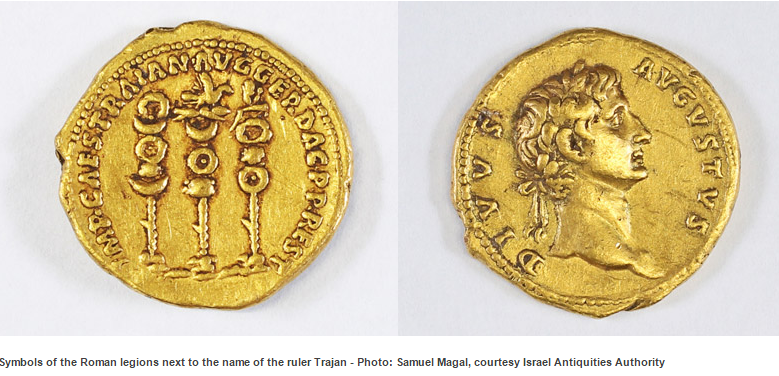
The famous British Museum possesses an ancient gold coin that until now was apparently the only one of its kind known in the world - a coin that bears the image of Emperor Augustus and was minted by Emperor Trajan. This coin, from 107 CE, was part of a series of nostalgic coins that Emperor Trajan minted and dedicated to the Roman emperors that ruled before him.     
 
A surprising random discovery by Laurie Rimon, a member of Kibbutz Kfar Blum, who was hiking with friends in the countryside, uncovered the "identical twin brother" of this rare coin - the second such coin of its kind now known to exist...


Here is the link for the rest of the story.

http://mfa.gov.il/MFA/IsraelExperience/History/Pages/Israeli-hiker-finds-rare-2000-year-old-gold-coin-14-Mar-2016.aspx

---

The wreck of the nau Esmeralda, a Portuguese East Indiaman and one of Vasco a Gama's ships was found.  It sank in 1503.  Recovered artifacts include a disc bearing the Portuguese royal coat of arms and the emblem of King Dom Manuel I, an inscribed bronze bell, a gold cruzadocoins that was minted in Lisbon between 1494 and 1501, an Indio, and an extremely rare silver coin struck specifically for trade with India along with many shot, breech chambers and firearms.

You can read more about that in the International Journal of Nautical Archaeology.  The article provides a lot of detailed material on the wreck site and artifacts.  You'll enjoy reading it.

http://onlinelibrary.wiley.com/doi/10.1111/1095-9270.12175/epdf

Among the finds shown in that article are the following iron core lead shot.


I'd challenge you to correctly identify that from your detector readout.  This lead shot had an iron core.  The example at the upper left still contains the iron core.  The others have lost the iron core.
The more rare an interesting items are the least likely to be correctly identified.


And above is one of the breech chambers found on the site.

---

I haven't been able to get out to the beach for two or three weeks now.  It has been a tough year so far with family illness etc.  Hopefully things will become more normal before long.

There were a lot of posts that received a lot of attention in February, but the most read post was the post on proposed Florida laws and citizens archaeology permit.  See 

The most Google Plused post was the post illustrating how artifacts always have a story behind them. See

There were many other widely read posts last month.  Remember, you can always use the search box on the blog to find particular topics.

---

Expect another day or two of smooth surf, then Friday the surf will begin to increase a little.

Happy hunting,
TreasureGuide@comcast.net

Tuesday, March 15, 2016

3/15/16 Report - Finding Shipwrecks Using Satellite Images. Target ID Issues.


Written by the Treasureguide for the exclusive use of treasurebeachesreport.BlogSpot.com.

NASA Satellite Photo Showing Plumes From Two Shipwrecks.
Researchers have found that shipwrecks near the coast can leave sediment plumes at the sea’s surface that help reveal their location. Using data from the NASA/USGS Landsat 8 satellite, researchers have detected plumes extending as far as 4 kilometers (about 2.5 miles) downstream from shallow shipwreck sites. This discovery demonstrates for the first time how Landsat and Landsat-like satellites may be used to locate the watery graves of coastal shipwrecks....


While airborne lidar (which uses light pulses to measure distance) can be used to detect shipwrecks close to shore and multibeam echosounders and other sound-based methods can be used anywhere deep enough for a survey vessel to sail, the former method requires clear water and cost prohibits both methods from being used to conduct exhaustive coastal surveys.
A new study published in the Journal of Archaeological Science by authors Matthias Baeye and Michael Fettweis, from the Royal Belgian Institute of Natural Sciences; Rory Quinn from Ulster University in Northern Ireland; and Samuel Deleu from Flemish Hydrography, Agency for Maritime and Coastal Services, aims to change things. The authors have found a way to use freely available Landsat satellite data to detect shipwrecks in sediment-laden coastal waters...

The two plumes coming from the shipwrecks marked by the two red dots are not easy to see in the above photo.  You might be able to see them more clearly if you use the link to go to the original article.

Here is the link for the entire article.

http://www.nasa.gov/feature/goddard/2016/landsat-spots-shipwrecks-in-coastal-waters
---

They say that ignorance is bliss.  It might be bliss and a lot of other things, but it is still ignorance.  I never make mistakes in my posts - at least not until I go back and check them, use spell checker, or post them. Then I find tons of mistakes that up until that point I didn't know I made.

The same thing is true in metal detecting.  You never know what you miss.  You never know for sure until you dig.  You might think you know.  You might be highly accurate, maybe even 99.9 % accurate, and that might be good enough for you, but for me, I get surprised from time to time, and the surprises are very valuable.  The surprises might be few, but it is the surprises that I learn from.  And it is the surprises often turn out to be rare artifacts or especially valuable items like Rolex watches.

I'm not trying to convince anyone.  I know that there are people who can not be convinced.  I learned long ago, that you can seldom change someone else's mind.  I'm just telling how I see it.

I might be the only one that has to actually dig a target and see it to be absolutely sure what it is. Everybody else might be 100% accurate with their target signal identification.  They might be absolutely certain that the target they just passed up was a pull tab or penny.  And they might never make a mistake.

I'm just not that good.  Every time I dig up a Rolex or some unusual artifact, I'm surprised.   Some of my most valued finds were complete surprises.

For a few years I wasn't digging iron and I wasn't digging big stuff.  I was focused primarily on coins and jewelry.  As a result, it took me a long time to find shipwreck spikes.  That was a conspicuous absence from my list of finds.  Now I don't like to miss shipwreck spikes so I change my decision strategies.  Now I usually dig things like that when I am in an area where they might be found.

That word "usually" is an important word.  I don't always dig those types of things - just when I am in the right places and when it fit my goals.

To optimize success it is important to take in to account a variety of factors.  I'd be an even bigger fool than I am to hunt the same way everywhere no matter what the situation or what I am trying to accomplish.

A lot of my strategy is to hunt areas where the types of things that I am targeting are concentrated. These days I seldom hunt where there are lots of the kinds of items that I want to skip.  So when I am successful in doing that, discriminating those items does not save a lot of time because they are simply not there in great numbers.  And when I run into a lot of them, I am in the wrong kind of area, and I move.  As I've explained before, junk provides information too.

I  can't get into that in any more detail now.
\
The other day when I was talking about some of the most popular detectors as indicated by the Kellyco People's Choice Awards.  I gave some of my positions on target ID.  One of the things I mentioned was that target ID is not perfect.  Just a few minutes ago I went to YouTube and the first video I looked at illustrated what I was saying.  The title of the video is Target Issues With the CTX 3030.  The guy, who seemed to be very thoughtful and competent, was running into a lot of twist off caps which gave him something like a 1242 reading. so he was bypassing them as would be natural. He didn't know what he missed on the first pass when he passed up items that gave that type of reading.  He decided to go back and check some that he passed on the first pass.  He ended up being surprised and thought maybe he should go back and check some of the other signals that he passed on.

Take a look a the video.  I highly recommend going through the entire thing.  It illustrates many points that I have mentioned in the past.

Here is the link.

https://www.youtube.com/watch?v=FzXUhou_maE

If you want to skip over targets, and everybody does to one extent or another, (there are definitely times to skip things) there is nothing wrong with that, but I want you to be aware of what could be happening.

I never have to tell people to use discrimination.  People will naturally do that.  Judging from my experience they are more likely to discriminate too much rather than too little.  And I will never convince anyone to dig more even though that is a lesson I've learned for myself.  Maybe I'm the only one that occasionally makes a big mistake when I don't dig.

Digging also has other benefits that I like.  I like removing junk from places that I hunt a lot so there are fewer junk signals when I return.  I don't like getting any kind of signal from the same pull tab day after day so I remove a lot of them.  It doesn't really take long to make a place you hunt frequently much less junky.  You can do it bit by bit.

---

I'm expecting to receive a report on a home site that was thoroughly sifted that will show how much is really there and how much is usually missed.  I can't wait to see the final report.

---

On the Treasure Coast expect a couple of days of one-foot surf.  The wind will be mostly from the west.

Happy hunting,
TreasureGuide@comcast.net

Monday, March 14, 2016

3/14/16 Report - Most Popular Gold Detectors. 17 Pound Gold Nugget Found. Smooth Surf.


Written by the Treasureguide for the exclusive use of treasurebeachesreport.blogspot.com.


Here is a 17 pound gold nugget found by a Chinese herdsman.

...That gold nugget, assuming it’s at least 80% pure, would be worth 1.6 million yuan ($255,313 U.S. dollars), says Xinhua, which also points out that a 1.84 kilogram nugget was discovered in the region in 2010. Gold US:GCJ5  for April delivery was trading at $1,261 an ounce on Thursday....


Here is the link for the photo and article. 


That isn't what I would call the most beautiful nugget.  In fact it looks odd to me.  I like delicate quartz laced nuggets.

---


Here are the three most popular gold detectors from the Kellyco People's Choice Awards. The Minelab is about ten times more expensive than the Garrett AT and the White's GMT.  That is a big difference.  In my opinion the GPX should have been in the professional category with other detectors in that price range.

Gold detectors are designed for hunting gold nuggets and are designed to handle heavily mineralized ground.  As you can see from the price on the Minelab, serious nugget shooters will pay a  hefty price for a machine that will do the job.

While gold detectors are generally used for nugget shooting, some people will use them when targeting small gold jewelry.  Very often when thin gold chains are found, it isn't the chain that is detected but a charm or something on the chain.  If a gold chain is thin enough it will be almost impossible to detect with most detectors.  Some gold detectors will detect thin gold chains that other detectors will miss.

Since gold detectors can be used in challenging ground conditions such as heavily mineralized ground, they provide a lot of settings and can require ground balancing for optimal performance.  As a result they might not be the easiest detectors to adjust for optimal performance and are not a good choice for the beginning beach detectorist.

Another negative is that they can be so sensitive that they will pick up minute pieces of metal, including small bits of iron that can barely be seen by eye.  As you might imagine some beaches have so much small iron and junk that you would not want to use a gold detector like that on some beaches.

There are Treasure Coast beaches that really have a lot of tiny pieces of iron that will drive you crazy if you are accustomed to hunting in discrimination mode or hunting with a detector such as the Excalibur that will normally miss such small pieces of iron.  That is the negative side of working with so much sensitivity.  And turning up the discrimination or decreasing the sensitivity on a detector like that defeats the purpose of having so much sensitivity to begin with.

I've seen a similar Minelab (not the latest GPX model) being used on the Treasure Coast beaches, but not often.

I often use a gold detector on the Treasure Coast, but not one of the ones shown above.  These three are not water proof.  I prefer waterproof detectors for beach hunting.  You never know when an unexpected wave might hit you, and I don't want to be bothered by rain.  You also never know when you might wander into the water.

The right detector for a particular situation depends upon a variety of factors.

Even though I haven't been able to detect in areas where people usually hunt gold nuggets, I have found a few gold nuggets on Treasure Coast wreck beaches.  If you go back through the old posts you'll see some gold nuggets that were found on wreck beaches.

A Garrett AT detector came in first in both the gold and all-purpose categories.  There was a time when I didn't care for Garrett detectors, but am happy with the ones I have now.

---

Don't forget that you can use the search box at the top of the blog to find old topics.

I've been thinking of activating comments in this blog but haven't gotten around to it yet.  They will be screened comments though.  I'm wouldn't be able to keep up with tons of comments.  There are simply too many posts in this blog for me to be able to keep up with that.

---

The surf will be really smooth on the Treasure Coast for a couple of days.  That makes for some easy water hunting.  The wind will be first from the south and then from the west.

Happy hunting,
TreasureGuide@comcast.net
Sunday, March 13, 2016

3/13/16 Report - Three Most Popular All-purpose Metal Detectors. Family Finds Old Baseball Cards Worth Over A Million Dollars.


Written by the TreasureGuide for the exclusive use of treasurebeachesreport.blogspot.com.
All-Purpose Detectors Voted As Top Three In The Kellyco People's Choice Awards.

As you see, the Garrett AT Pro was voted the most popular detector in the all-purpose category.  I have not used the AT Pro enough say much about it.  It is obviously popular though.  I have been using another Garrett detector a lot lately, and it is an excellent detector.  At $600, the AT Pro costs less than one fourth the cost of second place detector, the CTX-3030.

The CTX has a lot of fancy features.  Personally I am not a big fan of computer screens on detectors. And I'm not just an old fuddy-duddy.  I've been using computers since the 1960s, including some of the biggest baddest computers ever made and made a good living for many years doing software development and consulting for fortune 100 companies, so it is not just that I don't like technology.  I am very particular about when and how to apply it though.

As I've shown in the past, people often think they save a lot of time by reading a screen before deciding if they want to dig a target.  I've studied videos on YouTube when various forms of target ID was used and counted the seconds to come up with a good reading and make a decision from a readout screen and also counted the number of seconds it takes to actually dig up a target.  What I found is that on average people spend more time getting a good reading and making a decision whether to dig than it takes to actually dig a target.  In the videos I studied, the targets were removed from inland sites where the recovery time should have been higher than what you would expect from targets recovered from sand where all you have to do is scoop and sift.

Of course you can save effort by not digging, and you might not get as frustrated by not digging as much junk, but when it comes to saving time, that is questionable at best.  From my observations, it actually slows things down.

A second important point is that no ID system is perfect.  There will be mistakes, and those kinds of mistakes can be huge.  What readout system will tell you if your coil is over a Rolex or Tag Heuer. So you didn't have to dig that Tag Heuer watch - does that make you happy?  You'll never know. No target ID system will correctly identify every type of target and some of the most valuable types of targets are the most likely to be missed.

Thirdly, no target ID system is more intelligent than the intelligence that was programmed into it. The system will have the advantage of being able to read the electronic signature of targets better than the detectorists using only audio signals.  You can however learn to identify much about targets from the audio alone if you do a lot of testing and really get to know your detector.  I find that I can tell more about a target from the audio output by not using a discrimination mode.  You can learn to tell much about size, shape and depth of a target from the audio output.  Using that kind of information combined with your knowledge of the environment, you can learn to do some good target ID from the audio signal combined with other acquired information.  I can't get into all of that in detail now, but the point is that the human brain is a much better computer than what you have in your detector.

The Fisher F44 comes in at under $400.  I have never used that detector, but am sure it is fine.

For people who are just starting, I recommend a low cost detector.  Don't spend too much on a detector until you learn more about yourself and the hobby and where you want to go with it.  If your detector is not great at hunting on a salt-water saturated beach for example, and you find out that that is important to you, then you know what to get in your next detector, but first learn to make the adjustments with the detector that you have so that you can improve the detector's performance in that environment.  What you learn as you work to gain better performance from your first detector will help you a lot in the future.  Your first detector will help you identify what you really need for hunting where going to hunt most.

It is always good to have a multi-purpose detector.  You might go to the beach and

 hunt the wet sand a while, move to the dry sand and then hunt an old home site on your way home.  It is good to have a detector with good flexibility.

Did you notice that the same three companies make the top three water hunting detectors and the top three all-purpose detectors?

---

Relatives looking through a loved one's dilapidated house found a treasure trove worth more than $1 million in a crumpled paper bag, in the form of super-rare Ty Cobb baseball cards...

For more on that story, here is the link.

http://www.nydailynews.com/news/national/family-finds-1-million-rare-ty-cobb-cards-article-1.2551240

I once had a huge baseball card collection.  Many from the fifties and sixties.  One day I returned from college and my mother had burned them all.  I had a lot of valuable cards. Many worth hundreds and thousands.  A big cardboard box full.  I know the same thing happened to a lot of collections.  Too bad!

---

On the Treasure Coast we'll have a smooth surf on Sunday.  The wind will be from the southeast.  Again, we'll have good negative tides.

Happy hunting,
TreasureGuide@comcast.net