Showing posts with label shipwrecks. Show all posts

Sunday, June 21, 2020

6/21/20 Report - Some Treasures Can Find You. Was Fenn Treasure A Hoax? Shipwreck Archaeology Symposium.


Written by the TreasureGuide for the exclusive use of treasurebeachesreport.blogspot.com.


Fenn Treasure.
Source: CNN.  See link below.

(CNN) — As soon as Forrest Fenn announced that his treasure was found earlier this month, rumors swirled about whether it had really been found or if the treasure hunt had been a hoax all along.
Well, this week, Fenn tried to put some of those to rest by unveiling the first photos of the discovered treasure.
On Tuesday, the 89-year-old art and antiquities collector posted three pictures of the treasure on dalneitzel.com, a fan blog dedicated to the treasure hunt that Fenn sparked 10 years ago after he published clues in his autobiography "The Thrill of the Chase." ...
Here is that link.

https://www.cnn.com/travel/article/forrest-fenn-treasure-chest-pictures-trnd/index.html

Some think that the Fenn treasure was a hoax and never hidden.

Thanks to William K. for the link.

----

Below are the contents of the Iron, Steel, and Steamship Archaeology Seminar from 2006.  It includes a long list of papers on shipwreck artifacts and their corrosion, distribution, cleaning and conservation.  You'll probably find at least a few articles of interest if you browse the content listing.


And here is the link to access any of those papers that might interest you.


https://www.academia.edu/17384667/The_latest_find_._With_Delgado_Johnson_Murphy_et_al_on_SubMarine_Explorer_a_Civil_War_era_in_Panama?email_work_card=title

---


Some treasures are very elusive.  You hunt for yeas and may never find them, but it seems there are other treasures that find you.  In my previous post I mentioned some treasures that found me.  They are treasures that just fell into my lap, so to speak.  I didn't target them.  I didn't hunt them - they came to me.  Here is how it happened.

I had done some consulting for the institution and knew one of the librarians from my consulting work.  She knew I appreciated books, and since the library was becoming computerized, they were deaccessing a lot of the books.  I was told I could look through their holdings to see if there were any that I would like to have, and if they were scheduled to be deaccessed, I could have them.

If you know me, I like books - especially old books.  I found an entire collection of old books in a room that was never used.  The collection included about 50 old and very collectable books going back to the 18th century, including some valuable first editions.  Many were history books.  The collection was stored in a locked room in a library for years but were hardly ever accessed or used.  In fact many were in a locked cabinet.  They were just the kind of thing I love.  I told them that those books were something special and should be taken care of. They weren't just old books and were very valuable in more ways than one.

The library tried to find a university library that wanted the collection, but none of the large university libraries responded.  After a year of trying to find a good institutional home for the books, they finally gave up and decided that I should have the books since I was the one that appreciated them and alerted them to their value.  It seemed like those books found me, and I'm glad they did.

A historical society was delighted to take a couple of the books that fit their needs, but didn't fit in with the primary focus of the collection.  Other than those two books, I received the entire collection.

There isn't much interest in old and collectible books anymore and most librarians don't know the value of books as collectibles.  I've seen books on library shelves that are well over a hundred years old that have never been read.  I know they've not been read because the pages were still untrimmed.  I've also seen valuable old books on library shelves that were destroyed by librarians or patrons that did not appreciate or care for them.  I hated to watch as one old and very valuable oversized leather bound volume of Durer prints was ruined by one patron who photocopied each of the pages on a copier, which, of course, destroyed the binding.  It would have been worth thousands of dollars and was probably destroyed and could have been eventually thrown out.

So some treasures you have to hunt for long and hard, some beckon you, and others you.  If you truly treasure an item for more than its economic value, it seems there is a better chance that kind of  treasure will find you.

---


Disturbances are flashing on the National Hurricane Center map.  There is one disturbance up by the Carolinas that could develop in the next few days.

Locally we are having more flat surf.  That is good for the salvage season, but isn't doing the beaches much good.

Happy hunting,
TreasureGuide@comcast.net

Wednesday, June 17, 2020

6/17/20 Report - Florida's Most Collected Gems. Fishing For Treasure.


Written by the TreasureGuide for the exclusive use of treasurebeachesreport.blogspot.com.

Florida Calcite Fossilized Clam Crystals.
Calcite crystals in fossilized clam shells are said to be the most collected Florida gems. I've talked about that and Ruck's Pit in previous posts but decided to make a few photos after finding one of my photos being used by Google or Bing or whoever it was describing fossilized shells.  They didn't give credit either, so they used copyrighted material without any mention whatsoever of the source.  But the photo was good, and evidently useful, so I thought I'd make a few more.


An internet search showed the photo below, which was originally posted in the above post.  It was made using ultraviolet light to show the fluorescence.  It wasn't an easy photograph to capture.  I guess I'll have to learn to label my photos better.

Fossilized Shell With Crystals Photographed in Ultraviolet Light.

Geologyin.com says, The calcite geodes [at Ruck's Pit] were also of special interest, as they had formed as large aggregations of dogtooth spar growing inside fossilized clams (bivalve mollusks) and whelks (gastropod mollusks). As far as is known, this type of dogtooth spar geode is unique to the Fort Drum Mine.  However, I've found them on Treasure Coast beaches. In fact, the one shown immediately above was found on South Hutchinson Island, and it is far from the only one that has been found there.


I even once showed crystals that formed in the hollow of a fossil bone.

Here is one more photo of a crystalized shell that I just took in natural light.

Fossilized Clam Shell Crystals.
---

Here is a link to a good article about the damage done by fish trawlers to shipwreck sites and the items that come up in the nets.

https://www.academia.edu/3597737/Sean_Kingsley_Out_of_Sight_Out_of_Mind_Fishing_and_Shipwrecked_Heritage?email_work_card=view-paper

Here are just a couple examples from that article.


Not only do the trawlers bring up the kinds of things you might expect. like olive jars and pottery, but also heavy and large things like cannons.

---

There is a fairly large statue of a mermaid in the Indian River that is not very recognizable because it is covered with oyster shells.

---


Source: nhc.noaa.gov

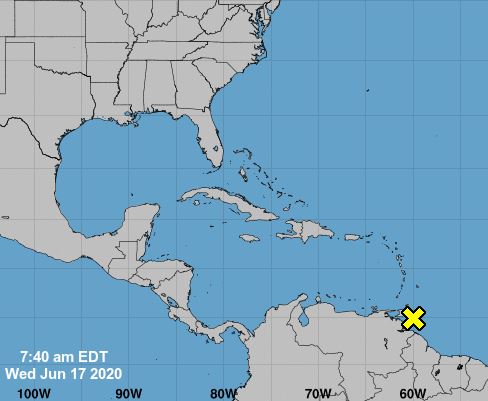
As you can see, there is a new system down by South America that could develop.  It is that time of year.

On the Treasure Coast today the surf is very small - only one or two feet.  The tides are not big, and the primary swell is ENE.

Happy hunting,
Treasureguide@comcast.net

Tuesday, June 16, 2020

6/16/20 Report - Our Ships on the Bottom of the Ocean. Gold Cross Find. Metal Detector Signals.


Written by the TreasureGuide for the exclusive use of TreasureBeachesReport.blogspot.com.

Gold Cross Laying on Sand
Find and photo by Alberto S.


The small gold cross (14KT written on the clasp) was laying on top of the (dry) sand and before picking it up I moved the coil of my CTX 3030 over it to listen to the FeCo tones and the values reported since this is my first gold cross I wanted to get an idea but, the tones and numbers kept jumping around not sure why, maybe the way it was laying on the sand, the shape of a cross and size or something else. The ctx 3030 is working fine as I double checked with a couple of coins I had found and later with an air test of the cross which gave me a solid sound and reading when moving in a horizontal position or flat over the coil, in a vertical position; silence. Beach conditions were not good at all but I needed the exercise so I am glad I went metal detecting today. Oh, and my metal detecting mistake #345 I started to walk away from the spot where the cross had been found before I went like wait, where is the chain? I retraced my steps and tried for a while but no luck. :(

Have a great evening,

Alberto S 


One good thing about all the rain we've been getting lately is the items that are uncovered by the rain.  Wind will uncover things too. 

Good idea to look for the chain.

A metal detector signal will be different for odd shaped objects and round objects.  On round objects the signal will be pretty much the same when you swing at one direction and then again at 90 degrees.  Very irregular shaped objects like the odd silver earring I showed the other day will give what I might describe as a jittery signal.  I meant to mention that at the time, but forgot.  You can usually tell the difference between a round object, a nail-shaped object and a fish hook, for example, from the audio signal alone.  Objects that aren't round, in addition to having a different audio signal when swept from different directions, will also tend to give inconsistent numbers as you hit them from different directions.

You can test that at home with various types and shapes of objects.  With practice you can learn to tell much about the shape of the object from the audio signal.

---


I found an interesting paper on early Portuguese shipwrecks.  The title, Our Ships at the Bottom Ocean, immediately made me suspicious.  The title seems to suggest a group of people, including the author as chief among them, that owns the ships at the bottom of the ocean.  I thought I remembered some of the author's previous wacko statements, and the paper confirmed my suspicions.  The author seems to rank anyone and everyone that has touched a shipwreck or anything that has came off one other than he and his group, as a part of an international network of thieves.  Nonetheless, the paper does present some good information that you might enjoy reading.  It is mostly about early Portuguese shipwrecks.


Here is one paragraph to give you the idea.


---

I felt like saying thank you to all the good police and found this Egard Watch commercial that does it for me.  Click here to view it.

---

I had a lot of trouble with yesterday's post.  First I wrote a long original essay and lost it, then the post wasn't displaying correctly, so I finally took it down.

---

Source: National Hurricane Center.


There is a weather system just north of Jacksonville that has a 10% of becoming a tropical storm in the next couple of days.

Our wind changed yesterday.  We only have about a two foot surf and small tides with a primary swell from the east but a secondary wind swell from the ENE.

Happy hunting,
TreasureGuide@comcast.net

Saturday, May 9, 2020

5/9/20 Report - 1733 Wrecks. All About Privateering. Mystery Maker's Mark.


Written by the TreasureGuide for the exclusive use of treasurebeachesreport.blogspot.com.

Unidentified Maker's Mark.
I've found a lot of silverware in the past, but recently found some new silverware that I researched.  I recently got one big ornate spoon from very deep on the back beach.  I'll get that one photographed before long, but it got me interested in going back and looking at some other finds that I hadn't yet taken the time to research. Some came from near the same area.

One that I cleaned a little and just looked at is an ornate spoon bearing the above maker's mark which I haven't yet found.  I photographed it both ways because I don't know which way it is supposed to go and it appears to have numbers both above and below the mark.  Between the globe and the Pat. is what appears to maybe be 1851.  On the other side of the crossed silverware appears to be 4800 or A.8.00 and maybe a 9 or 6.

I'm hoping someone can help me out with this.

Here is the spoon.

Dug Spoon.

I cleaned it a bit and took a photo of the handle.


Spoon Motif.

And here is what appears to be the patent date.  I cleaned it to show better.

Spoon Patent Mark.

It has enough good information on it.  I hope someone can identify the maker's mark.

I noticed I have some other interesting ones.  I'll be going through some of those, but am most interested in the big one recently dug from about two feet in old sand at the back of the beach.

---

As published in: Creating a shipwreck trail: documenting the 1733 Spanish Plate Fleet wrecks, by Jennifer McKinnon.
Here is the link.


---

You might enjoy this academic article by Sean Kingsley, The Art and Archaeology of Privateering: British Fortunes and Failures in 1744.  Here is the abstract.

Two shipwrecks discovered by Odyssey Marine Exploration in the English Channel in 2008 are embedded in the history of the War of the Austrian Succession (1739-48) and specifically the year 1744. The First Rate Royal Navy warship HMS Victory was lost in the western English Channel on 5 October that year, while returning from escorting to sea one outgoing commercial convoy and liberating another blockaded down the River Tagus in Lisbon.  The date of 1744 inscribed on the bell recovered from Site 33c in the same part of the Channel, alongside the name La Marquise de Tourny, revealed that Odyssey had also discovered the wreck of a Bordeaux corsair launched in the year when France joined the war. Both ships actively participated in the protection of trade and the art of privateering. This article contextualizes both wrecks by examining the objectives, character, structure and scales of privateering and securing prizes during the War of the Austrian Succession before discussing the few comparable wrecks to assess whether it is realistic to refer to an archaeology of privateering.
© Odyssey Marine Exploration, 2010

Here is the link.


And if you didn't look at the article on near-shore shipwrecks, I posted a link for that yesterday.  I think you'll find it interesting. 
---

I saw a few minutes of the Palm Beach County Commission meeting yesterday and I'd bet they are about to open the beaches.  Their medical person seemed to be in favor of it.

I get word that Sebastian Inlet State park is open with limitations.  You can go on the beach.  I think most of the Indian River County beaches are now open 7AM to 7PM except for Seagrape Trail.  The stairs at the Seagrape access are broken.

---

The surf will be smooth today with some pretty big tides.  At low tide you should be able to get pretty far out on the beach today.

Tomorrow the surf will begin to increase again, reaching four to six feet in a few days.

Happy hunting,
TreasureGuide@comcast.net


Friday, May 8, 2020

5/8/20 Report - Must Read: All About Near Shore Shipwrecks. Pre-Columbian Florida. Erosion.


Written by the TreasureGuide for the exclusive use of treasurebeachesreport.blogspot.com.

South of Turtle Trail Access Around Noon 5/7
A front came through yesterday and the wind was coming from the north. As I expected, there was a little erosion to some of the beaches.

Ambersands Beach Around 1PM On 5/7

The wind continued into the evening, so there could have been some more erosion.

Ambersands Beach Around 1PM on 5/7
There was one detectorist at Ambersands.  You can barely see him in the photo above.

Treasure Shores Beach Around 1PM on 5/7.

The tides will be high Friday, but the surf will be only two or three feet.

Unfortunately the surf predictions for the weekend are now looking like only three or four feet, at the most.  A few days ago it was looking a little more promising.

I'm adding this photo from Jerry P. showing the damaged access to Seagrape.  The Seagrape access is still closed.

Seagrape Trail Access.

Jerry stopped at Turtle Trail yesterday also and said finds were very few.  He saw no other detectorists.

Thanks Jerry.

Looks like the wind has changed Friday morning.  I wouldn't expect much more erosion.  Probably some filling soon.

---

It appears Florida tourism has been going on for thousands of years.

… Archaeologists estimate small-scale ceremonies began at Crystal River around A.D. 50, growing substantially after a residential community settled the site around A.D. 200. Excavations have uncovered minerals and artifacts from the Midwest, including copper breastplates from the Great Lakes. Similarly, conch shells from the Gulf Coast have been found at Midwestern archaeological sites.
"There was this long-distance reciprocal exchange network going on across much of the Eastern U.S. that Crystal River was very much a part of," Duke said.
Religious ceremonies at Crystal River included ritual burials and marriage alliances, Duke said, solidifying social ties between different groups of people. But the community was not immune to the environmental and social crises that swept the region, and the site was abandoned around A.D. 650. A smaller ceremonial site was soon established less than a mile downstream on Roberts Island, likely by a remnant of the Crystal River population....
Here is that link.


---

Anyone seriously interested in tracking shipwrecks or artifacts will want to read The Archaeology of Shore Stranded Shipwrecks of Southern Brazil, a dissertation by Rodrigo De Oliviera Torres, Texas A and M University, 2015.  While the study was conducted in Brazil the same principles apply locally, although the seasons are different and the most significant winds for us are from the north, while their's comes from the south.  Otherwise there is little difference.

I'll give you just a few examples from the dissertation to give you the idea of the types of things you will find in the dissertation.

First is the distribution of shipwrecks in the area (Fig. 19 below).  You will notice a clustering around the bar near the inlet.  Also most wrecks are near shore.  There are relatively few in deeper water.

Four sections of the hull of one wreck was buried on the beach.  Below is one of those after excavation.

Excavated Hull Section.
Below is a diagram showing the relative positions of the four beached sections of the hull.


While sections 1 and 2, which were larger and farther back on the beach, remained in the same relative position, sections 3 and 4 were moved over a three year period.

In the following photos you can see that the two sections are closer together in 2009 than they were in 2006.


It is not surprising, but it illustrates how even large sections like this can be moved on a beach.

Of course, weather and beach dynamics are discussed.  Below is an example.

Remember, the directions are reversed.  Their south winds are more like our north winds.


Notice the alternating erosional and depositional areas.

Here is one more diagram from the dissertation.

---

------------

And here is another paragraph from the dissertation.

McNinch et al. (2006), studying artifact deposition in a similar shallow, energetic
setting in North Carolina (Queen Anne’s Revenge site), observed that wrecks in these
conditions will normally settle into the sand via episodic scour processes driven by
storms and inlet migration, favoring preservation of heavier artifacts and hull parts. The
authors concluded that depending on the underlying geology and hydrodynamics, a
shipwreck could in fact settle through several meters of substrate in highly dynamic
settings. Although no systematic survey has ever been carried out in the area
surrounding the sand shoals at the Rio Grande bar, shipwreck debris varying from small
coal chunks to glass bottles and large timbers are frequently washed out onto the beach
after storms, suggesting shipwreck remains are still being reworked (Figure 60).


I don't really like the word "settle" as it is used here, but it does explain that it occurs along with the scour processes.  It is not a passive process, as "settle" would seem to imply.

Well, I can't go over the entire dissertation, but think I've given you enough to let you decide if you want to browse it for yourself.

Here is the link,.

https://www.academia.edu/12852042/The_Archaeology_of_Shore_Stranded_Shipwrecks_of_Southern_Brazil_Torres_2015_?email_work_card=view-paper

---


Friday, May 1, 2020

5/1/20 Report - 22 Shipwrecks in a 17-Square Mile Area. Analysis of Chain Mail Links. Mystery Item.


Written by the TreasureGuide for the exclusive use of treasurebeachesreport.blogspot.com.


A spate of shipwrecks recently found near a group of Greek islands has given researchers new insights into how trade routes and sailing technology evolved in the Eastern Mediterranean. And with more exploration planned, additional discoveries are still likely.

Over a stretch of two weeks in September, tips from local fishermen and sponge divers led a team of Greek and American archaeologists to the precise locations of 22 shipwrecks in a 17-square-mile area around the Fourni archipelago in the eastern Aegean.

The find is remarkable both for the sheer number of wrecks in the small area and the range of time periods the vessels came from.

The earliest wreck dates to the Archaic Period (700-480 B.C.), while the most recent is from the Late Medieval Period (16th century A.D.). Ships from the Classical Period (480-323 B.C.) and the Hellenistic Period (323-31 B.C.) were also found, though a majority—12 of the 22—sailed and sank at some point during the Late Roman Period (300-600 A.D.)...

Here is the link for the rest of that article.


---

Links of What Is Thought To Be Chain Mail 
Salvaged From The Site of The Mary Rose 


The artifacts shown above, which are thought to be links of chain mail from the wreck site of the Mary Rose, were analyzed using synchrotron X-ray diffraction.  The analysis provided detailed analysis of the composition of the links, and identified not only the main metals used, but also changes due to corrosion and preservation processes.

The links are 73% copper and 27% zinc.  The analysis suggested that zinc was lost from the surface of the links during corrosion.

Very small amounts of lead and gold were also found.  It was hypothesized that the minisciule amounts of those metals on the links could have been from tools used in the process of forming the links or pollution of the site.

Here is the link for more about that.

And here is the link to the original scientific article on the analysis.  Good reading.

http://journals.iucr.org/s/issues/2020/03/00/ok5009/index.html

---

Since the beaches have opened and people are back on the beaches, we will be seeing more finds.  William K. found a couple of unusual sinkers.  The one shown below, and wondered if anyone had any thoughts.  I don't know the reason for the large amount of wire on the top of the item or the loop at what would appear to be the bottom.


What do you think?  Any ideas?

---

In my 2/3/20 post I said, "Wouldn't it be better if our heroes were maybe scientists, engineers, or saints or people that do good things, rather than athletes and entertainers?  Its a crazy world."  

I don't know why I said that back when coronavirus wasn't yet being talked about - at least not much, if at all - but I wasn't hoping for anything like this.

---

The Kentucky Derby is going to be virtual.  No real race.  Too bad.  I was there for a couple of them.  The University of Louisville was within walking distance of the Downs.

The surf is still a bit choppy on the Treasure Coast.  I'm hoping for some really flat seas for a short while.

Happy hunting,
Treasureguide@comcast.net

Saturday, April 18, 2020

4/18/20 - Mystery Find. Diggin Dog. All-Time Engaging Posts From Blog History.


Written by the TreasureGuide for the exclusive use of treasurebeachesreport.blogspot.com.

Small Heart Pendant Find.
I got around to look at some old finds again.  Some I never figured out.  Here is one of those.  It is a small heart pendant photographed on top of a US quarter.

Both sides have a metal mesh that is puffed out some and the frame appears to be made of two halves that were once shut at the tip.  Below gives a side view (left) and shows a closeup of the tip.  It looks to me like the tip was at one time soldered shut.


You can see how the mesh sides puff out so there would be room for something to be enclosed inside.  The tip looks like it was connected.  There are no hinges, but I sprang it open to see if I could see if anything was in it.  I didn't see anything.

I'm wondering what you think.  Was it made to contain something?  If so, what might it be?

I would like to hear what you think.  Any and all ideas appreciated.

---

People are not the only ones making finds.  Susan E. sent a photo of a wheatie recently unearthed in her yard by the dog.  He often unearths shards and things, but this time he got a coin.

Find Made by Diggin Dog.
Photo by Susan E.

I usually check anywhere animals have dug, including mounds created by gopher tortoise.

---

South Carolina will announce the opening of public beaches and stores next week.  Social distancing, will still be enforced on the beaches.

Jacksonville's governor seemed to be happy with the results of his beach opening, even though there were those who protested.

Of course, as with anything these days, some people don't like it.

No one would dare repeat Roosevelt's quote, "We have nothing to fear but fear itself," these days.

---

Do you know what topic addressed in this blog resulted in the most active and positive response?  I received literally hundreds of emails in response to a post about a State of Florida bill that was thought to threaten beach access.  I received tons of emails about that.  There was almost unanimous consent among the detecting community and people were eager to add their names to a petition to prevent beach access being restricted.

Do you remember when a federal judge ordered Odyssey Marine to turn over $500 million worth of Spanish coins salvaged from a wreck to the Spanish government?

If not see  https://www.reuters.com/article/uk-usa-spain-shipwreck-idUSLNE81J01C20120220

Did you ever read about the battles between the Fishers and the government and between the State of Florida and the Federal government to determine who owns certain wrecks?

See https://people.com/archive/mel-fisher-finds-millions-under-the-sea-and-the-courts-now-say-its-all-his-vol-9-no-19/

Do you remember when St. Lucie decided to prohibit metal detecting in their parks?  That also resulted in a petition and numerous emails.

How about the topic of beach renourishment?  That has been a popular topic in this blog.

The rift between treasure hunters and archaeology has been a common topic.  I believe it has been an important topic that has seen some improvement in recent years.

Or who owns the salvage rights, and how are finds distributed with the State of Florida.?

Or maybe you were detecting or swimming in front of a big resort or beach club and were told you couldn't do that.  I've addressed that topic too.

People wonder when the storms come, why beach accesses are closed without any apparently justifiable reason.

Our tax dollars are continually dumped onto the beaches in the form of sand that won't last.  We've discussed that.

I could go on, but my point is simple and undeniable: you can't separate politics from metal detecting or treasure hunting.   The are intertwined.   Metal detecting and treasure hunting could be banned.  It has already been panned in some places, and there are those, such as some archaeologists, who would like to see it banned.  And it could be if you aren't interested, informed, active and involved.

---

I understand DeSantis has give municipalities the right to open additional beaches.  I would expect additional beaches to open soon, but we'll see.

They really did build that wall.  It is a wall of gates, barricades, and yellow tape that walls off hundreds of miles of beaches.

The surf is only around 3 or 4 feet now.

Happy Trails to You.
TreasureGuide@comcast.net