Showing posts with label silver dollar. Show all posts

Friday, May 17, 2019

5/17/19 Report - Coin Varieties and VAMs. A Submerged Archaic Period Site. 1715 Fleet Escudo Values.


Written by the TreasureGuide for the exclusive use of treasurebeachesreport.blogspot.com.


Source: See VAM link below.
---

If you are looking for one thing, you might find something else.  That was the case with a diver who was looking for fossils off Venice Florida in 2016.  21 feet under water, he found an Archaic Period burial pond site.  Here is an excert about that from the Herald Tribune (link below).

SARASOTA — Native Americans in the Archaic Period in Florida used the burial ground now known as the Manasota Key Offshore archeological site as far back as 8,000 years ago, Ryan Duggins told members of the Time Sifters Archaeological Society Wednesday evening in the Geldbart Auditorium at Selby Public Library.

Prior to this, previous activity at the site was thought to date back roughly 7,000 years.

Before the rising of the Gulf of Mexico, it was a shallow freshwater burial pond similar to Little Salt Springs in North Port...


Another bit from the same article...


“This demonstrates that we can have preservation of worked wood, of cordage of burials that have survived thousands of years of storms — It’s completely unprecedented.”...

See: https://www.heraldtribune.com/news/20190516/ancient-burial-site-off-manasota-key-is-1000-years-older-than-estimated

Things can remain very much protected under sand or other materials for a long time and then suddenly be uncovered by the right set of circumstances.

It was an amateur fossil hunter that found and reported this site.  How often do we hear about  detectorists or people hunting for other kinds of treasure that make exciting archaeological discoveries?  It seems like it happens a lot, yet many in the archaeological community are always talking about looting rather than the assistance they get from the public.

https://dos.myflorida.com/historical/archaeology/projects/manasota-key-offshore/

---

We normally only scratch the surface.  That applies to a lot of things, but it certainly applies to coin collecting.  People often begin by wanting one of each date.  Then they want an example from each mint too.  Then they start getting particular about the condition of their coins and want the finest coins they can get.

As detectorists, we usually don't get too deep into coin collecting.  We're  don't buy coins, and you can't systematically dig whole sets - certainly not in great condition, even though we might occasionally find some very nice caches that can make a good collection.

As detectorists, we do find a good number of coins and can benefit from knowing enough to recognize what coins might have extra value.  I suspect that we often fail to recognize coins (and other finds) that are more valuable than we wold have thought.

In addition to all of the date/mint combinations there are also a lot of coins that are valuable because of mint errors.  I didn't know hardly anything about mint errors until just the past couple of years.  I recently reported on a penny that was worth over $20,000 because of a mint error.

There are different types of doubling and some are not worth anything.  For example, doubling due to the die bouncing when it strikes the coin is called machine doubling.  It normally does not add any value to the coin.

Doubled die coins on the other hand can be worth a lot.  That type of doubling occurs when a doubled image is on the die that strikes the coin.

I wish I knew more about that type of thing years ago.  I could have found some valuable coins, and I maybe I would have enjoyed my finds even more.

I didn't find a lot of silver dollars over the years, but because of more recent finds, I'm just starting to learn about silver dollar VAMs.  Here is a definition of VAM.

Silver dollars are created by striking metal blanks with hardened dies containing the mirror image of the desired pattern. Through careful study, slight differences can be used to identify specific dies that created the coins. Sometimes these differences occur during the creation of the dies, while other times they are caused by the maintenance or use of the dies.

Source: http://ec2-13-58-222-16.us-east-2.compute.amazonaws.com/wiki/VAM

VAMs are not obvious to the untrained eye.  You have to know what to look for, and for me, it requires magnification to see the small differences.

At the top of this post is a photo of a Peace silver dollar VAM.  The VAM is identified by the gouge and dot that the arrows are pointing to.

Just roughly I'd say there are more than a hundred different Peace Dollar VAMs.

Coin varieties and errors are something that you might want to look into.  A lot of people search and collect Lincoln cent varieties and errors.  You can get a hundred pennies to search through for only a dollar, and then turn in the ones that aren't anything special for an entirely new batch.  Or, you can just study your finds, digging the pennies instead of skipping them.  They can be valuable too.

---

One of the first things a lot of detectorists want to know when they find something is how much it is worth.  We all know that something is only worth what somebody will pay for it, but how can you get an idea of what somebody will pay?  One thing I do is check the auction sites and other on-line sites where things are sold.  If you don't have a realized price auction list, you can still sometimes get a good idea from the auction estimates, especially when an quality experienced auctioneer is the source.

In the last Sedwick auction, for example, there were six 1715-Fleet Mexico cob 8-escudos listed together.  While some were better than others, or should I say, expected to bring a higher price than others, they didn't vary a lot.  If you looked at those estimates, you might conclude, as I did, that 1715-Fleet Mexico 8-escudos in good condition might be expected to bring a bit over six thousand dollars, on average.

I know that some of my readers aren't much interested in the auctions, but the auction catalogs are really a good source of information and can help answer a lot of common questions, of which value is only one.

---

We have some decent tides now, but it looks like the surf will run around two feet for a week or so.

Happy hunting,
TreasureGuide@comcast.net


Friday, January 4, 2019

1/4/19 Report - Gold Trending Up. Rare Matching Pair Finds. Silver Dollar VAMs.


Written by the TreasureGuide for the exclusive use of treasurebeachesreport.blogspot.com.

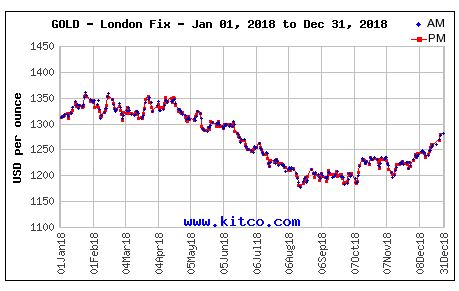
While the stock market has been going through wild gyrations, the price of gold has been doing well.  Above is the 2018 chart.  The early days of 2019 have also seen increases.  

The up-trend in gold prices started back around the end of August and has continued through yesterday, when it closed at about $1298 US dollars per ounce.  Today however it is down again.  You never know what it is going to do.

---

Some finds are rare for one reason or another.  Even though I used to target and find a lot of gold jewelry, I seldom found sets together.  There have been times though when I found a matching engagement and wedding ring.  On a few occasions I found a matching pair of ear rings.  I showed a diamond and pearl set before.

The one time that stick out in my memory when I found a matching engagement and wedding band together was in the shallow water beside a picnic area on a causeway in Pensacola.  They were only a couple feet apart.  They were the same size and design. They were gold and diamond, but fairly inexpensive.  I figured they just slipped off at the same time.  Maybe a little suntan lotion and a Frisbee or something was involved.  Who knows?  Anyway they ended up lost in the water in very close proximity.

Here is a more recent matching set found on a Treasure Coast beach.  14K with diamonds.  They were also found in shallow water very close together.  They make a more expensive set than the Pensacola set that I talked about.

Matching Engagement Ring and Wedding Band Set.

I always figured the matching earring finds were taken off together.  It is difficult to imagine a pair of those coming off at the same time.

---

Older silver dollars are also rare finds for me.  I haven't found too many, and most of the ones I did find were found together in a cache.  After finding those and doing a little research I learned just a little about VAMs.

VAMs are cataloged varieties of Morgan or Peace dollar. For each year and mint, there are varieties that are identified by characteristics that may include any of the following:


    VAM silver dollars are cataloged using a system of numbers and letters that incorporate the “VAM” name. A normal Morgan dollar or Peace dollar is classified as a “VAM-1.” Subsequent VAM dollars are recognized as a VAM-2, VAM-3, VAM-4, and so on...

The Comprehensive Catalog and Encyclopedia of Morgan and Peace Dollars by Leroy C. Van Allen and A. George Mallis.

See https://coins.thefuntimesguide.com/vam-dollars/

"VAM" is a combination of the initials of the fellows (Van Allen and A. Mallis) that extensively studied and catalogued all the Morgan and Peace dollar mint varieties in The Comprehensive Catalog and Encyclopedia of Morgan and Peace Dollars.

Some VAMS are quite valuable.

---

I added the 18th Century Material Culture Resource Center web site to my reference link list.  It is well worth browsing.

We'll have a few more days of calm surf on the Treasure Coast.

Happy hunting,
TreasureGuide@comcast.net

Wednesday, December 5, 2018

12/5/18 Report - Policarpa On Dug Coin. George Washington Silver Dollar Throw. Puzzling Use of New Tech. Ring Bearing Name of Pontius Pilate.


Written by the TreasureGuide for the exclusive use of treasurebeachesreport.blogspot.com.


Dug Columbian Coin Showing a Lady - Not Liberty.
I've been talking about coins showing Lady Liberty.  Here is a coin showing a lady with a very different look.  She appears to be bound.  She is not Lady Liberty.  She is known as Policarpa Salavarrieta.

From Wikipedia:  Policarpa Salavarrieta, also known as "La Pola," was a Neogranadine seamstress who spied for the Revolutionary Forces during the Spanish Reconquista of the Viceroyalty of New Granada. She was captured by Spanish Royalists and ultimately executed for high treason. The Day of the Colombian Woman is on "her" day. She is now considered a heroine of the independence of Colombia.

Coins often portray historical figures.  Sometimes they are presidents or other admired or respected people.  The image is not only meant to portray and honor the person, but also to convey a message and inspire people.  Even when the image is of a actual person, there are often myths that come to surround the person.

One story that you might have heard is that George Washington, as a young man, threw a silver dollar across the Potomac.  The story is meant to illustrate his strength, but is it true.  There is some disagreement on that.  Here is what one web site says.

But alas, his famous coin toss is apparently not the whole truth. This popular myth is often told to illustrate his strength, but the river was not the Potomac (about a mile wide) nor was it the Delaware. Looking at his childhood homestead, perhaps it was the Rappahannock River near Fredericksburg, Virginia. According to myth, Washington threw a piece of slate, about the size and shape of a dollar, not a actual silver dollar. This account took place according to Martha Washington's grandson, George Washington Parke Custis. While the story has never been verified, historians concede that the feat is a possibility. At the site of the Washington family homestead, the Rappahannock measures only 250 feet across, an impressive but not impossible throwing distance.


Moreover, there were no US silver dollars available when Washington was a young man.

Source: https://www.ngccoin.com/boards/topic/123308-did-george-washington-really-throw-a-silver-dollar-across-the-potomac-river/

Whether he actually threw a coin (silver dollar or not) across a specific river is not really the point, I guess, but you should realize that representations are not always literally true and that myths are often added to the image of historical people and events.

I'll have more to say about that in the near future as it relates to treasure hunting.  I also plan to talk about the psychology of meaning and how to interpret signs and symbols.

---


Just because a technology is available doesn't mean it should be used or that it will be used correctly. New technologies can seem promising, but if you don't use it well, it won't do you much good.

Ground penetrating radar has been around a while now.  In fact it was invented in the 1920s, but it wasn't used much until the 1970s when the military began exploring its use for finding mines, buried weapons, tunnels etc.  In recent years it has been used more frequently by archaeologists and treasure hunters.

The selection of the best technology for the job depends upon a variety of factors.  Using a golf analogy, there are times when you would chose a putter and times when you would use a driver.     

On one TV show (Oak Island) the EM61 metal detector was used on a strip of rocky land.  There seemed to be no strategy other than seeing what might be found.  Maybe they didn't know if the system might be useful and just wanted to explore using it a little.  If that was the case I can understand it to some extent.  But what was strange to me, was that after the EM61 "got a hit" then the CTX 3030 was used to detect the target before retrieval.  In each case that they showed, the target detected by the EM61 was also detected by the metal detector.  Again, that doesn't make much sense to me unless you are simply trying to find out how the EM61 works or how to use it.  I already talked about this to some extent in a previous post.

NOTE: I originally referred to the EM61 as a GPR system.  I am told that it is actually a metal detector, so I corrected the references in the above paragraph.   Thanks to Jorge Y. for pointing out that mistake.

Here is a link for information about the EM61.

http://www.geonics.com/html/em61-mk2.html


On the other TV program, a GPR system detected a very large area of disturbed earth, where it appeared there might have been a large object buried or uncovered in the past.  After scanning the ground with the GPR and detecting the large area of disturbed earth, the switched to using a Garrett ATX on the same ground.  That made no sense to me either.

The fellow using the ATX found what you'd expect to find around a mid 20th century building -  some bottle caps, pull-tabs, etc., and eventually a coin.  That had nothing to do with the GPR scan.  It seemed they ignored the large and deep area of disturbed earth,.  I don't really get that strategy either.

Not only did they seem to ignore the area detected by the GPR system, but the ATX was a bad choice for that situation too.  Although I am not generally a big fan of a lot of discrimination, for what they seemed to be doing, I would have chosen another type of metal detector.

---

To the very short list of clues about Pilate as a historical figure, archaeologists have added one more: a 2,000-year-old copper alloy ring bearing his name.

The ring was discovered in the late 1960s, one of thousands of artifacts found in the excavation of Herodium, an ancient fortress and palace south of Bethlehem, in the West Bank. But it was not until recently that researchers, analyzing those objects with advanced photography, were able to decipher the ring’s inscription.

It reads “of Pilates,” in Greek letters set around a picture of a wine vessel known as a krater, and is said by archaeologists to be only the second artifact from his time ever found with his name. Kraters are a common image in artifacts of that time and place...


The article continues:


Here is the link if you want to read the rest of the article.
https://www.geopost247.com/2018/11/pontius-pilates-name-is-found-on-2000-year-old-ring/


There is a good lesson.  The authors didn't try to jump to conclusion that the ring was Pilate's simply because his name was inscribed in it.  They considered other things and came up with a more reasonable conclusion.

----

It looks like the surf will increase a little by the weekend.  Not much else going on.

Source: MagicSeaWeed.com

Happy hunting,
TreasureGuide@comcast.net
Monday, September 17, 2018

9/17/18 Report - Reviewing Some of the Neat Treasure Coast Finds of the Summer of 1918.


Written by the TreasureGuide for the exclusive use of treasurebeachesreport.blogspo.com.

d
Silver Frame Found by Grant, Diver on the Bottomline
Photo by Captain Jonah Martinez

Before all the storm activity I was going to look back at some of the find's made on the Treasure Coast his summer.  It was a slow summer, but there were some great finds.

Among the top finds were those made by the salvage crews.  I posted a photo of the silver frame found by Grant and the crew of the Bottomline.  That is a very unique and significant discovery.

Author and researcher Laura Strolia provided this blog with some excellent research on the object.  She said it is probably a retablo associated with St. John.

Here is the link to that post.

http://treasurebeachesreport.blogspot.com/2018/08/81218-report-research-on-amazing-2018.html

This wasn't the only find made by the crew of the Bottomline.  I also showed a nice silver candlestick bottom, silver cob and olive jar shard found by those guys.

There were beach finds made by individual detectorists too.  One of my favorite beach finds was the cannon ball that was hidden in a conglomerate.  That was found by Fred B.

Here is that link.

http://treasurebeachesreport.blogspot.com/2018/08/82318-report-big-surprise-found-in.html

There was also a gold nugget found on a Treasure Coast beach by Duane C.

Here is that link.

http://treasurebeachesreport.blogspot.com/2018/08/gold-nugget-recently-found-on-treasure.html

I've found gold nuggets on Treasure Coast shipwreck beaches in the past.  This one looked different, but that was something that isn't found every day.

I probably forgot or missed a lot of great finds.  If you have Treasure Coast find from this summer that you want me to post, send a photo and description.

My personal favorite finds this year were not found on a beach.  A 1914 ten-dollar gold coin in excellent condition and over twenty silver dollars were found, along with a bunch of other older coins.  That helped ease the frustration of not getting out to the beach very much.

I was going to post more today but am tired of trying to work with a messed up computer.

There isn't any significant tropical weather to watch now.  The surf will be around two or three feet for most of this week.

A fellow up north got killed by a shark.

Florence is still dumping rain on North Carolina and other northern states.

I heard from some of the guys up in North Carolina that hunt the treasure beaches up there.  There will undoubtedly be some good finds made up that way.

Pray for those who had flooding and damage.

Thanks to the many volunteers who helped the residents.

That is all for now.


Happy hunting,
TreasureGuide@comcast.net

Tuesday, July 17, 2018

7/17/18 Report - Helpful Information and Web Sites for Modern Coin Die Varieties. Watershed Dates For the U. S. Mint.


Written by the TreasureGuide for the exclusive use of treasurebeachesreport.blogspot.com.

Reverse of 1880 Morgan Dollar Find.

Today there are some very helpful web sites.  The token catalog is the type of thing that appeals to me.  It takes a basic database program and seeks to build a comprehensive listing of tokens.  The more complete it is, the more useful it is.  It collects, organizes, and makes all the examples readily available to much of the world, and that shared data expands on the overall knowledge level concerning tokens.  

Coin collecting has been affected  by the internet in the same way.  Databases of examples and numismatic information is made available and widely shared.  The internet has also changed the market for coins, as it has for many collectibles.  Common coins aren't worth as much now because they are easily found and seem much more common than in the days before the internet.  True rarities become more desired and more expensive.  The bar is raised.  With access and knowledge, people want finer and more rare items.

As more is known, people put significance on smaller details.  Now people study not just coins of a particular year and mint, but also the various states of the die.  As a die is used, wears, develops cracks, and eventually is worn out and replaced.  You can tell if a coin is an early or late die state coin by the impression left by the die.

A VAM is a Peace, or Morgan silver dollar die variety that has been identified in an all-inclusive book called The Comprehensive Catalog and Encyclopedia of Morgan and Peace Dollars by Leroy C. Van Allen and A. George Mallis. The term VAM derives from the first initials of Van Allen's and Mallis' last names. These two researchers noticed small differences between coins produced in the same year and at the same mint.

The great popularity of noting the many die varieties found, especially on Morgan Dollars, has led to the term VAM being used to describe practically any deviation from a "normal" Morgan or Peace silver dollar for that year and mint. It is now common language among coin collectors that people talk about having found a "VAM" when the variety they are referring to has not been assigned a VAM Number...
They began to photograph and catalog these differences to identify the different die varieties in the Morgan and Peace silver dollar series.

Here a the link to read more about that.

I'm a novice at studying modern coins, but I am enjoying it.

I have been presenting a variety of Philip monogram half reales and comparing them, but that is just a very basic beginning and I will never develop an extensive catalog, yet I find the comparisons interesting and enjoyable.

I found a very good web site on coin varieties.  Here are a few dates to remember.

1909 is the beginning of the modern minting process.  Prior to 1909 a partial hubbing process was utilized by the U.S. Mint. This process left the date and mintmark to be hand punched into each working die. 1909 saw for the first time, the date engraved into the master die, so that every working hub and working die carried the same date positioning. Mintmarks, however, were still applied to the working dies by hand as each branch mint had a need for dies.

1985 is when the mint began punching mintmarks into the master die.

1986 is when the mint began using a single squeeze hubbing process.

In 1990 the mint began punching the mintmark into the master die for cent and nickel coins.

In 1991 they began punching the mintmark into the master die for other denominations.

Here is the link for more about watershed dates.

http://www.varietyvista.com/Watershead%20Dates.htm

The same web site provides a long detailed list of specific die varieties.

---

We're still having some nice big tides on the Treasure Coast.  The surf is still small too, but will pick up just a little tomorrow.

Happy hunting,
TreasureGuide@comcast.net