Written by the TreasureGuide for the exclusive use of treasurebeachesreport.blogspot.com.
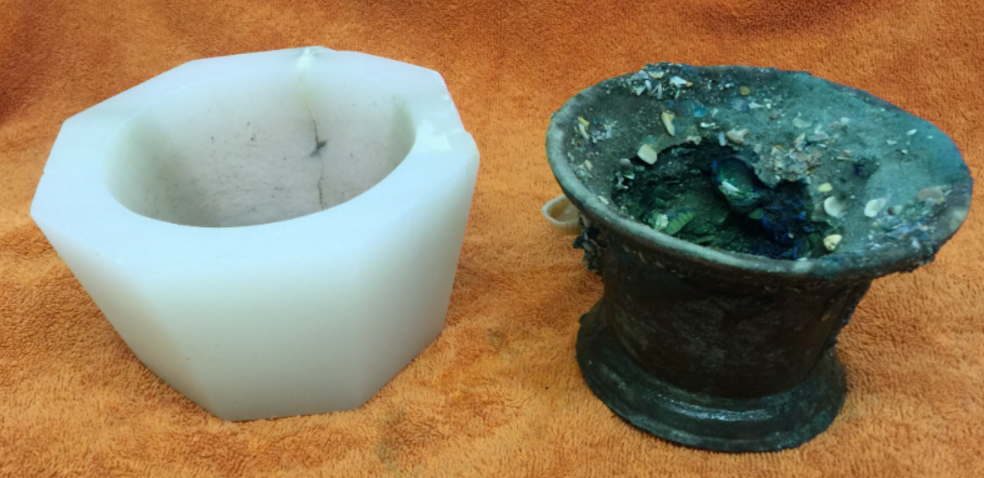 |
| Two of the Latest Finds by the Crew of the Capitana Submitted by Captain Jonah Martinez |
 |
| Bill B. With the New Finds. Photo submitted by Captain Jonah Martinez |
One appears to be alabastar and the other a copper alloy. Information sheet 18 from the Royal Pharmaceutical Society says the following.
Perhaps, the most distinctive pharmaceutical mortars are made from an alloy known as bell metal, comprised of copper and tin. The alloy melts easily and may be used again and again. They are known as bell metal mortars because they were made in foundries alongside bells. Historians often thought that mortars were made from alloy ‘left over’ after the casting of a large bell. Recent analysis has revealed that the copper-based alloy of most mortars contains a good deal more lead than tin...
Smaller mortars in a variety of materials were used on the pharmacy counter or in the dispensary. Mortars are always made with an associated pestle used to grind the substance within the mortar. However it is very rare for a historical mortar to have survived with its original pestle...
These appear to be the smaller variety.
Mortars are often decorated. Some have wording and/or the mark of the maker or owner. Mortars can also sometimes be identified by design. Important identifying information might be present.
There should be two pestles remaining out there somewhere unless they've already been found.
Antique mortars seldom are sold with their original pestle. Usually they are sold with a replacement.
While the indigenous populations of South America also used mortars, those were usually made of basalt.
Common uses besides pharmaceutical include food preparation and making dyes.
Here is the link to the Royal Pharmaceutical Society information sheet.
http://www.rpharms.com/museum-pdfs/18-mortars.pdf
Thanks much for sharing again Jonah! Beautiful finds!
---
 |
| Source: nhc.noaa.gov. |
---
According to wikipedia:
| If birthright citizens are counted as immigrants, the US has about 80-85 million immigrants,[2] about 25-26% of the population, or about 34% of the world total. In the developed world only the US and Canada grant birthright citizenship.[3][4) |
When people talk about immigration of the past, they neglect to mention the controls that were exercised. People arriving at Ellis Island were thoroughly screened for illness, disability and an ability to take care of themselves. Many who spent everything they could borrow to make the trip were sent back either because of a illness, disability or not being able to show that they were able to provide for themselves. Imagine the heart-ache of sacrificing home and everything to come to America and then being put back on the ship for the long return home. One of my wife's ancestors faced exactly that fate.
Many of those that came earlier than that were often indentured servants who had to work for years to repay their passage.
The following is from UShistory.org.
This system seemed to benefit the servant as well. Each INDENTURED SERVANT would have their fare across the Atlantic paid in full by their master. A contract was written that stipulated the length of service — typically five years. The servant would be supplied room and board while working in the master's fields. Upon completion of the contract, the servant would receive "freedom dues," a pre-arranged termination bonus. This might include land, money, a gun, clothes or food. On the surface it seemed like a terrific way for the luckless English poor to make their way to prosperity in a new land. Beneath the surface, this was not often the case.
Only about 40 percent of indentured servants lived to complete the terms of their contracts. Female servants were often the subject of harassment from their masters. A woman who became pregnant while a servant often had years tacked on to the end of her service time. Early in the century, some servants were able to gain their own land as free men. But by 1660, much of the best land was claimed by the large land owners. The former servants were pushed westward, where the mountainous land was less arable and the threat from Indians constant. A class of angry, impoverished pioneer farmers began to emerge as the 1600s grew old. After BACON'S REBELLION in 1676, planters began to prefer permanent African slavery to the headright system that had previously enabled them to prosper.
Here is that link.
http://www.ushistory.org/us/5b.asp
---
Happy hunting,
TreasureGuide@comcast.net


