Showing posts with label disturbance. Show all posts

Sunday, July 30, 2017

7/30/17 Report - $130 Million In Sunken Nazi Gold. Pirates And The 1715 Fleet. Tropical Activity In The Gulf.


Written by the TreasureGuide for the exclusive use of treasurebeachesreport.blogspot.com.

Source: See FoxNews link below.

SS Minden, a German cargo ship scuttled in waters near Iceland during the early days of World War II, may contain a huge trove of Nazi gold.

The merchant vessel, which is 120 nautical miles south of Iceland, is in the international spotlight following the reported discovery of a chest containing up to four tons of Nazi gold on the wreck. The horde is valued at 100 million British pounds (approximately $130 million), according to news reports.

U.K. salvage company Advanced Marine Services (AMS) has reportedly requested permission from Icelandic authorities to cut a hole in the ship’s hull and remove the chest.

Here is the link.

http://www.foxnews.com/science/2017/07/27/sunken-wwii-ship-may-contain-130-million-nazi-gold.html

---

I found a very good web site about pirates.  I'll give you a few short excerpts that relate to our area just to give you some idea of the kind of information you'll find on that site.

The pirate population of New Providence was swollen in 1715 by a shipwreck off the Florida coast. This wasn’t just an everyday shipwreck. The dozen or so ships that were driven aground by a hurricane made up the Spanish plate fleet. In the hold of just one of the flag ships were three million silver pieces-of-eight, gold bars and coins, pearls and jewellery. The second ship of the fleet was almost as heavily loaded, with another three million pieces-of-eight, and there were nine more ships with smaller quantities of treasure....


Pirates close in

Soon, of course, English officials sat up and paid attention. The first was the governor of Virginia, who wrote to his bosses in London that
The Spanish plate fleet, richly laden, consisting of eleven ships, are, except one, lately cast away in the Gulf of Florida to the southward of St. Augustine …I think it my duty to inform his Majesty of this accident which may be improved to the advantage of his Majesty's subjects by encouraging them to attempt the recovery of some of that immense wealth.
Archibald Hamilton, the governor of Jamaica, also took an interest in the wreck. In fact, he took a very close interest indeed. Towards the end of November, not long after divers had stopped work for the winter, he sent two ships to sea. According to Hamilton, the Eagle and the Bathsheba were on a pirate-hunting mission that would last six months. Since Jamaica was itself a den of pirates, and had grown rich on the buccaneering trade, this perhaps seems rather surprising. So too was Hamilton’s choice of captain: he picked one Henry Jennings to command the Bathsheeba.

Jennings was no stranger to piracy – or at least, to its more upright brother, privateering. Jennings had successfully attacked Spanish ships in the war that had recently ended. Possibly Hamilton believed that Jennings’ experience as a privateer would make him a very effective pirate hunter, just as poachers make the best gamekeepers. But it’s much more likely that the governor and the captain had something altogether different in mind. Certainly Jennings wasted no time. The Eagle, the Bathsheba and three sloops sailed straight to the salvage site with 300 men.
Mooring their ships off-shore, the pirates waited until nightfall, cleaning their pistols, and sharpening their cutlasses ready for the attack. Then, armed to the teeth, they rowed to the sandbank. The raiders pulled their boats up the beach, well beyond the reach of the pounding surf that hid the sound of their approach. Then they lay low until dawn. The following morning, the company regrouped and drew their weapons before marching across the sand to the Spanish camp. Finding himself surrounded and outnumbered five-to-one, the Spanish commanding officer stared down the barrel of Henry Jennings flintlock pistol, then quizzically asked “Is it war?”.
“No” said Jennings “We have come to fish for the wrecks.”
“There is nothing of yours here…” replied the officer “…the vessels belong to his Catholic Majesty the King of Spain, and I and my people are looking for the treasure.” ...

That is actually a fairly long excerpt, but a very small portion of what you'll find on the site.

Here is the link.

http://www.piratechart.com/pages_ages/golden_age.php

---

On the Treasure Coast we still have a small surf.

There are now two disturbances: one in the Atlantic and one in the Gulf.

The one in the Atlantic is not expected to strengthen real soon.  The other, however, is close to the Florida Panhandle and has a twenty percent chance of becoming a cyclone in the next 48 hours.

Source: nhc.noaa.org
Happy hunting,
TreasureGuide@comcast.net

Tuesday, August 2, 2016

8/2/2016 - More Great 1715 Fleet Finds From the Crew of the Capitana. Weather System Moving Through Caribbean. Immigration.


Written by the TreasureGuide for the exclusive use of treasurebeachesreport.blogspot.com.

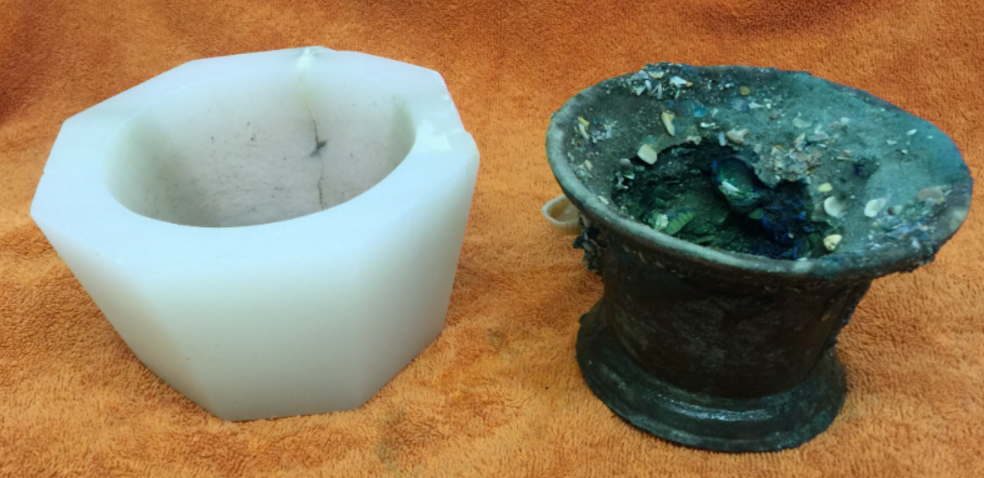
Two of the Latest Finds by the Crew of the Capitana
Submitted by Captain Jonah Martinez
Bill B. With the New Finds.
Photo submitted by Captain Jonah Martinez

One appears to be alabastar and the other a copper alloy.  Information sheet 18 from the Royal Pharmaceutical Society says the following.

Perhaps, the most distinctive pharmaceutical mortars are made from an alloy known as bell metal, comprised of copper and tin. The alloy melts easily and may be used again and again. They are known as bell metal mortars because they were made in foundries alongside bells. Historians often thought that mortars were made from alloy ‘left over’ after the casting of a large bell. Recent analysis has revealed that the copper-based alloy of most mortars contains a good deal more lead than tin...

Smaller mortars in a variety of materials were used on the pharmacy counter or in the dispensary. Mortars are always made with an associated pestle used to grind the substance within the mortar. However it is very rare for a historical mortar to have survived with its original pestle...

These appear to be the smaller variety.

Mortars are often decorated.  Some have wording and/or the mark of the maker or owner.  Mortars can also sometimes be identified by design.  Important identifying information might be present.

There should be two pestles remaining out there somewhere unless they've already been found.

Antique mortars seldom are sold with their original pestle.  Usually they are sold with a replacement.

While the indigenous populations of South America also used mortars, those were usually made of basalt.

Common uses besides pharmaceutical include food preparation and making dyes.

Here is the link to the Royal Pharmaceutical Society information sheet.

http://www.rpharms.com/museum-pdfs/18-mortars.pdf

Thanks much for sharing again Jonah!  Beautiful finds!


---


Source: nhc.noaa.gov.
As you can see, the disturbance I've been watching is in the Caribbean Sea.  It looks like it will cross Yucatan and hit Mexico, so won't affect us much.

---

According to wikipedia:
If birthright citizens are counted as immigrants, the US has about 80-85 million immigrants,[2] about 25-26% of the population, or about 34% of the world total. In the developed world only the US and Canada grant birthright citizenship.[3][4)
That is a figure that surprised me.

When people talk about immigration of the past, they neglect to mention the controls that were exercised.  People arriving at Ellis Island were thoroughly screened for illness, disability and an ability to take care of themselves.  Many who spent everything they could borrow to make the trip were sent back either because of a illness, disability or not being able to show that they were able to provide for themselves.  Imagine the heart-ache of sacrificing home and everything to come to America and then being put back on the ship for the long return home.  One of my wife's ancestors faced exactly that fate.

Many of those that came earlier than that were often indentured servants who had to work for years to repay their passage.

The following is from UShistory.org.

This system seemed to benefit the servant as well. Each INDENTURED SERVANT would have their fare across the Atlantic paid in full by their master. A contract was written that stipulated the length of service — typically five years. The servant would be supplied room and board while working in the master's fields. Upon completion of the contract, the servant would receive "freedom dues," a pre-arranged termination bonus. This might include land, money, a gun, clothes or food. On the surface it seemed like a terrific way for the luckless English poor to make their way to prosperity in a new land. Beneath the surface, this was not often the case.


Only about 40 percent of indentured servants lived to complete the terms of their contracts. Female servants were often the subject of harassment from their masters. A woman who became pregnant while a servant often had years tacked on to the end of her service time. Early in the century, some servants were able to gain their own land as free men. But by 1660, much of the best land was claimed by the large land owners. The former servants were pushed westward, where the mountainous land was less arable and the threat from Indians constant. A class of angry, impoverished pioneer farmers began to emerge as the 1600s grew old. After BACON'S REBELLION in 1676, planters began to prefer permanent African slavery to the headright system that had previously enabled them to prosper.


Here is that link.

http://www.ushistory.org/us/5b.asp

---

Happy hunting,
TreasureGuide@comcast.net

Saturday, October 11, 2014

10/11/14 Report - Silver Air Force Gunner's Wings Found. Couple Examples of Detected Old Coins Mounted In Jewelry. Disturbance 1 Possibly Developing.


Written by the TreasureGuide for the exclusive use of treasurebeachesreport.BlogSpot.com.


WWII U.S.A.F Gunner's Wings
Find and photo by William M.

William M. says he has been on a bit of a roll.  

Here is one of his nice sterling silver finds - Air Force
Gunner's wings.

William is one of the Treasure Coast guys that does a lot of inland hunting and really likes the old stuff.

Thanks or sharing William.

Here are a couple of links to good information and photos of USAAF wings, including gunner's wings.  Also some nice history and details.  Read about sweetheart wings too.  Good reading.


http://www.anaspides.net/military/aviator_wings.html#sterling_silver
.

http://www.anaspides.net/military/aviator_wings_american.html


A few days ago I talked about mounting found coins in bezels.  At the time I showed one bimetallic Italian coin that was found already mounted.  It was not the nicest example. 

Today I have a couple prettier examples of detected mounted coins.

The first is mounted on a nice pendant and chain, as found.  It is all quality work.


Gold Chain With Mounted Coin in Pendant.
And below is a two-escudo mounted in a ring.


Two-Escudo In Ring.


Those are just two examples.  I think they show how nice mounted coins can be and how you can do something with them that is a little more fun.

Fay is still out there in the Atlantic and not predicted to affect us.

The biggest change that I see is that the next disturbance heading West now has a 30% chance of developing into a cyclone in the next 48 hours.


Source:  www.nhc.noaa.gov

 
October or November often gives us at least one good beach ripping storm.  I'll be watching the two following Fay.

They are now predicting a 2 -3 foot surf tomorrow and around a 3 - 5 foot surf for Monday.  That still is not enough to improve beach detecting conditions enough.  Maybe a few slightly improved spots, but nothing that will likely wash out the old stuff yet.

We are getting enough activity right now to keep a good watch.

Happy hunting,
TreasureGuide@Comcast.net

Tuesday, August 19, 2014

8/19/14 Report - Three Surprises. One Dense Coin Hole. Brass Button Found. How To Reinforce Metal Detector Rod Stem.


Written by the TreasureGuide for the exclusive use of treasurebeachesreport.BlogSpot.com.

Concave Brass Button Found This Morning
I went out this morning to do a little detecting near low tide and had a couple of surprises.  The first was that my camera battery was dead.  That turned out to be especially disappointing because of the next surprise.

I was digging a target at the waterline while facing the beach when I heard something behind me.  I turned around a saw an unusually large manatee not much more than five yards behind me.  The beach dropped off very steeply there.  Anyhow I wish I had my camera working at that point.

I guess I need to check more than my detector before going out.  I did check my detector but not my camera.


I spent most of my time in an area not much bigger than ten square yards.  The targets were dense.  Probably near fifty coins and things in that small area.  Mostly modern coins.

 I like those kinds of areas even if most targets are nothing special.  When they are densely packed, there will usually be at least one or two better things.

I didn't get a picture because of the above mentioned reason, but I'll try to draw a diagram to show what it was like and how the targets were distributed.  I'll try to do that tomorrow.  It is instructive.

That was the kind of area that you can spot a mile away (exaggeration), and the kind of place that I would never pass up.

There was very little trash in that area. 

This area is seldom detected.  I don't think I've ever seen anyone else detect there over the years.


Whites detectors seem to have some problems with the plastic parts.  I don't know if they suffer from the Florida heat or what, but I've had a few broken plastic parts that received no unusual amount of stress.

The plastic part that connects one ear phone to the ear phone holder broke.   And two different lower rod stems broke. 

Working in the water does put more stress on a detector.  

In the old days I broke about six arm rests on an old Fisher Aquanaut before I got a metal one to replace the weak plastic ones. 

But since two Whites lower rod stems broke on me, that seems to be a weakness, and so I decided to reinforce that area.

Whites Reinforced Lower Rod Stem.
The above picture shows the reinforced lower rod assembly.   A section of pvc pipe that would not fit over the entire lower stem without slitting was cut to a short length, and then the section was slit along the length of the section, and then slipped on over the lower stem.  The slit along the section of pipe allowed the short section to open just enough so that it would fit very tightly on the stem.   That should provide additional strength so that the stem will not break again.

The lines drawn on the pvc section shows the larger rod on the left, which the smaller diameter stem fits into.  Two pins go through both the larger rod and stem to hold the stem in place.

On the two breaks that I've seen, the stem broke at the lower of the two pins where the red line is drawn on the illustration.

We'll see if this reinforcement keeps the new rod stem from breaking.  I think it will.


One more surprise.  Treasure Coast conditions remain poor.  That is no surprise.  The button shown above was found.  That is a surprise, given the poor conditions.

It was found where old things have not been found before even though a lot of modern things have been found there.

The button is 2 centimeters in diameter, and is in unusually good condition, and appears to have a good bit of remaining gilt.  It must have been buried safely for a long time.   Unfortunately there is no back mark or anything to date or identify it.

The best web site about old Spanish military artifacts that I know of is the one listed in my rerference list.  

If you've never looked at it, you should.  The button information is absolutely great.

Here is a link to see similar buttons.

http://www.artifacts.org/Early%20Buttons.htm

The above button looks something like the example labeled Presidio.


Source: www.nhc.noaa.gove
On the Treasure Coast we still have a one-foot surf, and will for a while.

There are, however, two weather systems in the Atlantic to watch.  The one nearest us has a 30% of becoming a cyclone in the next 48 hours.

Happy hunting,
TreasureGuide@Comcast.net