Showing posts with label indentured servant. Show all posts

Tuesday, August 2, 2016

8/2/2016 - More Great 1715 Fleet Finds From the Crew of the Capitana. Weather System Moving Through Caribbean. Immigration.


Written by the TreasureGuide for the exclusive use of treasurebeachesreport.blogspot.com.
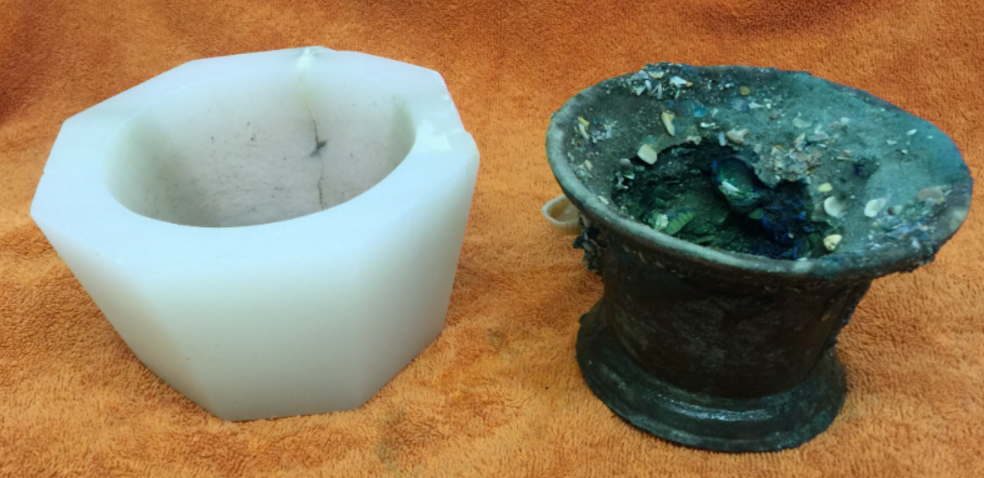
Two of the Latest Finds by the Crew of the Capitana
Submitted by Captain Jonah Martinez
Bill B. With the New Finds.
Photo submitted by Captain Jonah Martinez

One appears to be alabastar and the other a copper alloy.  Information sheet 18 from the Royal Pharmaceutical Society says the following.

Perhaps, the most distinctive pharmaceutical mortars are made from an alloy known as bell metal, comprised of copper and tin. The alloy melts easily and may be used again and again. They are known as bell metal mortars because they were made in foundries alongside bells. Historians often thought that mortars were made from alloy ‘left over’ after the casting of a large bell. Recent analysis has revealed that the copper-based alloy of most mortars contains a good deal more lead than tin...

Smaller mortars in a variety of materials were used on the pharmacy counter or in the dispensary. Mortars are always made with an associated pestle used to grind the substance within the mortar. However it is very rare for a historical mortar to have survived with its original pestle...

These appear to be the smaller variety.

Mortars are often decorated.  Some have wording and/or the mark of the maker or owner.  Mortars can also sometimes be identified by design.  Important identifying information might be present.

There should be two pestles remaining out there somewhere unless they've already been found.

Antique mortars seldom are sold with their original pestle.  Usually they are sold with a replacement.

While the indigenous populations of South America also used mortars, those were usually made of basalt.

Common uses besides pharmaceutical include food preparation and making dyes.

Here is the link to the Royal Pharmaceutical Society information sheet.

http://www.rpharms.com/museum-pdfs/18-mortars.pdf

Thanks much for sharing again Jonah!  Beautiful finds!


---


Source: nhc.noaa.gov.
As you can see, the disturbance I've been watching is in the Caribbean Sea.  It looks like it will cross Yucatan and hit Mexico, so won't affect us much.

---

According to wikipedia:
If birthright citizens are counted as immigrants, the US has about 80-85 million immigrants,[2] about 25-26% of the population, or about 34% of the world total. In the developed world only the US and Canada grant birthright citizenship.[3][4)
That is a figure that surprised me.

When people talk about immigration of the past, they neglect to mention the controls that were exercised.  People arriving at Ellis Island were thoroughly screened for illness, disability and an ability to take care of themselves.  Many who spent everything they could borrow to make the trip were sent back either because of a illness, disability or not being able to show that they were able to provide for themselves.  Imagine the heart-ache of sacrificing home and everything to come to America and then being put back on the ship for the long return home.  One of my wife's ancestors faced exactly that fate.

Many of those that came earlier than that were often indentured servants who had to work for years to repay their passage.

The following is from UShistory.org.

This system seemed to benefit the servant as well. Each INDENTURED SERVANT would have their fare across the Atlantic paid in full by their master. A contract was written that stipulated the length of service — typically five years. The servant would be supplied room and board while working in the master's fields. Upon completion of the contract, the servant would receive "freedom dues," a pre-arranged termination bonus. This might include land, money, a gun, clothes or food. On the surface it seemed like a terrific way for the luckless English poor to make their way to prosperity in a new land. Beneath the surface, this was not often the case.


Only about 40 percent of indentured servants lived to complete the terms of their contracts. Female servants were often the subject of harassment from their masters. A woman who became pregnant while a servant often had years tacked on to the end of her service time. Early in the century, some servants were able to gain their own land as free men. But by 1660, much of the best land was claimed by the large land owners. The former servants were pushed westward, where the mountainous land was less arable and the threat from Indians constant. A class of angry, impoverished pioneer farmers began to emerge as the 1600s grew old. After BACON'S REBELLION in 1676, planters began to prefer permanent African slavery to the headright system that had previously enabled them to prosper.


Here is that link.

http://www.ushistory.org/us/5b.asp

---

Happy hunting,
TreasureGuide@comcast.net

Friday, August 8, 2014

8/8/14 Report - Unusually Patinated Dug 1927 Quarter. Beach Coal. British Loyalist Wrecks. Genealogical Research Again.


Written by the TreasureGuide for the exclusive use of treasurebeachesreport.BlogSpot.com.


1927 Quarter With Unusual Gold Color Patina.

In my opinion this is the most attractive natural dug patina that I have seen on a coin. 

The gold color patina has a shine to it.  It is much more attractive in person.

I have no idea how the patina was created, but it is the way it was dug.

It has a melt value of about $3.60, but is rare enough that in poor condition should sell for around $9.00.  In excellent condition, it would go for around $250.  If it had an S mint mark, in excellent condition it would be more like $6000.


This one is poor condition, but the beautiful toning might raise the price a little.  I should check that out.

Other Side Same Coin Showing Same Gold Patina.

We often talk about the famed 1715 Fleet, but there are plenty of other wrecks along the Treasure Coast.  The Roberts and Spring of Whitby are two that are well known. 

St. Augustine was a Spanish settlement first, but after that it was British.  Artifacts from a British fleet are now being studied by the St. Augustine LAMP Program.  Here are a few sentences from a recent article about that.

On New Year’s Eve, 1782, sixteen British Loyalist ships carrying evacuees from Charleston, S.C., ran aground while trying to enter the St. Augustine Inlet. More than 200 years later, archaeologists from the St. Augustine Lighthouse & Museum are carefully conserving artifacts recovered from one of those sixteen ships in hopes that they will reveal clues about these ill-fated vessels.
“Based on the artifacts we’ve recovered so far, we know this ship was part of a huge fleet that evacuated British Loyalists from the colonies near the end of the American Revolution,” said Chuck Meide, Director of the Lighthouse Archaeological Maritime Program (LAMP). “Our ship sailed from Charleston and was probably carrying both civilians and soldiers who were seeking refuge in St. Augustine. At that time in history, Florida was the closest British-held colony where evacuees could take shelter and try to start their lives again.”

Here is the link for the rest of the article.

http://historiccity.com/2014/staugustine/news/florida/lighthouse-hope-1782-cannon-yields-new-clues-46571

In Florida it is easy to focus on the Spanish history and forget some of our other history.  Don't forget the other shipwrecks that are out there.  And don't forget about later eras.

I was reminded that some wrecks are from later times when I found a few lumps of coal on a beach. 

 ... in 1911 coal was still the primary source of power for naval vessels. The Royal Navy had adopted oil for submarines and destroyers, and in most ships it was sprayed on coal to increase its combustion. But coal remained the principal fuel, especially for larger vessels like battleships. It was widely available, especially in Britain, where Cardiff coal mined in Wales was preferred by navies worldwide.

Here is the link for more about that.

http://www.epmag.com/archives/digitalOilField/5911.htm

But, of course, it wasn't necessarily from a coal powered ship.  The coal could have also been cargo.

Anyhow, there are wrecks besides the 1715 wrecks along our beaches, and reminders of those wrecks can pop up at different times.

The more you know, the more complicated things become.

I've mentioned before how much I've enjoyed and benefited from genealogical research.   I just read about some of my ancestors that departed Rotterdam for Philadelphia in August 1733.  That was the month after the Atocha sank.   It is interesting to make the connections.   While my ancestors were crossing the ocean, the Keys were a bee hive of salvage activity.

Those ancestors sailed on a ship named Elizabeth.  One died two days out.  After landing in Philadelphia, two boys were sold as indentured servants to pay for passage. 

From Wikipedia: Indentured Servitude in Pennsylvania.

As for indentured colonists, the reasons for entering into such an arrangement varied. Colonists might indenture themselves or their relations in response to economic circumstances. For example, parents unable to financially support their children might place them under indenture, since the terms of the agreement usually specified the provisioning of "meat, drink, lodging and washing."
Colonists also became indentured servants as punishment for some form of transgression or debt. In the case of the latter, individuals could present a "petition" to the courts, whereby they would "admit" to the debt and agree to fulfill their obligations by indenturing themselves. The indenture could be granted to the creditor or another party who paid the servant's debt.  Overall, however, only a small portion of the indentured servants in Pennsylvania derived from colony's residents.

Those of the "criminal" or "meaner" sort comprised another form of indentured servitude. For these individuals, indentured servitude provided a "conditional" alternative to judicially prescribed punishments. By serving a certain number of years under indenture, such persons would legally absolve themselves of their crimes. However, if these servants reneged on their contracts and returned to the home country, they would be subject to the penalty of death.

I was lucky to find a lot written about some of my ancestors.  It really makes history come alive, and it can provide many clues to good detecting sites.   I keep learning more and more.  You might enjoy researching your own family.


Occasionally we have some immigrants that come ashore on the Treasure Coast.  That happened recently.

http://www.wpbf.com/news/south-florida/treasure-coast-news/10-believed-to-be-illegal-immigrants-found-on-Hutchinson-Island/13478092#!bx8hMo

We have South winds and one foot seas for days to come.   I don't know a time when I've seen the water so smooth for so long.

I have some new modern jewelry finds to show.

Happy hunting,
TreasureGuide@Comcast.net