Showing posts with label Fort Pierce Beach. Show all posts

Monday, April 23, 2018

4/23/18 Report - Beach Reports. How Coins Move On A Beach. Tips For Cache Hunting.


Written by the TreasureGuide for the exclusive use of treasurebeachesreport.blogspot.com.

Beautiful Fort Pierce Beach Monday Morning.

Dumping More Sand and Money In The Big Black Hole. 
I went out to see what the higher surf did this weekend.  The answer is, not much.

Below are two photos of John Brooks Beach.

John Brooks Beach Monday Morning Near Low Tide.
There were some small scallops and peaks here.  You can see that in the photos.

The beach down near the water was pretty firm and flat.  Even zinc pennies were down a few inches.

The sand bar was out in front of the beach some thirty or so yards.

Notice the sea weed.
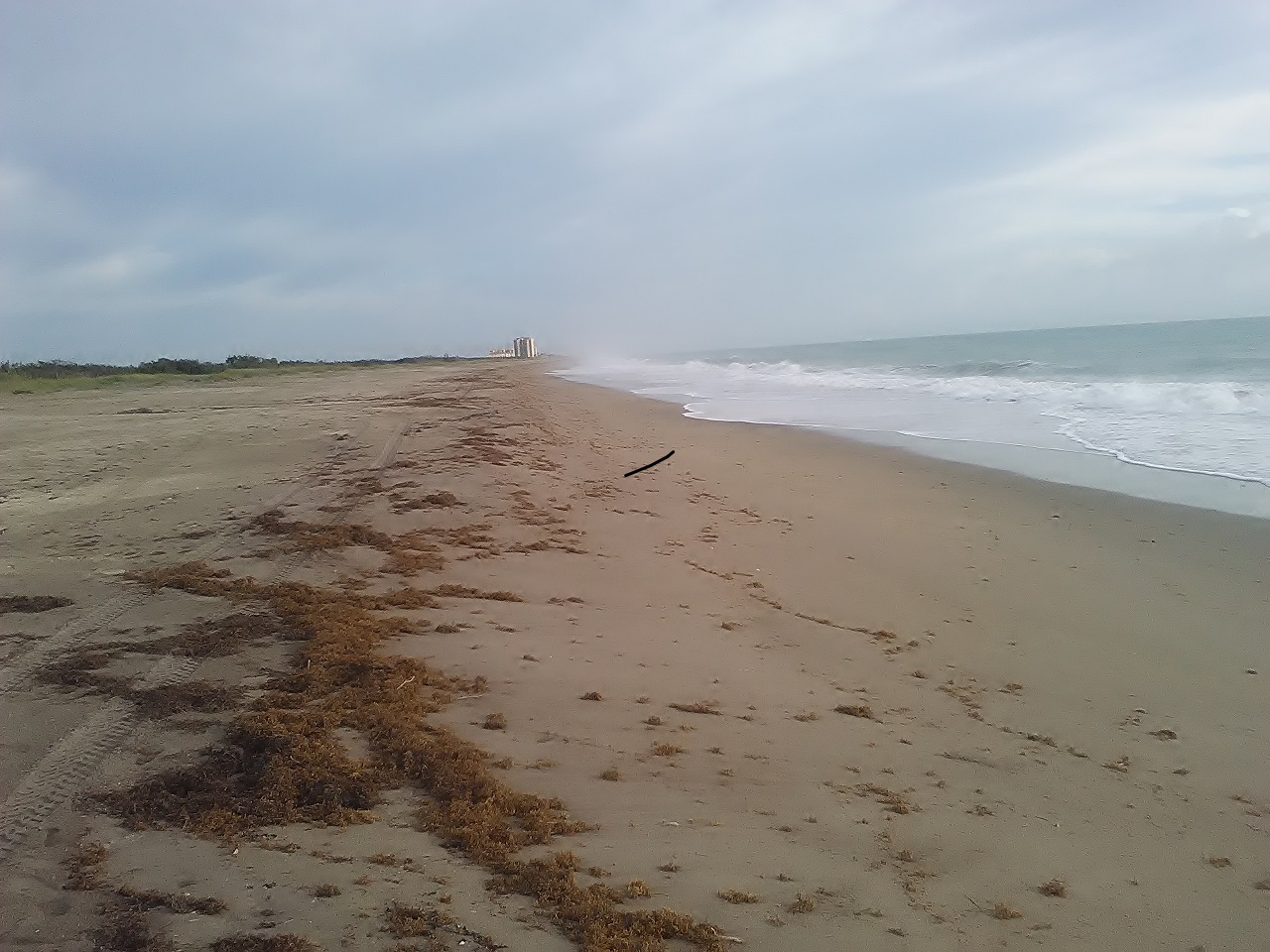
John Brooks Beach Near Low Tide Monday Morning.
A little farther south where there were some decent cuts back not too long ago, a lot of sand had accumulated and filled the cuts.

Blind Creek Beach.
There were good numbers of modern clad coins in the dry sand and a few in the wet sand this morning.  Those in the wet sand were at least a few inches deep.

---

I don't generally post YouTube videos, but it has been a while since I talked about the movement of sand and other objects, and SuperRick made this video that shows how a coin can quickly move in the shallow water near the water line.  I've observed the same thing and talked about it before, but this shows it.

https://www.youtube.com/watch?v=ttcQacW3F90&feature=youtu.be

Thanks Rick.

A coin that has just been uncovered so that it is on the surface can move quickly.  There are times when I'll throw a coin in the surf and track it just to observe how things are moving, particularly in front of a cut where there is a concentration of coins.

Back some time ago I did an experiment to determine what factors determine how much items are moved by the water.

Here is that link.

http://treasurebeachesreport.blogspot.com/2013/08/8513-report-what-actually-determines.html

Everybody talks about weight, but as I've explained many times, it isn't weight.  A ton of styrofoam still floats.  It is more about density and the shape of the object.

And here is a post about five ways coins move on a beach.

http://treasurebeachesreport.blogspot.com/2015/07/7115-report-five-ways-coins-move-on.html

---

A couple people offered good suggestions for hunting in an area like the area where the ten dollar gold coin was found in a canning jar.

Dan B. suggested tuning into the canning jar and looking for more.  Since the jar was found under a piece of concrete he also suggested probing for concrete.  Good ideas.

You'll also recall the sifting experiment done by one reader that showed that only a small percent of the coins buried in one lot were found by repeated metal detecting sessions.  I featured that post for a while.  That reader also suggested that there were most likely much more buried at that site.  That is something I believe too.  There will be more on that in the future.

---

My Comcast has been out more than it has been working for several days now.  Really a pain.


The surf will be decreasing gradually for a few days.  I don't expect to see any improvement in beach conditions any time soon.

I'd really love to see some good cuts into old sand.  They have been very scarce the past couple of years.

Happy hunting,
TreasureGuide@comcast.net


Sunday, May 7, 2017

5/7/17 Report - Fort Pierce Beach. John Brooks. 18th Century Ship Interiors. Silver Bar. Lead Pipe.


Written by the TreasureGuide for the exclusive use of treasurebeachesreport.blogspot.com.

Fort Pierce Jetty  South
Beautiful Fort Pierce Beach is now a construction site.  Renourishment has begun.


This very course material was in a pile.  Most of the renourishment material was a fine grey powder.  I don't know if they are putting this course stuff on the bottom and then covering it up with the finer stuff or what.


Above is the narrow strip that can be accessed now.


John Brooks Beach Sunday Around Noon.
You could see the remains of an old cut.  In front of that was new mushy sand.

There were a lof of beach-goers out.  Most were now Florida residents.  Not nearly as many snow birds.

As I've been saying, the surf is small.  The weather is beautiful.  Not smoldering hot yet. 

---

Here is a good thesis to read.  The title is Eighteenth-Century Merchant Ship Interiors.

The study looks at a number of ships that are being excavated in the York River where they remained in fairly good condition.  Of course, the study also looks at related literature.  It also talks about where things were typically located on such ships and a shows a number of artifacts.

Here is a brief excerpt.


Here is the link.

http://nautarch.tamu.edu/pdf-files/Renner-MA1987.pdf

---

The red-coral rosary that I previously talked about sold in the recent Sedwick auction for $72,000, plus buyers premium.  Another item that brought in a lot of money was the 83 pound silver bar.  The winning bid for that bar was $55,220.  Below is the auction description.

Large silver bar #72, 83 lb 7.52 oz troy, Class Factor 1.0, dated "Po(tosi) 1622" in cartouche, foundry / assayer MEXIA in cartouche, five tax stamps (two different designs), fineness IIUCCCLXX (2370/2400 = 98.75% fine), manifest number DCCCCXXXII (932), silvermaster A, from the Atocha (1622). 13-3/4" x 4-3/4" x 3-3/4". Attractively marked "silver loaf" (typical shape) that is particularly interesting for the fact that it shows two kinds of tax stamps (three with lions and castles and two with monogram) and an "overdate" manifest number with the second C punched over a D (probably just a mistake), although the clarity of the assayer and date cartouches is remarkable as well. Most of tax stamps appear to be more complete than usual. The middle of the top of the bar contains the usual peanut-shaped assayer's "bite." At one end is what appears to be the letter V with an up-arrow to its left for the owner/shipper, who is/are apparently not listed on the manifest. The surface of this bar is relatively uncorroded, with a couple small pits on top that existed before sinking and mostly contain small pieces of coral now. From the Atocha (1622), with Fisher photo-certificate #S72.

---

Hollow Log Sewer PipeSource: See the link below.
Water and sewer pipes were made of wood back in the 18th century.

Here is a link.

http://www.sewerhistory.org/photosgraphics/pipes-wood/

I found the above when I was trying to find out when lead pipes were used.

I found this piece of lead pipe.  Really heavy!

Piece of Lead Pipe.

I learned that most cities in the United States quit using lead pipes for water by the 1920s although lead pipes were approved by national plumbing codes into the 1980s.  Lead pipes were used centuries ago.  I have no idea how old this one might be.

---

I'd like to see this beautiful weather go away.

Thanks for responding to the blog poll.

Happy hunting,
TreasureGuide@comcast.net