Showing posts with label canning jar. Show all posts

Wednesday, July 25, 2018

7/25/18 Report - Complexities of Detecting Coins Buried in Jars. The Silver Picture Frame Treasure Surfacing.


Written by the TreasureGuide for the exclusive use of treasurbeachesreport.blogspot.com.

Grant Surfacing to The Bottomline With Silver Picture Frame.
Photo submitted by Captain Jonah Martinez 
I posted a couple pictures of the frame yesterday, but here is one more.  Really great find!

If you didn't see the larger picture I posted yesterday, you should go back and take a look.

---

Coins have been around hundreds and hundreds of years  And they really haven't changed much.  The are usually round and flat with a design on two sides.   That is a basic design that has worked well and has remained little changed for centuries.

One thing that detectorists probably do not appreciate enough is the effect of the position of coins and other objects in the ground on the signal produced by a metal detector.  They usually assume that coins are lying with one face parallel to the coil.  That is how air tests are conducted and that is how depth measurements are usually taken.  But sometimes a coin can be on edge or at an angle, and that definitely affects the detector reading.

The amount of surface area presented to the coil is an important factor.  Tilting the coin (or the coil) affects that.

I gave some tips on cache hunting a couple days ago, and mentioned how you never know what metals or items might be in a cache.  The container itself might be what you detect, and the container will seldom be made of a precious metal.

Like I mentioned, canning jars or cans are sometimes used.  Not too long ago 23 Peace and Morgan silver dollars were found in a canning jar.  There are a lot of variables involved in how a metal detector might respond to that.  There were the coins and how they were positioned, but there was also a metal screw cap on the canning jar.  The position of the lid is another important factor.

I showed how the Ace 250 responded to a silver dollar not too long ago.  You'd think the signal would be much louder for twenty-three coins compared to a single silver dollar.  In this case, the silver dollars were stacked but not standing up.  They were wrapped in a rag and lying like a wrapped roll in the jar.  They were wrapped with a rag, but not as tight as they would be in a regular con wrapper.

The sound was louder than a single coin laying flat, but not as much as I expected.  They were standing on end next to each other, so the surface presented to the detector coil was nothing like it would have been if they were scattered out over the ground.

People often talk about the halo affect when talking about coins in the ground, but in this case, the coins were inside a glass jar, so there was no halo affect from the coins.  However there was a metal screw lid that was badly rusted.

Detecting the silver dollars lying in a row stacked on the ground without the jar, resulted in a signal that was somewhat louder than a single coin lying flat, but not by a huge amount. They were detected at about a foot.  That wasn't very much considering the amount of silver. The surface area presented directly to the coil is very important.  I should do a good demonstration and take some good measurements.

Another factor, as they were found, was the canning jar lid.  The jar could be buried standing up or lying down.  The lid could be facing the coil or on its side.  In this case the jar was lying, and the coins were in the position that I just described.

Here is a video showing how the jar full of silver dollars would sound if you sweep in one direction.


That was sweeping in one direction.

I advise sweeping at a 90 degree angle and observing the difference in sound when you are trying to figure out what the item might be.

Below is another short video.  This time the coil is moved 90 at a different angle.


I'm sure you noticed how different the signal was. 

If an object is round and the item is not made of different parts and the object is lying flat, you'll get the same signal no matter which direction you sweep your coil relative to the object.  That would have been the case if the jar was standing up and you swept over the lid of the jar.  In that case, you would be hearing the lid more than the coins inside the jar.

My point is that you can tell a lot about a buried object from the signal you get, especially when you sweep from more than one angle.  Mixed items or items lying at different angles can be more difficult to identify from the signal alone.  That can make cache hunting a tricky.  You are not looking individual coins or rings but mixed items that can be buried in a variety of ways.

----

There are no significant storms in the Atlantic and not much change in beach conditions.

Happy hunting,
TreasureGuide@comcast.net

Monday, July 23, 2018

7/23/18 Report - Cache Hunting: Tips and Misconceptions. Fisher Organization Salvage Activities.


Written by the TreasureGuide for the exclusive use of treasurebeachesreport.blogspot.com.

I've written about a couple of Florida cache finds this year.  Caches are found, but not real often.

Hunting for a cache is different than hunting for individual coins or pieces of jewelry, and a lot of what you read about how to find a cache is wrong.

The first thing about cache hunting, is you have to have reason to be looking for one.  If you just go out and cover a lot of ground, you might eventually find one, but the odds are very long against it.

Caches are rare, so it helps if you have reason to believe there might be one.  Of course if you are hunting the right kind of place, for example a historic home site, you should be aware that there is always the possibility of a cache being present.  If you don't want to miss any possible caches, you want to alert to a variety of types of targets that you otherwise might discriminate out.

If you read most articles about cache hunting, you'll probably read about things like two-box detectors for detecting really deep targets.  For many caches, a regular detector will work just fine if you aren't using too much discrimination.  The idea that every cache is going to be buried ten feet deep just isn't true.  People don't have to dig down ten feet to hide a cache.  There are other things that will hide a cache as well or better than a few feet of earth.

Someone who buries a cache, will usually hide it where they think they can find it again.  That means that the cache will be near landmarks or features - perhaps a tree, wall, fence or walk.  That can cause a problem for the detectorist.  They will not be able to detect the area well either because of physical obstacles, like walls, or noise from rebar or buried cables.  You can't detect with a two-box detector in small areas or around other big metal items.

The caches that I'm most familiar with were buried in canning jars, not treasure chests.  One cache was distributed around a home site with individual jars placed in different areas.  And each jar contained different kinds of coins.  You don't know what the container might be so you don't want to discriminate iron or a lot of other metals

If you've been hunting very long, you can probably easily tell the difference between a small surface target and a deeper large target from the sound of the signal.  You can't pay too much attention to your meter.  Many caches will give mixed signals because there can be signals from the container as well as the coins or whatever else is in the container.  They can be quite a mixed bag.

---

A very dark two carat emerald was discovered on 7/11/18 while the Magruder was working Emerald City.

The Magruder will be going back to the site of the Margarita to dig the virgin area on the northern trail near where the gold chalice was found years ago.  They will be using an airlift to excavate holes in the bedrock.

The Margruder was finding Ming Dynasty blue and white porcelain and olive jar shards on the Atocha site.

The Fisher organization will also be returning to the deep target site with Dolores.

---

I think it is amazing how little coins have changed over the past thousand years.  I guess they were well-designed for the job and worked well.  Mostly flat and round with designs on two sides.  It is fairly obvious what works well about that.

Anyway, I think coins will be going away before long.  Canada quit producing the-one cent coin in 2012.

Keys had a long run too, and are disappearing.

---

We had a nice west wind this morning, but there are no storms around, and the surf is only one to two feet.

Happy hunting,
TreasureGuide@comcast.net

Monday, April 23, 2018

4/23/18 Report - Beach Reports. How Coins Move On A Beach. Tips For Cache Hunting.


Written by the TreasureGuide for the exclusive use of treasurebeachesreport.blogspot.com.

Beautiful Fort Pierce Beach Monday Morning.

Dumping More Sand and Money In The Big Black Hole. 
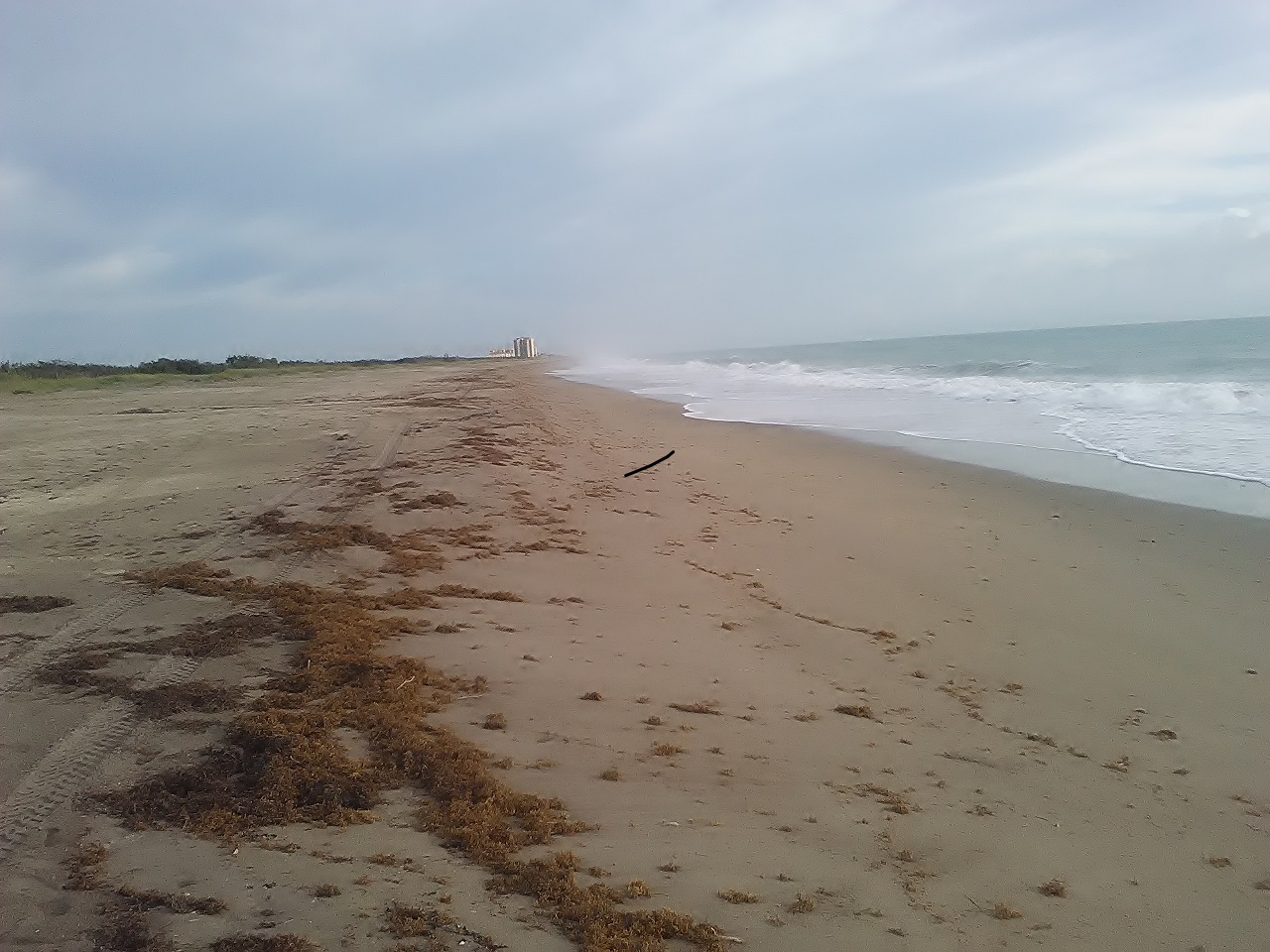
I went out to see what the higher surf did this weekend.  The answer is, not much.

Below are two photos of John Brooks Beach.

John Brooks Beach Monday Morning Near Low Tide.
There were some small scallops and peaks here.  You can see that in the photos.

The beach down near the water was pretty firm and flat.  Even zinc pennies were down a few inches.

The sand bar was out in front of the beach some thirty or so yards.

Notice the sea weed.

John Brooks Beach Near Low Tide Monday Morning.
A little farther south where there were some decent cuts back not too long ago, a lot of sand had accumulated and filled the cuts.

Blind Creek Beach.
There were good numbers of modern clad coins in the dry sand and a few in the wet sand this morning.  Those in the wet sand were at least a few inches deep.

---

I don't generally post YouTube videos, but it has been a while since I talked about the movement of sand and other objects, and SuperRick made this video that shows how a coin can quickly move in the shallow water near the water line.  I've observed the same thing and talked about it before, but this shows it.

https://www.youtube.com/watch?v=ttcQacW3F90&feature=youtu.be

Thanks Rick.

A coin that has just been uncovered so that it is on the surface can move quickly.  There are times when I'll throw a coin in the surf and track it just to observe how things are moving, particularly in front of a cut where there is a concentration of coins.

Back some time ago I did an experiment to determine what factors determine how much items are moved by the water.

Here is that link.

http://treasurebeachesreport.blogspot.com/2013/08/8513-report-what-actually-determines.html

Everybody talks about weight, but as I've explained many times, it isn't weight.  A ton of styrofoam still floats.  It is more about density and the shape of the object.

And here is a post about five ways coins move on a beach.

http://treasurebeachesreport.blogspot.com/2015/07/7115-report-five-ways-coins-move-on.html

---

A couple people offered good suggestions for hunting in an area like the area where the ten dollar gold coin was found in a canning jar.

Dan B. suggested tuning into the canning jar and looking for more.  Since the jar was found under a piece of concrete he also suggested probing for concrete.  Good ideas.

You'll also recall the sifting experiment done by one reader that showed that only a small percent of the coins buried in one lot were found by repeated metal detecting sessions.  I featured that post for a while.  That reader also suggested that there were most likely much more buried at that site.  That is something I believe too.  There will be more on that in the future.

---

My Comcast has been out more than it has been working for several days now.  Really a pain.


The surf will be decreasing gradually for a few days.  I don't expect to see any improvement in beach conditions any time soon.

I'd really love to see some good cuts into old sand.  They have been very scarce the past couple of years.

Happy hunting,
TreasureGuide@comcast.net