Showing posts with label Roosevelt Dime. Show all posts

Monday, July 22, 2019

7/22/19 Report - Corroded Silver Coin. Old Bottle Finds. Dates For Artifacts. Weather System Developing.


Written by the TreasureGuide for the exclusive use of treasurebeachesreport.blogspot.com.


Corroded Silver.

Can you identify the coin in picture above?

I think it is interesting how the corrosion causes different patterns on the silver.

If you could not tell what the one above is, can you tell from the picture below?


Same Object Shown Above.


The second photo is the same, with the same magnification, same lighting and everything, except it is more out of focus.

It is a silver Roosevelt dime.

I thought it might actually be a little easier to identify the Roosevelt profile in the out-of-focus photo.


---

The first old bottles I ever found at the beach were found after Hurricane Andrew in South Florida.  I was digging old coins when I noticed what looked like an old bottle in the surf.  The coins I were finding were old but were in terrible condition.  I decided to start collecting the old bottles.  I found a plastic bag on the beach and started collecting the bottles.

 One of the very first that I found was an embossed Gordon's Dry Gin bottle like the one shown here.

This is one I found not long ago.  Since the first one that I found, I've found a few similar bottles.  One was found recently.

Two Very Similar Gordon's Dry Gin Bottles.

I've found several now.  Only the first was found down south.  The others were found on the Treasure Coast.

They all have the wolf's head symbol on the bottom (below).

Bottom of Gordon's Dry Gin Bottle.
These are not very rare bottles.  As I said, I've found a few, and you can find them online.  It didn't take much research to find an age for the bottle.

They also have a number on the back.  The number is 610617.


No. On One Side of Same Bottle.
It didn't take much research to find an age.  The BayBottles.com web site (link below) says that number means the bottle dates to 1912 -1913.

Interestingly, Miami-Dade County voted itself dry in 1913.

The lips on the bottles are different.

Lips On Same Two Bottles.

The lip on the greener bottle looks more crudely made.  The lip of that one is applied over the neck, which makes a more narrow opening.

That would make me think the bottles might be of different ages.

The initial Gordon’s Distillery dates back to 1769 in London and they began making a form of dry gin sometime after the advent of continuous distillation in the 1830’s.

Gordon & Company merged with Tanqueray  in 1898 and it was around this time  that listings for Gordon Dry Gin began to appear in U.S. newspaper advertisements. The first mention that I could find in a New York City newspaper were several advertisements for Macy’s, who listed Gordons Gin under the heading “Fine Wines for Medicinal Use.”
See https://baybottles.com/2016/11/07/gordons-dry-gin-london-england-regd-610617/

Also https://www.thespiritsbusiness.com/2015/02/gordons-gin-a-brand-history/

---

When you talk about the date of an object, exactly what is the date of interest?  Do you want to know when the item was made, or when it was being used, or the date it was lost?  Maybe the date of interest is the date of an associated event, such as a battle or the sinking of a ship.

One thing that can be forgotten is that items, especially older items, were often used for long periods of time and might have been repaired or repurposed and reused for centuries.  An old tea kettle, for example, could be repaired many times with additional copper and rivets and then finally the copper turned into points, decorations or any of a variety of things and used again and again in different forms. I have a book that shows many dug artifacts that were manufactured out of the copper of old tea pots.  The life cycle of old objects could be very long, especially when you consider how the items were repurposed and the parts reused.

I once found a ;penny bearing the date 1909.  The penny appeared to show almost no circulation wear, but had a few big scratches.  It was found at the site of an old house that had just been demolished, not far from the corner of the house. The date on the penny was the same year that the house was built.  I wondered if it might have been placed with the laying of the cornerstone for good luck.  That was  not an uncommon practice.

Being marked with a date, coins can provide good reference points, however the date marked on the coin is the year it was made, which can differ very significantly from the the dates it was used or the date it was lost.  Very old coins can be lost after being safely stored for decades or centuries.

In this case the date of the penny matched the date the house was built.  I knew the date the house was built from my research.   Were the matching dates significant or just coincidence?  That question remains.

When we talk of salvaged shipwreck items we might be interested in the age of the item (when it was made), but just as often, I think we are interested in the date of the wrecking, especially when you have no better information about the date of the item.

In summary, when I attempt to determine the date of an item, there might actually be several dates of interest. I might be most interested in the date of manufacture, the date or time period when the item was in use, the date when it was lost, or the date of some important event associated with the item.

---

I added the GORDON'S DRY GIN bottles to my TGBottleBarn.blogspot.com site and added an archive gadget to make it easier to find old posts about other bottles.


Expect another week of small surf.

There is a weather system southeast of Miami that could develop.

Source: nhc.noaa.gov

Happy hunting,
TreasureGuide@comcast.net

Thursday, August 3, 2017

8/3/17 Report - Dug Silver and What It Looks Like. Antique and Collectible Keys Web Site.


Written by the TreasureGuide for the exclusive use of treasurebeachesreport.blogspot.com.

Object Found on Beach.
You might be surprised what it is.

Someone asked what silver coins and objects look like when they come out of the ground.  It isn't easy to answer that because it varies so much depending upon a number of factors.  Generally silver turns a darker grey to black when it has been on a beach for a while, especially if it has been in salt water.  Above is an example of a piece of silver found on a beach.

It is difficult to identify this coin from this view.  It looks something like a corroded silver cob.  Below you can see the other side of the same object.

Other Side of Same Object.
Can you tell what it is now?  It is a silver Roosevelt dime.

From the appearance, you could easily think that it might be something much older.  When you hold the above object, you can't really see the design very well unless you have the right kind of lighting.

Roosevelt dimes were made from 1946 to 1964, so I don't know how long the dime was on the beach, but it can't be more than 71 years, which might sound like a long time to some of you, but it isn't anything like a Spanish cob, which might have been out there for three hundred years.

Here is a new Roosevelt dime.  It is not silver, but you can match up the images.

New Not-Silver Roosevelt Dime

The older silver dimes were 90 percent silver and 10 percent copper.  The newer dimes are a "sandwich" of pure copper inner layer between two outer layers of cupronickle (75% copper, 25% nickel) alloy giving a total composition of 91.67% Cu and 8.33% Ni.

If you look at edge of one of the newer dimes, you can see a strip of copper.

You might remember when I suggested cutting a silver dime in halves or quarters and using the pieces as test objects for reales.  I said if you can detect piece of a silver dime, you can detect a small silver reale.  They are really very much alike.  In fact some reales from Potosi were assayed and found to have about 10 percent copper content like even though they were not supposed to have that much copper content.

Silver can be encrusted or discolored, depending upon where it has been.  It is really difficult to give a single answer saying what silver will look like when it comes out of the ground.  You can, however, with a good amount of experience, learn to identify silver most of the time from just looking at it, no matter how badly corroded it might be.

Like I said above, the appearance of silver will vary depending upon where it was found.  The silver coins I found in a cold water lake in Minnesota were more of a bluish tint, for example.  They did not corrode much at all compared to those found on a salt water beach or around mangroves.  Salt water beaches and acid soil are both very hard on silver.

For the person that asked what dug silver looks like, you'll find many examples if you read back through the old posts.  Some are shown before and after cleaning.  You can also see Spanish reales in various states of cleaning.

I also found that you can almost always tell a silver coin from the sound it makes when you drop it on a ceramic tile.  Try it.

---

Hotel keys used to be very common beach finds.  That was before the more modern key cards.  I found gallons of hotel keys.  Some were the nice big ornate brass keys, while others were smaller and had those large plastic tags bearing the name of the hotel and room number.

I found this very useful web site about antique and collectible keys.

http://www.collectorsweekly.com/tools-and-hardware/keys

---

There is nothing much to watch in the weather right now.  There is one disturbance just coming off of Africa, but it is too early to pay it much attention.

We're in for more one to two foot surf on the Treasure Coast and south winds.   That means hot weather.

Happy hunting,
TreasureGuide@comcast.net

Saturday, March 5, 2016

3/5/16 Report - Cross Between A Coin And Nail Auctioned. Metal Detecting Survey of Battle Site. Surf To Increase.


Written by the TreasureGuide for the exclusive use of treasurebeachesreport.blogspot.com.

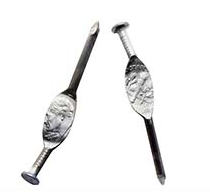
Yesterday I asked what would a cross between a horse and mule be called?  That wasn't a difficult question.  I have an more difficult question today.  What would you call a cross between a nail and a dime?  Maybe nime or dail.  I call it really neat.

Error coins aren't all that unusual, but this one is.  A zinc-coated sexpenny nail somehow got into the coin production line and got stamped with the Roosevelt Dime die.

Sixpenny Nail Roosevelt Dime.
This particular error coin was graded MS65 PCG.  It sold for $42,300 on Jan. 6, 2016 in a Florida United Numismatists U.S. Coins Signature Auction.

Here is one link to an article about that.  And here is another.

The second article says, This coin struck onto a nail is not the first coin to have such a distinction. A few examples of cents struck onto nails were discovered in the 1970s. The total number of similar errors, including this one, is thought to be approximately six.

What would have happened if a detectorists heard the signal from that item.  Would you have left it in the ground?  There is a good chance you would.

---

A metal detecting survey on the site of the Battle of Killiecrankie ... has unearthed dozens of items linked to the famous 1689 skirmish.  The artefacts include a copper alloy pendant, a harness boss, two buckles, part of the support for a sword belt, horse shoes, buttons, and musket munitions. 

...To augment previous studies undertaken on the battlefield site, Guard Archaeology have undertaken a metal detecting survey at Killiecrankie Battlefield over summer 2015. Guard were assisted in the work by the Centre for Battlefield Archaeology Glasgow University and metal detectorists from Detecting Scotland and the Scottish Artefact Recovery Group. 

The battle of Killiecrankie took place on the 27 July 1689 between a Jacobite army under the command of John Graham of Claverhouse, 1st Viscount of Dundee ‘Bonnie Dundee’ - and a Government army commanded by General Hugh Mackay. The armies came face to face at Killiecrankie as both were attempting to reach Blair Atholl to use it as a base for future operations. - See more at: 

http://www.transport.gov.scot/news/a9-unearths-killiecrankie-battle-relics#sthash.hyOxhohd.dpuf

---

The wind turned north yesterday, but the surf didn't increase much.  The surf is supposed to increase up to 4 - 7 feet by Monday.  We'll see if that actually happens.

Happy hunting,
TreasureGuide@comcast.net

Monday, July 6, 2015

7/6/15 Report - Corroded Silver Coins. Corrosion As A Clue. Coins and Layers of Sand.


Written by the TreasureGuide for the exclusive use of treasurebeachesreport.blogspot.com.


 As you know finds come in a variety of conditions.  Some come up looking like they were lost yesterday and some barely survive.

Of course some were lost just yesterday, but some that were lost long ago, still look very good, while others that aren't as old have deteriorated to near nothing.

Silver shipwreck cobs are the same way.  Some show great full detail, while others are worn away to just a fraction of what they once were. The two sides of the same coin can be very different too.

It is very common for cobs that are found on an ocean beach to have lost as much as one third of there original weight.

As I said yesterday, I've been looking at some old finds that I never really looked at very well.  In that group were a good number of Rosies and Mercs in various conditions.

Here are two of the Mercury dimes in not terrible condition.

As you probably know, silver tends to turn black, especially when it has been in sea water.

On the other hand, silver dimes that I've found in cold fresh water lakes up North, have a more gun metal blue patina and very little erosion.

The two mercury dimes above were found on Florida ocean beaches.  I don't recall exactly where.

The second one (1934) is more corroded than the top one (1941) and shows sand still adhering to the surface.

The third is also a silver dime.  This one is much more corroded.   You can't tell if it is a Rosie or Merc or what.  It does appear to be a dime though.

Notice that it also has sand still adhering firmly to the surface.  That tends to cause a mottled rough surface that is very commonly seen on more corroded silver dimes that come from an ocean beach.

I went through several that looked like this yesterday, as well as some that were worn paper thin and some that were worn completely through in some places.

Those that were paper thin were either still round though.

Some reales show the same type of corrosion.  This half reale was found at Jupiter and has one very crisp side.  The side shown in the photo was completely covered with a thick shell crust when it was found.  The other side had no sand sticking to it and that side was completely visible when dug, but the details aren't as crisp.  It seems the sand shell on the one side protected and maintained the surface of the reale.  After the sand shell was cleaned off using Muriatic acid, I saw what you see here.

Exactly how one side was so heavily encrusted and the other side not at all, I don't know.  My theory is that it rested in the sand dunes for hundreds of years unmoved.  It is hard to explain how one side attracted sand and the other side not at all.  Other cobs have been found paper thin, but still showing good detail.

Here is an uncleaned dime, which seems to have lost silver in a way that is relatively unusual for a silver dime.  They often maintain the round shape even when severely corroded.  I've seen very few silver dimes that have lost the round shape like this one.

On this one you can still make out some of the detail on the side shown in the photo.  There is no detail that can be seen on the other side.

If you look at the amount of wear, or lack of wear on a piece of silver, you might get some clue about where it has been.  If you can figure out where they have been, then you will better know where to look to find more.

Unfortunately I don't know now where these dimes came from.

I do know exactly where the half reale came from, and I am pretty sure that it just washed out of a sand dune before it was dug up.  I suspect that it was in the dune undisturbed for hundreds of years.  Undoubtedly in that time it was washed over by sea water at least a few times.  Perhaps that accounts for how one side got encrusted but not the other.

My main point today is that if you pay attention to your finds, you might get some clue to the source and therefore know where to look for more.

I suspect that coins that lose a lot of material, like the irregular shaped dime shown above, at some point was in the churning sand in the shallow water.  In contrast, I am pretty sure that was not the case for the half reale.

As a side note, I've coins found in acidic black soil around mangrove trees really corrode and dissolve.

---

A few days ago you saw in this blog how old shipwreck coins and items were found using blowers near shore.  A good bit of sand had to be moved to expose those items.  There are two ways that such items would have ended up under feet of sand.

Items that were lost during a hurricane might have been lost when tons of sand had just been removed and found their way down to near bedrock right away.

The other way is that items could be lost on top of layers of sand, either in the water or on the beach or on the dunes, and then gradually found their way to lower levels over the years and centuries.

Each time a layer is removed, the objects go deeper.  Sometimes they are covered again by new layers and remain there under the new layers until new erosion removes sand to deeper depths.

And of course there are times when coins and things are washed up with the new sand.  The coins that most recently washed up will then be in layers of sand above those that were in layers that previously eroded.

---

It looks like the surf on the Treasure Coast will be just a touch bigger this week, but not very much at all - it is still a smooth surf.

Happy hunting,
Treasureguide@comcast.net