Showing posts with label silver dime. Show all posts

Saturday, June 29, 2019

6/29/19 Report - Vacation Metal Detecting. Pigeon Island. Coin Cleaning. D. B. Cooper Mystery. Reader Comments.


Written by the TreasureGuide for the exclusive use of treasurebeachesreport.blogspot.com. 

Pigeon Island, St. Lucia.
Photo I took from resort across bay.

It's the time of year when you might want to take a vacation and go somewhere else.  Above is a photo that I took back years ago.

I made a number of personal firsts on that island.  I don't know if it was in the eighties or nineties, but it was a good trip.

If it looks familiar, I talked about it before in this blog, but you might have seen it on the Sandals TV commercial that has been running lately.  They show the island from almost the same angle.

Pigeon Island is now a National Park and there is an admission fee.  When I was there it was virtually abandoned.

I found grape shot, musket balls, military buttons, musket parts, and some other neat stuff.

It always made me laugh to watch the crab pull in their legs in and roll down the hill.

At the resort, I didn't do as well as expected - a lot of coins, but not a lot of gold.

One lady at a restaurant refused to accept the coins I found.  She said they looked like they had been burned.  I did spend most of them though.

I found this picture on the internet and added arrows to some of the places of interest that I remember

Aerial View of Pigeon Island From St. Lucia Commerce Web Site.
I added the arrows.

A.  Fort Rodney.  There was only one at the time I was there.
B.  Trash dump over the hill.
C.  Steep hill where things were found showing evidence of battle.
D.  Cave with indigenous carvings, supposedly also used by pirates.  Must dive to enter.
E.  Remains of old stone buildings.
F.  Building now converted to restaurant.
G. Cannon emplacement on other side of hill.

The causeway was made in 1972.  The red roofed resort in the photo wasn't there when I was.

Here is a little of the history.

Pigeon Island was first occupied by the Amerindians, mainly Caribs. The island was later occupied by pirates whose leader was a Norman Captain called Francois Le Clerc. He had a wooden leg and was known to the French as Jambe de Bois. The French who owned the island in 1778 declared war on the British, who retaliated by attacking them in Saint Lucia and capturing the island. The British then built a Naval Base at Gros-Islet Bay, heavily fortifying Pigeon Island. From there they were able to monitor the French fleet in Martinique which resulted in the defeat of the French at the Battle of the Saints in 1782. Pigeon Island was therefore a key factor in the Battles between the British and the French. In 1909 a whaling station was established at Pigeon Island. Legislation to control whaling in 1952 put an end to this operation. Pigeon Island was leased to Josset Agnes Hutchinson, an actress with the D’Oyle Carte Theatre of England in 1937. When the American established a Naval Base at Rodney Bay in 1940 she left the island. In 1947 she returned to establish a thriving yachting industry, entertaining many guests and giving the island the reputation of a paradise island. She relinquished the lease in 1970, finally retiring to England in 1976...

See https://www.slunatrust.org/sites/pigeon-island-national-landmark/

Here is a photo of a grape shot, which I left.  I wasn't about to take a chance it being considered an explosive.  It might still be snuggled between the roots of the tree where I left it.

Grape Shot Found on Pigeon Island.

54th and 74th Regiment of Foot and some other buttons were found.  I believe they came from the 1778 Battle of Morne de la Vierge, also known as the Capture of St. Lucia.

Pewter British Buttons.


I know a lot more about it now than I did when I was there.  I often find myself wishing that I knew then what I know now.  I don't care how much it has been searched or excavated, I know where I'd go to find artifacts, metal detector or not.

---

Same Dime Before and After Additional Immersion in Acid.
On the left is the silver dime after about 12 hours in Muriatic Acid.  After two additional similar periods of immersion, once with a strengthened solution (right), I can see no significant difference in the appearance of the surface.  My conclusion is that leaving the dime in a Muriatic solution for a period of time will achieve results.  Continuing immersion seems to produce neither additional results nor damage.

The difference in color of the two photos is caused by lighting, not a change in the color of the dime.

---

James F. added his thoughts on the article I posted about the "comtemporary archaeology" of Woodstock. 


Interesting to know that "Contemporary archaeology is a very big thing right now..," And I thought that I'd heard everything at this point. I have previously looked up the definition of archaeology in the past and find that it is defined as 1) the scientific study of historic or prehistoric peoples and their cultures by analysis of their artifacts, inscriptions, monuments, and other such remains, especially those that have been excavated. or 2) Rare. ancient history; the study of antiquity. Apparently "contemporary archaeology" meets none of those conditions. I studied archaeology as a minor course of study in college, and none of this new take on the subject really complies with the study of ancient or prehistoric cultures.


I find this sort of thing by the archaeological community as waste of time and resources...50-years later collecting surface samples from the Woodstock Festival. Seems like they are really reaching here, their scientific findings reveal Woodstock "...took on a life of it's own."  All they really needed to do was watch a few documentaries in full color with sound on the festival, filmed by people who were actually there, most of whom are still alive today. Or type "Woodstock" in the little window on YouTube for all the sound and video you could stomach. This is the sort of thing that may bring about the un-funding of archaeological groups...and maybe it should!

James F.

---

Here is an excerpt from a lengthy article on the D. B. Cooper skyjacking mystery.

… Eric Ulis has been researching the famous skyjacking for years. And like many amateur Cooper sleuths before him, he believes he’s solved the mystery. The Phoenix entrepreneur, one of the creators of the defunct poker-playing TV show “High Stakes Hold ’Em,” says he’s “98 percent” convinced that Peterson is D.B. Cooper.

That’s why he was hacking through thick foliage on Bachelor Island, near Ridgefield, Wash., last weekend. He believes the FBI misidentified Cooper’s “jump zone” and so searched the wrong stretch of forest in the weeks and years after the high-profile crime. This small isle along the Columbia River, most of which is part of the Ridgefield National Wildlife Refuge, offers pristine woodlands that have been largely untouched by humans for decades. Ulis has analyzed wind speeds, “free fall” data and other information that led him to conclude the skyjacker likely came down here...

Here is the link for more.

https://www.oregonlive.com/pacific-northwest-news/2019/06/db-cooper-search-leads-to-bachelor-island-ex-fbi-agent-says-suspect-will-get-away-with-it-unless-he-confesses.html

Thanks to Dean R. for that link.

---

More of the same beach conditions.  A lot of thunder early this morning, but just a little rain.

Happy hunting,
Treasureguide@comcast.net

Saturday, November 10, 2018

11/10/18 Report - Holed Mercury Dime. Holed 1851 Dollar Gold Piece. Silver Penny. Fronts Bringing Bigger Surf.


Written by the TreasureGuide for the exclusive use of treasurebeachesreport.blogspot.com.

"Holed" Mercury Dime
Find and photo by SuperRick.

Yesterday I was talking about "holed" coins.  SuperRick found the one shown above.  Here is the story that goes with that one, as told by Rick.


Coins with holes we all have found a few of them but last year one of the beaches that is right by our condo has some homeless staying on the beach at night. One guy told me that if I found a mercury dime with a hole in it that it was the one that he lost!

I'm coming off the beach one night and one of the guys said that he lost the keys to his car! So I said that I would try to find them for him and while doing that I get a hit on a dime and it turns out to be the mercury dime.

The guy that told me many months ago was sitting there on the beach and I told him that I had something for him! Here is the photos of the dime and me giving it back to him. The dime was given to him by his father who had passed away the look on his face was priceless, he couldn't thank me enough for giving it back to him!


Owner Showing Returned Dime.
Photo by SuperRick.

I find these guy quite interesting and when there are on the beach I always stop and talk to them. They have some very interesting stories to tell about how they became homeless. Basically, if you are living week to week anybody can become homeless! I learned years ago that you can learn from anybody and being homeless is a problem that can be overcome with some help.

Thanks SuperRick!

When hunting something for somebody else, it seemed like I always found something else good.

I was saying yesterday how "holed" coins have a story.  This one not only had a story but also a real emotional significance for the owner.

Notice the hole and how it is crudely made.   That adds a bit to the story.


---

Silver Penny and "Holed" Gold Piece
Photo by Sebastian Steve

Sebastian Steve sent the photo of the silver dime and "holed" 1851 one-dollar gold piece.

He said the penny shows no trace of copper - not even on the rim.

I don't recall if I ever mentioned it, but one day I got some very shiny quarters in change at a Dollar Tree store.  They really stood out as something special.   Turns out they were silver plated.

The United States Mint sells both colorized and silver and gold plated coins.

See https://www.usmint.gov/news/consumer-alerts/consumer/colorized-and-plated-coins

You can also buy plating kits and do it yourself.   Some jewelers do it.

Rio Grande Jewelry Supply sells all the necessary supplies and equipment that you might need.

See https://www.riogrande.com/category/tools-and-equipment/plating?c=0af4596e-db4a-497f-82c4-a7b80157fbc8&pageNum=1


Other Side Same Coins.
Photo by Sevastian Steve.


Here is what else Steve had to say about the gold coin.


A small addition to your story on “holed” coins. This 1851 $1 gold piece (type 1) was the -only- coin I ever found that was holed, in my thirty plus years of salvaging shipwrecks. This includes over one hundred wrecks in four of the five Great Lakes, and all the other regions of the world. You seem to have a lucky touch!

This very small coin... again picture being down at 160 feet deep in total darkness other than your hand held light, the swirling mud is all around you, as you gradually work away at a two foot vertical edge of rotting organic material. One of these $1 gold pieces flys by and behind you in an instant, and you just catch an instant of a “glint” of gold and it’s GONE. And you just sit there and go...”Oh Shoot!” Yeah right. Because now you have deposited this minute object into the “tailings” pile behind you! Good Luck!

Know this...just as any detectorist (worth his salt) knows... a site is never, ever totally barren of targets. Just the same principal applies on shipwrecks! And -that- is good news!

It’s ironic and funny in a way, that when I went to the web to locate a quick outline of these $1 gold pieces, up first came a “for sale” listing. And looks what it says! (Cleaned and x-jewelry). See what I mean?

These coins were designed by James B. Longacre and were only minted from 1849-1854. This Type 1 Liberty Head Gold $1 coin has been cleaned or may be ex-jewelry.

Interestingly... this holed coin that I found was on a small woman’s bracelet. Total junk, fell apart up in the boat already. But of course I saved the coin for “ show and tell” in my wallet. Along with an 8...in my wallet...makes good bar talk...


Thanks Steve.

---

It's about that time of year when we often get some good fronts moving through and historically have had some pretty good metal detecting days.

I could feel a west wind this morning and there is more to come.

Here are the surf predictions: three to five feet this weekend and then up to eight feet later.

Source: MagicSeaWeed.com.
Happy hunting,
TreasureGuide@comcast.net

Thursday, April 20, 2017

4/20/17 Report - Barber Dime and Other Fort Pierce Yard Finds. Small Surf and Tides. Satellite Views.


Written by the TreasureGuide for the exclusive use of treasurebeachesreport.blogspot.com.

1899 Barber Dime Find.
Find and photo by Erin A.
 I've said it before.  Detect your yard.  This dime, along with the mystery bar and some items I'll show below, was found in a Fort Pierce yard after a deck was removed.

Same Dime.
Photo by Erin A.
Here is an interesting bit of trivia.  According to forecasters, the farthest south snow had ever fallen in Florida was along a line from Fort Myers to Fort Pierce back in 1899. But now, for the first time on record, snow was falling in Southeast Florida, from West Palm Beach to Broward County and south across Miami-Dade.  (January 19, 1977 Sun Sentinel)

If the dime was clean and new, this is what it would look like.
Source: https://coinvalues.com/barber-dime/1899

I don't know the mint of the found dime.  That would have some impact on its value.

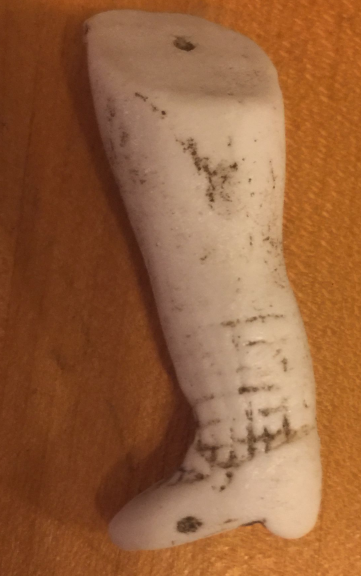
Also found in the same yard were the following (all by Erin A.).


2 Inch High Pineapple.
Doll Leg


Bullet

Weight.

Thanks for sharing Erin.

---

I recently removed some plants from an area of my yard and went over it with one detector.  Didn't find anything interesting.  I'll take another detector over it sometime soon.

---

Here is a web site you can use to view the earth from various satellites.  You might enjoy playing with it.

http://www.fourmilab.ch/earthview/satellite.html

---

It looks like we're stuck with two or three foot surf and flat tides.  In a few days we'll get bigger tides, including some negative tides, along with a more east/northeast swell.

Happy hunting,
TreasureGuide@comcast.net

Saturday, November 14, 2015

11/14/15 Report - Finds On An Inland Hunt. ID Help Requested. Surf Increasing On Treasure Coast


Written by the TreasureGuide for the exclusive use of treasurebeachesreport.blogspot.com.

Mystery Item.
What do you think it is?
As I said the other day, I was up north recently and did some detecting in an area that has a wooded path up a hillside that has been more or less continually used for hundreds of years.  Everything from Indian artifacts to yesterdays losses are found there.  That makes it difficult to tell what era unidentified finds might be from.

Here is one find that I'd like help in identifying.  The most obvious answer is drawer knob, although it is a little unusual for that.  For one thing, I think it is iron.  Another thing is that it is slanted oddly.

I'd like to hear your opinions on what it is.

Another item found along the path is this ring.  It is not silver or gold.  I think it is older and still needs some more cleaning.


The last ring I found on this path was a 1930s gold high school class ring.

I can not see how these stones are mounted.  I've looked at it under close magnification, but part of it is still encrusted.

It is a rather large size.  Too large to be a child's ring.  The band is broken and bent in.  It was in compacted rock and soil.


Copper coins found in this area are usually very corroded and many are unreadable.

Below are a few examples of that.

1939 Penny.
Totally Unreadable
Maybe Penny.
Barely Readable 1946 Nickle.

Here comes the exception.  The above coins were typical.  Not very readable.  Then comes this silver dime out of compact rock and soil just like it is shown.  I did not clean it or anything.

1957 Dime As Dug.
It still blows my mind.

This is the same general area where I found the 1829 large cent a year or so ago.

The silver Rosie would have about a dollar of melt value and a few dollars for collector value.

There were other finds.  I should have the good one ready for you soon.

There were a couple of things that struck me about this hunt.  One is that the path is not hunted out yet despite the number of times it has been detected, and not only by me.

The heavy weed coverage that protected the sides of the path in the spring was now gone.  That allowed me to detect where I couldn't easily detect then.  There is a seasonal aspect to hunting there.  Of course, the path will soon be covered by ice and snow.

Another thing that struck me, is how certain areas produced and others didn't.

On one side of the path there is a hump having a few inches of rock and soil over top of a layer of yellow clay.  The used part of the path is much lower, in some places a foot or so.  And on the other side of the path is a hill.  At the bottom of the hill on that side of the path, there were no targets other than junk. Old items were deeply buried beyond detector range there.

---

On the Treasure Coast the surf is increasing.  We're supposed to get something like five feet today and six tomorrow.

The wind was coming from the northeast or a while.

I hope to get out to see what is happening on the beach.

Happy hunting,
TreasureGuide@comcast.net

Monday, July 20, 2015

7/20/15 Report - Alternate Methods To Metal Detecting. Air Lift Dredge. Silver Rosie dimes. History of Shipwrecks Book.


Written by the Treasureguide for the exclusive use of treasurebeachesreport.blogspot.com.

90% Silver Rosie
Source: http://cointrackers.com/coins/839/2004-s-roosevelt-dime/

Metal detecting isn't the goal for most of us.  The goal for most people is finding things.  Metal detecting is just the method.

Sometimes people act as if metal detecting is the goal, but we shouldn't forget that there are other methods for finding things.  Sifting, dredging and eye-balling are a few examples.

There are times when other methods will pay off, and there are times when metal detecting just won't work.

Other methods might actually be the best choice in some situations.  One would be when metal detecting isn't allowed.  Another would be when valuable objects are not made of metal.  Another might be when there is too much overburden or junk.

There are times when you can eye-ball coins and things somewhat effectively.  For example, when a strong wind has scoured a busy dry beach.  I've done that.  You can find a good number of coins by eye-balling.  Or when there has been erosion at a good spot where coins and things are being uncovered in front of your eyes.  Or along streets or curbs.

There have been places like that where I have found a good numbers of coins.  While you obviously won't find buried coins by eye-balling, you can find uncovered coins, and in some cases you can follow up with a detector.

Eye-balling can be the first step in narrowing down where you want to spend your time detecting.  If you find a coin or two that has been just uncovered along the surf line that is a place to check with a detector.

A good thing about eye-balling is the ease of quickly scanning large areas.  It works best in busy areas where there might be high concentrations of targets.

You might eye-ball for bills along a fence line after a carnival, for example.  Or along a sea weed line.

I know of one dip in the water off of a busy resort where bills tend to collect.  Snorkeling for bills often produces a few ones, fives or twenties.

In my 6/15 report I posted about how Russ P. does some sifting sometimes when he doesn't have a promising detecting spot.  It is a lot of work, but can be effective in the right place and has the advantage of being able to uncover non-metallic targets as well as metallic.

One thing you might consider is an air lift dredge.  It is only for those who dive though.

Here is an illustration.  It isn't too hard to construct an air lift dredge and it can be used to lift metallic as well as non-metallic items.  Of course it is easier to buy than make if you have the money.

I believe the Fisher organization used an air lift dredge in areas known for emeralds.

The illustration shown here and the excerpt below is from Wikipedia.

Typically, the airlift is constructed from a 3 metre to 10 metre long, 10 cm diameter pipe. A controllable compressed air supply vents into the inside, lower end of the pipe (The input end always being the lower end). Compressed air is injected into the pipe in one to three second bursts with an interval long enough to let the resulting bubble to rise to the higher, output end of the pipe. The bubble moves water through the pipe sucking debris from the lower end and depositing it from the upper end of the pipe. Ejected debris can be either cast off (as in simply removing oveburden) or collected.

Here is a YouTube demonstration..  https://www.youtube.com/watch?v=LuHgxoFrz6s

Two problems with air lift dredges is that they are most effective in deeper water and are not easily moved.  A small gas powered dredge would work in shallow water.  Keene is one well known manufacturer of portable gold dredges.

There are other methods that I haven't yet discussed.  Some much less expensive and easy to construct.  I just wanted to make the point that metal detecting is not the goal, and that there are plenty of other techniques.  Also that there are situations when other techniques might even work better.

Of course, you can use different methods in combination too.  The bigger point is to keep thinking.

What inspired me to write this today is that I've been using some alternative methods lately but want to get some good pictures and record results before I post about them.  Just like with metal detecting, sometimes they don't work out real well, but sometimes they do.

---

I ran across a book you might want to take a look at.  It is History of Shipwrecks by Angus Konstam.
You can preview it free online.  Click on the underlined title above to go there.

---

Here is something to watch for even though it would be rare to find in circulation.  Starting in 1992 the San Francisco Mint  produced some 90% silver Roosevelt dimes, though all such silver dimes have been struck in Proof format.  A 2004 S dime would have a melt of around $1.00 and in mint state sell for around $6.00.

---

The Treasure Coast predictions are for a two-foot surf next Monday.  Normally I wouldn't pay any attention to that, but we haven't had anything that big for weeks, if you can believe that.  I never thought I'd see the day when a two-foot surf looked like a bump up.  It might not even happen.

Happy hunting,
TreasureGuide@comcast.net

Monday, July 6, 2015

7/6/15 Report - Corroded Silver Coins. Corrosion As A Clue. Coins and Layers of Sand.


Written by the TreasureGuide for the exclusive use of treasurebeachesreport.blogspot.com.


 As you know finds come in a variety of conditions.  Some come up looking like they were lost yesterday and some barely survive.

Of course some were lost just yesterday, but some that were lost long ago, still look very good, while others that aren't as old have deteriorated to near nothing.

Silver shipwreck cobs are the same way.  Some show great full detail, while others are worn away to just a fraction of what they once were. The two sides of the same coin can be very different too.

It is very common for cobs that are found on an ocean beach to have lost as much as one third of there original weight.

As I said yesterday, I've been looking at some old finds that I never really looked at very well.  In that group were a good number of Rosies and Mercs in various conditions.

Here are two of the Mercury dimes in not terrible condition.

As you probably know, silver tends to turn black, especially when it has been in sea water.

On the other hand, silver dimes that I've found in cold fresh water lakes up North, have a more gun metal blue patina and very little erosion.

The two mercury dimes above were found on Florida ocean beaches.  I don't recall exactly where.

The second one (1934) is more corroded than the top one (1941) and shows sand still adhering to the surface.

The third is also a silver dime.  This one is much more corroded.   You can't tell if it is a Rosie or Merc or what.  It does appear to be a dime though.

Notice that it also has sand still adhering firmly to the surface.  That tends to cause a mottled rough surface that is very commonly seen on more corroded silver dimes that come from an ocean beach.

I went through several that looked like this yesterday, as well as some that were worn paper thin and some that were worn completely through in some places.

Those that were paper thin were either still round though.

Some reales show the same type of corrosion.  This half reale was found at Jupiter and has one very crisp side.  The side shown in the photo was completely covered with a thick shell crust when it was found.  The other side had no sand sticking to it and that side was completely visible when dug, but the details aren't as crisp.  It seems the sand shell on the one side protected and maintained the surface of the reale.  After the sand shell was cleaned off using Muriatic acid, I saw what you see here.

Exactly how one side was so heavily encrusted and the other side not at all, I don't know.  My theory is that it rested in the sand dunes for hundreds of years unmoved.  It is hard to explain how one side attracted sand and the other side not at all.  Other cobs have been found paper thin, but still showing good detail.

Here is an uncleaned dime, which seems to have lost silver in a way that is relatively unusual for a silver dime.  They often maintain the round shape even when severely corroded.  I've seen very few silver dimes that have lost the round shape like this one.

On this one you can still make out some of the detail on the side shown in the photo.  There is no detail that can be seen on the other side.

If you look at the amount of wear, or lack of wear on a piece of silver, you might get some clue about where it has been.  If you can figure out where they have been, then you will better know where to look to find more.

Unfortunately I don't know now where these dimes came from.

I do know exactly where the half reale came from, and I am pretty sure that it just washed out of a sand dune before it was dug up.  I suspect that it was in the dune undisturbed for hundreds of years.  Undoubtedly in that time it was washed over by sea water at least a few times.  Perhaps that accounts for how one side got encrusted but not the other.

My main point today is that if you pay attention to your finds, you might get some clue to the source and therefore know where to look for more.

I suspect that coins that lose a lot of material, like the irregular shaped dime shown above, at some point was in the churning sand in the shallow water.  In contrast, I am pretty sure that was not the case for the half reale.

As a side note, I've coins found in acidic black soil around mangrove trees really corrode and dissolve.

---

A few days ago you saw in this blog how old shipwreck coins and items were found using blowers near shore.  A good bit of sand had to be moved to expose those items.  There are two ways that such items would have ended up under feet of sand.

Items that were lost during a hurricane might have been lost when tons of sand had just been removed and found their way down to near bedrock right away.

The other way is that items could be lost on top of layers of sand, either in the water or on the beach or on the dunes, and then gradually found their way to lower levels over the years and centuries.

Each time a layer is removed, the objects go deeper.  Sometimes they are covered again by new layers and remain there under the new layers until new erosion removes sand to deeper depths.

And of course there are times when coins and things are washed up with the new sand.  The coins that most recently washed up will then be in layers of sand above those that were in layers that previously eroded.

---

It looks like the surf on the Treasure Coast will be just a touch bigger this week, but not very much at all - it is still a smooth surf.

Happy hunting,
Treasureguide@comcast.net

Wednesday, April 15, 2015

4/15/15 Report - Different Detectors For Different Beach Hunting Jobs. Rosie and Merc.


Written by the TreasureGuide for the exclusive use of treasurebeachesreport.BlogSpot.com.


Two Silver Dimes With Different Patinas.


Before I start my main topic for today, here are two dimes with different patinas.  The Rosie is a 1963 that was graded by a coin dealer as proof.  The Merc is a 1944 and was graded AU.

The Rosie has a lot of lustre.  The Merc is more the color that you might expect, but the surface is duller.

Under magnification you can see that the bluish color on the Rosie is a very thin coating that has not affected the sharpness of the coin's details.   Both have been stored in a plastic coin holder for a good twenty plus years.

Just an example.  Now on with my main topic for today.

-----

Yesterday I began a comparison of three different types of metal detectors that could be used for beach hunting, but I only got the first done.  Today I'll get to the other two.

The purpose of talking about these three detectors isn't so much about the three specific detectors, it is more about how different types of detectors have different strengths and weaknesses and about how strategic decisions of detector selection should be made.  This discussion is therefore not a detailed analysis of each of the detectors or a analysis of depth or performance, but rather more of a discussion of features and how those features help determine how different types of detectors might be used strategically.

I started with the Ace 250 yesterday, which is a detector that would be a decent choice if and when the strategy is to quickly sift through dry sand for modern coins and jewelry, especially when there is some junk.  The disadvantage of the small stock coil on the Ace is compensated by the ability to quickly pinpoint and identify targets and the ability to hunt close to metal obstacles such as beach chairs.

The Excalibur is used by many Treasure Coast beach hunters who tend to be more oriented to old shipwreck items.  Treasure Coast beach hunters, as contrasted with South Florida beach hunters, tend to focus more on targeting old shipwreck items and generally hunt less crowded beaches that are visited by more conservative beach-goers.

The Excalibur, of course, costs about four or five times what the Ace costs.  The Excalibur is water proof and can be submerged for water hunting.   That makes it more versatile.  If you want similar performance at half the price and don't need a waterproof detector, the Minelab Sovereign would do about the same job while costing less.

Unlike the Ace, the Excalibur has simple linear discrimination.  One discrimination knob is used for discrimination and another for sensitivity.

The Excalibur is simple to operate.  There is no ground balancing.  It performs about equally well in dry sand, wet sand and under water.  It will do a good job almost anywhere on a Florida beach.  You can start in wet sand and decide to scan a little dry sand or go into the water and dive with it. That is all good and easy.  You can discriminate but even with no discrimination, the Excalibur is not as hot for iron as some detectors.

The biggest difficulty that I see with the Excalibur is with the casual detectorist who tries to use the Excalibur in the wet sand in motion mode.  The less experienced detectorists can find detecting difficult where the water is coming and going.

I once had a guy come up to me and ask me what settings I was using because he saw me working the wet sand where the water was moving in and out and he was trying to do the same and was having trouble.   The main difference was that he was working in the motion mode and hadn't made any other adjustments, while I was using the pinpoint mode, as I almost always do with the Excalibur.

Anyhow, the Excalibur is a good sturdy general-purpose detector with some discrimination that has a good response to gold and small targets such as small cobs or small gold rings.  If you are hunting shipwreck items in wet sand, it is an easy choice over the Ace, whereas if you are hunting the dry sand, the Ace might be the best choice in some situations.  The Ace is also much lighter to swing on dry land.

While the Excalibur is used by many on the Treasure Coast, the Minelab CTX 3030 is very prominent on South Florida beaches.  The CTX costs about twice as much as an Excalibur.

The CTX has a lot more features and settings than the Excalibur, including a screen for target ID, various program selection, GPS, etc.  Instead of a few knobs, the CTX provides a lot of flexibility and options.

South Florida beaches have a lot more valuable modern jewelry and that is what the hard-core guys down there focus on most of the time.   It is also easier to justify the additional cost of a more expensive detector in South Florida where you can hunt in the water more of the year and where there is a lot more expensive jewelry to be found.  The additional expense can often be paid off by a single find.

I mention the relative prominence of the Excalibur on the Treasure Coast as compared to the CTX in South Florida only to point out how situations affect detector selection.

The third detector that I want to discuss is the Garrett ATX.  The ATX is often used in the gold fields and has good sensitivity to small gold.  The cost of the Garrett ATX (just over $2000) is close to that of the Minelab CTX.

The ATX is very different from the Ace, the Excalibur and the CTX, which I just discussed in passing.

I've discussed the ATX some in recent posts.  The keep it short, the ATX is a not the easiest detector to use straight out of the box - at least not if you want to be absolutely sure that you are getting good performance from it.

The ATX is a Pulse Induction detector and is very sensitive to small iron.  If you are someone who likes using a lot of discrimination, the ATX is not for you. The Excalibur is not overly sensitive to iron, but the ATX is very sensitive to iron.  Yes the ATX offers discrimination, but if you use much of it, you will really reduce sensitivity to good low conductive targets and negate the very features you paid for.

The ATX has both a non-motion and motion mode.  The non-motion mode is the most sensitive, but also the most difficult to use.  Even the manual states that the non-motion mode is not for beginners.

To get near optimal performance out of an ATX requires experience and skill.  If you want maximum sensitivity and depth, which is considerable with the ATX, you need to get the settings right.

So when would you use the ATX on a beach or in the shallow water?  My answer is, When you want the best depth on small valuable targets and have the patience and skill to deal with junk.  

The ATX will detect near microscopic pieces of iron, but it also gives you good sensitivity to small gold.  It will detect a small gold ring deeper than it will detect a clad dime. You will get good depth on small gold IF you use the ATX well.

There are a lot of options and settings on the ATX.   Careful adjustment and proper use will pay off in good performance.

There are times when the ACE, costing around $250, would be the better choice than the ATX, which costs about ten times as much.  The ACE might well be the choice in dry sand when you want to quickly skim for modern finds, as one example.

This post is not about three or four detectors.  It is about making calculated strategic decisions based upon how features of different detectors match the circumstances and your goals.

----

Odyssey Marine Explorations stock has really fallen off as they are being sued by the Securities and Exchange Commission. 

-----

On the Treasure Coast we have another couple of days of smooth surf and South winds.  Nothing new or exciting about that.

Happy hunting,
TreasureGuide@Comcast.net