Showing posts with label corrosion. Show all posts

Friday, January 24, 2020

1/24/20 Report - A Couple Reales and Some Other Finds. Treasure Coast Beaches and Beach Developments.


Written by the TreasureGuide for the exclusive use of treasurebeachesreport.blogspot.com.

Four-Reale Found Wednesday.

The four-reale I showed yesterday needs some cleaning.  Much of the detail is obscured by a corrosion and crust.  Even the parts that look clean are not.  It took me a while to get the lighting so I could show some of the details.  In the photo above, you can see that the reale has the Florenza cross and was minted in Mexico.

Zooming in more, you can see that most of the surface, even the parts that look clean, is covered by crud (to use a technical term) and corrosion.

Close-up of Surface of Same Four Reale.
I think it will show more detail when it is cleaned some.

That four-reale was the first good target I dug Wednesday.  I dug a lot of small stuff that day too.

On the Equinox, using the factory preset settings, but in beach mode 1, the four-reale gave a coin tone, and the number I think was 26, or maybe 30.

I was very pleased that all the cobs I dug, whether it was the chunky 13 gram four-reale shown above or the small one gram half-reale that I dug a little later, resulted in what I'll call the coin tone, and none of the other stuff that I dug that day gave the coin tone.  If cobs are consistently identified as coins, that could be very handy at times.

I have not done a direct comparison under the same conditions, but suspect that the ATX might still be my choice to make sure I don't miss anything deeper.  With the ATX you can spend a lot of time digging very deep holes and trying to find very small nearly invisible targets.  I like the Equinox for doing quick general purpose scans, but might in some circumstances do a final check with the ATX.  I didn't have time to recheck with the ATX Wednesday.   Search strategies can get complex.  I'll have to do more posts on that someday.

Below is a pretty representative sample of the other miscellaneous small stuff I dug Wednesday in the same general area where I dug the four-reale.  I should have put a dime or something in for size comparison.  I'll look at some of these items more closely some other day.

Some Miscellaneous Small Stuff Dug Wednesday In The Same Area As Cobs.
I think a few of those are probably shipwreck related, but some are definitely modern junk, and I'm not sure about quite a few.  What I am pleased with is the equinox correctly identifying cobs with a coin tone while not giving a coin sound for any of these other various types of items.

Here is a quick look at another cob found Wednesday.  This one is the smallest cob I found that day, weighing just around 1 gram.  Again, it gave a coin tone just like the 13 gram four reale.

Half-Reale Found Wednesday.

The surface of this one is corroded almost exactly like the four-reale shown above.  I took close-up photos of the surface of both, but since the close-ups look so much alike I won't bother to show both.  They both have the same kind of grains attached and show the same kind of corrosion.

So what I'm going to do next is some cleaning on these and a couple more corroded cobs and take a closer look at some of the smaller miscellaneous finds.

DJ sent in the following photo showing the erosion control bags at Turtle Trail covered yesterday.


Turtle Trail 1/24

He also said, Went by Golden Sands where a sign said trucks entering and leaving, caution.
Two guys in orange vests were at the entrance... 


And,  Treasure Shores, strangely, had a photo shoot with about twenty vehicles and about 50 people milling around. 

Thanks DJ.


I think I showed a photo I took from there earlier in the day when the bags were just a bit more exposed.  That shows how the sand was accumulating at that spot during the day.


John Brooks Beach 1/24.

I took the John Brooks and Frederick Douglass photos just an hour or two ago.  I guess if you want to get the photos as soon as possible, it might help to Follow the blog.  Since I'm not peddling books or promoting anything, I don't know much about that, but I believe you get a notice when there is a new post if you are a blog follower.  I'm sure someone will correct that if I'm wrong.


John Brooks Near Low Tide 1/24.  

Some Detectorists Shooting the Breeze at Frederick Douglass 1/24

Frederick Douglass Near Low Tide 1/24


Frederick Douglass Near Low Tide 1/24

Of course beaches change continually.  Everybody knows that.  It is something like the stock market: there are minute by minute changes, daily changes and year over year changes.  A beach will continually change, but it helps if you know where it was recently as well as in the more distant past.  You can project some of the changes and develop some reasonable expectations if you know where the beach has been in recent days and what is going on that will affect the beach, which is the reason for the surf reports etc.  That is a big topic that will take a lot of posts.


The surf today was five to seven feet, dropping down to something like four or five feet tomorrow.  The decreasing surf can will give you access to spots you couldn't easily detect before.  There was a lot of open beach at low tide today.

Happy hunting,
Treasureguide@comcast.net

Monday, July 22, 2019

7/22/19 Report - Corroded Silver Coin. Old Bottle Finds. Dates For Artifacts. Weather System Developing.


Written by the TreasureGuide for the exclusive use of treasurebeachesreport.blogspot.com.


Corroded Silver.

Can you identify the coin in picture above?

I think it is interesting how the corrosion causes different patterns on the silver.

If you could not tell what the one above is, can you tell from the picture below?


Same Object Shown Above.


The second photo is the same, with the same magnification, same lighting and everything, except it is more out of focus.

It is a silver Roosevelt dime.

I thought it might actually be a little easier to identify the Roosevelt profile in the out-of-focus photo.


---

The first old bottles I ever found at the beach were found after Hurricane Andrew in South Florida.  I was digging old coins when I noticed what looked like an old bottle in the surf.  The coins I were finding were old but were in terrible condition.  I decided to start collecting the old bottles.  I found a plastic bag on the beach and started collecting the bottles.

 One of the very first that I found was an embossed Gordon's Dry Gin bottle like the one shown here.

This is one I found not long ago.  Since the first one that I found, I've found a few similar bottles.  One was found recently.

Two Very Similar Gordon's Dry Gin Bottles.

I've found several now.  Only the first was found down south.  The others were found on the Treasure Coast.

They all have the wolf's head symbol on the bottom (below).

Bottom of Gordon's Dry Gin Bottle.
These are not very rare bottles.  As I said, I've found a few, and you can find them online.  It didn't take much research to find an age for the bottle.

They also have a number on the back.  The number is 610617.


No. On One Side of Same Bottle.
It didn't take much research to find an age.  The BayBottles.com web site (link below) says that number means the bottle dates to 1912 -1913.

Interestingly, Miami-Dade County voted itself dry in 1913.

The lips on the bottles are different.

Lips On Same Two Bottles.

The lip on the greener bottle looks more crudely made.  The lip of that one is applied over the neck, which makes a more narrow opening.

That would make me think the bottles might be of different ages.

The initial Gordon’s Distillery dates back to 1769 in London and they began making a form of dry gin sometime after the advent of continuous distillation in the 1830’s.

Gordon & Company merged with Tanqueray  in 1898 and it was around this time  that listings for Gordon Dry Gin began to appear in U.S. newspaper advertisements. The first mention that I could find in a New York City newspaper were several advertisements for Macy’s, who listed Gordons Gin under the heading “Fine Wines for Medicinal Use.”
See https://baybottles.com/2016/11/07/gordons-dry-gin-london-england-regd-610617/

Also https://www.thespiritsbusiness.com/2015/02/gordons-gin-a-brand-history/

---

When you talk about the date of an object, exactly what is the date of interest?  Do you want to know when the item was made, or when it was being used, or the date it was lost?  Maybe the date of interest is the date of an associated event, such as a battle or the sinking of a ship.

One thing that can be forgotten is that items, especially older items, were often used for long periods of time and might have been repaired or repurposed and reused for centuries.  An old tea kettle, for example, could be repaired many times with additional copper and rivets and then finally the copper turned into points, decorations or any of a variety of things and used again and again in different forms. I have a book that shows many dug artifacts that were manufactured out of the copper of old tea pots.  The life cycle of old objects could be very long, especially when you consider how the items were repurposed and the parts reused.

I once found a ;penny bearing the date 1909.  The penny appeared to show almost no circulation wear, but had a few big scratches.  It was found at the site of an old house that had just been demolished, not far from the corner of the house. The date on the penny was the same year that the house was built.  I wondered if it might have been placed with the laying of the cornerstone for good luck.  That was  not an uncommon practice.

Being marked with a date, coins can provide good reference points, however the date marked on the coin is the year it was made, which can differ very significantly from the the dates it was used or the date it was lost.  Very old coins can be lost after being safely stored for decades or centuries.

In this case the date of the penny matched the date the house was built.  I knew the date the house was built from my research.   Were the matching dates significant or just coincidence?  That question remains.

When we talk of salvaged shipwreck items we might be interested in the age of the item (when it was made), but just as often, I think we are interested in the date of the wrecking, especially when you have no better information about the date of the item.

In summary, when I attempt to determine the date of an item, there might actually be several dates of interest. I might be most interested in the date of manufacture, the date or time period when the item was in use, the date when it was lost, or the date of some important event associated with the item.

---

I added the GORDON'S DRY GIN bottles to my TGBottleBarn.blogspot.com site and added an archive gadget to make it easier to find old posts about other bottles.


Expect another week of small surf.

There is a weather system southeast of Miami that could develop.

Source: nhc.noaa.gov

Happy hunting,
TreasureGuide@comcast.net

Sunday, September 3, 2017

9/3/17 Report - Following Hurricane Irma. Comparative Corrosion of Silver Dimes. Metal Detector Repair Issues. A Few Items That Might Come In Handy When Metal Detecting


Written by the TreasureGuide for the exclusive use of treasurebeachesreport.blogspot.com.


Source: MagicSeaWeed.com.
The main thing I'm paying attention to is Irma.  As you can see from the above surf predictions, a 14 to 22 foot surf is expected for next Sunday.  That is certainly the biggest surf we've seen on the Treasure Coast for quite some time.

I've been watching the National Hurricane Center web site as well as the Ventusky and Windyty.com weather sites.  From what I'm seeing on all of them, the projected path of Irma is creeping a little closer to the Florida Coast and the Treasure Coast.  A day or two ago, it looked like it was going just a little more to the east of the Bahamas.  Now it is over some of the Bahama islands.  But that is only an early look, and the cone of uncertainty is wide.  

There is another system following right behind Irma and one forming down in the Gulf of Mexico.  I'm hoping the one in the Gulf, which does look like it will head towards Texas, fizzles out without dumping any more rain on them.

We still have nearly a week to watch how Irma is going to go.  I'd really like to see it turn more to the north.

---

Badly Corroded Roosevelt and Mercury Beach Dimes

Although both are badly corroded silver dimes, the Roosevelt dime, the youngest of the two, is the most corroded.

This is an illustration of how silver corrodes on a beach over time and the imperfect correlation of age and corrosion.  The specific circumstances have a lot to do with the amount of corrosion.

---

GoldNugget of North Carolina sent his Exclibur 200 to KellyCo Detectors for repairs months ago. He said it has been there since June 15 of 2017.  After much frustration and delay, he contacted Minelab U S A, and they said they will contact Kellyco next week to see what the problem is.  That kind of delay is intolerable.  From my recent poll, I know that a large number of my readers use Minelab detectors. You don't want to be waiting for months to get your metal detector repaired.  I hope GoldNugget keeps me informed of any developments so I can let you know what is happening.

I had a similar problem with Kellyco a few years ago. It concerned a Minelab detector too.  As I recall it was a new detector.  After failing to get any kind of satisfactory response to my inquiries, I drove up to Orlando and got a replacement detector right away.  That should not have been necessary.

While I'm on the subject of metal detector repairs, my worst experience was with Tesoro.  I owned two Tesoro detectors.  My problem with Tesoro is that they advertise a lifetime warranty, yet when each of my two older detectors needed repairs, they wouldn't honor the warranty because they claimed the detectors were obsolete.  People with newer Tesoro detectors reportedly receive good service, but a lifetime warranty should be a lifetime warranty, not an advertising gimmick.

---

I don't like to take unnecessary equipment when I detect. I like to travel light, so sometimes I don't have everything I need.  Sometimes you can return later with the right equipment, but that doesn't always work.  It surprises me how long some targets remain in place on heavily hunted beaches.

Here are a few extra things that can come in handy at the beach. I won't mention such obvious things as batteries or a spare detector.

I seldom take a shovel, but sometimes a shovel is needed for those deep difficult to dig targets. It is surprising how long deep targets will often stay on a beach. Some remain in place for years. I know of some right now that were just beyond what I'm typically willing to dig that have been in place for months. Eventually I'll go equipped for digging deeper targets and remove them.  I'll do that sort of thing when there aren't many people around. I removed one of those big deep targets on my last outing. It had been there for at least two months.

Binoculars can also be very helpful, although I usually don't take them. They can save a lot of walking. Binoculars will give you a good look at a distant part of the beach without having to walk there.

A back-pack or large heavy duty bag can come in handy too. Bigger finds won't fit in your pocket. There have been times when I found plastic bags on a beach to carry away unexpected finds like antique bottles or larger fossils. Plastic bags don't work well for heavy or sharp objects and a plastic bag will tear.  A heavy duty large canvas bag can be very handy.

There are also times when a screen or sifter will come in handy. Lets say you run into a broken necklace of gold beads. It can be quicker and easier to screen them than find them individually. I've wasted a lot of time trying to find a single small gold bead even after I threw it on my coil with a handful sand.

A good magnet can come in handy when you are working a beach that has a lot of iron.  A magnet on short pole or mounted in your scoop will pick up pieces of iron very quickly.

Those are a few things that come to mind.  For land hunting, there is another list of items that I might talk about some other time.

---

This was declared to be a National Day of Prayer to pray for those affected by Harvey.

Wasn't it nice to see people helping people with very little looting.

Happy hunting,
Treasureguide@comcast.net


Thursday, August 31, 2017

8/31/17 Report - One Very Strange Dug Coin. Hurricane Irene. The Most Popular TBR Metal Detector Brand is...


Written by the TreasureGuide for the exclusive use of treasurebeachesreport.blogspot.com.

What is this dug coin?  Find out below.

I made a mistake the other day that I corrected.  I originally posted that the year the gold box was found was 2001.  It was actually 2003.  I went back and corrected that after Bruce B. brought my attention to the error. 

I make more than my share of mistakes.  But it isn't all bad.  I often learn from my mistakes, and sometimes what I learn is totally unrelated to the original mistake.

Just the other day I was hoping to run across a particular ring  to illustrate the rapid rate of silver corrosion.  I didn't run across the ring, but ran across some Jefferson nickels and noticed one that was very thin.  I thought I might be able to use it to illustrate how quickly things can corrode, so I chose another nickel for comparison and took the following photo.

Edge of Thin Nickel Shown Beside a Normal Nickel
I was too quick once again.  After looking at the thin qnickel a little more, I don't think it showed normal beach corrosion.  Here it is.

Very Thin Jefferson Nickel.
I've seen dug coins that were corroded this much and more, I just don't think this is normal beach corrosion.  If it is not from one of my experiments, I'd say it came from some highly acidic soil like that found among rotting mangrove leaves.

Remains of Date Found on Quarter.
You can see the date of the thin quarter at the upper right of the photo.  It is 1962.

But here comes the surprise.  After I looked at the comparison nickel I noticed that it is even more strange.  Here it is

Very Strange 1956 Nickel.
That big lump by Jefferson's chin looks to me like it has to be a mint error.  But that isn't the worst o it.  The photo at the top of this blog shows the reverse of the same 1956 Nickel.  Now that is a real mess of a coin.  There is only the faintest shape of Monticello.

After doing a little research, my opinion is that this nickel is a die cap strike error.  What do you think?

I know you might not be able to tell from a photo, but my opinion is that there is no way that the globs are added to the planchet after minting.

The JimsCoins web site (see link below) says, When a die cap error is occurring, the dies continue to strike more coins even though a coin is capped around one of the dies. If the coin is capped around the obv. die, the coins stuck with that die will appear blank or have varying degrees of mushyness on the obv. due to the obverse die being obstructed. If the cap stays on indefinitely, eventually it will wear through the planchet and the coins struck by that die will become less and less obstructed causing a "late-stage" capped die strike where the image is less distorted.

Here is the example that the web site shows.


Below is the link to Jim's error coin web site.  Seems very useful.

http://www.jimscoins.com/error_coin_examples.php

If there are anyone that can offer an informed opinion on the possible error coin, I'd like to hear your thoughts.

So what is my message?  1.  Research can lead you to many unexpected interesting ideas and facts.  2. It might be worth taking a good look at your old dug coins.  I don't know how I skipped over this one.  I probably just though it was a badly corroded coin before I looked at it a little better.  3. Even modern coins can be interesting.  4. Metal detecting is a great hobby that always presents something new for you to learn.

---

The most recent blog poll has concluded and the results are in.  The brand of metal detector that is most used by the 106 people who responded to the blog poll is Minelab.  The question was, "What metal detector brand do you use most often these days."

As you can see from the above chart, 40% reported using Minelab, 26% Garrett, 16% Whites, 9% Fisher, 4% Ex Deus, and 1% Bounty Hunter, Teknetics, Tesoro, and Other.

I"m not surprised that Minelab is the leader.  That is what you see a lot on the beaches - mostly Excaliburs and CTX 3030s.  Garrett is a strong second, with Whites and Fisher following.  I've used all four of those brands at one time or another.  I also used custom made detectors as much.

My first serious detecting was a Whites, then I started doing a lot of water detecting after that with a Fisher 1280, then used some custom detectors made by Steve Noga and then Herb MacDonald for a lot of years.  I don't know what happened to Steve, but I know Herb is gone.

---

Source: nhc.noaa.gov
Harvey is going away after doing a lot of damage down around Texas.  The one to watch now is Irma, which is already a hurricane and expected to be a major hurricane before long.

They don't usually get that strong that far out.  The times I visited St. Lucia, the natives always told me they never get hurricanes.  This might be different.

Hopefully that one will stir some sand but not do anybody a lot of harm.

Happy hunting,
TreasureGuide@comcast.net

Monday, August 28, 2017

8/28/17 Report - Famous 1715 Fleet Find From the Past. More on Silver and Gold Rings. Silver Corrosion and Wear. Storm Situation.


Written by the TreasureGuide for the exclusive use of treasurebeachesreport.blogspot.com.

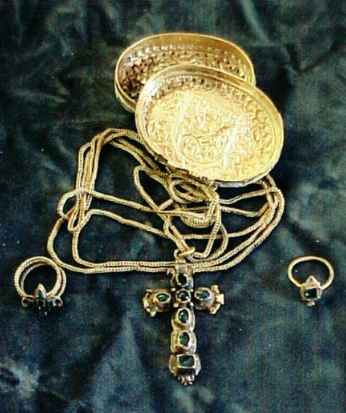
Famous Find From the 1715 Fleet
Photo submittted by Darrel S.

Darrel S.sent the above and following photos, about which he said, I remember when Capt. Jon Wilson found the gold box with these items inside near the Cabin Wreck. Steve Hancock received one of the rings, Jon got the necklace, state got the box, AND TAFFI GOT THE CROSS (displayed in their Sebastian Museum.)

It isn't a recent find. Darrel also said, The gold box with cross, necklace, cross, and rings was found 6/1/03.  [I originally posted 01, but the correct year is actually 03.]

 The photos are Darrel's personal photos, which he said were originally taken in the Fisher lab in Sebastian.

In the past couple of posts, I've been talking about intertwined or interlinked rings.  That discussion started with a couple of silver rings found by John C. along with a couple of cobs.  

The rings shown in the above and following picture have a very common design that I might describe as a twisted rope design.  Three gold twisted rope bands make one ring that has a gold setting with emeralds.  

Here is a closer picture of that.

Gold Ring Found by Captain Jon Wilson.
Photo submitted by Darrel S.
The twisted rope design is a very common design still used today.  You'll see that type of ring in silver and gold and other metals.

Thanks much to Darrel S. for the great pictures.


John C., after sending me the photos of the intertwined rings that were found with a couple of cobs, also sent me the following picture of a very thin silver ring and said, Some may be thinking, a silver wire ?  No it's what's left of a very badly worn silver ring .I guess it depends on the original size, but how many years does it take for a ring to become so badly worn ?

Thin Silver Ring.
Find and photo by John C.
Of course gold is not subject to the same type of corrosion as silver.  Some silver cobs found on the beaches are worn very flat and thin - by my estimation, sometimes to less than half the original weight.  The above ring is certainly worn down a lot, but I suspect was originally fairly thin to begin with. You can often find a joint on rings like that where they were cut and soldered together.

I think this kind of silver wear and corrosion can take place surprisingly quickly.  I think that kind of corrosion can take place in a matter of a few decades.  If I remember, and I run across the examples I'm thinking of, I might post them in the next few days.

Not long ago (8/3/17 post) I showed a paper thin silver Roosevelt dime that was found on a beach.  It is shown below.  I have others that are literally paper thin, and when I say literally, I mean it.

Paper Thin Silver Dime.
My first possible reale find was what I would call a razor.

Obviously, some silver coins and rings are not as worn.  Some show very little silver loss.  The amount of corrosion and material loss depends to a large extent on exactly where it has been, how much the item as been tumbled in the sand and rough surf and how much air and salt water it has been exposed to.

I still don't know why divers almost never find silver rings on the 1715 Fleet.  I have shown one example attributed to a 1715 Fleet source by our state archaeologist, who also has documented silver rings to Spanish colonial archaeological sites.  I suspect that more than one factor is involved.

Some jewelry found on the Nieves site suggests the presence of a jeweler on board.  Incomplete pieces, as well as materials and jeweler's tools, have been found on that site.

---

I hope I didn't make too many mistakes in this post.  I kept finding them, but I hope I got most of the typos corrected.

---

Maybe in the near future I'll post more examples of the kind of thing I was talking about today.

---

Source: nhc.noaa.gov
The low pressure area that has been hanging over Florida looks like it will become a tropical storm and skirt South and North Carolina.  We'll have a small surf for most of the week.

Havey looks to be headed towards Arkansas rather than going back out into the Gulf.  He won't affect us much.

There is still time to respond to the blog poll.

Happy hunting,
TreasureGuide@comcast.net

Wednesday, April 26, 2017

4/26/17 Report - Metal Detector Damage That Can Be Prevented. Artifacts Left Behind After Inca Attack.


Written by the TreasureGuide for the exclusive use of treasurebeachesreport.blogspot.com.

Detector Showing Poor Maintenance and Serious Damage.

Yesterday I started a post in which I was talking about why you might want to keep old metal detectors in good working order.  I mentioned the dangers of salt water.  Above is a good example of the damage that can be done to a metal detector by things like wind driven sand and salt spray and splashing water.

Notice the corrosion around the knobs and toggle switches.  Also notice the sand in the speakers.  The headphone plug is also vulnerable.

The best conditions for metal detecting can be the worst conditions for your detector.  The wind can be blowing sand and salt and the water can be splashing off of steep cliff faces.  Even knowing all of that, you can be caught by surprise.

There was one time that I was wading not much more than knee deep water in a calm bay and a single wave surprised me and splashed up onto my detector control box (not the detector shown in the pictures).  While I mostly use submersible detectors, I was not using one on this occasion.  The very small amount of salt water that splashed onto the control box was noted by the manufacturer and voided the warranty even though the detector worked fine for many years to come.

Closer Look At Some of the Corrosion.
The damage to the detector shown in these pictures is extreme and severe but happened with normal but heavy usage.  Obviously much needed maintenance was not done.

Most of my detectors are submersible.  Submersible detectors are better protected from the dangers of salt water environments, although even submersible detectors need to be rinsed and properly maintained.  If you work salt water beaches at all, wind driven sand and salt spray is enough to require periodic maintenance.  Salt and sand seem to find their way into the smallest cracks and crannies.

A lot of people complain about detector rods freezing up.  My experience is that all detector rods used on salt water beaches or in the salt water will freeze if they are not maintained.  Rinsing and working them occasionally should prevent that.  While I hear a lot of complaints about the ATX rods, I've had no trouble with them and prefer that type of rod to the others that I've used.

Some people seldom change their detector settings.  I advise working all knobs and switches once in a while even if you don't change your settings much.  I think it helps keep things in good working order and helps you identify any signs of deterioration early.

Even if you get salt water in your control box, rinsing it out with an electronics cleaner can save the electronics.

WD-40 or other oils and cleaners can be a good idea for various parts of your detector.

The Florida sun and heat can also cause damage.  The sun and heat can weaken plastic parts.  I had a lot of trouble with the plastic parts on a White's detector breaking.  It wasn't an old detector either.

Replaced Ear Phone Attachment.
Plastic parts on both the rod and ear phones broke.  I replaced the ear phone tab by making a new one from the metal of a soda can.  The rod was repaired by using a small section of PVC pipe.

I like to have more than one detector with me but I seldom do because I don't like to leave a metal detector in the car in the hot Florida heat.   I also don't like to leave anything good in the car because of possible theft.  That does happen on the Treasure Coast.  I saw some broken glass in a beach parking lot no long ago.  I reported other break-ins at the same parking lot before.

Dennis S. wrote and reminded me to mention the damage that can be caused by leaving old batteries in a metal detector.  Leaking batteries damaged one of his detectors.  I'm sure that many of you have experienced the same thing.  Don't leave batteries stored in your detector when you are not using it for a while.  Thanks for the reminder Dennis.

My main point today is that the beach is a tough environment for metal detectors, but with periodic maintenance you might be able to keep your metal detector working for many years.  The pictures I showed today show extreme and severe cases, but they do show what can happen.

---

Here is an interesting article.


Treasure trove of bronze and copper reveals incredible speed of flash Inca invasion

Bronze jewellery, stone tools and intact pottery were abandoned as the native Colla people fled...


Bronze Chisel Left Behind by Colla.Source: See link below.

Here is the link for the entire article.

http://www.ibtimes.co.uk/treasure-trove-bronze-copper-reveals-incredible-speed-flash-inca-invasion-1618394

---

I have some good emails and other things to talk about tomorrow.

The weather is beautiful on the Treasure Coast.  The air was cooler this morning after the front went through.

The surf is small, but we're having some nice low tides.

Happy hunting,
TreasureGuide@comcast.net

Thursday, February 11, 2016

2/11/16 Report - Surface Analysis Of Corroded Reales: Part II.


Written by the TreasureGuide for the exclusive use of treasurebeachesreport.blogspot.com

Yesterday I left off discussing the following excerpt from a study of seven 8-reales from the wrecksite of the San Pedro.  I'll discuss a little more of that study today.

Here is that excerpt (no. 3) again.

The large amounts of iron found in the concretions and as distinct films on the coins recovered from a buried microenvironment is consistent with the history of the site. The majority of the surfaces of coins 4325, 4327, and 4331 were covered with a layer of pure hydrated iron oxides, such as FeOOH.xH2O. The films are compact and of relatively uniform thickness. The deposition of this material is likely to have occurred during the salvaging of the João Diogo as a continuous film that was subsequently eroded/corroded away in areas to reveal underlying layers of silver halides. The absence of iron on coins 4315, 4030 and 4342 is a reflection that these coins are highly eroded and corroded and have very little concretion.

The authors of the study believed that iron oxide accumulated on the coins came from the Joao Diogo wreck, a later wreck that scattered over the San Pedro wrecksite.  I feel certain that if they later wreck was not in the area, there would still be some coins showing some iron oxide.  Cobs from 1715 Fleet beaches sometimes show the iron rust appearance.  All it takes is for a silver coin to rest on or near iron objects such as cannons or spikes.  I've commented on the rust-like residue seen on some reales found on Treasure Coast beaches.

As the last sentence in the excerpt suggests, layers of corrosion can also be eroded off of coins, especially when they are end up getting tossed about in the surf and sand.

In the same way that iron products get transferred to coins at times, a similar thing can happen with other metals.

In nautical archaeology galvanic corrosion is an important topic.  It was observed that copper sheathing would cause iron spikes to rapidly corrode, for example.  Also, cleaning by electrolysis makes use of a similar process.

Here is link to a web site about galvanic corrosion.

https://en.wikipedia.org/wiki/Galvanic_corrosion#Anodic_index

And here is a table showing how susceptible different metals are to galvanic corrosion.  The table shows copper as being more cathodic than iron, which means iron will be drawn to copper, as in the example I mentioned concerning copper sheathing and iron spikes.  Forgive my simple explanation. Chemistry was one of my least favorite subjects, and really don't know much about it.
Most Cathodic
Gold, solid and plated, Gold-platinum alloy−0.00
Rhodium plated on silver-plated copper−0.05
Silver, solid or plated; monel metal. High nickel-copper alloys−0.15
Nickel, solid or plated, titanium an s alloys, Monel−0.30
Copper, solid or plated; low brasses or bronzes; silver solder; German silvery high copper-nickel alloys; nickel-chromium alloys−0.35
Brass and bronzes−0.40
High brasses and bronzes−0.45
18% chromium type corrosion-resistant steels−0.50
Chromium plated; tin plated; 12% chromium type corrosion-resistant steels−0.60
Tin-plate; tin-lead solder−0.65
Lead, solid or plated; high lead alloys−0.70
2000 series wrought aluminum−0.75
Iron, wrought, gray or malleable, plain carbon and low alloy steels−0.85
Aluminum, wrought alloys other than 2000 series aluminum, cast alloys of the silicon type−0.90
Aluminum, cast alloys other than silicon type, cadmium, plated and chromate−0.95
Hot-dip-zinc plate; galvanized steel−1.20
Zinc, wrought; zinc-base die-casting alloys; zinc plated−1.25
Magnesium & magnesium-base alloys, cast or wrought−1.75
Beryllium−1.85
Most Anodic
Note that zinc is near the bottom of the list.  It is very anodic.  That probably explains at least partly why zinc pennies hold up so poorly in salt water.  On the other hand, gold is at the top of the list and normally shows no effect of being in the water for centuries.

    Excerpt 4.

    Since the San Pedro de Alcantara site is an area of constant and aggressive surge action, erosion corrosion plays a major role in the deterioration of metals on this site. The coins 4342, 4030 and 4315 were found lying on top of the sediment and their much higher mass loss is a measure of the erosion effect. Prior to recovery, coin 4315 was lying flat on top of a thin layer of sediment in a shallow bedrock hole, which meant it was fully exposed to water and sediment movement, and this resulted in more than a 60% mass loss. 

    I've commented about the loss of mass seen on many Treasure Coast beach-found cobs in previous posts.  Some are less than half of their minted weight.  Such coins likely come from exposed areas with rough surf like those mentioned in this excerpt.  Tumbling in the surf zone is surely a factor.

    Excerpt 5.

    Calcareous concretions, especially those that grow in tropical waters tend to be somewhat porous and good conductors for the corroding metal they cover (MacLeod, 1982). In contrast, iron oxide films tend to be poor ionic and electrical conductors and can passivate the underlying corroding metal. There is a clear discrepancy between the preservation of those coin surfaces that are covered by iron oxide films and those that are not. Where the surface of coins 4325 is covered by an iron oxide film the raised design is well preserved, while the surfaces without the protective iron have the design obliterated. Clearly the iron oxide films are providing erosion and corrosion resistance to the coin surfaces they cover. 

    That does not require additional comment.

    I've probably carried on with this too long, but many of my casual observations and conclusions were verified and elaborated by this study.  To me it was validation.  It added to my understanding of the processes involved.  I hope you found it as interesting as I did.

    Whether you understand all of it or not (I don't) you might benefit from wading through it to take what you can from it.

    I didn't comment on the parts the explain the corrosion processes, such as how silver coins develop different layers, even though that information also expanded upon some of my personal observations.

    The main point in looking at this study is to reinforce the idea that if you study your finds and understand how they got to look like they do, you'll then be able to draw conclusions about where they have been and where they are coming from.  When you know something about the source of those coins, you'll have some good information about where to look for more of them.

    ---

    I received some good information relative to the proposed citizen archaeology permit.  I need to discuss that some day.

    I also have some other good things too discuss in the future.

    On the Treasure Coast beaches we've been having a small surf and will for a couple more days.

    I have to go.

    Happy hunting,
    TreasureGuide@comcast.net


    Wednesday, February 10, 2016

    2/10/16 Report - How To Locate More Old Coins - Surface Analysis Of Corroded Reales


    Written by the TreasureGuide for the exclusive use of treasurebeachesreport.blogspot.com.


    Yesterday I said I was going to present a study of how silver reales are affected by the ocean environment.  The title of the study is Surface analysis of corroded silver coins from the wreck of the San Pedro De Alcantara (1786).  The authors are I.D. MacLeod  and E. Schindelholz.

    A detailed morphological study of the corroded surfaces of the seven coins was conducted using low pressure scanning electron microscopy (SEM) with energy dispersive spectroscopy (EDS) analysis.

    You can access the original study by using the following link.

    http://www.nma.gov.au/__data/assets/pdf_file/0020/346043/NMA_metals_s2_p02_surface_analysis.pdf

    The sample consisted of seven 8-reales that were minted in Lima between 1772 an 1788.  Those are the Carolus III type.  That obviously isn't a large sample size.

    As the study says, the wreck site of the San Pedro ...is scattered over 200 metres long in water 3-9 metres deep, lying off a rocky coast near Peniche, Portugal. The sea bottom consists of irregular rocks, with numerous cavities and crevices filled with up to 0.5 metres of stone and sand.

    I'll present some excerpts from the study and then add my comments.  Here is the first excerpt.

    The degree of preservation of the recovered coins related to their location on the wrecksite. Coins 4324, 4325, 4327 and 4331, which were found buried under 15cm of coarse sediment, have more or less retained their original dimensions. Coins 4315, 4030, and 4342, which were found lying atop the seabed, have lost a majority of their original surface and dimensions. 

    The first sentence in the above excerpt supports a main point that I presented yesterday.  Where a coin spends its time determines what happens to it, therefore if you know how various environments affect certain types of coins, you can then look at a coin and get an idea of where it came from.

    As I have documented and mentioned in this blog in the past, many beach-found cobs weigh much less than their minted weight.  They have lost significant amounts of material.

    This study shows, however, that cobs that were buried under 15cm of sediment were not corroded that much.  They were protected by the sediment.

    It should be noted that this wreck site was in 3 to 9 meters of water. The deeper the water, the less the bottom sediments will be churned by the waves.  Also in deeper water, the bottom sediments will generally be more fine.  The passage of a wave only affects the water down to the wave base, which is half the wave length. Below that depth there is negligible water movement, so the sand will not be moved unless conditions are unusually rough.

    Unlike the protected coins, coins that were found lying exposed had lost material.  

    For coins to wash up onto a beach, they must be uncovered and go through the rough and turbulent zone at the front of the beach where the waves crash and the sand is churned.  Coins that are in excellent shape most likely did not come through that zone.

    So how can you find old coins on a beach that look almost like new?  One way is that they can come from the dunes rather than being washed up.  I also supposed that there are rare occasions when coins can remain protected for very long periods of time only to be exposed and washed up by very unusual conditions such as a hurricane without spending much time in the rough surf.

    Here is the second excerpt.

    There was only one coin (no.4325) with any significant amount of concretion; the deposits consisted of sand-sized to pebble-sized sedimentary particles and small shells bound together by calcareous concretion (see Figure 2). Coins 4325, 4331, 4324, and 4327 all have considerable amounts of iron corrosion products on their surfaces.


    Concreted Coin 4325.


    Coin 4325 (left) was concreted.  It was one of the four coins that were found covered by 15cm of coarse sediment, and the only one of the four with significant concretion. So why was this one encrusted while the other three were not?

    The immediate environment of a coin can affect what happens to it.  Note the appearance of rust on this particular coin.  I've seen that on some beach-found cobs and mentioned that in this blog in the past.

    Here is another excerpt from the study.  I'll call it excerpt 3.   It provides a clue as to why coins like 4325 have rust on the surface.

    The large amounts of iron found in the concretions and as distinct films on the coins recovered from a buried microenvironment is consistent with the history of the site. The majority of the surfaces of coins 4325, 4327, and 4331 were covered with a layer of pure hydrated iron oxides, such as FeOOH.xH2O. The films are compact and of relatively uniform thickness. The deposition of this material is likely to have occurred during the salvaging of the João Diogo as a continuous film that was subsequently eroded/corroded away in areas to reveal underlying layers of silver halides. The absence of iron on coins 4315, 4030 and 4342 is a reflection that these coins are highly eroded and corroded and have very little concretion.

    I am not so sure that the Joao Diogo wreck, which occurred later in the area of the San Pedro, is the entire reason for the concretion.  I plan to address that tomorrow or sometime soon when I continue this discussion.  That is as far as I can go with it today.

    You might wonder why all of this is important.  The answer is that if you understand how the environment affects coins and other objects, you can look at the object and get a good idea where it has been.  That can help lead you to the source and the possible location of additional items.

    ---

    I didn't get many emails concerning the proposed citizen archaeology permit that is being considered in the Florida legislation.  I hope that does not mean that the metal detecting community is becoming apathetic.  If you don't stay informed and active, you can expect to encounter more and more legislation that will prohibit or limit metal detecting.

    If you did not read that post, I'd recommend that you go back and check out the sources and become informed on the issues.

    One link provided a list of emails of Florida representatives.  Please make your feelings on the subject known to them.  Apathy is a good way to lose freedom.

    ---

    There was a whale and baby in the Sebastian Inlet.  Crowds were able to see these magnificent mammals.  That was a rare opportunity.

    Here is a link to the story.

    http://www.fox35orlando.com/home/87340117-story

    ---

    We got another cool front and will have the west wind for another day.  The surf remains small.

    Happy hunting,
    TreasureGuide@comcast.net